📑 Table of Contents
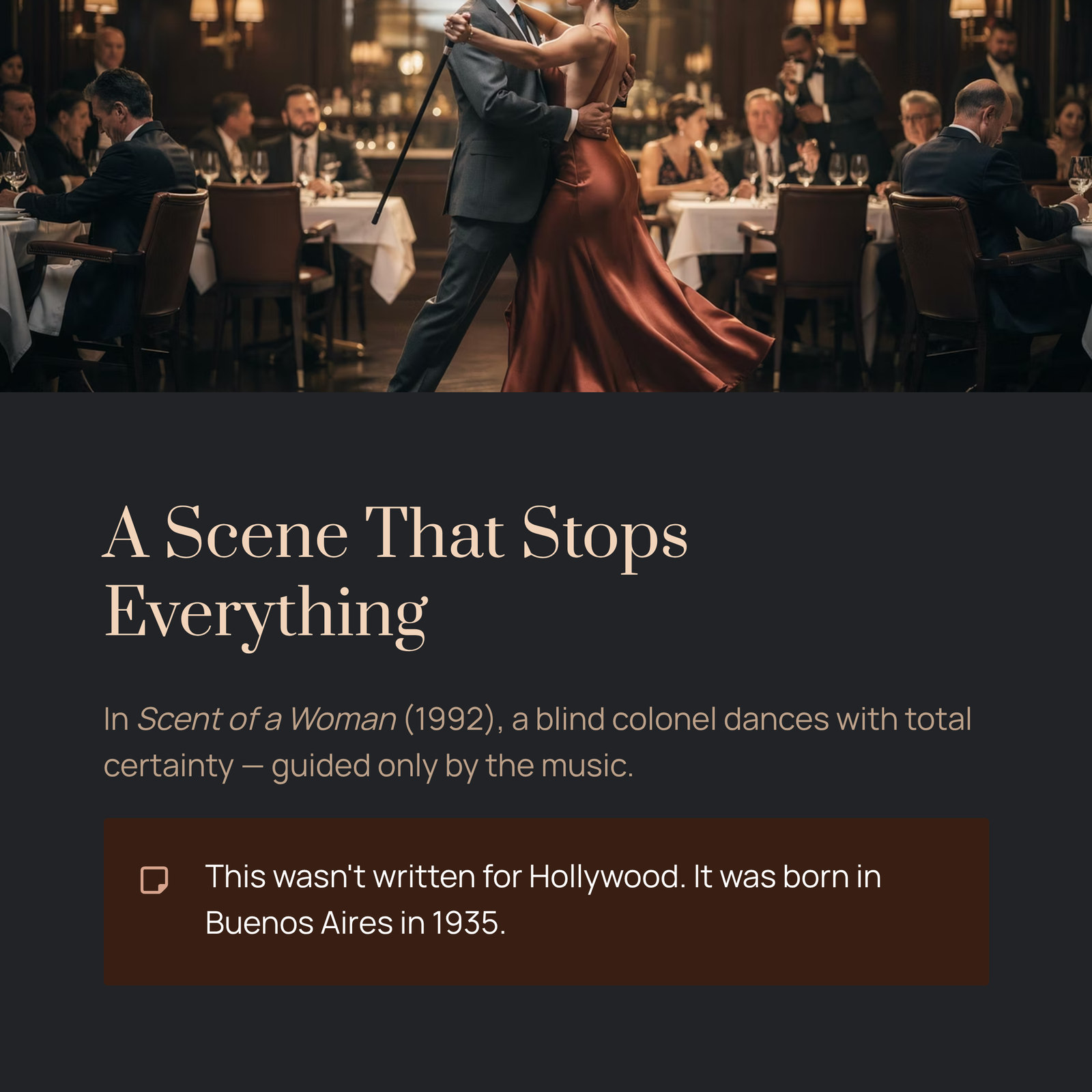
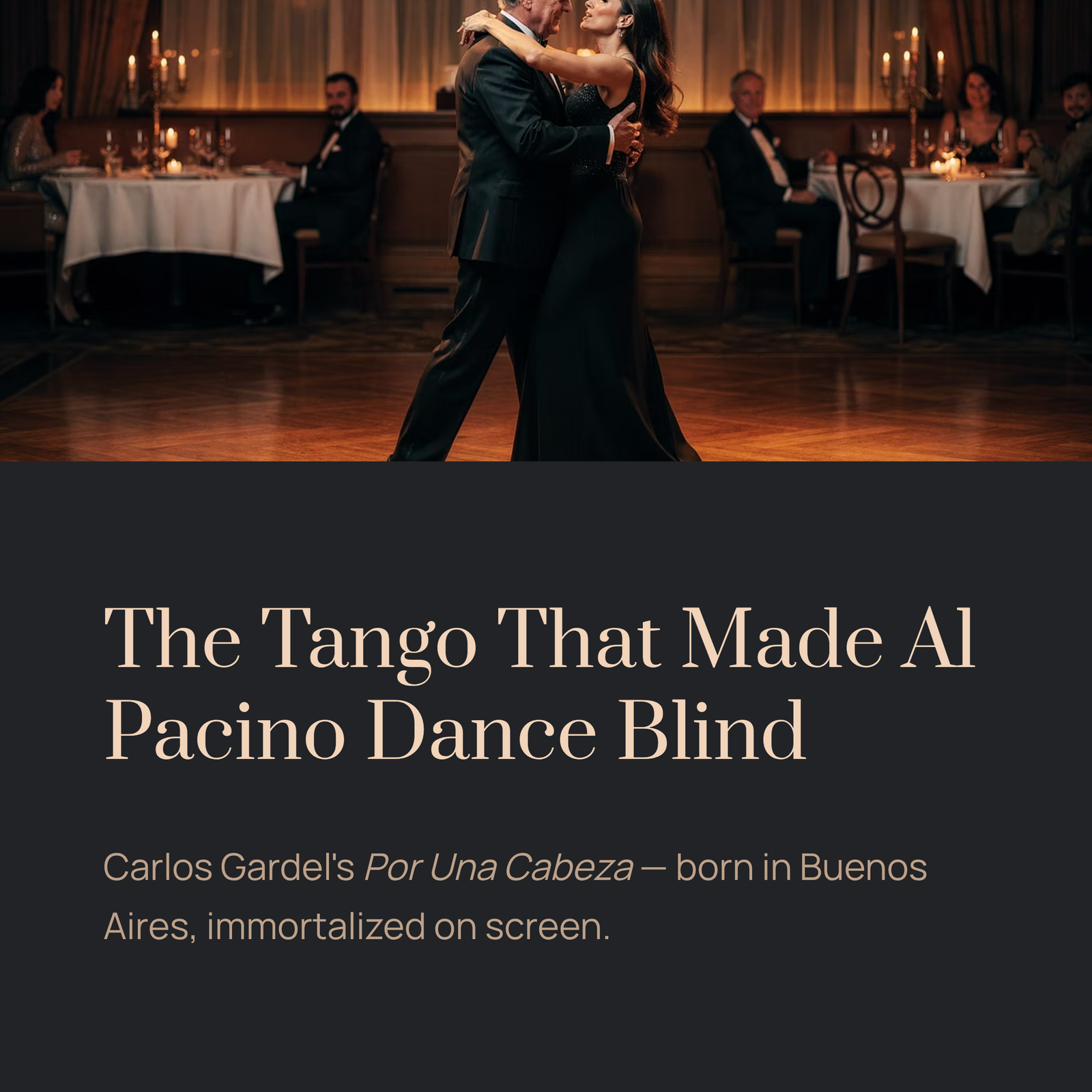
There is a moment in Scent of a Woman (1992) where everything stops. Al Pacino, playing a blind retired colonel, rises from his chair in a crowded restaurant, takes the hand of a young stranger, and leads her into a tango. He cannot see her face. He cannot see the floor beneath his feet. And yet, every step is certain—guided not by sight, but by the music pulling him forward.
That music is Carlos Gardel’s “Por Una Cabeza.” And once you hear it in that context, you never quite hear it the same way again.
But here’s the thing most people don’t realize: this piece wasn’t written for Hollywood. It was born in Buenos Aires in 1935, carrying the dust of racetracks and the ache of a gambler who keeps losing—not at cards, but at love. The fact that it ended up soundtracking one of cinema’s most unforgettable scenes is just proof that some melodies refuse to stay in their own century.
A Voice from the Streets of Buenos Aires
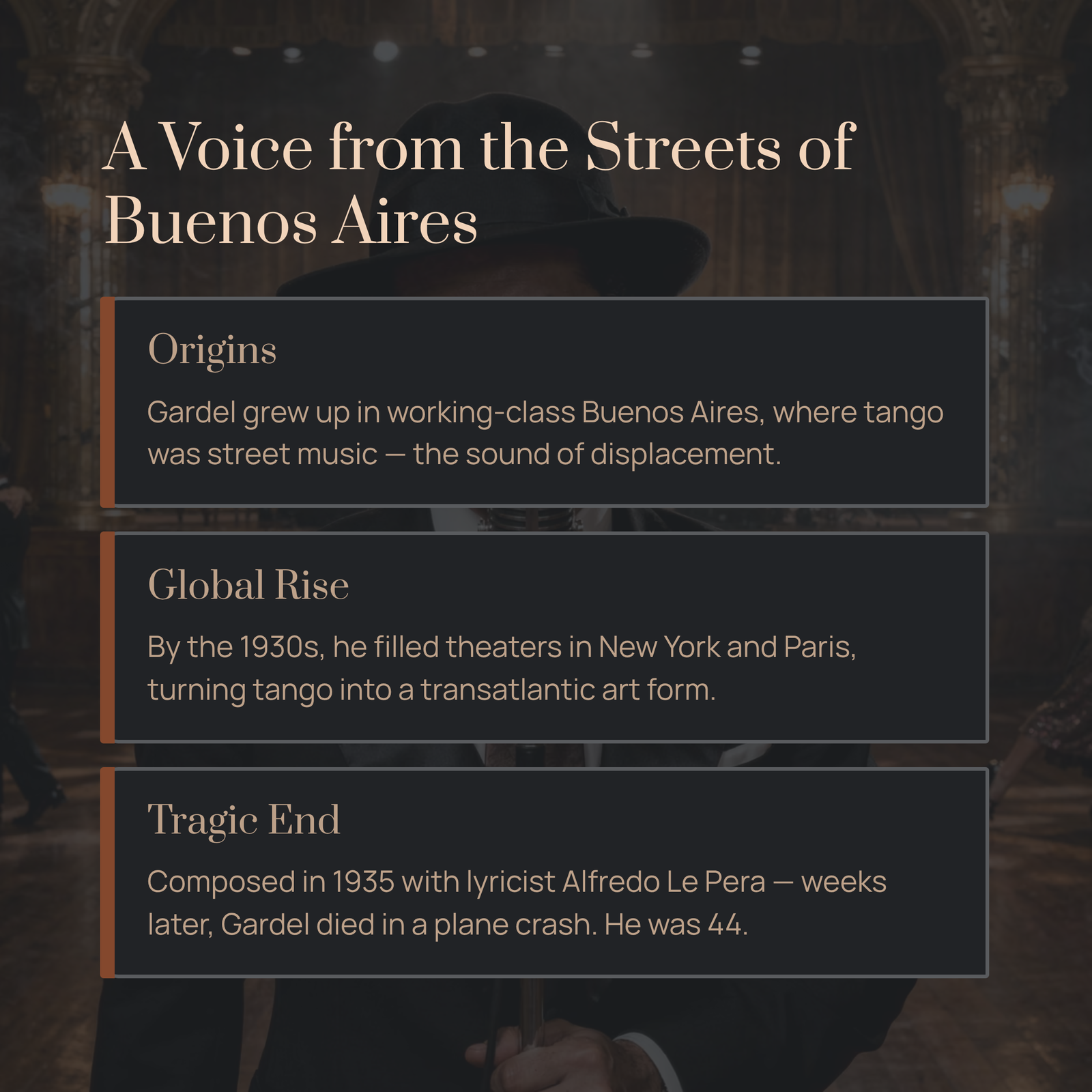
Carlos Gardel is not a name you’ll find in most classical music textbooks. He belongs to a different world—the world of tango, of smoky dance halls in 1920s Argentina, of immigration and longing and reinvention. Born in the late 1800s (the exact year is still debated between France and Uruguay, both claiming him), Gardel grew up in the working-class neighborhoods of Buenos Aires, where tango was not yet respectable. It was street music. It was the sound of people who had been displaced, who carried their homesickness in their bodies.
Gardel changed that. With a voice that could shift from velvety warmth to raw desperation in a single phrase, he turned tango into an art form that crossed oceans. By the 1930s, he was filling theaters in New York and Paris. He recorded hundreds of songs, starred in films, and became the closest thing Argentina had to a national saint.
“Por Una Cabeza” was composed in 1935 with lyricist Alfredo Le Pera. It would be one of Gardel’s final works—just weeks after recording it, he died in a plane crash in Medellín, Colombia. He was at the peak of his fame. He was 44 years old.
What “By a Head” Really Means
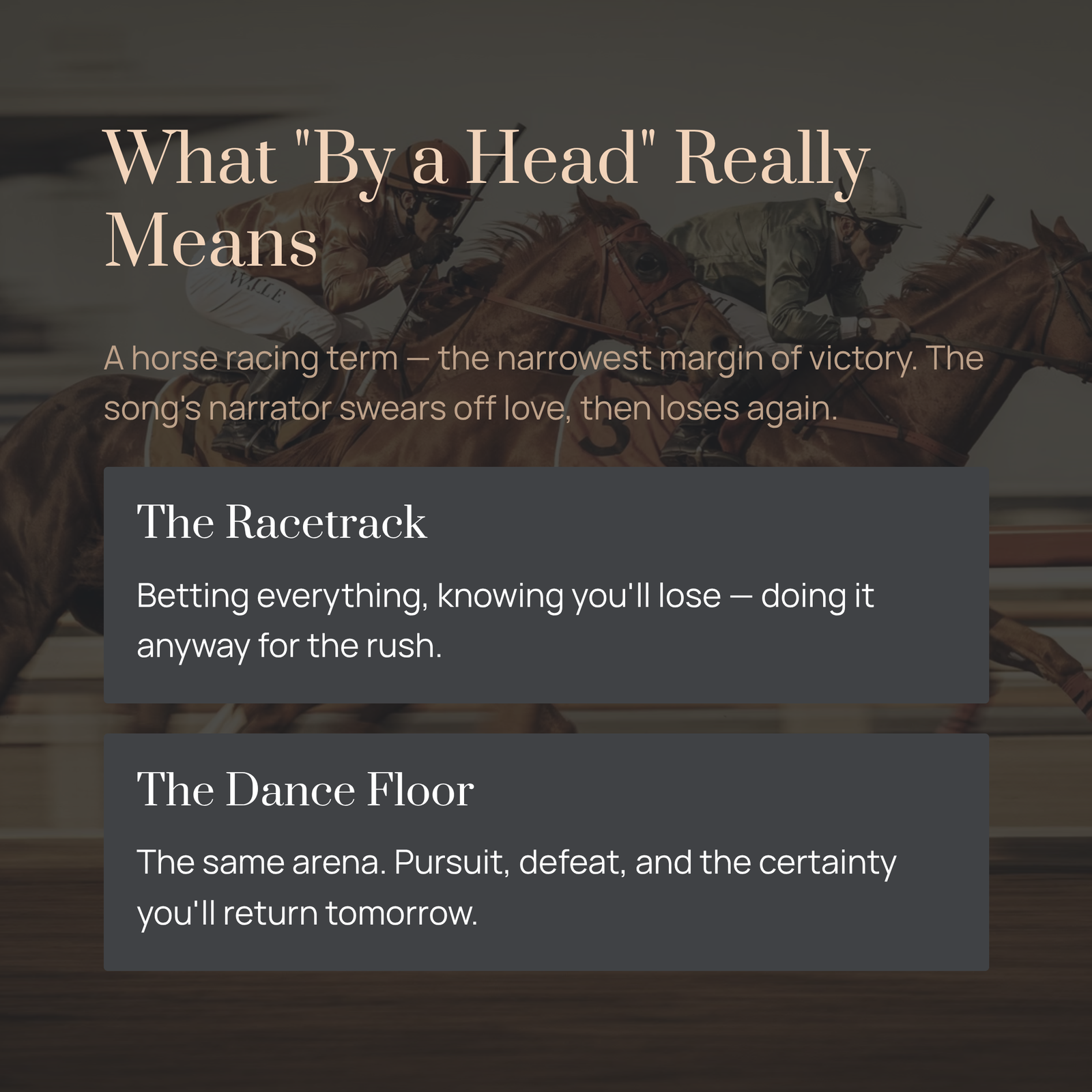
The title translates literally to “by a head”—a horse racing term for the narrowest possible margin of victory. And that metaphor runs through every line of the song. The narrator compares his hopeless addiction to love with a gambler’s compulsion at the racetrack. He swears he’s done, that he’ll never fall again—and then another woman passes by, and he’s lost once more, by a head.
It’s a brilliant conceit because it captures something universally true: the way we keep returning to the things that hurt us, not out of stupidity, but out of some deep, irrational hunger for feeling itself. The racetrack and the dance floor become the same place—arenas where you bet everything knowing you’ll probably lose, and you do it anyway because the rush of the race is the whole point.
This is what separates “Por Una Cabeza” from a simple love song. It’s not about winning someone’s heart. It’s about the intoxication of pursuit, the sweetness of defeat, and the absolute certainty that you’ll do it all over again tomorrow.
Listening Through the Melody: Where Passion Lives
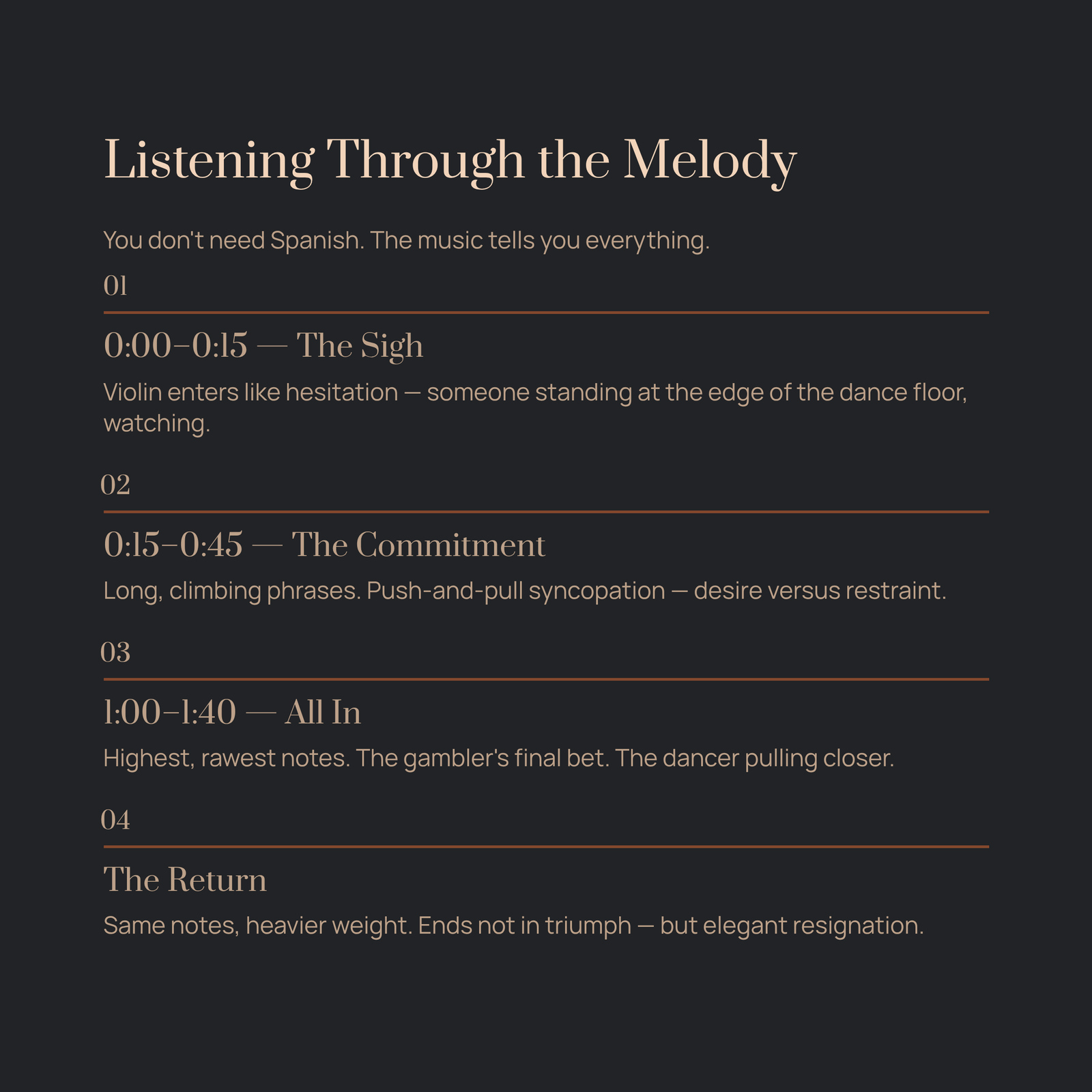
You don’t need to understand a word of Spanish to feel what this piece is doing. The melody itself tells you everything.
The opening violin phrase (0:00–0:15): Pay attention to how it enters—not with a grand statement, but with something closer to a sigh. The melody rises and falls in a pattern that mirrors breathing, as if the music is gathering courage to speak. There’s an elegance here, but also hesitation. It’s the sound of someone standing at the edge of a dance floor, watching.
The main theme unfolds (0:15–0:45): Now the melody commits. The violin line stretches out with long, singing phrases, each one climbing a little higher before dipping back. This push-and-pull is the heartbeat of tango—the conversation between desire and restraint. Notice how the rhythm beneath the melody has a slight syncopation, a catch in the step that makes you lean forward.
The passionate middle section (around 1:00–1:40): Here the piece opens up emotionally. The melody reaches its highest, most exposed notes—this is the gambler going all in, the dancer pulling his partner closer. The violin tone shifts from smooth to something rawer, with more pressure on the bow. If you’re listening with good headphones, you can almost feel the friction of horsehair on string.
The return and resolution: The opening theme comes back, but it lands differently now. You’ve heard the confession, the recklessness, the surrender. The same notes carry more weight. The ending doesn’t resolve with triumph—it fades with a kind of elegant resignation, as if to say: I know how this ends. I don’t care.
Why a 1935 Tango Still Stops Us Cold
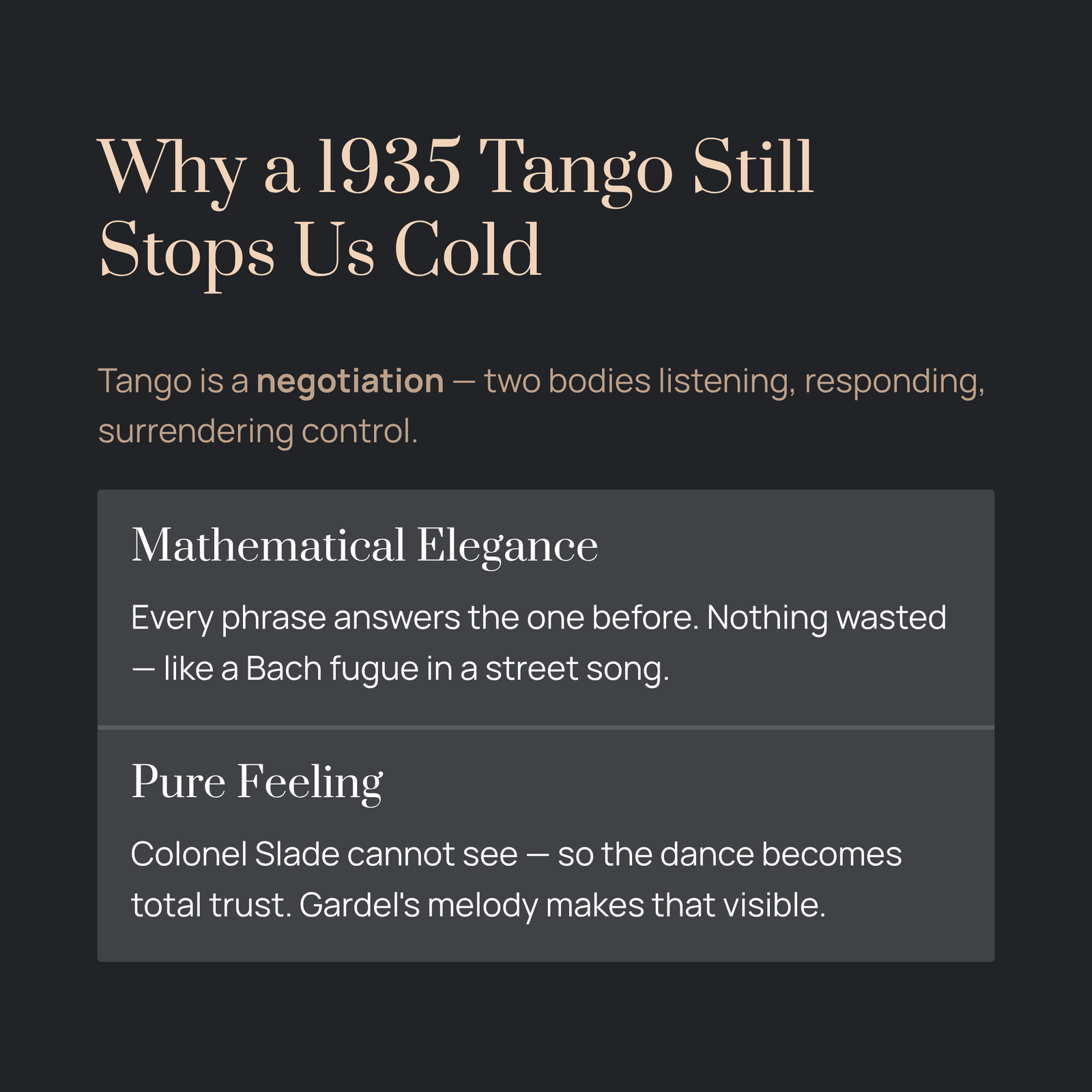
Part of the answer is structural. Gardel and Le Pera built “Por Una Cabeza” on one of the most perfectly balanced melodies in popular music history. It has the mathematical elegance of a Bach fugue wrapped in the emotional directness of a street song. Every phrase answers the one before it. Nothing is wasted.
But the deeper answer has to do with what tango itself communicates. Unlike waltz, which floats, or jazz, which improvises, tango is a negotiation. Two bodies moving together must constantly listen, respond, and surrender control. The music encodes this dynamic—tension and release, advance and retreat, pride and vulnerability—in ways that go straight past the intellect and into the nervous system.
This is why the Scent of a Woman scene works so powerfully. Colonel Slade cannot see, so the dance becomes pure feeling, pure trust. And Gardel’s melody, with its elegant ache, provides exactly the right emotional architecture for that moment. The music doesn’t manipulate you into feeling something. It simply makes visible what was already there.
Recordings Worth Your Time
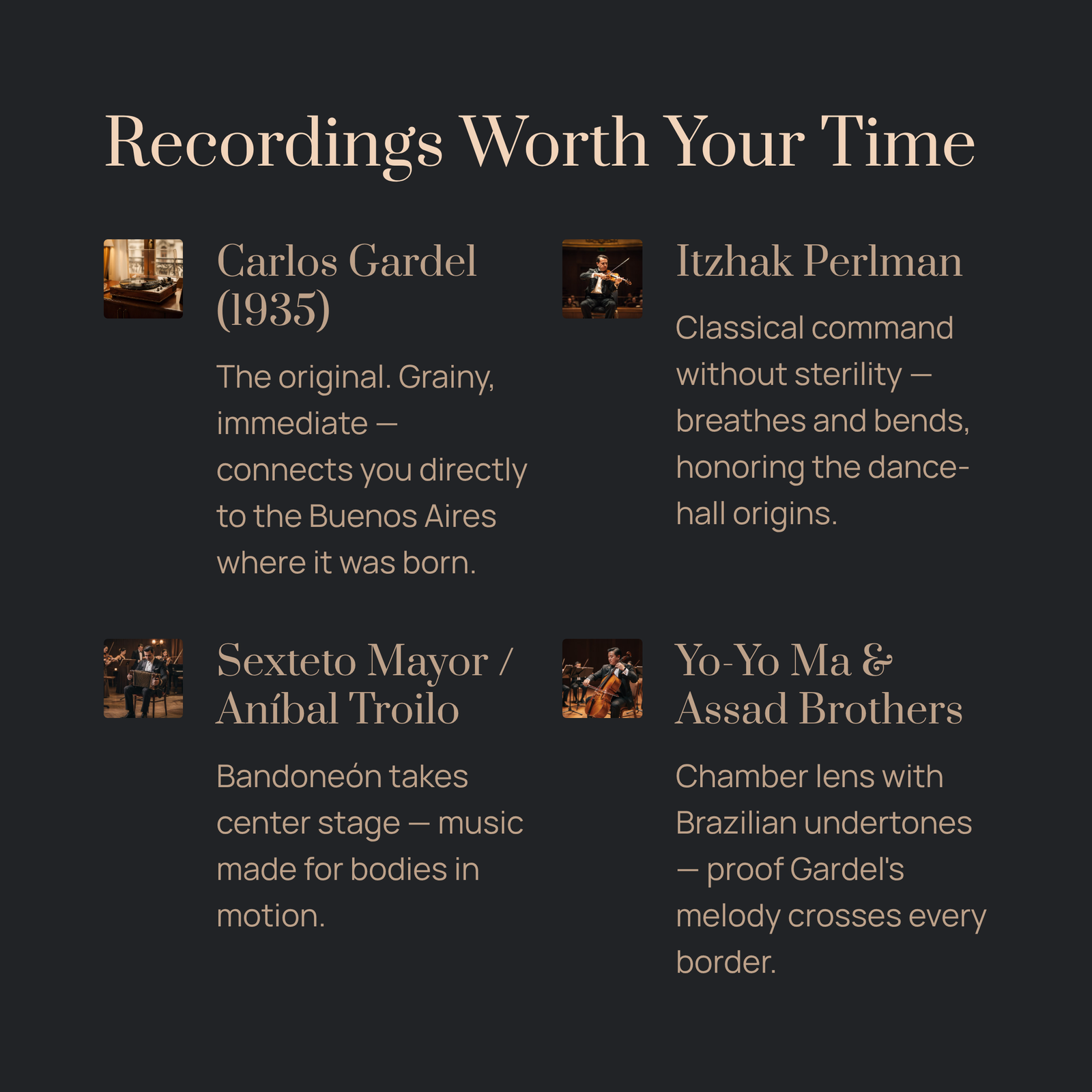
The original 1935 recording by Gardel himself remains essential listening—his voice has a grainy, immediate quality that no remaster can fully capture, and it connects you directly to the Buenos Aires where this music was born. For the instrumental version most people recognize, the Scent of a Woman soundtrack arranged by Thomas Newman is the definitive starting point.
Beyond film, the Itzhak Perlman recording deserves special attention. Perlman brings a classical violinist’s technical command to the tango idiom without sterilizing it—his version breathes and bends in ways that honor the dance-hall origins. For a more traditionally Argentine interpretation, seek out recordings by the Sexteto Mayor or Aníbal Troilo’s orchestra, where the bandoneón (the small accordion-like instrument that defines tango’s sound) takes center stage and reminds you that this music was made for bodies in motion.
If you want to go deeper, the Yo-Yo Ma recording with the Assad Brothers reworks the piece through a chamber music lens, adding Brazilian undertones that reveal how easily Gardel’s melody crosses borders.
A Final Thought: Music That Knows You’ll Come Back
There’s a reason “Por Una Cabeza” keeps appearing in films, in ice skating routines, in wedding dances, in moments where people reach for something that feels both timeless and desperately alive. It’s not because it’s “beautiful” in some generic sense. It’s because Gardel captured a specific human truth—that we are creatures who chase feeling even when we know it will cost us—and set it to a melody so perfectly constructed that it feels less like a composition and more like a natural law.
You’ll listen to it once and think, that was lovely. You’ll listen to it again and notice the violin phrase you missed. By the third time, you’ll realize you’re already hooked—losing by a head, just like the song promised.
And you won’t mind at all.