
📑 Table of Contents

There is a particular kind of sadness that doesn’t sting. It sits somewhere between a smile and a sigh — the feeling you get when you flip through old photographs of someone who told the most extraordinary stories, stories you once dismissed but now wish you could hear just one more time. That is exactly the emotional territory Danny Elfman maps out in the main theme of Big Fish. The first time I heard it, I wasn’t prepared. I thought I was simply watching a Tim Burton film. Instead, I found myself ambushed by a melody so gentle, so achingly sincere, that it felt less like a piece of music and more like a hand reaching across years of silence.
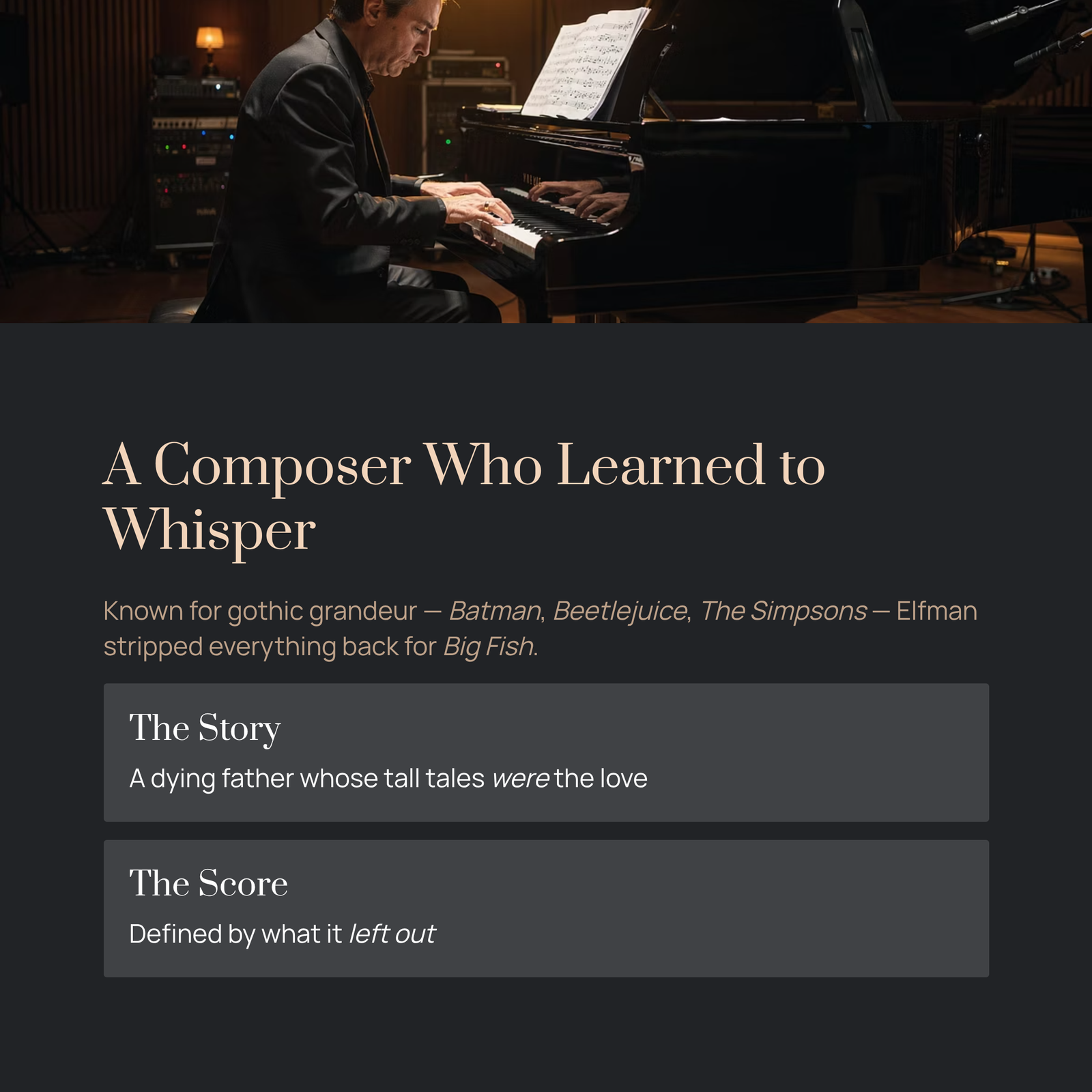
A Composer Who Learned to Whisper
If you know Danny Elfman’s name at all, you probably associate it with the macabre. The frantic circus energy of Beetlejuice. The brooding gothic grandeur of Batman. The eerie, xylophone-driven theme of The Simpsons. For decades, Elfman built his reputation on music that thrills, startles, and unsettles — a sonic world of sharp edges and dark carnival rides.
So when Tim Burton handed him the script for Big Fish in 2003, something shifted. This was not a story about ghosts or superheroes. It was a story about a dying father, Edward Bloom, whose entire life had been told through tall tales — stories of giants, witches, and towns too perfect to be real. And it was about his son, Will, who had spent years resenting those stories, only to realize, too late, that the stories were the love.
Elfman understood the assignment in a way that still astonishes me. He did not reach for his usual bag of orchestral tricks. Instead, he stripped everything back. He wrote a theme built on simplicity — a piano melody so transparent you can almost see through it, supported by strings that breathe rather than soar. It was, perhaps for the first time in his career, a score defined not by what it contained but by what it left out.
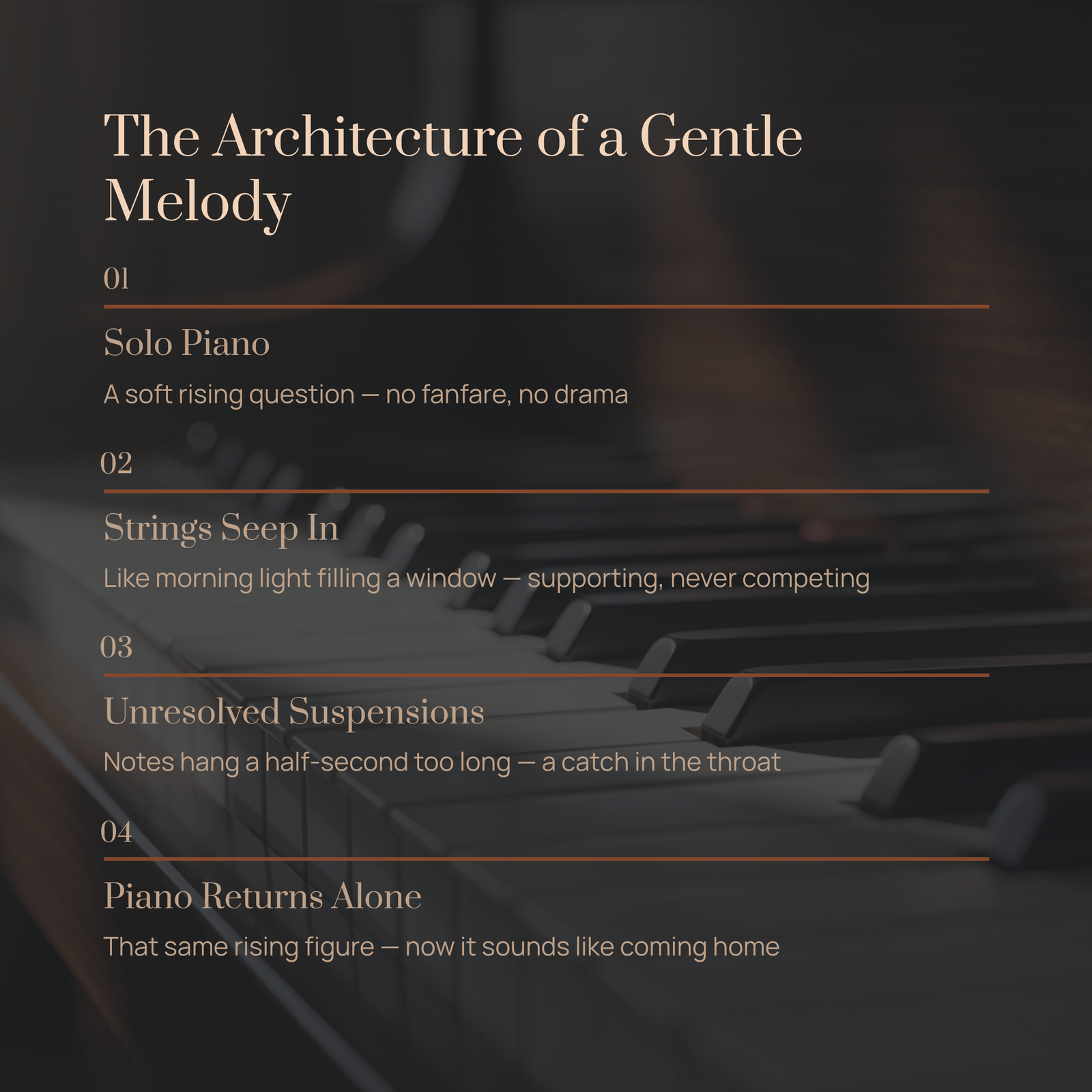
The Architecture of a Gentle Melody
Let me walk you through what makes this theme so quietly devastating, even if you have never read a single page of music theory.
The piece opens with a solo piano figure — a rising pattern of notes that sounds almost like a question being asked very softly. There is no dramatic introduction, no timpani roll, no brass fanfare. Just a piano, alone in a room, turning a simple phrase over and over like someone worrying a smooth stone in their pocket.
Then the strings enter, and this is where Elfman’s craftsmanship becomes extraordinary. They do not arrive with force. They seep in, the way morning light gradually fills a window. The violins carry a counter-melody that moves in gentle parallel with the piano, never competing, always supporting — like two people walking side by side who do not need to speak to understand each other.
Pay attention to the harmonic language here. Elfman stays mostly within major keys, but he keeps drifting toward unresolved suspensions — moments where a note hangs in the air a half-second longer than expected before settling into its resting place. This is the musical equivalent of a catch in the throat. It is why the theme sounds simultaneously warm and wistful, like a bedtime story told by someone who knows it might be the last time.
The middle section introduces a slightly fuller orchestration. Woodwinds — a clarinet, perhaps an oboe — add a pastoral color, evoking the small-town Alabama landscape where Edward Bloom’s stories unfold. There is something almost folk-like in these passages, a deliberate simplicity that suggests front porches, fireflies, and the particular quality of light just before sunset.
And then, the theme returns to where it started. The piano, alone again. That same rising figure. But now, after everything you have heard, it sounds different. It sounds like someone coming home.
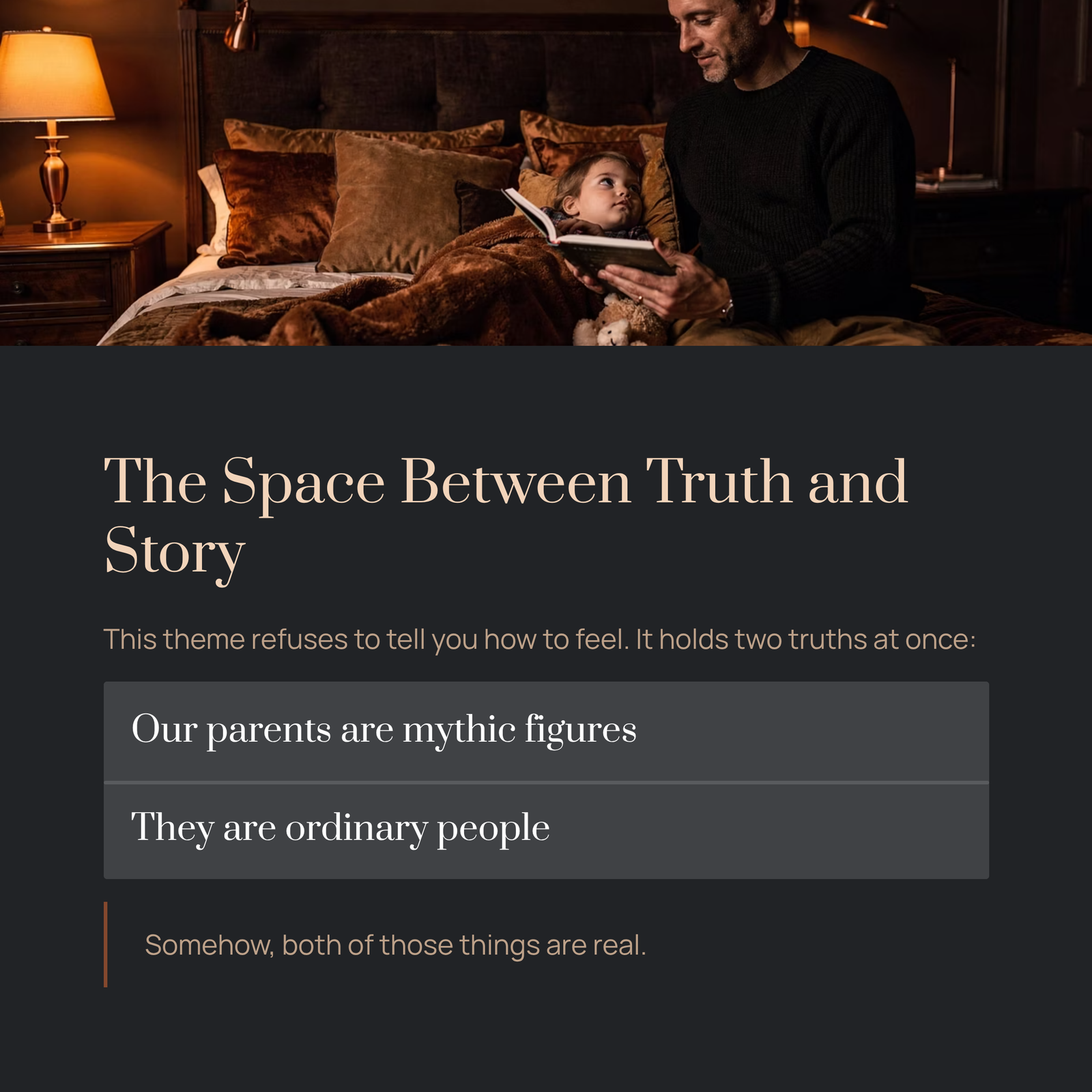
The Space Between Truth and Story
What makes this theme linger long after the credits roll is its refusal to tell you how to feel. So much film music operates like an emotional subtitle — swelling to tell you “this is sad,” crashing to announce “this is exciting.” Elfman’s Big Fish theme does none of that. It simply exists in the space between truth and fiction, between a father’s exaggerations and a son’s desire for honesty, and it lets you bring your own grief, your own nostalgia, your own unfinished conversations to the listening experience.
I think about my own father when I hear this piece. Not because our story mirrors the Blooms’, but because every family has its version of tall tales — the stories parents tell that shape who we think they are, stories we spend half our lives believing and the other half questioning. Elfman’s melody captures that universal tension with a precision that words struggle to match. It does not argue for one side or the other. It simply holds both truths at once: that our parents are mythic figures, and that they are ordinary people, and that somehow both of those things are real.
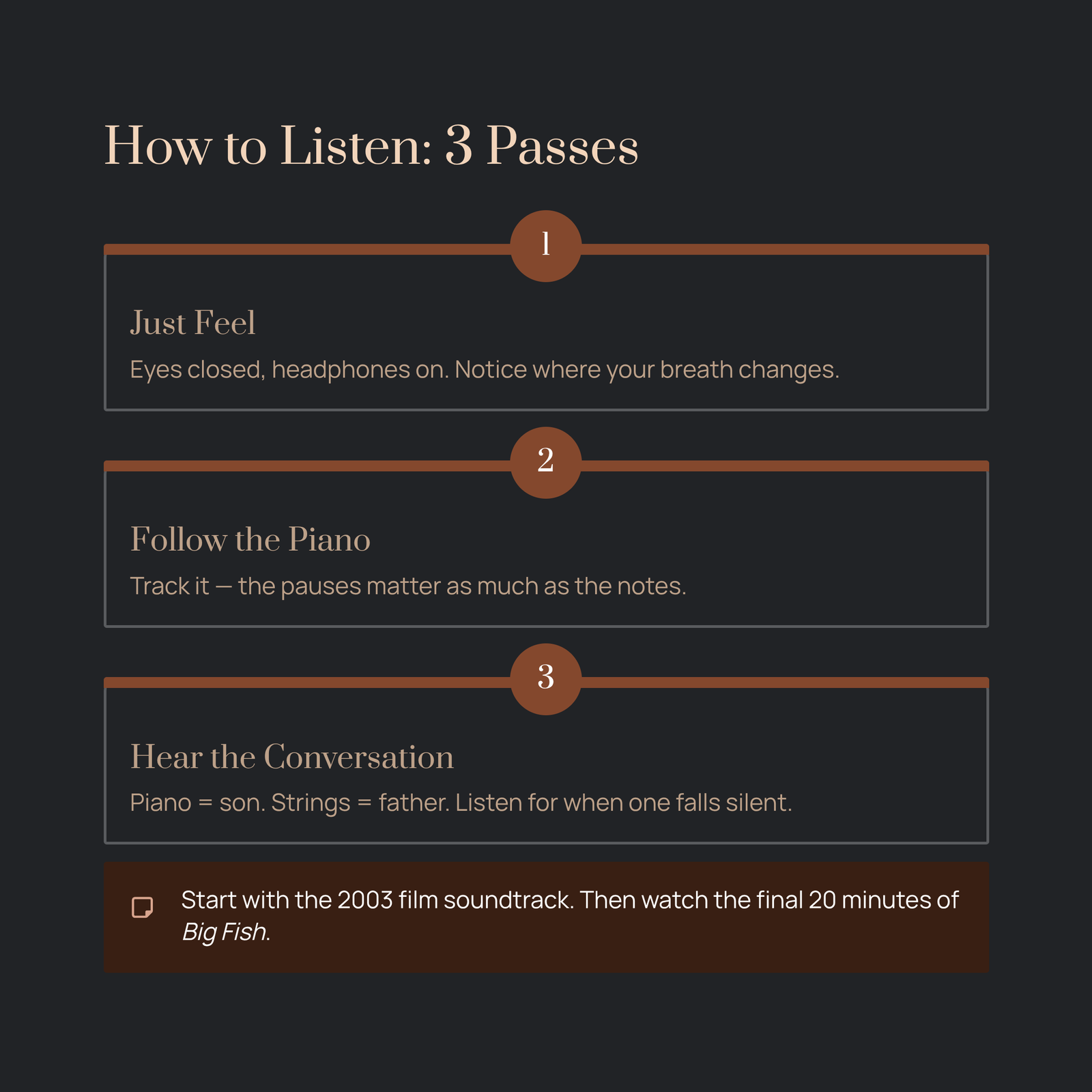
How to Listen: Three Passes Through the Theme
If this is your first encounter with the Big Fish main theme, I want to suggest a way in that might deepen the experience.
First listen — just feel. Do not analyze. Do not think about structure or instrumentation. Put on headphones, close your eyes, and let the melody wash over you. Notice where your breath changes. Notice if a particular moment makes your chest tighten. Trust your body’s response before your mind tries to explain it.
Second listen — follow the piano. Now, focus exclusively on the piano line. Track it as it moves through the piece. Notice how it sometimes leads and sometimes yields to the strings. Listen for the moments when it pauses — those silences are as important as the notes. Elfman uses space the way a painter uses negative space: to give the eye, or in this case the ear, somewhere to rest and reflect.
Third listen — hear the conversation. On this pass, try to hear the theme as a dialogue between the piano and the orchestra. The piano is the son. The strings are the father. Sometimes they speak in harmony. Sometimes one falls silent while the other continues. And in the final moments, when the piano returns alone, ask yourself: is this an ending, or is it the beginning of understanding?
For recordings, the original 2003 film soundtrack remains the definitive version — Elfman supervised every detail of the orchestration and mixing. I also recommend watching the final twenty minutes of the film itself; the way Burton synchronizes this theme with the closing images creates a cumulative emotional effect that the music alone, as beautiful as it is, only hints at. If you enjoy this, explore Elfman’s score for Edward Scissorhands — another Burton collaboration where Elfman proved he could write tenderness as convincingly as he writes terror.
What Remains After the Music Stops
There is a moment near the end of Big Fish when Will finally understands his father. It is not a moment of revelation or dramatic confession. It is simply a moment when a son chooses to enter his father’s story — to stop demanding facts and start offering imagination. The main theme plays under this scene, and it sounds, in that context, like forgiveness.
I return to this piece often, not because it makes me sad, but because it reminds me that the distance between people is rarely as vast as it seems. A melody this simple should not be able to carry that much weight. But Elfman, in stripping away everything unnecessary, found something essential — the sound of one person finally hearing another. And in a world that grows louder every day, that quiet act of listening might be the most extraordinary story of all.