📑 Table of Contents
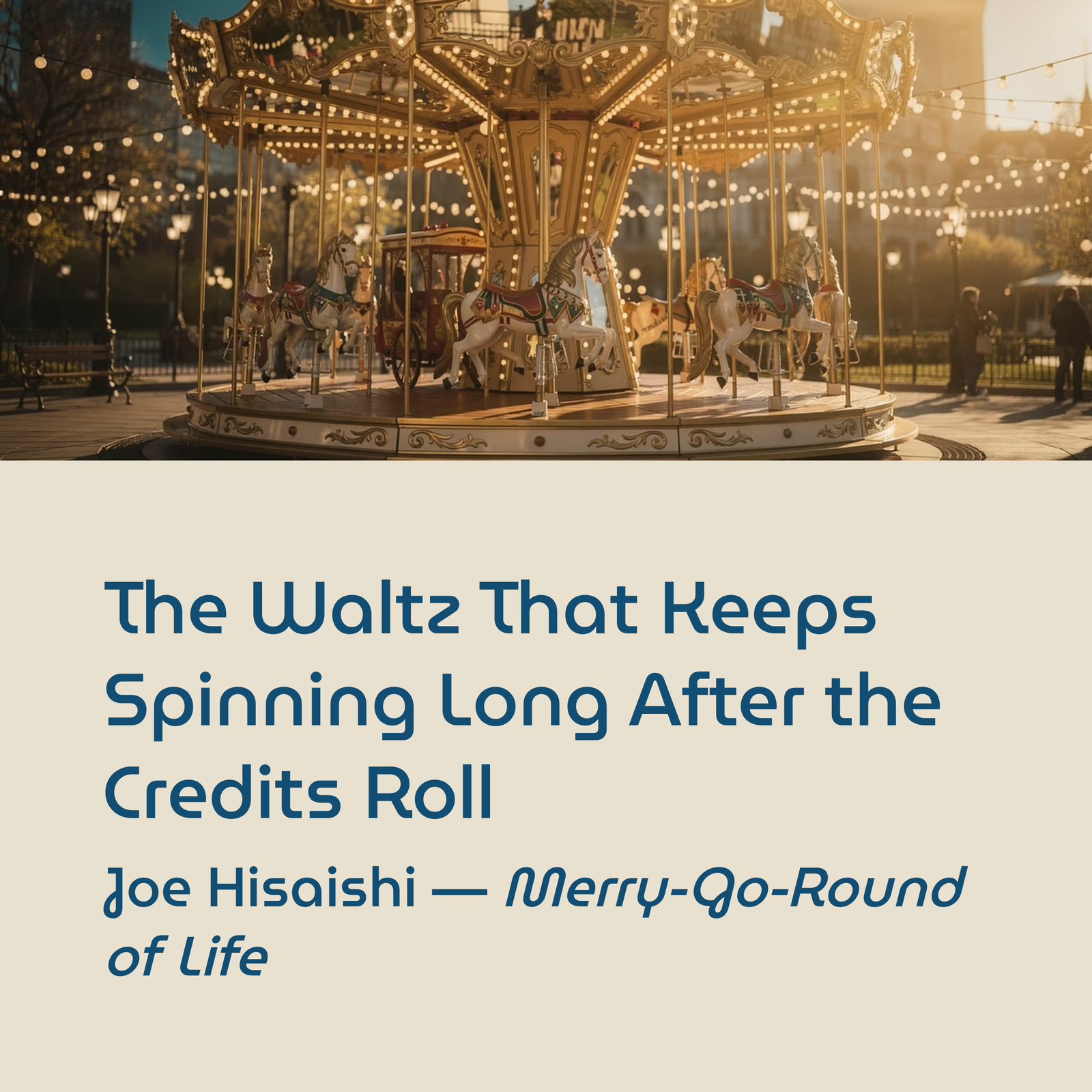
There is a strange thing about certain melodies. You hear them once, and they settle somewhere deep in your chest — not in your memory, but in some older, quieter place. Joe Hisaishi’s “Merry-Go-Round of Life” is that kind of music. It arrives disguised as a simple waltz, the kind you might hear drifting from a European carousel on a Sunday afternoon. But stay with it. Let it turn once, twice, three times. By the time the orchestra swells and the melody lifts into its full, aching grandeur, you realize this was never just a waltz. It was a spell.
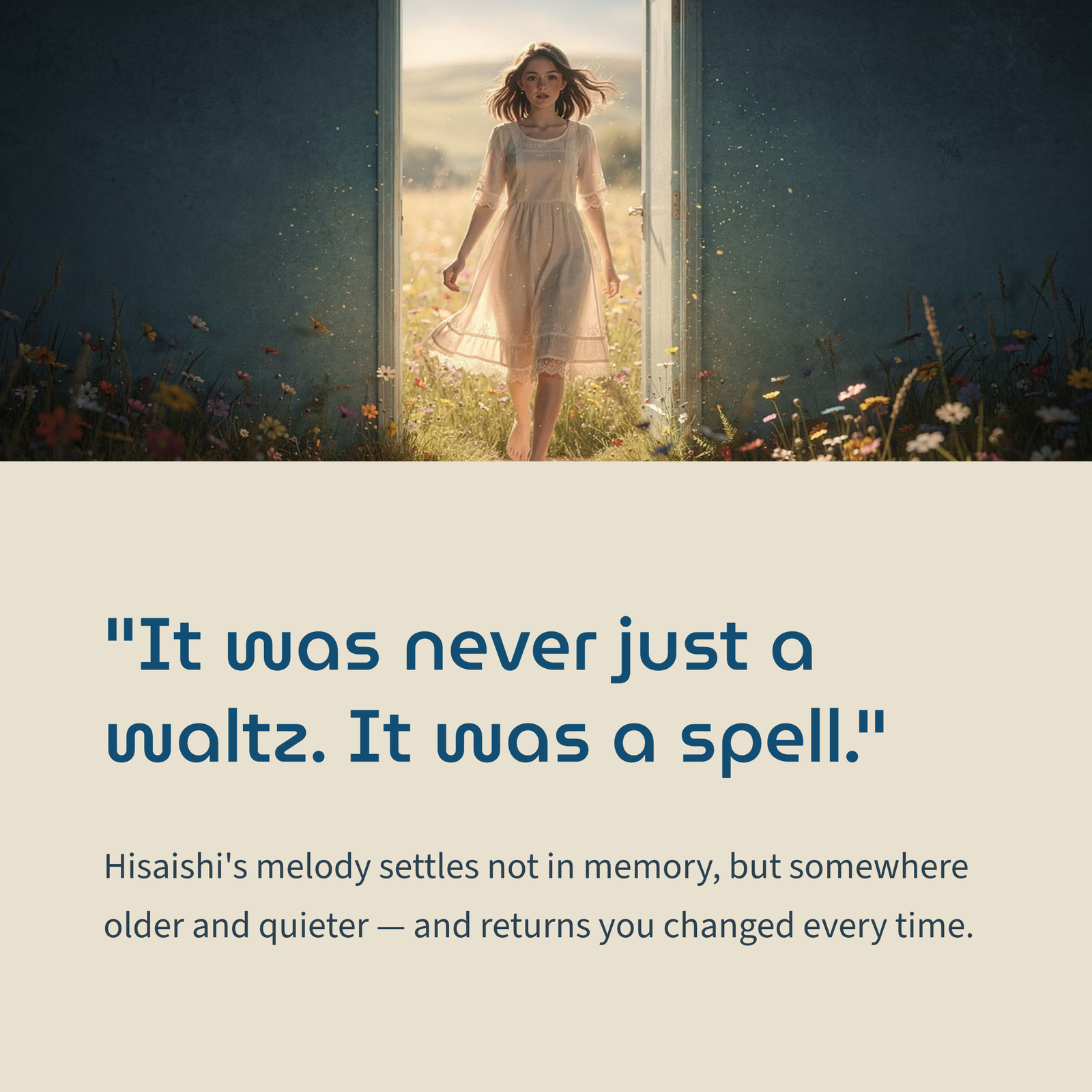
I first heard this piece in a darkened theater, watching Hayao Miyazaki’s Howl’s Moving Castle. Sophie was stepping through a door into a field of wildflowers, and the music poured in like sunlight through a window you didn’t know was there. I couldn’t name what I felt. I only knew that the world had grown briefly, impossibly larger. Years later, I still return to this piece the way one returns to a favorite room in a house — not because I’ve forgotten what’s inside, but because being there changes something in me every time.
The Composer Who Learned to Speak in Wind and Light
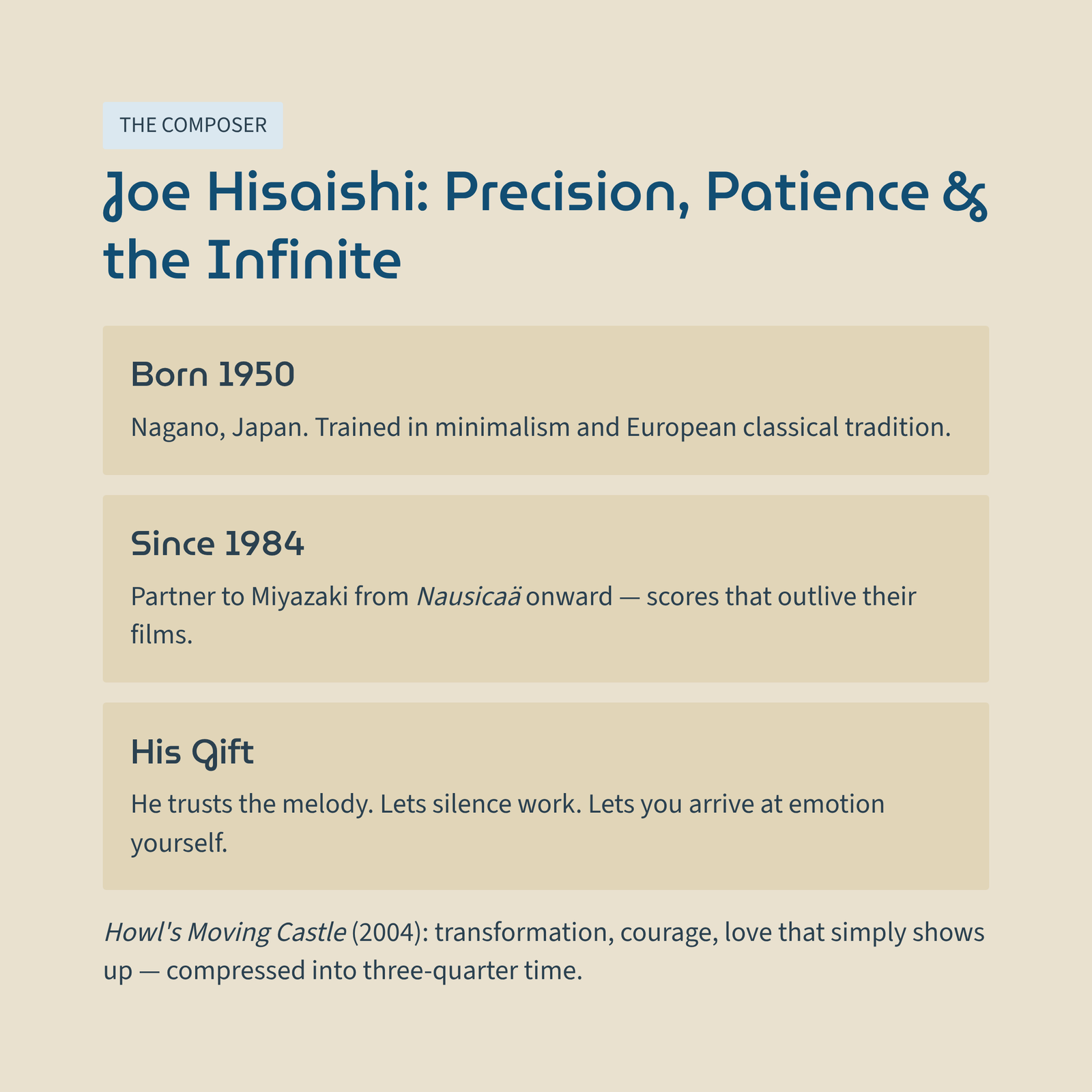
Joe Hisaishi — born Mamoru Fujisawa in Nagano, Japan, in 1950 — is one of those rare composers whose name has become inseparable from an entire world of feeling. His partnership with Miyazaki, stretching back to Nausicaä of the Valley of the Wind in 1984, has produced some of the most emotionally resonant film scores ever written. But Hisaishi is no mere accompanist to animation. Trained in minimalism and deeply influenced by the European classical tradition, he builds his compositions the way an architect builds a cathedral: with precision, with patience, and with an unwavering faith that simplicity, handled well, can hold the weight of the infinite.
What makes Hisaishi extraordinary is his refusal to manipulate. In an era when film composers often reach for dramatic crescendos to tell audiences what to feel, Hisaishi does something far more difficult. He trusts the melody. He lets a phrase breathe, lets silence do its work, and allows the listener to arrive at emotion on their own terms. This is why his music outlives the films it was written for — it doesn’t need the images to be complete.
Howl’s Moving Castle, released in 2004, was adapted from Diana Wynne Jones’s beloved fantasy novel. The film tells the story of Sophie, a young hat-maker cursed into the body of an elderly woman, and Howl, a mysterious wizard whose heart — quite literally — belongs to a fire demon. It is a story about transformation, about courage found in unexpected places, and about the kind of love that doesn’t announce itself but simply shows up, steady and unshakable. Hisaishi understood all of this. And he compressed it into three-quarter time.
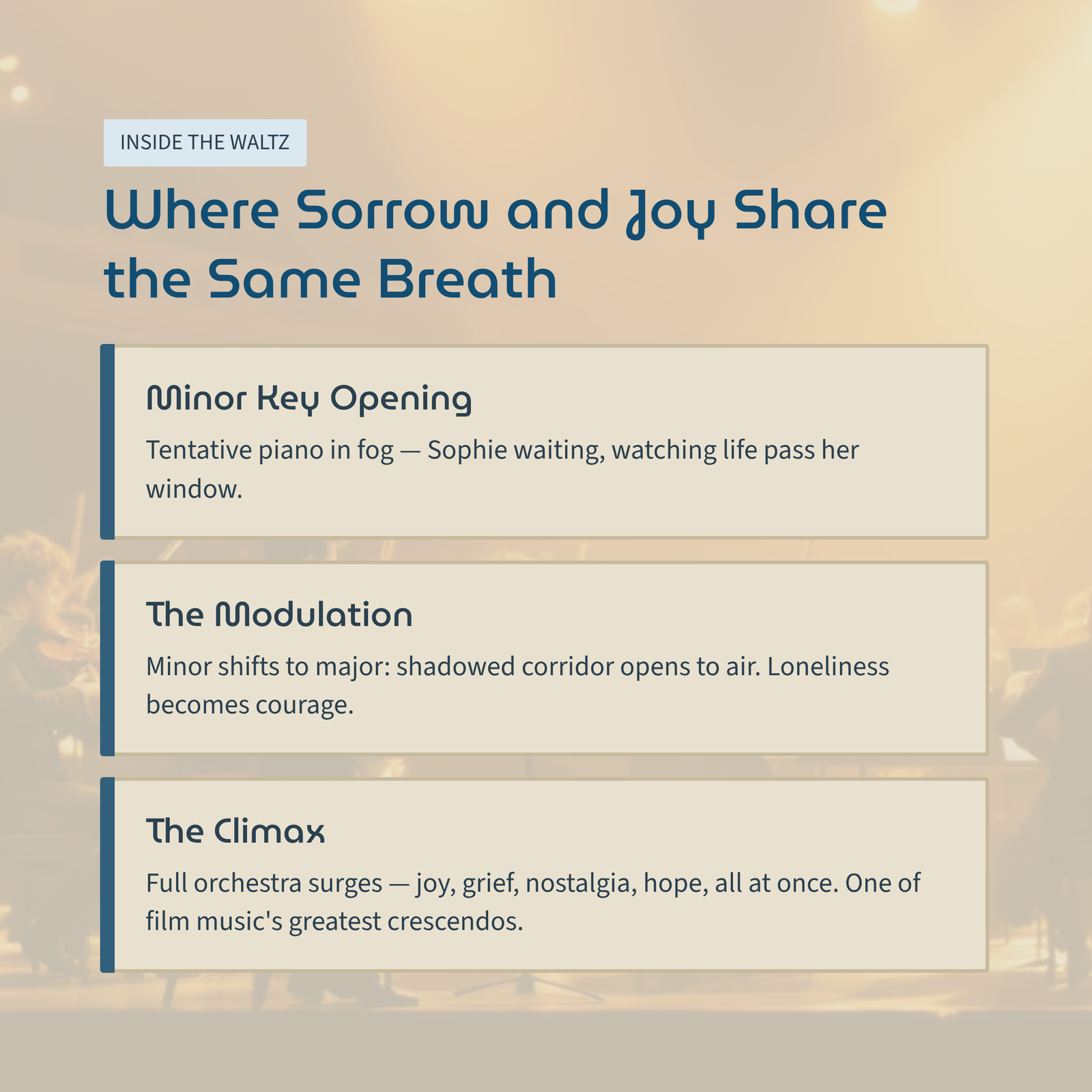
Inside the Waltz: Where Sorrow and Joy Share the Same Breath
The genius of “Merry-Go-Round of Life” lies in its deceptive architecture. On the surface, it is a waltz — that most civilized of dances, born in the ballrooms of Vienna. But Hisaishi uses the waltz form the way a poet uses a sonnet: as a container for something far wilder than its structure suggests.
The piece opens with a gentle, almost tentative piano figure. The melody is in a minor key, and there is a quality of searching in it, as if the music is feeling its way through fog. This is Sophie’s theme — not the Sophie who runs and fights and breaks curses, but the Sophie who sits quietly in her hat shop, watching life pass by her window. The waltz rhythm gives the melody a sense of forward motion, but the minor tonality holds it back, creating a tension between movement and stillness, between wanting and waiting.
Then something remarkable happens. The melody modulates — it shifts from minor to major, and the effect is like stepping from a shadowed corridor into open air. The orchestra enters, and what was intimate becomes vast. Strings carry the melody upward, and suddenly the waltz is no longer a private reverie. It is a declaration. This is the moment the music stops describing Sophie’s loneliness and begins to describe her courage. The same melodic shape, the same three-beat pulse, but transformed by harmony into something luminous and brave.
Pay attention to the way Hisaishi layers the orchestration. The strings don’t simply play the melody — they pass it between sections like a conversation, each voice adding a new shade of meaning. The woodwinds provide countermelodies that weave around the main theme like vines around a trellis. And beneath it all, the piano continues its waltz pattern, steady as a heartbeat, reminding us that no matter how grand the music becomes, it grew from something small and human.
The climactic passage is almost overwhelming in its emotional weight. The full orchestra surges, the melody reaches its highest point, and for a few extraordinary measures, the music seems to contain every feeling at once — joy and grief, nostalgia and hope, the ache of time passing and the stubborn beauty of being alive to feel it pass. It is, I think, one of the most perfectly constructed emotional crescendos in all of film music.
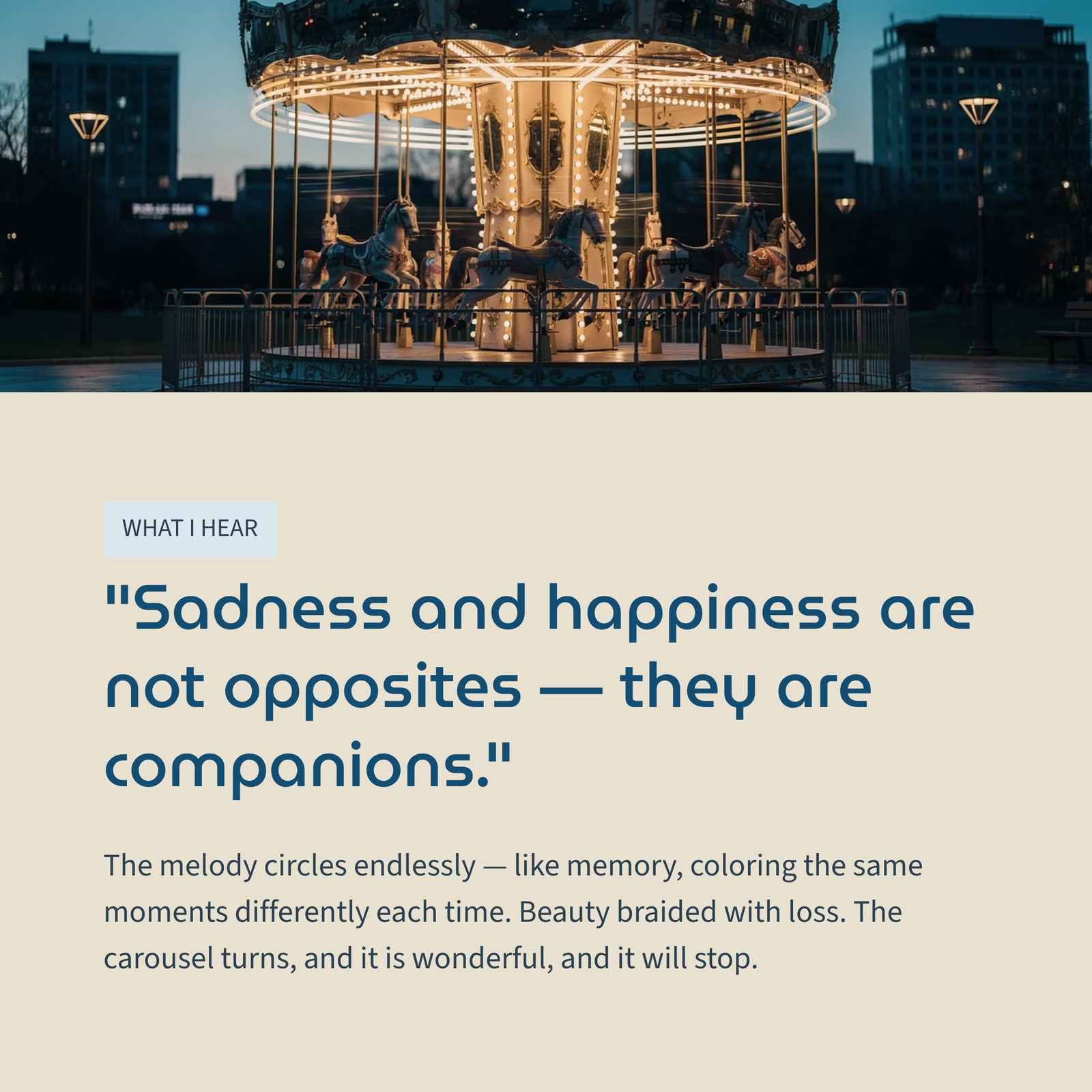
What I Hear When the Carousel Turns
I have listened to this piece hundreds of times, in dozens of versions, and it never arrives the same way twice. Some days I hear it as a love story — not the dramatic, cinematic kind, but the quieter love that lives in small gestures: a hand on a shoulder, a door left unlocked, a fire kept burning through the night. Other days, I hear it as an elegy for something I can’t quite name. The melody’s insistence on returning to its opening phrase, that endless circling, feels like the way memory works — always bringing us back to the same moments, but coloring them differently each time.
What moves me most is the piece’s refusal to resolve neatly. Even in its most triumphant moments, there is a thread of melancholy running through the harmony, a shadow in the major key. Hisaishi seems to understand something that the greatest composers have always known: that real beauty is never pure. It is always braided with loss, with the knowledge that every moment of joy is also a moment passing. The merry-go-round turns, and it is wonderful, and it will stop.
This, I think, is why the piece resonates so deeply with so many people. It doesn’t offer easy comfort. It offers something harder and more valuable — the recognition that sadness and happiness are not opposites but companions, turning together in the same endless waltz.
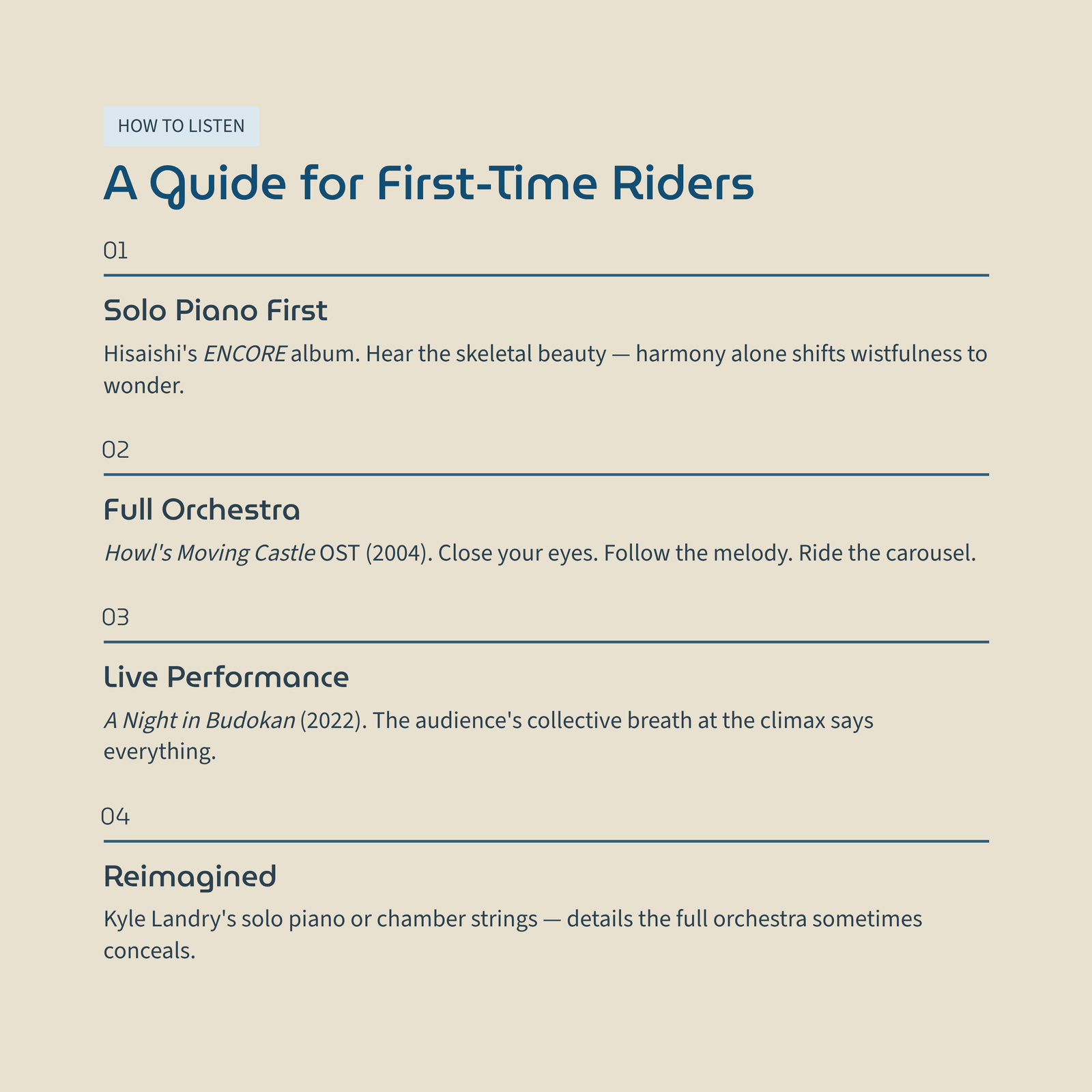
How to Listen: A Guide for First-Time Riders
If you are coming to this piece for the first time, I want to suggest a few ways to let it fully unfold.
First listen — the piano alone. Start with a solo piano version. Hisaishi himself has recorded a beautiful arrangement on his album ENCORE. Stripped of orchestration, the melody reveals its skeletal beauty. Notice how much emotional information is carried by the harmony alone — the way a single chord change can shift the entire mood from wistfulness to wonder. The piano version is the piece in its most honest form, before the orchestra dresses it up for the ball.
Second listen — the full orchestral version. Now listen to the original film soundtrack recording, ideally the version from the Howl’s Moving Castle Soundtrack album (2004, Tokuma Japan Communications). Close your eyes if you can. Follow the melody as it moves from instrument to instrument. Notice the moment when the strings first enter — that expansion of sonic space is one of Hisaishi’s most masterful touches. Let the crescendo wash over you without trying to analyze it. There will be time for analysis later. For now, just ride the carousel.
Third listen — the live performance. Seek out a recording from Joe Hisaishi’s symphonic concerts, particularly the performances with the New Japan Philharmonic or the Tokyo Philharmonic Orchestra. There is a 2022 concert film, Joe Hisaishi: A Night in Budokan, that captures the electric atmosphere of hearing this piece performed live. The audience’s collective intake of breath at the climax tells you everything about what this music means to people.
For a different perspective, the arrangement by pianist Kyle Landry offers a virtuosic solo piano interpretation that expands the harmonic landscape considerably. And if you want to hear the piece completely reimagined, look for chamber ensemble versions that strip the orchestration back to strings and piano — they reveal melodic details that the full orchestra sometimes conceals.
The Carousel That Carries Us All
There is a Japanese word — mono no aware — that roughly translates to “the pathos of things,” the bittersweet awareness of impermanence that gives beauty its depth. No single English phrase captures it fully, but if any piece of music comes close to expressing the feeling itself, it is this one.
“Merry-Go-Round of Life” is not a complicated piece. Its melody can be hummed by a child. Its waltz rhythm is as old as Vienna. But within that simplicity, Hisaishi has hidden something vast — a meditation on time, on transformation, on the way love changes us without our permission. Sophie begins the film as one person and ends it as another, and yet she is always, unmistakably herself. The music does the same thing. It turns and turns, changing with each revolution, and yet it always comes home to the same tender, searching phrase with which it began.
I think this is why we keep coming back to it. Not because it takes us somewhere new, but because it reminds us where we have always been — riding the carousel, watching the world turn, holding on to something precious and temporary, and finding, in that very impermanence, a reason to hold on tighter.
The waltz plays on. The credits end. And still, somewhere inside us, the merry-go-round keeps turning.