📑 Table of Contents

There is a particular kind of silence that arrives after you have been fighting yourself for a very long time. Not the silence of defeat, but the silence of surrender — that trembling instant when you stop clenching your fists and simply let yourself be held. If you have ever known that moment, then you already understand what James Horner captured in “Grace” from the film A Beautiful Mind.
I first encountered this piece on a night when I had no business being awake. The apartment was dark, my laptop screen the only light, and I was scrolling through film scores the way some people scroll through old photographs — looking for something I could not name. Then these opening bars drifted out of the speakers, and I stopped moving entirely. It was not dramatic. There were no crashing chords, no sweeping crescendos demanding my attention. Instead, a piano spoke a handful of quiet notes, and somehow, those notes already knew everything I was carrying.
That is the particular power of this piece. It does not ask you to feel something. It simply mirrors what you already feel, and in doing so, tells you that those feelings are allowed.
The Man Who Heard What Others Could Not
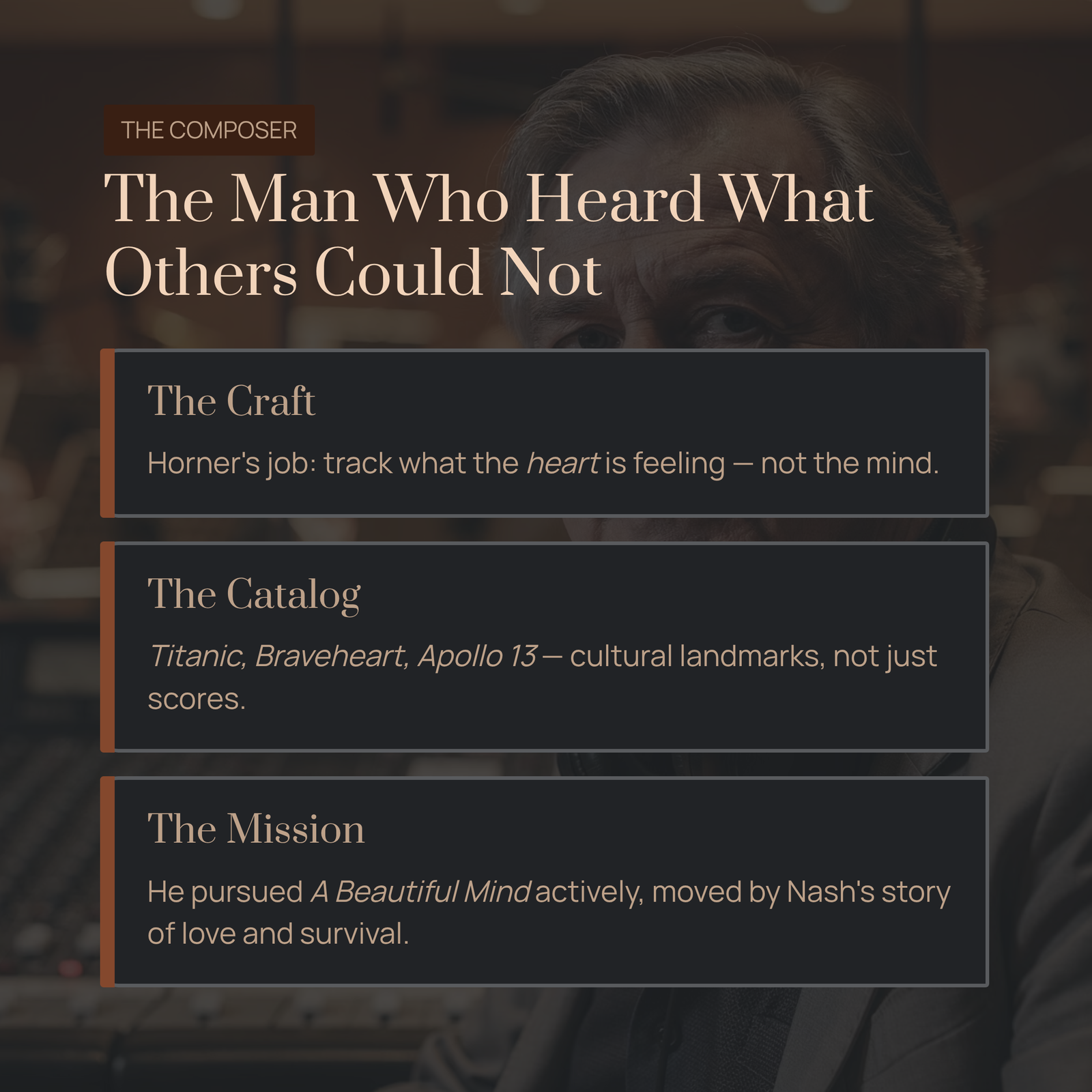
James Horner was born in Los Angeles in 1953, the son of a Hollywood set designer, and grew up surrounded by the machinery of storytelling. He studied piano from the age of five, spent formative years at the Royal College of Music in London, and later earned a doctorate in musical composition at UCLA. By the time he scored A Beautiful Mind in 2001, he had already built one of the most formidable catalogs in film music history: Braveheart, Apollo 13, Titanic, Legends of the Fall — these were not merely film scores but cultural landmarks that shaped how millions of people experienced emotion in a darkened theater.
Yet what made Horner remarkable was not his technique, though it was formidable. It was his instinct for the interior landscape. In a 2009 interview, he described his role with characteristic clarity: his job, he said, was to track what the heart is supposed to be feeling at every turn of a film. Not the mind. The heart. He did not write with a computer or even at a piano. He composed in his head first, trusting some internal compass that seemed to point unerringly toward the emotional center of a story.
For A Beautiful Mind, that story was the life of John Forbes Nash Jr. — a Princeton mathematician of extraordinary brilliance who spent decades tormented by paranoid schizophrenia, and who ultimately found his way back to the world through the unwavering love of his wife, Alicia. Horner pursued this project actively, so deeply moved was he by Nash’s story. And it shows. This is not a score that merely accompanies a film. It inhabits the film’s emotional architecture the way light inhabits a cathedral.
Where Numbers Dissolve into Tenderness
Understanding “Grace” requires understanding where it sits within the larger emotional arc of the score. Horner built A Beautiful Mind around a deliberate duality. In the first half, we hear the kaleidoscopic brilliance of Nash’s mind — rapid piano ostinatos, swirling patterns that form and dissolve like mathematical proofs unfolding in real time. Horner himself described this approach using the metaphor of a kaleidoscope: patterns that change quickly on the surface while creating slower, deeper patterns underneath. The piano and the ethereal voice of then-fifteen-year-old Welsh singer Charlotte Church were his primary instruments for this sonic portrait of genius.
But as Nash descends into illness — as the line between real and imagined blurs into something terrifying — the music darkens. Strings tighten. The kaleidoscope fractures. And then, gradually, something extraordinary happens. The score begins to shed its complexity. Layers fall away. What remains is something stripped bare, almost unbearably intimate.
“Grace” lives in that stripped-bare space. It is the sound of a man returning to himself — not through intellectual triumph, but through the slow, painful, miraculous process of being loved when he is at his most unlovable. The piano line is devastatingly simple, moving in intervals that feel less like composed music and more like breathing. There is no virtuosity here, no attempt to impress. Horner understood something essential: that grace, by definition, is unearned. And so the music earns nothing. It simply arrives.

Listening with the Body, Not the Mind
Here is what I would suggest for your first encounter with this piece — or your fiftieth.
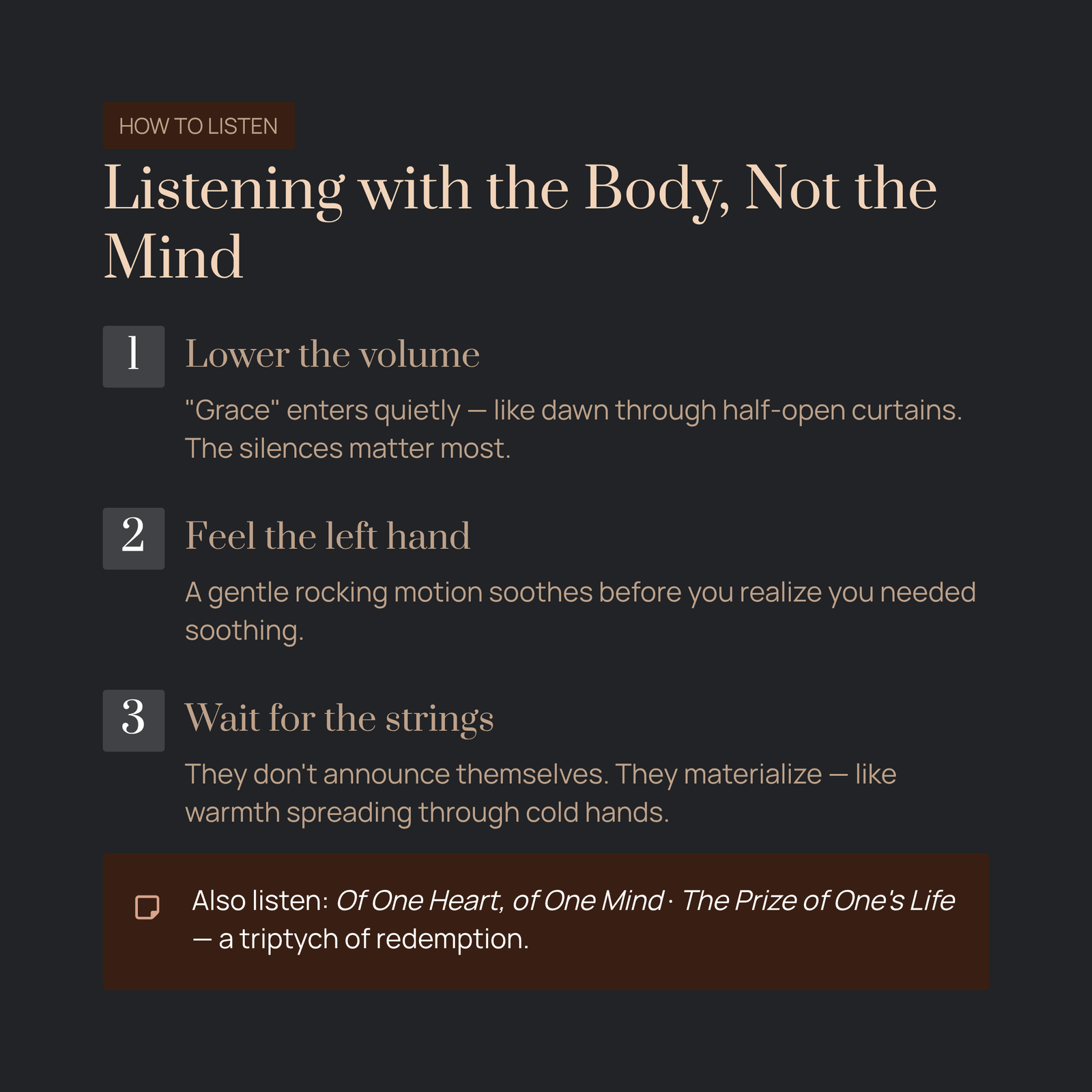
First, lower the volume slightly from where you would normally set it. This is important. “Grace” was not written to fill a room. It was written to enter one quietly, the way dawn enters through half-open curtains. If you play it too loud, you will hear the notes but miss the silences between them, and it is in those silences that the piece does its most important work.
Second, pay attention to what happens in the lower register. The left hand of the piano establishes a gentle, rocking motion — not quite a lullaby, but something with that quality of repetition that soothes before you realize you needed soothing. Above it, the right hand introduces a melody so simple that a child could play the notes, yet so perfectly placed in time that it aches. Listen to how certain notes are held just a fraction longer than you expect. Horner was a master of this technique — using duration, rather than volume or harmony, to create emotional weight.
Third, notice the moment when the strings enter. They do not announce themselves. They simply materialize, like warmth spreading through cold hands. This is where the piece transforms from a solo meditation into something communal, as if the piano’s private grief has been overheard and answered by a larger, gentler presence. If Charlotte Church’s voice appears in your version, listen to how it floats above the orchestra — not singing words, but vocalizing in a register that Horner described as caught between child and adult. There is something in that ambiguity that speaks directly to the theme of innocence persisting through suffering.
For those who want to explore further, the full soundtrack album is available on major streaming platforms. I would recommend listening to “Of One Heart, of One Mind” and “The Prize of One’s Life… The Prize of One’s Mind” alongside “Grace” — together, they form a triptych of redemption that represents Horner at his most emotionally generous.

What the Music Knows That We Forget
I have a theory about why certain film scores outlive the films they were written for. It is not about melody, though melody matters. It is not about orchestration, though Horner’s orchestration here is impeccable. It is about truth-telling.
The film A Beautiful Mind is, in many ways, a conventional Hollywood narrative: a great man struggles, falls, and rises again. But Horner’s score tells a different, more honest story. In his music, the rising is not triumphant. It is tentative. The victory is not over illness but within it — a quiet, daily choosing of reality over delusion, of love over isolation, of the messy imperfection of actual life over the seductive elegance of imagined patterns. “Grace” captures this with an emotional precision that the dialogue and images alone could not achieve.
Horner died on June 22, 2015, when the small plane he was piloting crashed into the Los Padres National Forest in California. He was sixty-one years old. He left behind over 160 film scores, two Academy Awards, and a body of work that has shaped the emotional vocabulary of modern cinema. Those who knew him described a deeply sensitive man — someone who, by his own account, experienced the world differently, and who channeled that difference into music of extraordinary empathy. His principal horn player recalled seeing Horner’s eyes water during recording sessions when the orchestra played something particularly beautiful. It came, as the musician put it, from deep within the man himself.
I think about this whenever I listen to “Grace.” There is a generosity in this music that goes beyond craft. It is the generosity of someone who understood suffering from the inside and chose, again and again, to transform that understanding into sound that makes the listener feel less alone.
A Permission Slip Written in Sound
There are pieces of music that teach you something, and there are pieces of music that remind you of something you already knew but had forgotten. “Grace” belongs firmly in the second category.
What it reminds us is deceptively simple: that we do not have to solve ourselves in order to deserve tenderness. That the fractured, confused, struggling version of us is not a rough draft of some better person waiting to emerge — it is the person, whole and worthy, right now. John Nash did not overcome his illness through willpower or brilliance. He learned, with excruciating slowness, to live alongside it, held steady by a love that did not require him to be fixed first.
Horner heard that story and recognized it as universal. Not all of us battle paranoid schizophrenia, but all of us have stood at some version of that threshold — the place where we believe we are too broken, too strange, too much trouble to be loved. “Grace” is the sound of someone standing on the other side of that threshold, not shouting reassurance, but simply leaving the door open and waiting.
If you are at that threshold tonight, put this piece on. Lower the volume. Close your eyes. Let the piano speak those few quiet notes. And notice that you do not need to do anything at all except listen. The music will meet you exactly where you are. That is what grace does. That is all it has ever done.