📑 Table of Contents
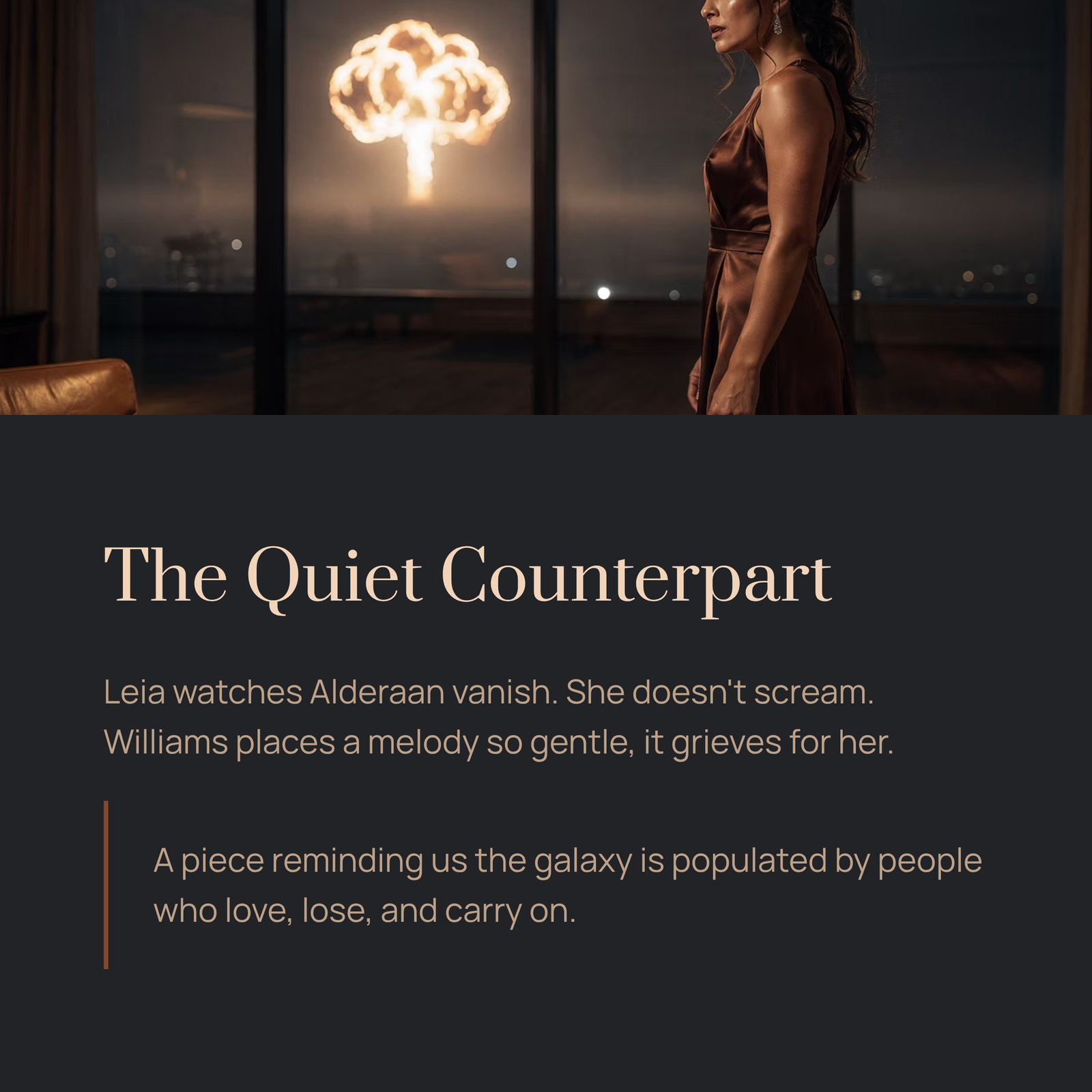
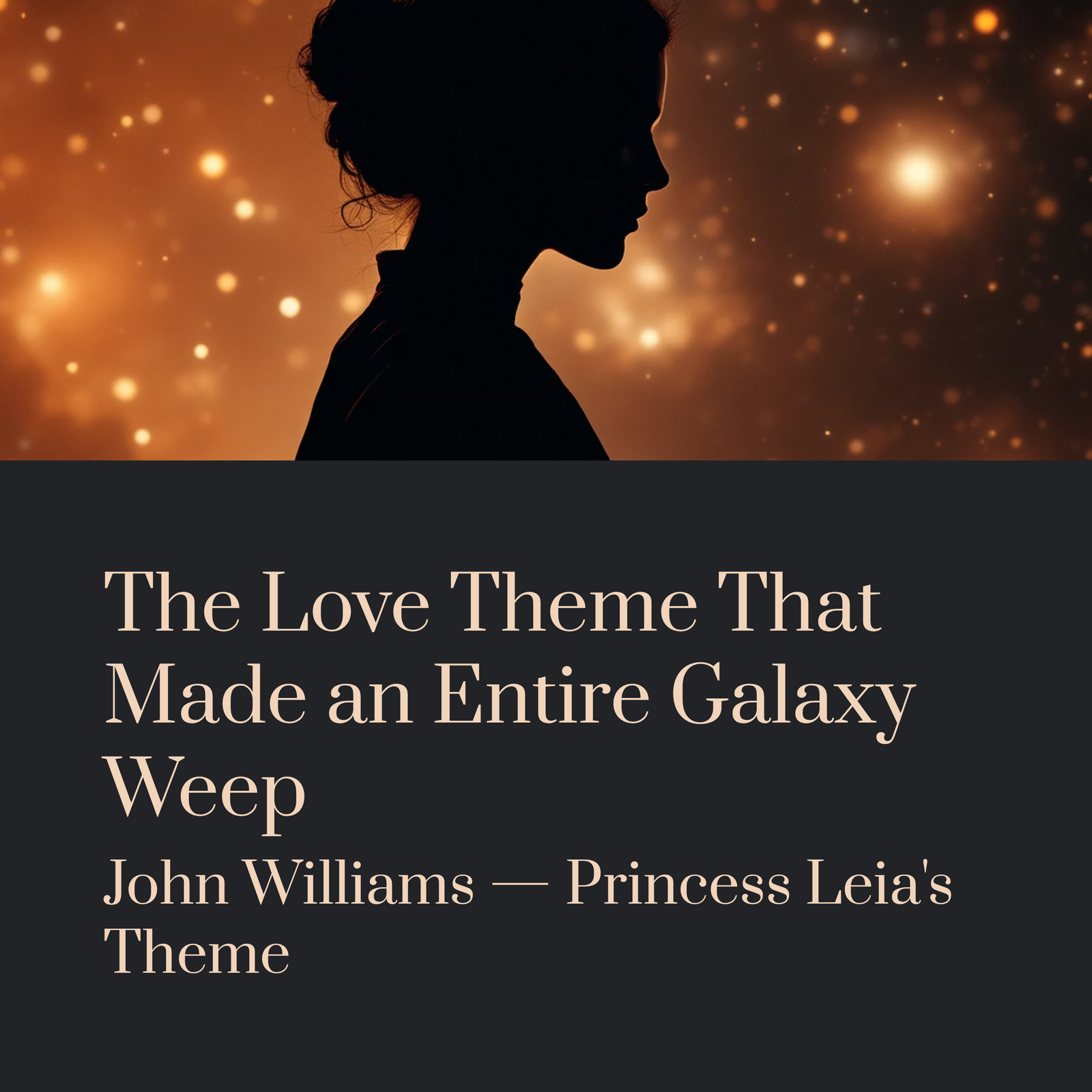
There is a moment in the original Star Wars that most people overlook. It’s not a lightsaber duel or a starship chase. It’s the scene where Princess Leia watches her home planet, Alderaan, vanish in a flash of light. She doesn’t scream. She doesn’t collapse. She simply stands there, absorbing the unimaginable.
And underneath that silence, John Williams places a melody so gentle, so achingly human, that it does the grieving for her.
Princess Leia’s Theme is not the triumphant brass fanfare people hum when they think of Star Wars. It’s the quiet counterpart — the piece that reminds us the galaxy far, far away is populated not just by heroes and villains, but by people who love, who lose, and who carry on despite it all.
The Composer Who Taught Hollywood How to Feel
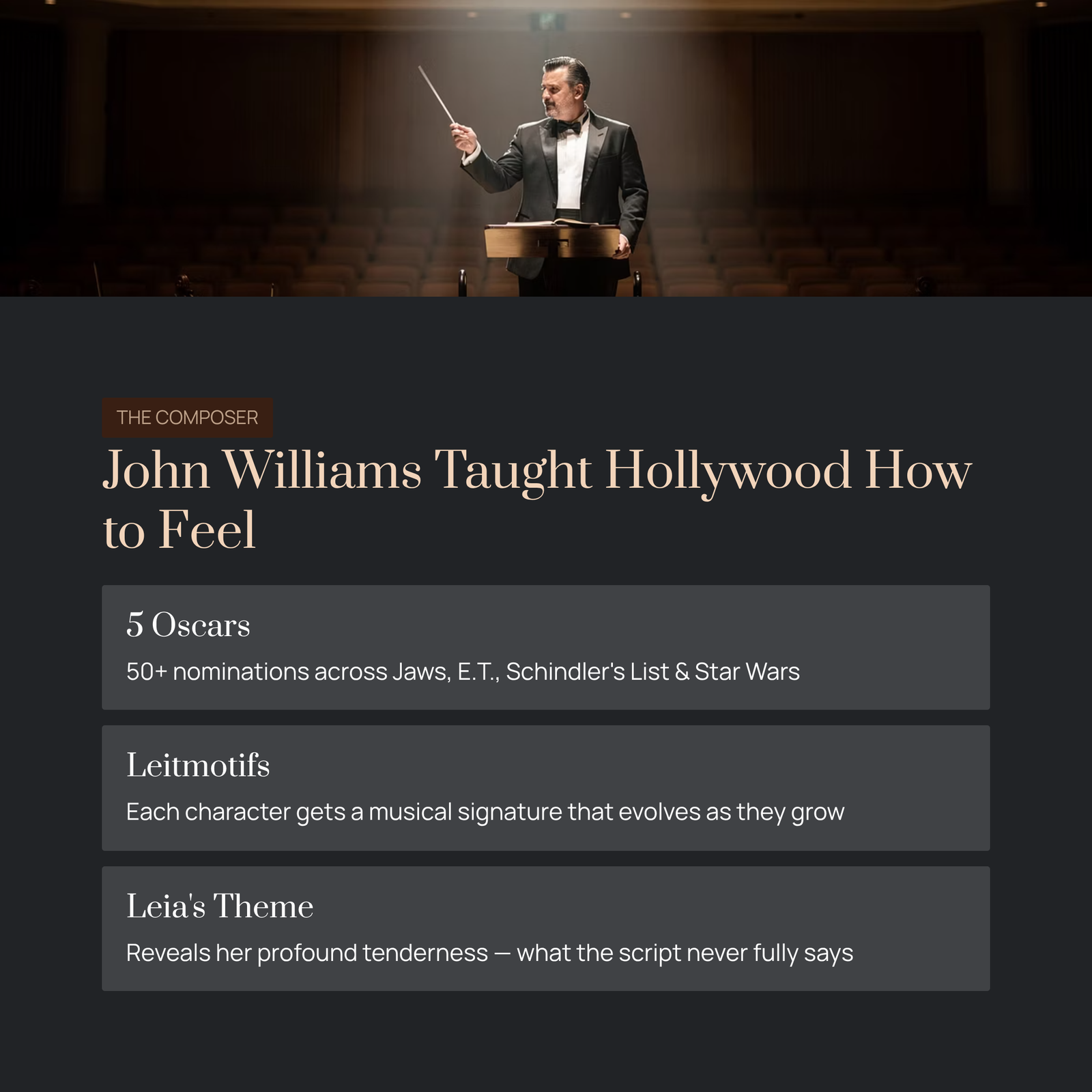
John Williams, born in 1932 in Floral Park, New York, hardly needs an introduction. His filmography reads like a catalog of modern mythology — Jaws, E.T., Schindler’s List, Jurassic Park, Harry Potter, and of course, the entire Star Wars saga. With five Academy Awards and over fifty nominations, he has shaped how we emotionally experience cinema more than perhaps any other living composer.
But what makes Williams exceptional isn’t just his ability to write memorable melodies. It’s his gift for psychological precision. Each character in Star Wars receives a leitmotif — a recurring musical signature — that evolves as the character grows. The Imperial March tells you everything about Darth Vader’s menace. Luke’s theme radiates youthful ambition. And Leia’s theme? It tells you something the script never fully articulates: that beneath the diplomatic composure and the sharp wit, there is a profound tenderness.
When Williams sat down to score the original Star Wars in 1977, director George Lucas had temped the film with existing classical works, including pieces by Holst, Dvořák, and Tchaikovsky. Williams took that late-Romantic sensibility and distilled it into something new — orchestral writing that felt both timeless and deeply personal. Princess Leia’s Theme emerged as one of his most intimate creations, a piece that owes as much to Rachmaninoff’s lyrical sweep as it does to the golden age of Hollywood scoring.
Listening to the Architecture of Longing
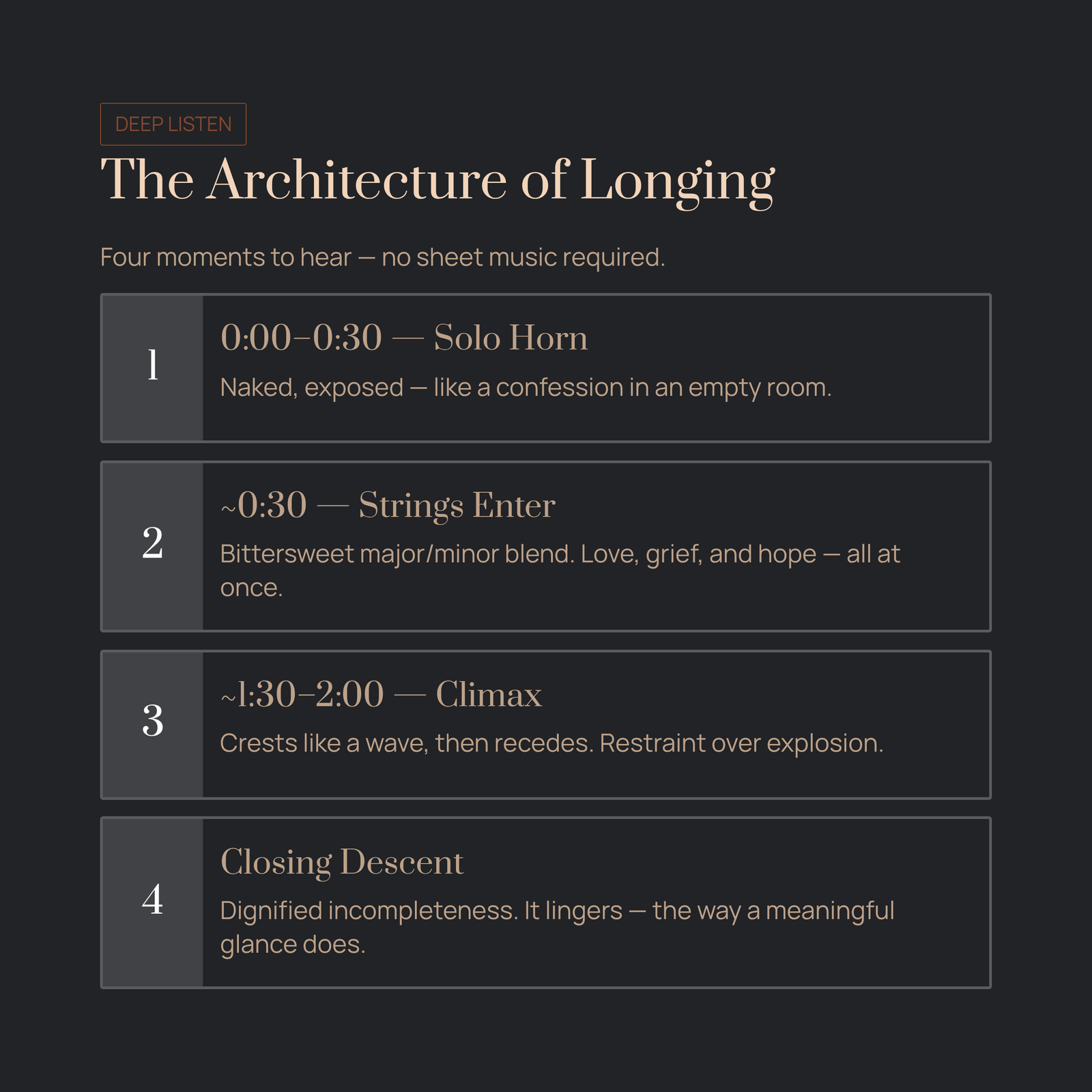
The theme opens with a solo French horn — warm, unhurried, almost hesitant. If you close your eyes, it sounds like someone gathering the courage to say something important. The melody rises gently, pauses, and then continues with a slight ache in its intervals, as though the notes themselves are reaching for something just beyond grasp.
Here are a few things to listen for, even if you’ve never read a note of sheet music:
The opening phrase (0:00–0:30): Pay attention to how the French horn carries the melody completely alone for the first several bars. There’s no harmonic cushion, no orchestral safety net. It’s as exposed and vulnerable as a confession whispered in an empty room. This nakedness is deliberate — Williams wants you to feel the solitude before the warmth arrives.
The string entrance (around 0:30): When the full string section gently swells beneath the horn, the effect is like stepping from a cold hallway into a sunlit room. The harmony doesn’t resolve into pure happiness, though. There’s a bittersweet quality, a mixture of major and minor inflections that keeps the emotional temperature ambiguous. Is this love? Grief? Hope? Williams lets it be all three at once.
The climactic arc (around 1:30–2:00): The melody is now passed to the full orchestra, and the dynamics build toward a soaring peak. But notice how quickly Williams pulls back. The crescendo doesn’t explode — it crests like a wave and then recedes. This restraint is what separates a great film composer from a merely competent one. The most powerful emotions, Williams seems to suggest, are the ones we almost express but hold just inside.
The closing descent: As the theme winds down, the melody returns to quieter territory, ending with a sense of dignified incompleteness. It doesn’t resolve with a neat bow. It lingers, the way a meaningful glance lingers after someone has left the room.
Why This Theme Hits Differently Than You Expect
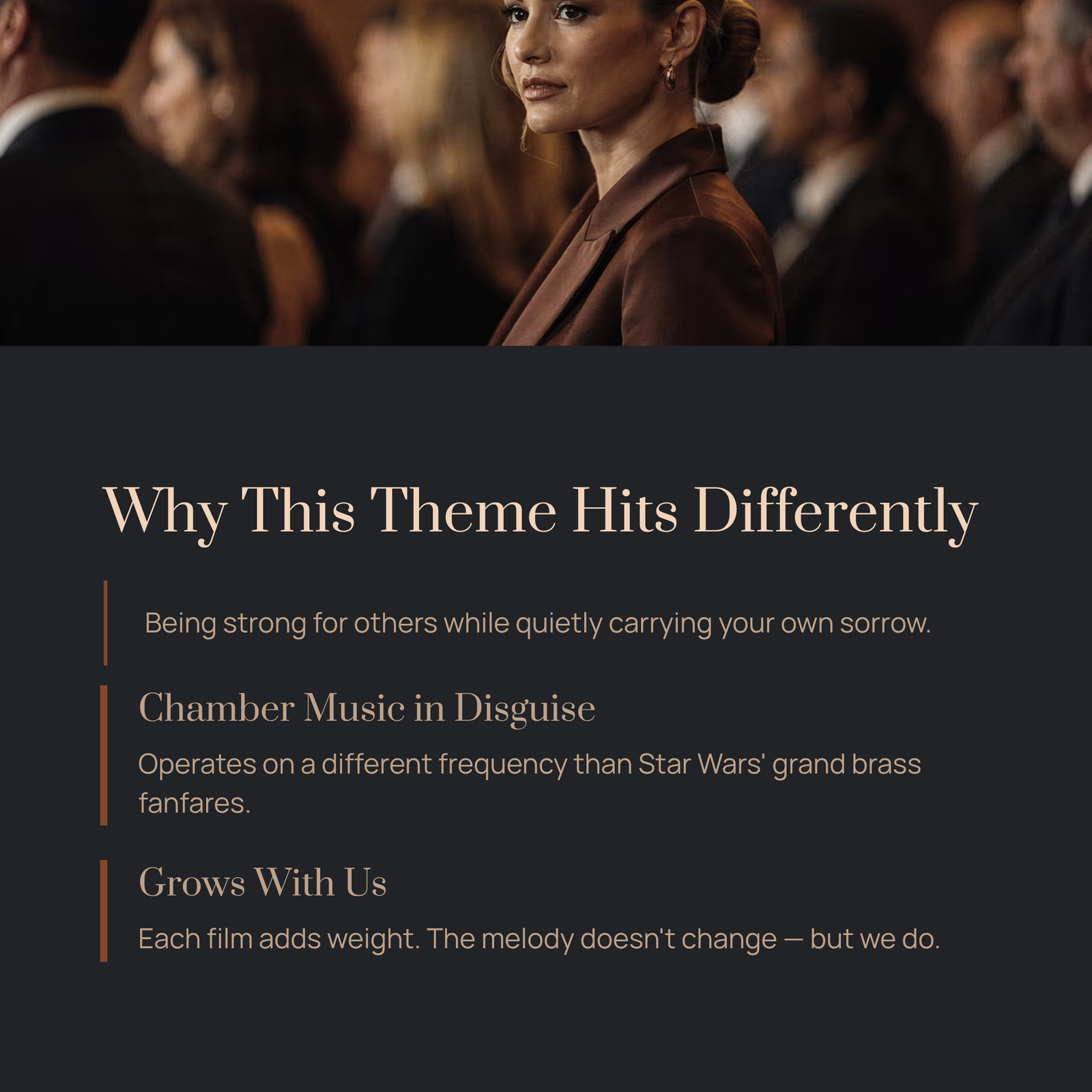
Most people associate Star Wars music with grandeur — massive brass chords, thundering timpani, the kind of orchestral spectacle that fills IMAX theaters. Leia’s Theme operates on an entirely different frequency. It’s chamber music disguised as a film score.
What strikes me most, listening to it outside the context of the film, is how complete it feels as a standalone piece. You don’t need to know anything about the Rebel Alliance or the Galactic Empire. The melody communicates something universally recognizable: the experience of being strong for others while quietly carrying your own sorrow. It’s the emotional vocabulary of anyone who has ever held themselves together in public and only allowed themselves to feel in private.
There’s also something remarkable about its role within the Star Wars saga. As the films progressed, Williams wove Leia’s Theme into increasingly complex emotional contexts — her reunion with Luke, her relationship with Han Solo, and ultimately, in The Last Jedi, her solitary vigil as the Resistance crumbles around her. Each time the theme returns, it carries the accumulated weight of everything we’ve witnessed. The melody doesn’t change, but we do, and so it means more each time we hear it.
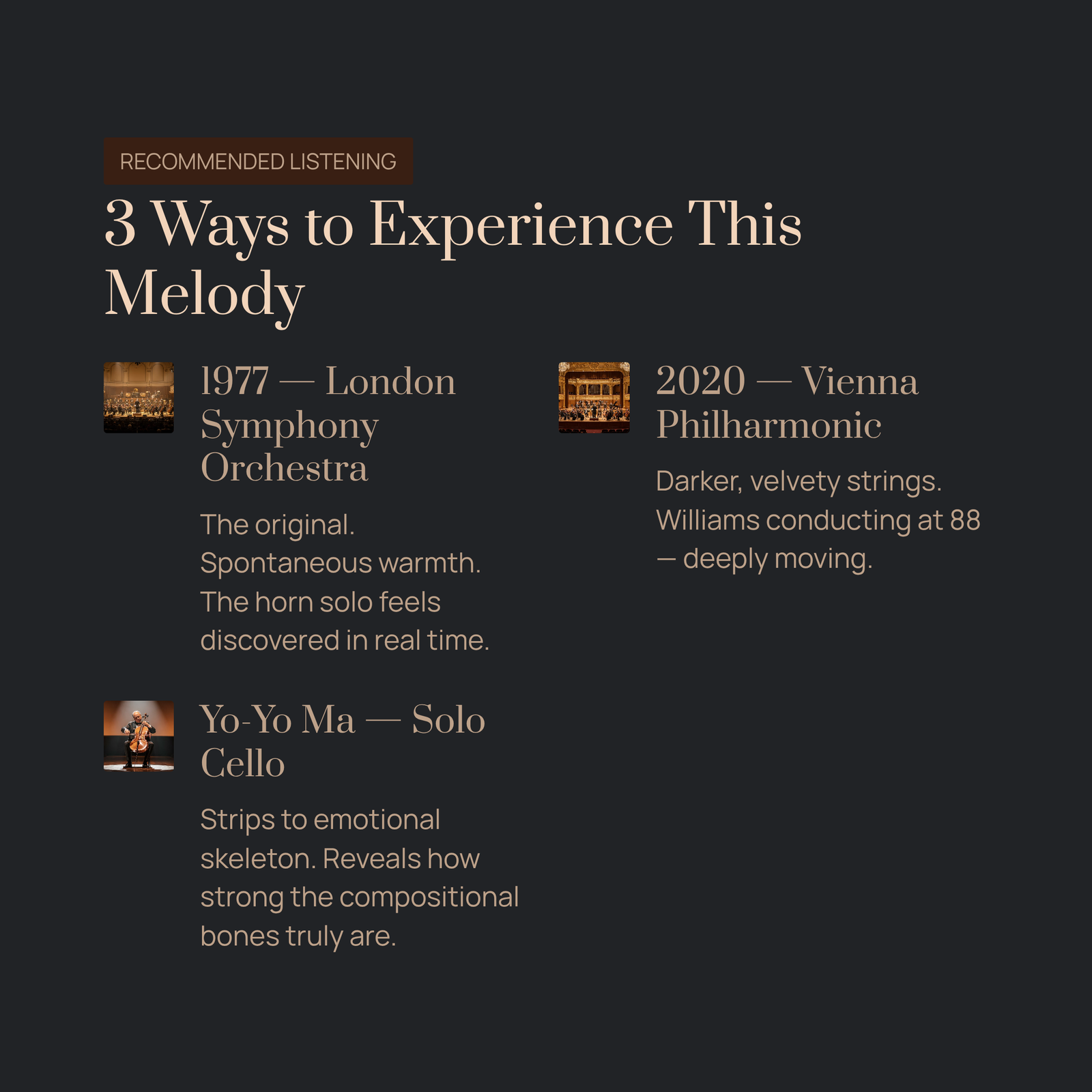
Recommended Listening: Three Ways to Experience This Melody
1. The Original Soundtrack Recording (1977, London Symphony Orchestra conducted by John Williams)
This is where it all began. The LSO’s performance has a warmth and spontaneity that later, more polished recordings sometimes lack. The French horn solo in this version feels genuinely tender, as though the player is discovering the melody in real time.
2. John Williams in Vienna (2020, Vienna Philharmonic conducted by John Williams)
Recorded live with one of the world’s great orchestras, this version brings a European richness to the sound. The strings have a darker, more velvety quality, and the overall interpretation feels more mature — less like a young princess and more like the general she eventually becomes. This concert recording is widely available and worth seeking out for the visual dimension alone: watching Williams conduct his own music at eighty-eight years old is deeply moving.
3. Yo-Yo Ma Plays the Music of John Williams (widely available arrangement)
Cellist Yo-Yo Ma has performed Williams’ melodies in various settings, and hearing Leia’s Theme transcribed for solo cello strips the piece down to its emotional skeleton. Without the orchestral color, you’re left with pure melody and pure feeling — an excellent way to hear how strong the compositional bones of this theme truly are.
A Melody That Refuses to Be Forgotten
There is a test I sometimes apply to music: can it make you feel something even when you can’t remember where you first heard it? Princess Leia’s Theme passes this test effortlessly. Separated from the spacecraft and the blasters and the scrolling yellow text, it becomes simply a piece of music about human resilience — about the quiet, unglamorous kind of courage that doesn’t announce itself with trumpets.
John Williams once said in an interview that he thinks of film music as an emotional memory that audiences carry with them long after the credits roll. If that’s the standard, then Leia’s Theme may be his most successful creation. Not the loudest, not the most famous, but the one that settles deepest — the melody you find yourself humming on a difficult afternoon, not entirely sure why it helps, only knowing that it does.
Sometimes the most powerful music isn’t the kind that fills a concert hall. It’s the kind that fills the silence you didn’t know was there.