📑 Table of Contents
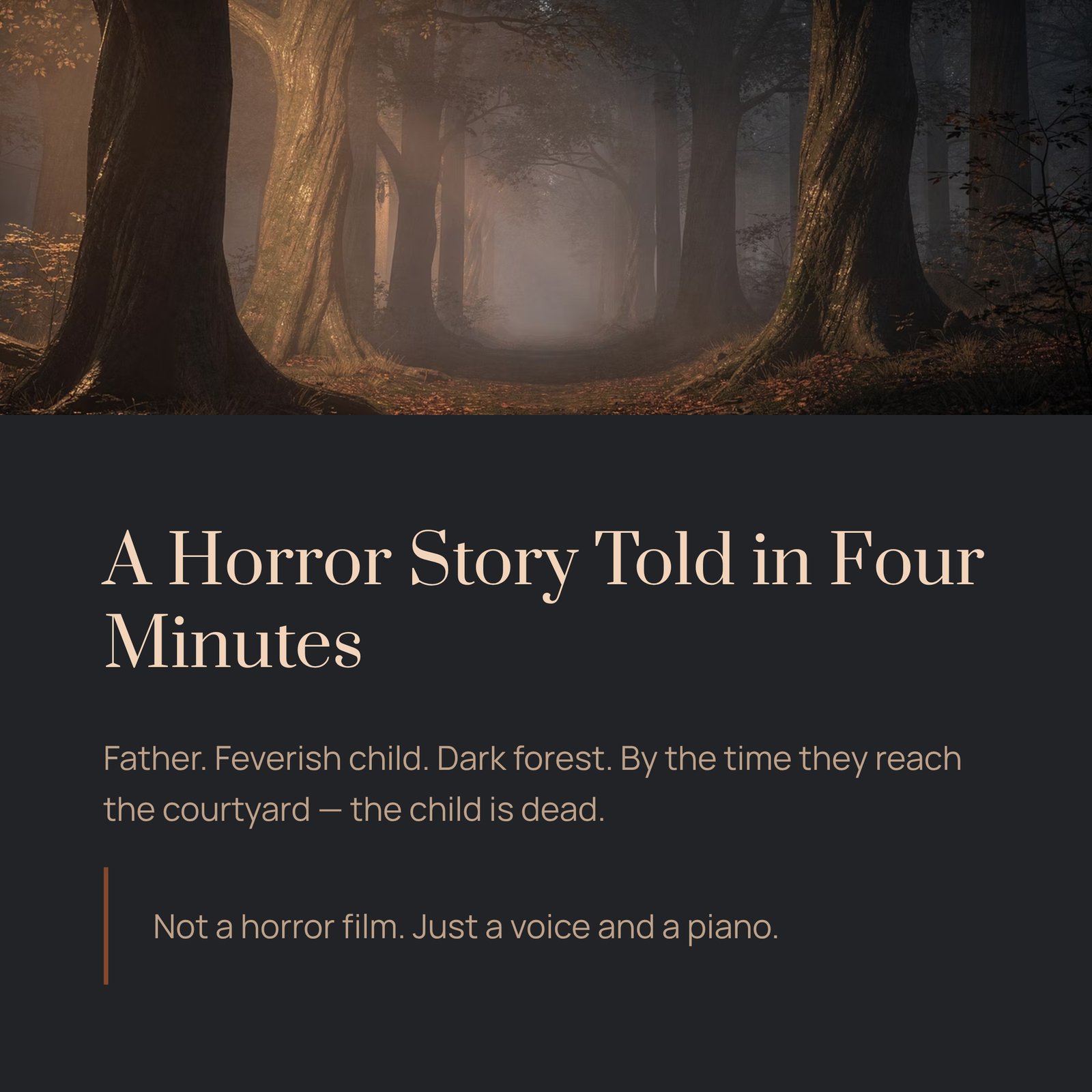
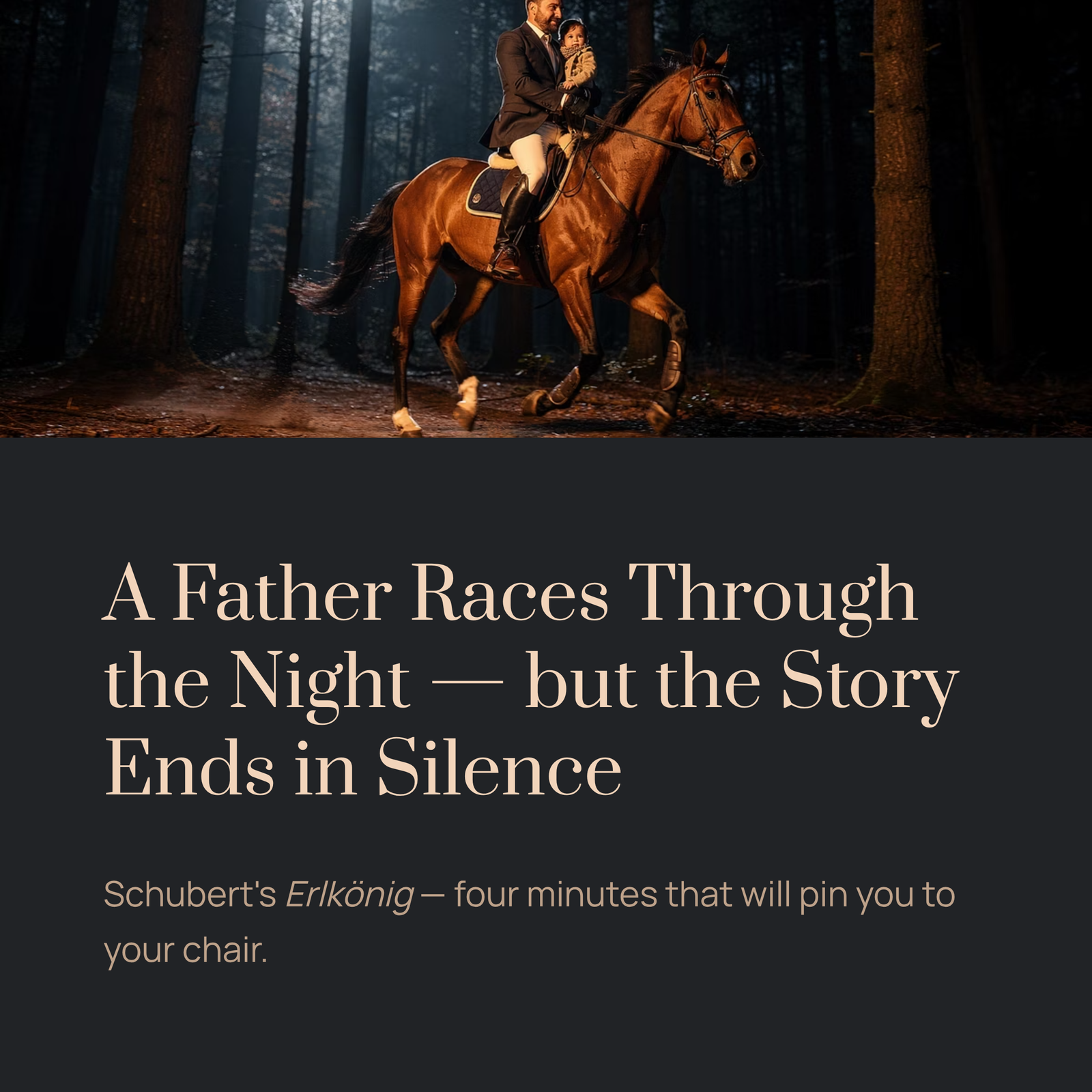
Imagine a father on horseback, clutching his feverish child, tearing through a dark forest at full speed. The wind howls. The child screams that something is reaching for him. The father whispers that it is only the fog, only the wind, only the old willow trees. But by the time the horse reaches the courtyard, the child in his arms is dead.
This is not the plot of a horror film. It is the story Schubert tells in under four minutes — with nothing but a voice and a piano.
I remember the first time I heard Erlkönig all the way through. I had pressed play almost casually, expecting another polite classical song. What I got instead was a galloping, breathless sprint that pinned me to my chair. When the final line landed — quiet, almost clinical — I realized I had been holding my breath. That is the kind of piece this is. It does not ask for your attention. It seizes it.
An Eighteen-Year-Old, a Poem, and a Feverish Afternoon
Franz Schubert was only eighteen years old in 1815 when he set Johann Wolfgang von Goethe’s poem Erlkönig to music. The legend says he composed it in a single sitting, the notes pouring out so fast that his friend Josef von Spaun found him at his desk practically trembling with excitement. Whether or not every detail of that story is true, the result speaks for itself: a work of staggering dramatic power written by a teenager.
Goethe’s poem, published in 1782, draws on a Danish folk legend about a supernatural creature — the Erl-King — who lures children to their deaths. The poem is structured as a dialogue among four characters: a narrator, a father, his dying son, and the Erl-King himself. Each voice carries a different emotional weight. The father is rational, reassuring. The child is terrified. The Erl-King is seductive, sweet, and ultimately deadly. And the narrator frames the whole tragedy with chilling detachment.
What makes Schubert’s setting revolutionary is that he gave all four voices to a single singer. One performer must shift between desperate tenderness, childlike panic, supernatural charm, and cold narration — sometimes within a single phrase. It was a demand that had no real precedent in the art song tradition, and it essentially redefined what a lied could be.
Goethe himself, by the way, was reportedly unimpressed when he received the score. He preferred simpler, strophic settings of his poems. History, as it often does, sided with the young composer.
Inside the Storm: How the Music Tells the Story
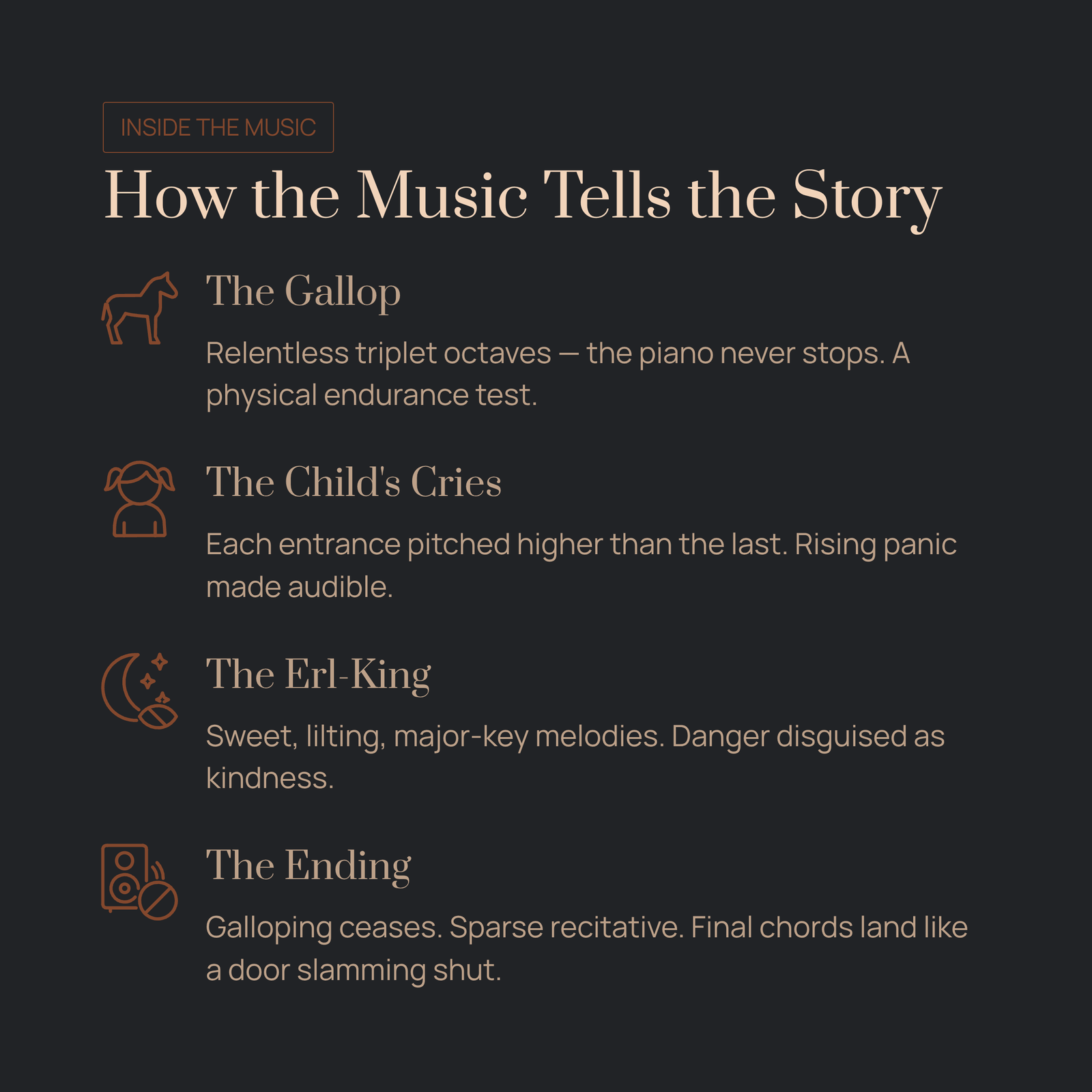
The piano part of Erlkönig is famous for a reason, and that reason hits you in the very first measure. A relentless pattern of rapid triplet octaves in the right hand — the same figure, pounding over and over — creates the sensation of a horse galloping at full tilt. This is not background accompaniment. This is the engine of the entire drama. The pianist’s hand must maintain this furious motion for nearly the entire piece, a physical endurance test that mirrors the father’s desperate ride.
Beneath that galloping figure, the left hand introduces a rising motif that feels like the wind itself — restless, searching, never quite settling. Together, these two layers establish an atmosphere of dread before the singer has even opened their mouth.
Now listen for how Schubert differentiates the four characters through melody and harmony. The narrator sings in a declamatory, almost recitative-like style — factual, detached. The father’s lines sit in a lower register, warm but strained, always trying to comfort. The child’s cries leap upward, each entrance pitched slightly higher than the last, the rising panic made physically audible. And the Erl-King? His music is the most unsettling of all — because it sounds beautiful. His melodies are sweet, lilting, almost like a lullaby, set in major keys that feel grotesquely out of place against the surrounding darkness. It is the sound of danger disguised as kindness.
Pay close attention to the moments of transition between characters. There are no pauses, no neat separations. One voice bleeds into the next, creating a claustrophobic sense that no one can escape this ride. The tempo never lets up. The triplets never stop. The harmonic tension ratchets tighter with each verse.
And then — the end. The galloping ceases. The piano drops to a slow, spare recitative. The narrator returns with two devastating lines: “He reaches the courtyard with effort and dread; in his arms, the child was dead.” The final chords land like a door slamming shut. There is no resolution, no comfort, no musical mourning. Just silence where a heartbeat used to be.
Why This Piece Still Shakes Us Two Centuries Later
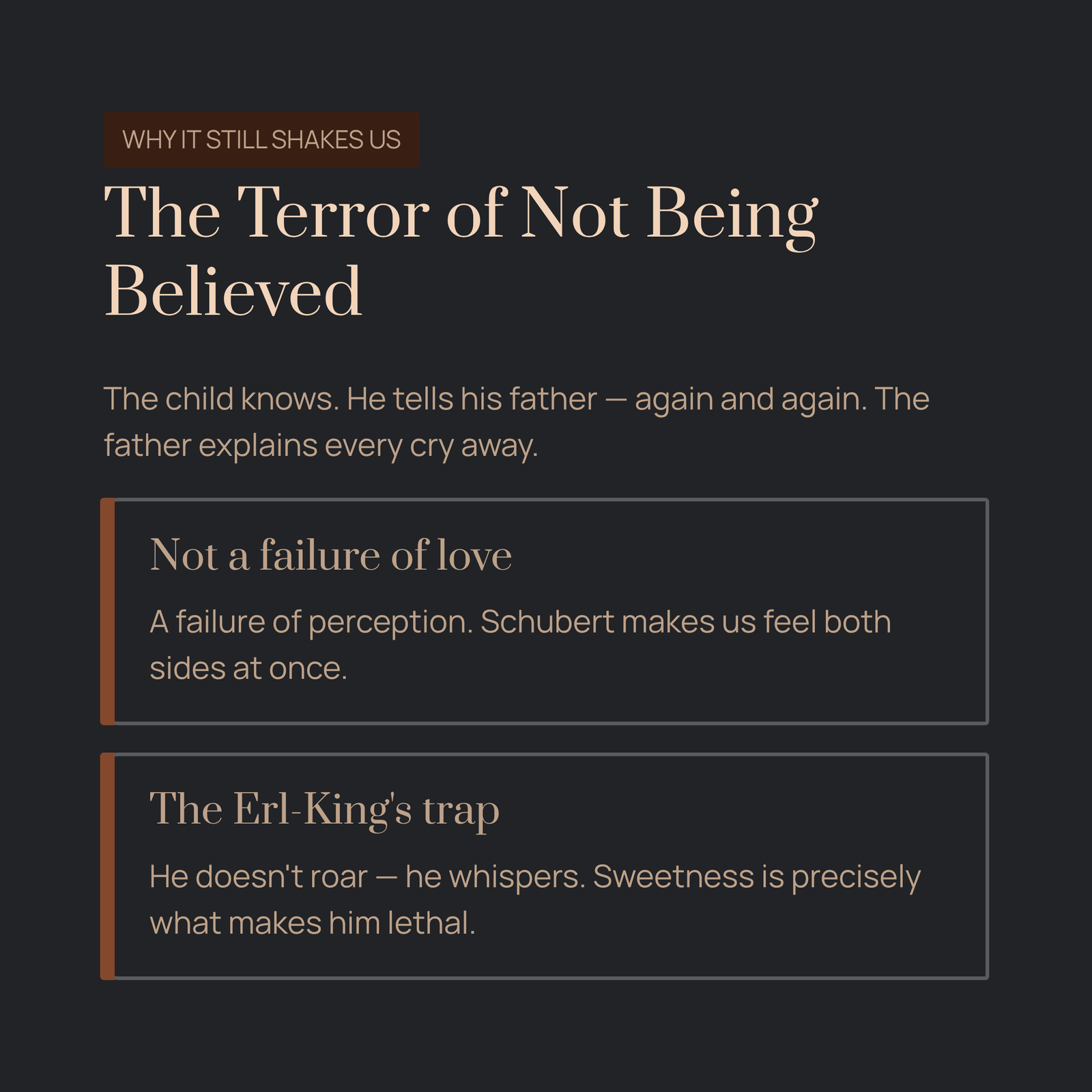
There is something about Erlkönig that reaches past musical appreciation into something more primal. I think it is the terror of not being believed. The child knows exactly what is happening to him. He tells his father, again and again. And the father, with all the love in the world, cannot hear what his son is hearing. He rationalizes every warning. He explains away every cry.
That gap — between what the child experiences and what the father is willing to accept — is one of the most painful things in all of music. It is not a failure of love. It is a failure of perception. And Schubert makes us feel both sides simultaneously: the father’s desperate hope and the child’s desperate truth, layered on top of each other with no way to reconcile them.
This is also why the Erl-King’s beautiful melodies are so disturbing. In a world where the father trusts only what he can see and explain, the real threat comes wrapped in sweetness. The Erl-King does not roar. He whispers. He promises games, flowers, golden robes. He sounds like everything a frightened child might want to hear — which is precisely what makes him lethal.
Every time I return to this piece, I hear it slightly differently. Some days I am drawn to the father’s impossible position. Other days the Erl-King’s seduction feels more central. The music holds all these readings at once, which is the mark of a work that will never finish revealing itself.
A Listening Guide: Three Ways to Experience Erlkönig
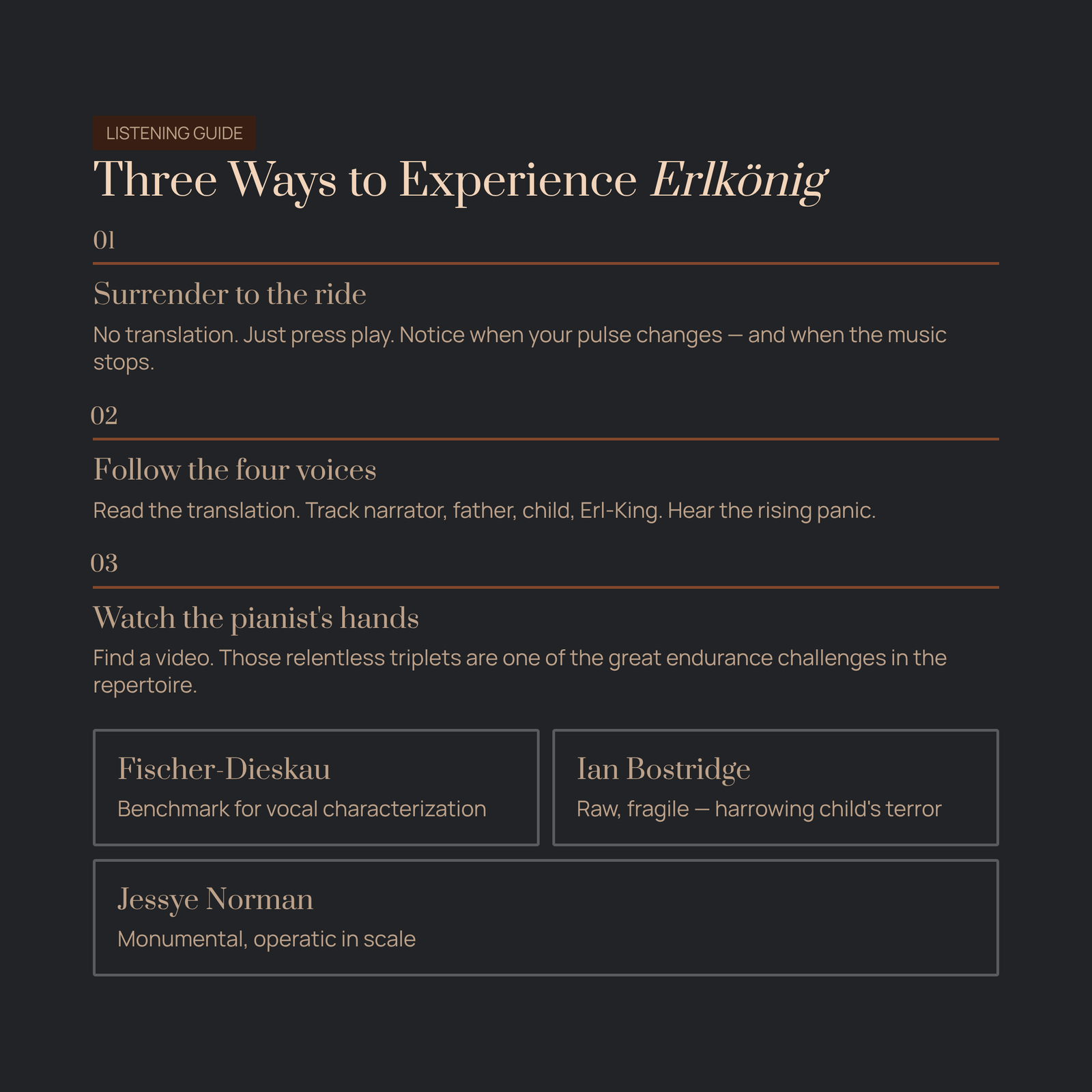
First listen — surrender to the ride. Do not read the text. Do not look up the translation. Just press play and let the galloping piano and the shifting vocal colors wash over you. Notice how your pulse changes. Notice the moment the music stops. That visceral, physical reaction is exactly what Schubert intended.
Second listen — follow the four voices. This time, read an English translation alongside the music. Track when the narrator, father, child, and Erl-King are singing. Listen for the rising pitch of the child’s cries. Listen for the sickly sweetness of the Erl-King’s major-key melodies. Notice how the father’s reassurances become less convincing as the song progresses.
Third listen — watch the pianist’s hands. Find a video performance and focus on the piano. Those relentless triplet octaves are one of the great endurance challenges in the vocal repertoire. Watching a pianist sustain that intensity while also shaping the dynamics and supporting the singer adds an entirely new dimension to the experience.
Recommended performances to start with:
Dietrich Fischer-Dieskau, the legendary German baritone, recorded Erlkönig multiple times throughout his career, and his performances remain a benchmark for vocal characterization — each of the four roles distinctly colored, with a dramatic intelligence that few have matched. His earlier recordings crackle with youthful intensity; his later ones carry a deeper gravity.
For a different vocal color, try Ian Bostridge’s interpretation. His tenor voice brings a raw, almost fragile quality to the child’s lines that can be genuinely harrowing. The thinner, brighter timbre makes the terror feel closer, more exposed.
Jesse Norman’s soprano version offers yet another perspective — monumental, operatic in scale, treating the piece almost as a one-woman music drama. It is a performance that reminds you how much interpretive range this single song can hold.
Among pianists, Gerald Moore’s partnership with Fischer-Dieskau set the gold standard for collaborative intensity, but more recently, pianists like Mitsuko Uchida have brought a chamber-music sensitivity to Schubert’s accompaniments that reveals details often lost in the storm.
The Silence After the Last Chord
There is a tradition among performers of pausing for a long moment after the final chords of Erlkönig before breaking character. The best performances honor this silence, letting the weight of what just happened settle over the room. No bow, no smile, no acknowledgment of applause — just stillness.
I think that silence tells us something important about what Schubert achieved. He was eighteen. He had not yet experienced the poverty, illness, and obscurity that would define much of his short life. And yet he understood, with a clarity that bordered on prophecy, that the most devastating stories are the ones that end not with a scream, but with a door quietly closing.
Erlkönig is not a comfortable piece. It does not soothe or uplift or provide the gentle beauty we often associate with classical music. What it offers instead is something rarer — the experience of being fully, inescapably present inside someone else’s nightmare. And in that presence, if we are willing, we find not just horror but recognition. The father who cannot hear. The child who cannot be saved. The voice in the dark that sounds so much like tenderness.
Two centuries later, the horse is still galloping. The child is still crying out. And we are still listening, because some truths never stop demanding to be heard.