📑 Table of Contents

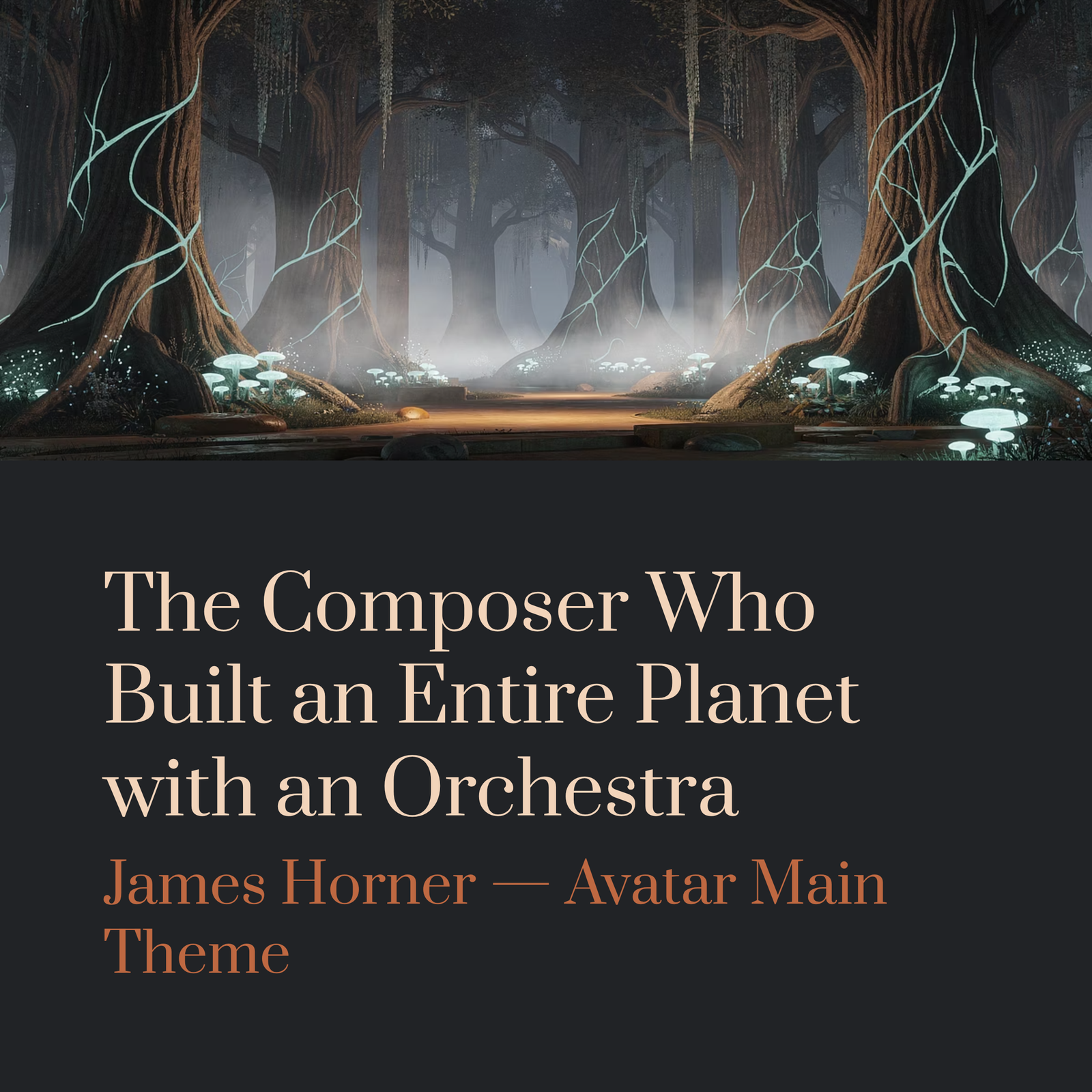
Close your eyes for a moment and imagine stepping into a forest that has never known a human footprint. The air hums with something ancient, something alive. Bioluminescent light pulses beneath your feet like the earth itself is breathing. That is exactly what James Horner’s Avatar main theme does — it doesn’t just accompany a movie; it builds a world from the ground up, note by note, breath by breath.
When I first heard this piece, I wasn’t watching a screen. I had my headphones on during a late-night walk, and within the first thirty seconds, the sidewalk beneath me had vanished. In its place was something vast and impossibly green. That is the strange, beautiful power of this music: it doesn’t ask you to imagine Pandora. It takes you there.
The Man Behind the Music: James Horner
James Horner was one of Hollywood’s most gifted and prolific composers, responsible for some of the most emotionally devastating scores in film history. Born in Los Angeles in 1953, Horner studied at the Royal College of Music in London before earning his doctorate at UCLA. His career spanned over three decades and more than one hundred films, including Titanic, Braveheart, A Beautiful Mind, and Apollo 13.
What set Horner apart was not just technical brilliance — it was his almost uncanny ability to locate the emotional heartbeat of a story and translate it into sound. He wasn’t interested in showing off. He was interested in making you feel something you couldn’t quite name. His scores often carried a sense of yearning, a melancholy beauty that lingered long after the credits rolled.
Tragically, Horner passed away in a plane crash in 2015 at the age of sixty-one. The Avatar score, released in 2009, stands as one of his crowning achievements — a work that pushed the boundaries of what a film soundtrack could do.
Why This Theme Sounds Like Nothing Else
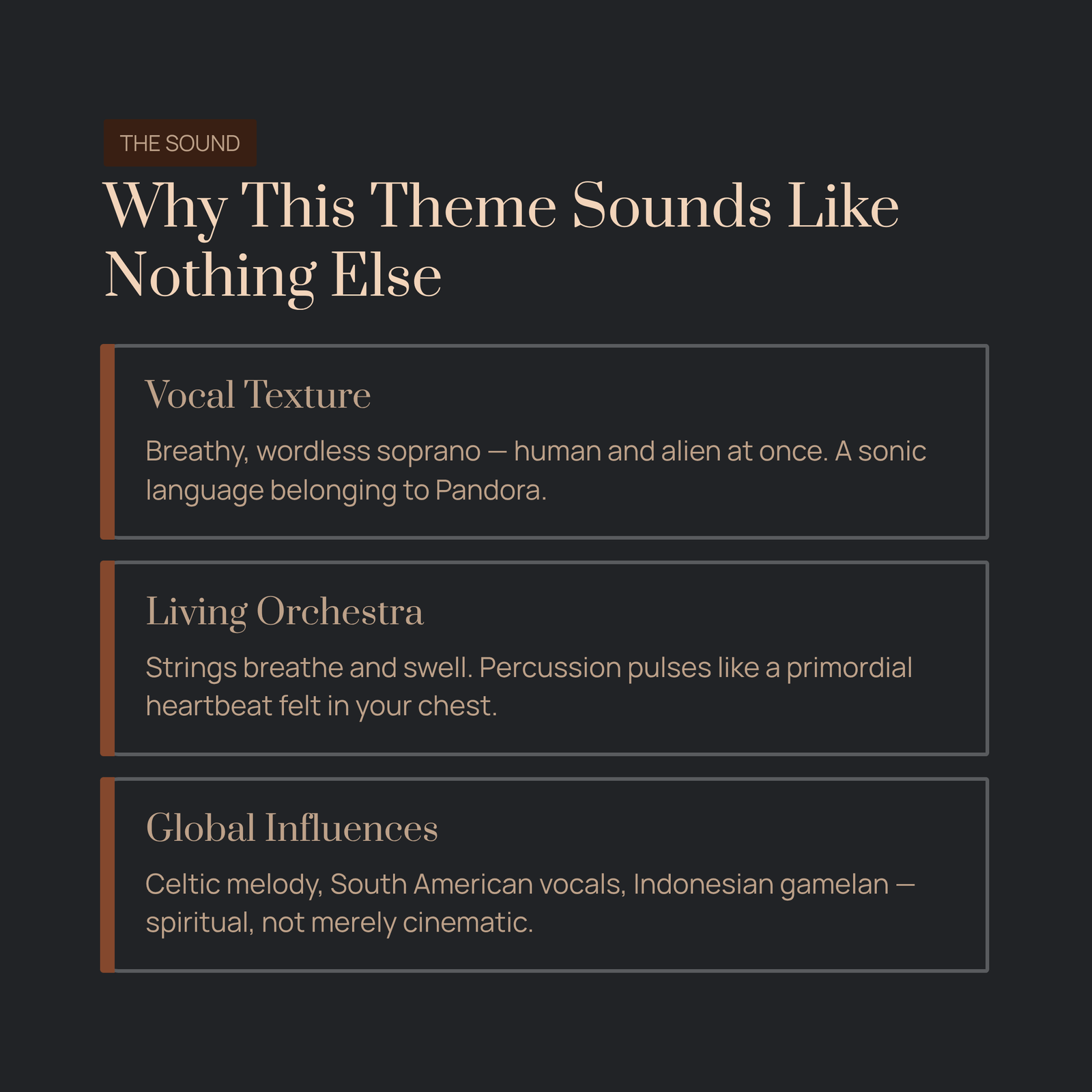
The Avatar main theme opens with a gentle, almost tentative string melody that floats upward like mist rising from a jungle canopy. Within moments, Horner introduces something unexpected: an ethereal vocal line, performed with a breathy, wordless quality that feels both human and alien at the same time. This was no accident. Horner collaborated with singer Leona Lewis and employed ethnic vocal textures to create a sonic language that belonged not to Earth, but to Pandora.
What makes this score so distinctive is the way Horner layers his orchestra. The strings don’t simply play harmony — they breathe and swell like a living organism. Woodwinds dart through the texture like the winged creatures of the film. Percussion arrives not as rhythm but as a kind of primordial pulse, something you feel in your chest rather than count with your mind.
And then there is the chorus. When the full choir enters, it doesn’t feel like an arrangement. It feels like a ceremony, like something sacred is being invoked. Horner understood that the world of Avatar needed music that felt spiritual, not merely cinematic. He drew from traditions far beyond the Western classical canon — hints of Celtic melody, South American vocal inflections, and Indonesian gamelan textures all weave through the fabric of this score.
How to Listen: Three Doors into Pandora
If you are coming to this piece for the first time, I want to suggest three different ways to experience it, each revealing a different dimension of the music.
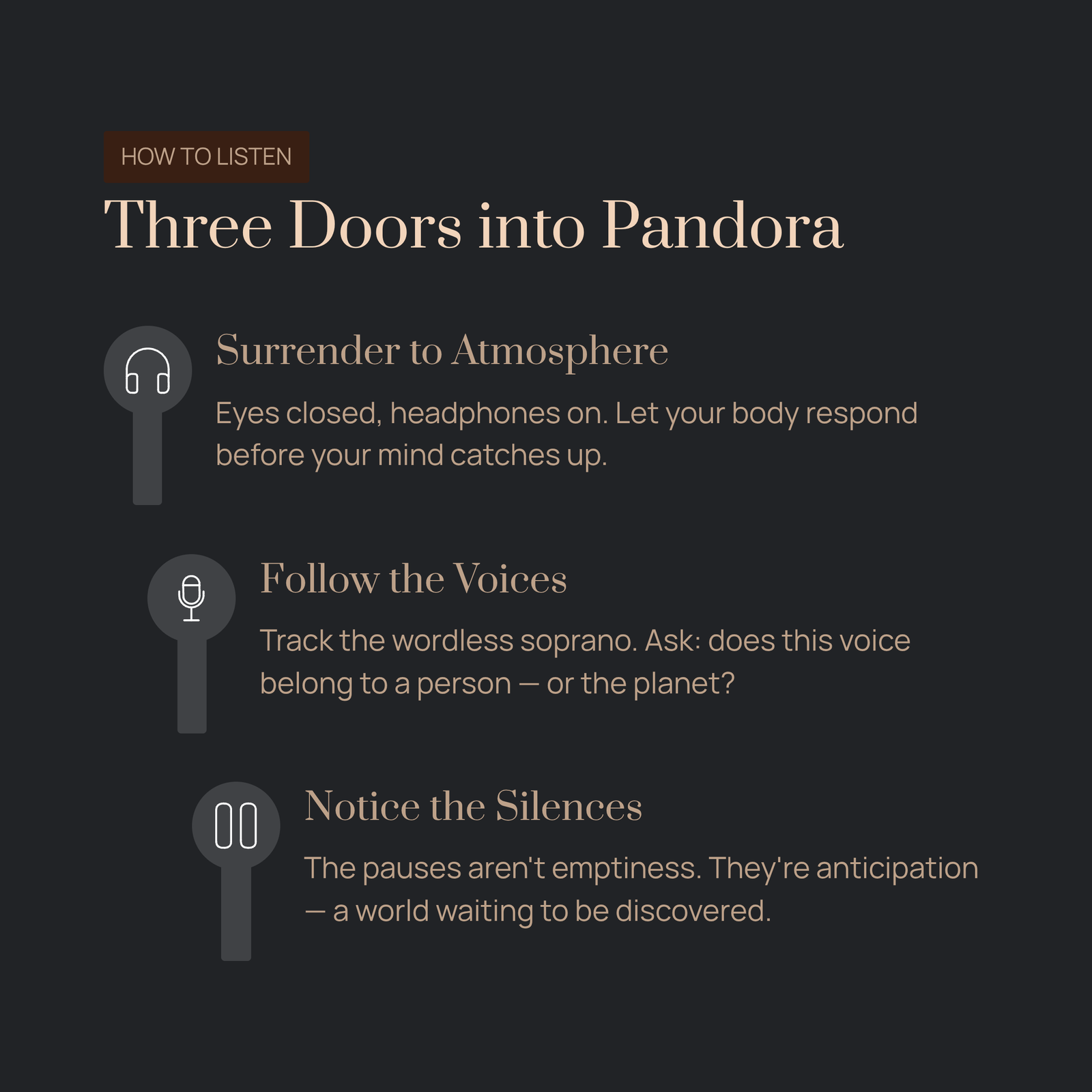
First listen — surrender to atmosphere. Don’t analyze anything. Put on headphones, close your eyes, and simply let the music wash over you. Pay attention to how your breathing changes. Notice when you feel a chill run through you, or when your shoulders drop and relax. This music was designed to work on a physiological level, and your body will respond before your mind catches up.
Second listen — follow the voices. On your next listen, track the vocal elements specifically. Notice how the wordless soprano enters and exits, how it weaves between the orchestral lines like a thread of light through a dark forest. Ask yourself: does this voice belong to a person, or to the planet itself? Horner deliberately blurred that line, and the ambiguity is part of the magic.
Third listen — notice the silences. This is the listening strategy that changed the piece for me entirely. Horner was a master of negative space. Between the grand orchestral swells, there are these tiny, fragile pauses — moments where the music holds its breath. These silences are not emptiness. They are anticipation. They are the sound of a world waiting to be discovered.
Recommended Recordings and Versions
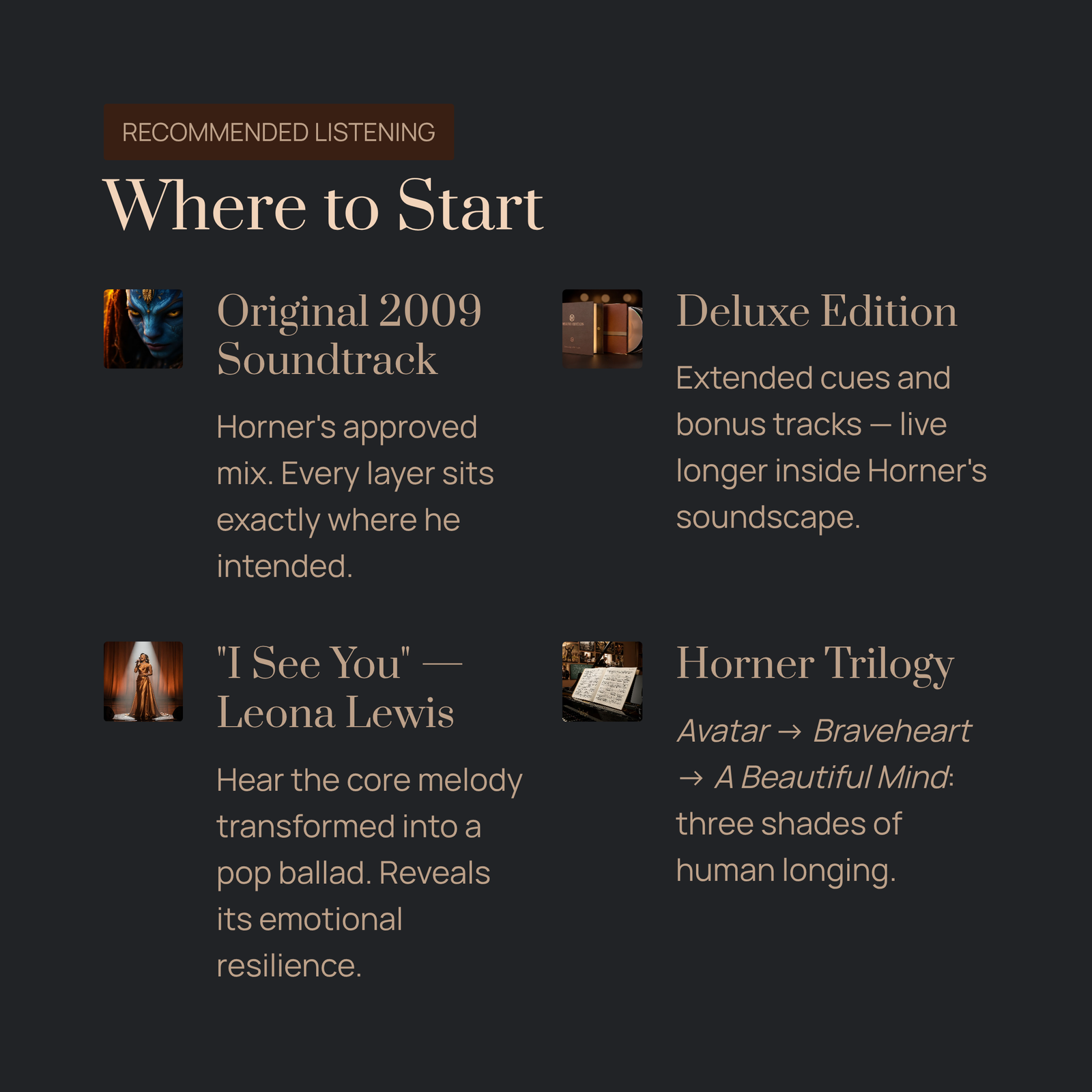
The definitive version of the Avatar score is the original 2009 soundtrack album, available on most major streaming platforms. This is James Horner’s own approved mix, and the sound design is meticulous — every layer sits exactly where he intended.
For a more immersive experience, seek out the Avatar: Music from the Motion Picture (Deluxe Edition), which includes additional cues and extended versions of several tracks. The expanded runtime allows you to live inside Horner’s soundscape for longer, and some of the bonus tracks reveal textures that the standard album trims.
If you enjoy the vocal dimension of this score, Leona Lewis’s performance of “I See You (Theme from Avatar)” is worth a dedicated listen. It transforms Horner’s orchestral theme into a pop ballad format, and while the two versions are very different beasts, hearing them side by side illuminates how flexible and emotionally resilient the core melody truly is.
For those interested in Horner’s broader work, I would recommend moving from Avatar to the Braveheart score and then to A Beautiful Mind. These three together form an unofficial trilogy of Horner’s most transcendent writing — each one exploring a different shade of human longing.
More Than a Soundtrack
There is a particular kind of music that doesn’t just accompany an experience — it becomes the experience itself. James Horner’s Avatar main theme belongs to that rare category. It is not background music. It is not even foreground music. It is the air you breathe inside a world that exists only in sound.
What I find most remarkable about this piece, years after first hearing it, is its generosity. Horner gave this music everything — every ounce of craft, every shade of emotion, every textural nuance he had spent a lifetime learning to summon. And he asked for nothing in return except that you listen.
So listen. Not to understand. Not to critique. Just to be somewhere else for a little while — somewhere ancient and luminous, where the music itself is alive, and where it knows your name even if you have never been there before.