📑 Table of Contents
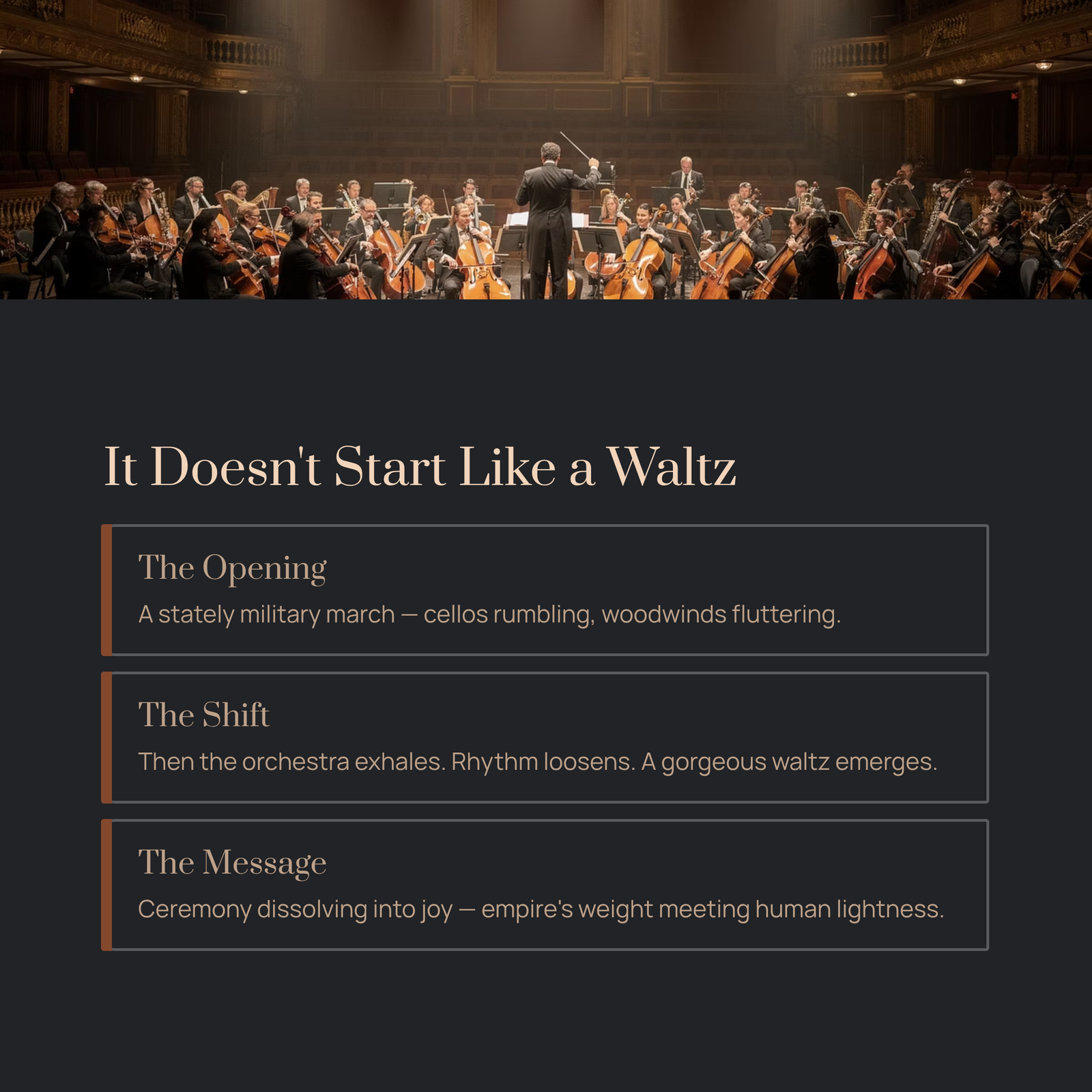
Here’s something that catches everyone off guard the first time they hear the Emperor Waltz: it doesn’t start like a waltz at all.
Instead, you get a stately march — deliberate, almost military in its bearing. Cellos rumble low, woodwinds flutter overhead, and for a solid minute you might wonder if you’ve accidentally played the wrong piece. Then, as if the entire orchestra collectively decides to exhale, the rhythm loosens. The tempo shifts. And suddenly you’re swept into one of the most gorgeous waltzes ever written, a melody so effortlessly graceful it practically pulls you to your feet.
That opening gambit — the march dissolving into the waltz — isn’t just a clever musical trick. It tells you everything you need to know about what Johann Strauss II was trying to capture: the tension between ceremony and joy, between the weight of empire and the lightness of the human spirit.
The Waltz King Writes for Two Empires
Johann Strauss II didn’t earn the nickname “The Waltz King” by accident. By the time he composed the Emperor Waltz in 1889, he had already written hundreds of waltzes, polkas, and operettas that made him the most famous composer in Vienna — and arguably the most popular musician in all of Europe. His “Blue Danube” had already conquered the world. But the Emperor Waltz was different. This one had a diplomatic mission.
In 1889, the political alliance between Austria-Hungary and the German Empire was a matter of serious concern across Europe. Emperor Franz Joseph I of Austria and Kaiser Wilhelm II of Germany were forging closer ties, and Strauss composed this waltz to celebrate their meeting. The original title was actually “Hand in Hand” — a nod to the political handshake between the two empires. It was later renamed “Kaiserwalzer” (Emperor Waltz), a title that elevated it from mere occasion piece to something timeless.
But here’s what makes Strauss a genius: he took a politically motivated commission and turned it into pure music. You don’t need to know a single thing about Austro-German politics to feel the warmth and grandeur of this waltz. The politics gave him the occasion; what he created transcended it entirely.
Inside the Music: Five Waltzes Woven Into One
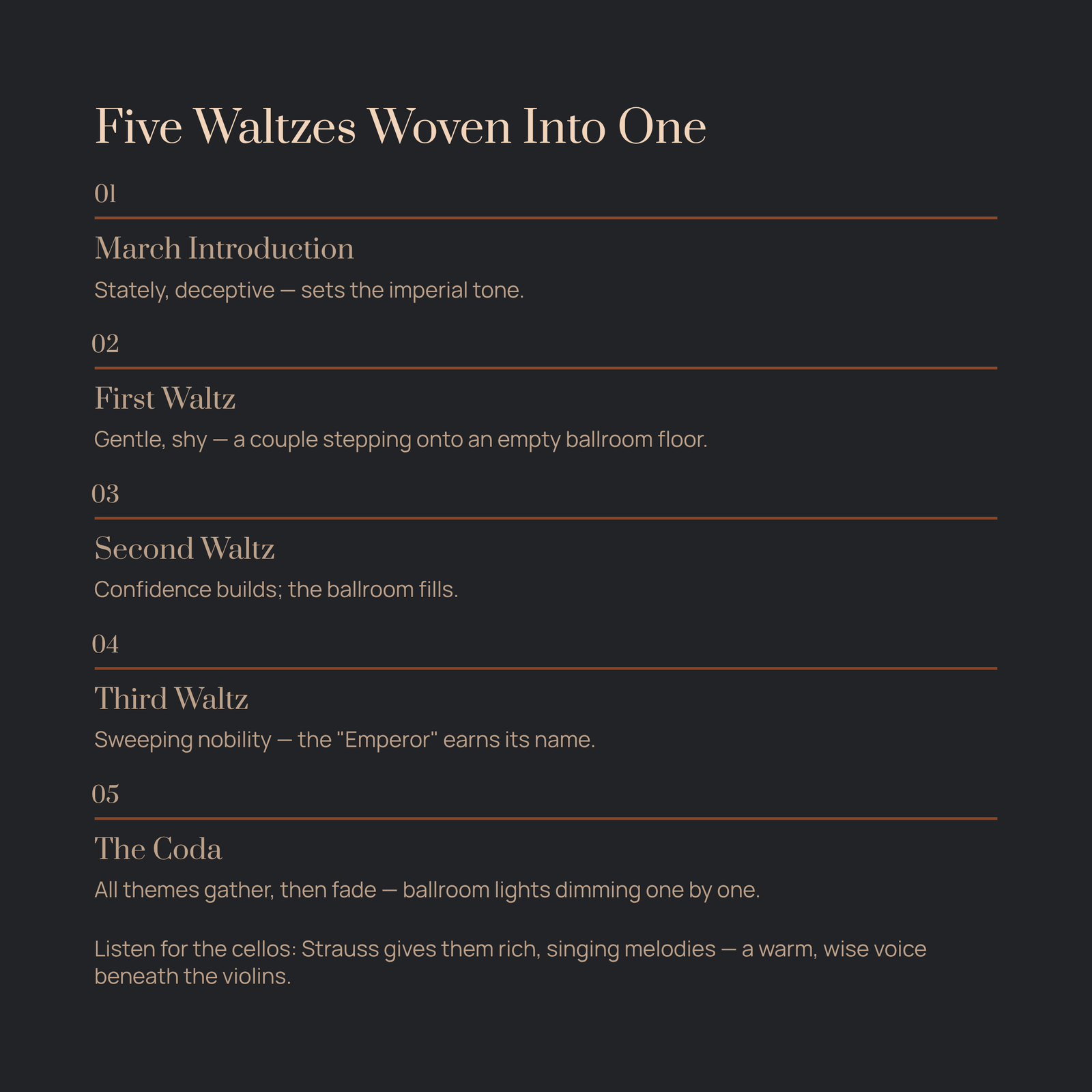
The Emperor Waltz follows the traditional Viennese waltz structure — a series of individual waltz sections strung together — but Strauss handles the form with an architectural sophistication that lifts it far above a simple dance piece.
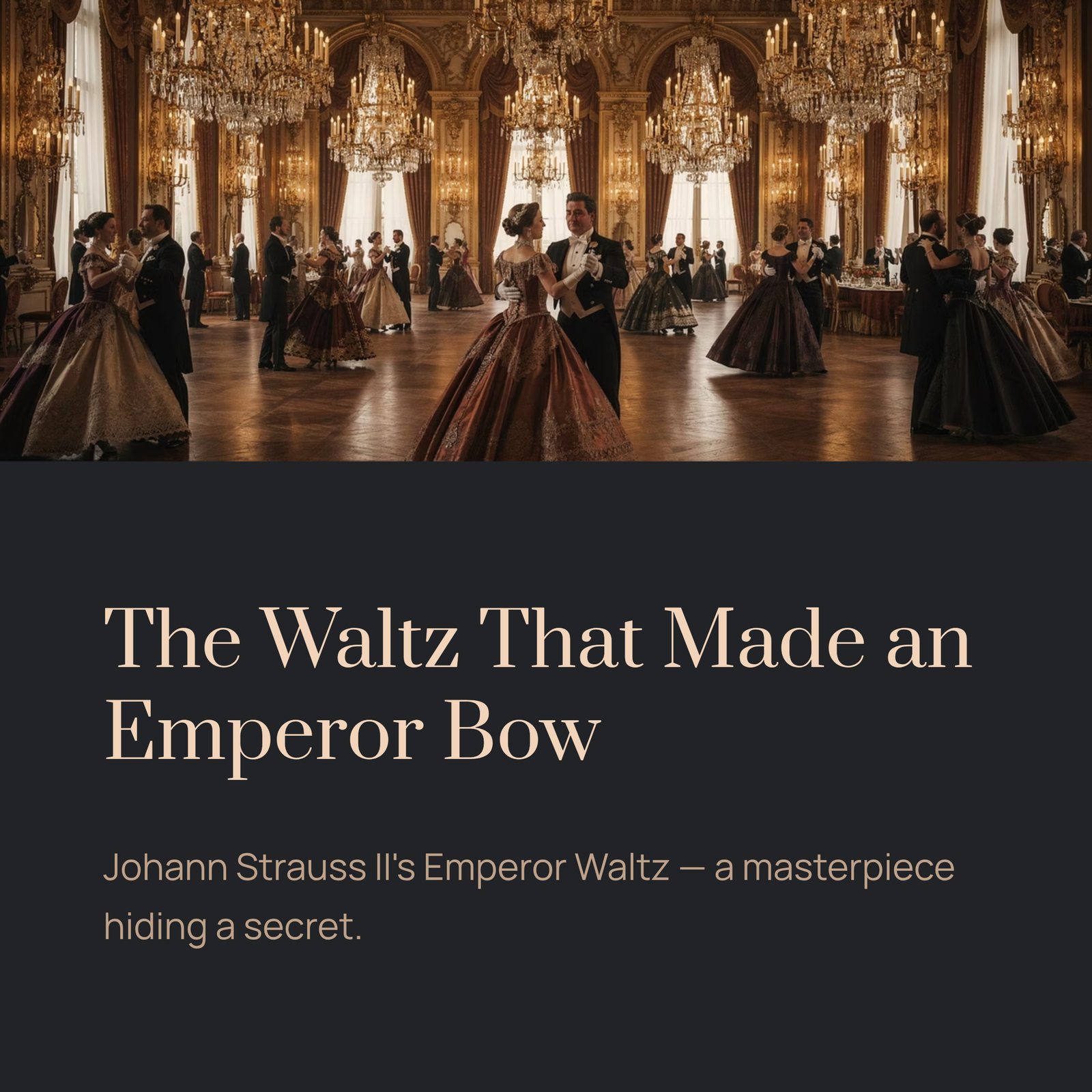
After that deceptive march introduction, the first waltz theme enters with a gentle, almost shy quality. Picture a couple stepping onto a ballroom floor before anyone else, still a little self-conscious. The strings carry a melody that’s tender, intimate, not yet ready for the grand stage.
Then the second waltz arrives, and the confidence builds. The melody broadens, the orchestration thickens, and you can feel the ballroom filling up. By the third waltz, Strauss introduces a theme of such sweeping nobility — a long, arching melody in the strings — that it feels less like a dance and more like a declaration. This is the heart of the piece, the moment where the “Emperor” in the title truly earns its name.
Pay special attention to how Strauss uses the cello throughout. In most dance music, the cello simply keeps rhythm. Here, Strauss gives it rich, singing melodies that add an unexpected emotional depth. It’s like hearing a wise, warm voice speaking underneath all the glitter of the violins.
The waltz sections continue to build and interweave, each one offering a new shade of feeling — playfulness, nostalgia, triumph — before a magnificent coda gathers all the themes together. And then, in a stroke of brilliance, the piece doesn’t end with a thunderous finale. Instead, the music gradually slows, softens, and fades away — as if the ballroom lights are dimming one by one, and the last dancers are reluctantly heading home.
Why This Waltz Feels Like a Novel
I think what sets the Emperor Waltz apart from so many other dance pieces is its emotional arc. It doesn’t just make you want to dance; it makes you feel something shifting inside you as it unfolds. There’s a bittersweet quality hiding beneath all that elegance, a sense that the world this music celebrates — the world of glittering ballrooms and imperial grandeur — is already beginning to fade even as the orchestra plays.
And historically, that intuition was correct. The Habsburg Empire that Strauss’s waltz honored would collapse just three decades later. Listening now, knowing what came after, the Emperor Waltz takes on an almost elegiac quality. It becomes a portrait of a civilization at its most beautiful and most fragile.
But you don’t need history to feel this. Just close your eyes during that final coda and notice how the music seems to hold two emotions at once — celebration and farewell, joy and the quiet ache of something ending. That’s the mark of a composer who understood human feeling at a level that went far beyond writing catchy tunes.
How to Listen: A Practical Guide
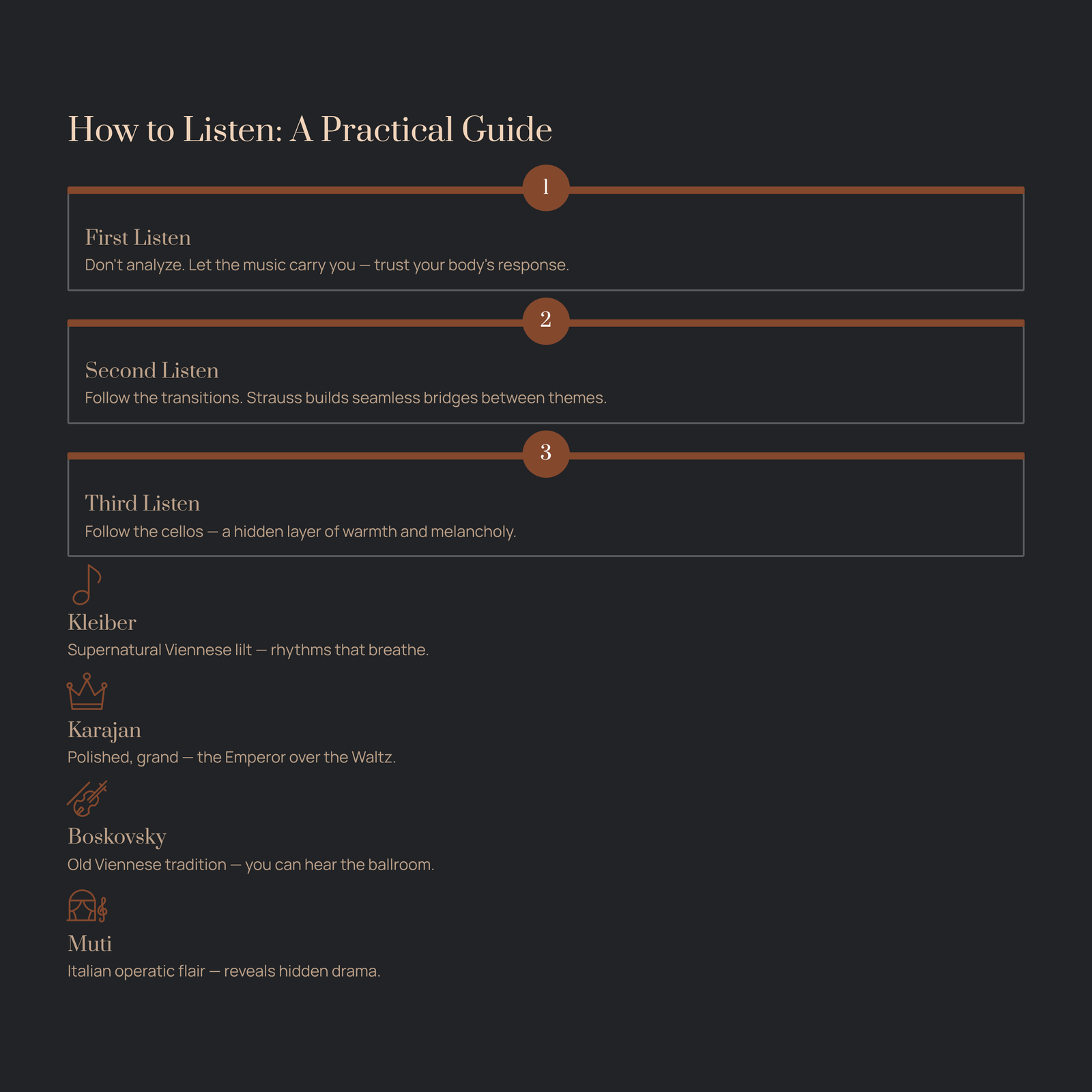
If you’re hearing the Emperor Waltz for the first time, here’s a simple roadmap.
On your first listen, don’t analyze anything. Just let the music carry you. Notice how your body responds — the march will make you sit up straight, and the waltzes will make you want to sway. Trust those physical instincts; they’re the fastest way into this music.
On your second listen, pay attention to the transitions. Strauss was a master of the seamless shift, and the way each waltz section flows into the next is where much of the magic lives. Notice how he never jolts you from one theme to another but instead builds little musical bridges that feel as natural as conversation.
On your third listen, follow the cellos. Once you tune into that lower voice beneath the violins, you’ll hear a whole hidden layer of warmth and melancholy that completely changes the experience.
For recordings, I’d point you toward a few distinct interpretations. Carlos Kleiber’s reading with the Vienna Philharmonic captures the Viennese lilt with an almost supernatural ease — the rhythms breathe in a way that feels completely organic. Herbert von Karajan’s version is more polished and grand, emphasizing the “Emperor” over the “Waltz.” For a historical perspective, Willi Boskovsky’s recordings are delightful; he conducted in the old Viennese tradition, violin in hand, and you can hear the ballroom in every phrase. And if you want something unexpected, try Riccardo Muti’s interpretation — he brings an Italian operatic flair that reveals dramatic qualities you might not have noticed before.
The Last Dance
There’s a reason the Emperor Waltz remains one of the most performed orchestral pieces in the world, well over a century after it was written. It isn’t because it’s easy to enjoy — though it is. It isn’t because it’s technically brilliant — though it is that too. It endures because it captures something true about the human experience: the way our happiest moments always carry within them the seed of their own passing.
Every New Year’s Day, when the Vienna Philharmonic performs their famous concert broadcast to millions around the world, the music of Johann Strauss II fills living rooms across every continent. The Emperor Waltz is a staple of that tradition. And every year, it reminds us that a waltz is never just a waltz. In the right hands, three-quarter time can hold the weight of empires, the warmth of a crowded ballroom, and the quiet sadness of knowing that the music, beautiful as it is, will eventually stop.
But not yet. For now, the orchestra is still playing. Pull up a chair, or better yet, find a partner. The Emperor is waiting.