📑 Table of Contents
- The Composer Who Emerged from Silence
- A Message from Hell: The Text of the Second Movement
- The Architecture of Grief: How the Music Unfolds
- The Unexpected Phenomenon: When Grief Went Mainstream
- How to Listen: Three Approaches to This Sacred Space
- Recommended Recordings: Voices in the Darkness
- What This Music Teaches Us
There are certain pieces of music that do not simply accompany grief—they hold it. They sit with you in the dark, asking nothing, offering no false comfort. Henryk Górecki’s Symphony No. 3, particularly its devastating second movement marked Lento e largo – Tranquillissimo, is such a work. It does not try to explain suffering. It simply acknowledges that suffering exists, and that somehow, impossibly, we continue.
The first time I heard this movement, I did not cry. I could not. The music seemed to freeze something inside me, suspending time itself. Only later, hours after the final note had faded, did I realize I had been holding my breath. This is music that reaches the places words cannot touch.

The Composer Who Emerged from Silence
Henryk Mikołaj Górecki was born in 1933 in Czernica, a small industrial town in southern Poland. His early life was marked by hardship—he lost his mother when he was just two years old, and childhood illness left him with permanent damage to his hip. Perhaps these early encounters with loss planted the seeds for the profound empathy that would later define his music.
In his youth, Górecki was a musical radical. During the 1960s, he composed aggressive, dissonant works that placed him at the forefront of the Polish avant-garde. But something shifted within him. By the mid-1970s, he had turned away from complexity toward a musical language of extreme simplicity—long, sustained tones, slow-moving harmonies, and an almost unbearable emotional directness. Critics called this style “sacred minimalism.” Górecki himself rarely explained his transformation. The music, he seemed to suggest, should speak for itself.
The Symphony No. 3, completed in 1976, emerged from this period of profound artistic change. Subtitled Symfonia pieśni żałosnych—the Symphony of Sorrowful Songs—it consists of three movements, each setting a different Polish text about maternal grief and separation. The work was largely ignored upon its premiere. It would take sixteen years for the world to discover what Górecki had created.
A Message from Hell: The Text of the Second Movement
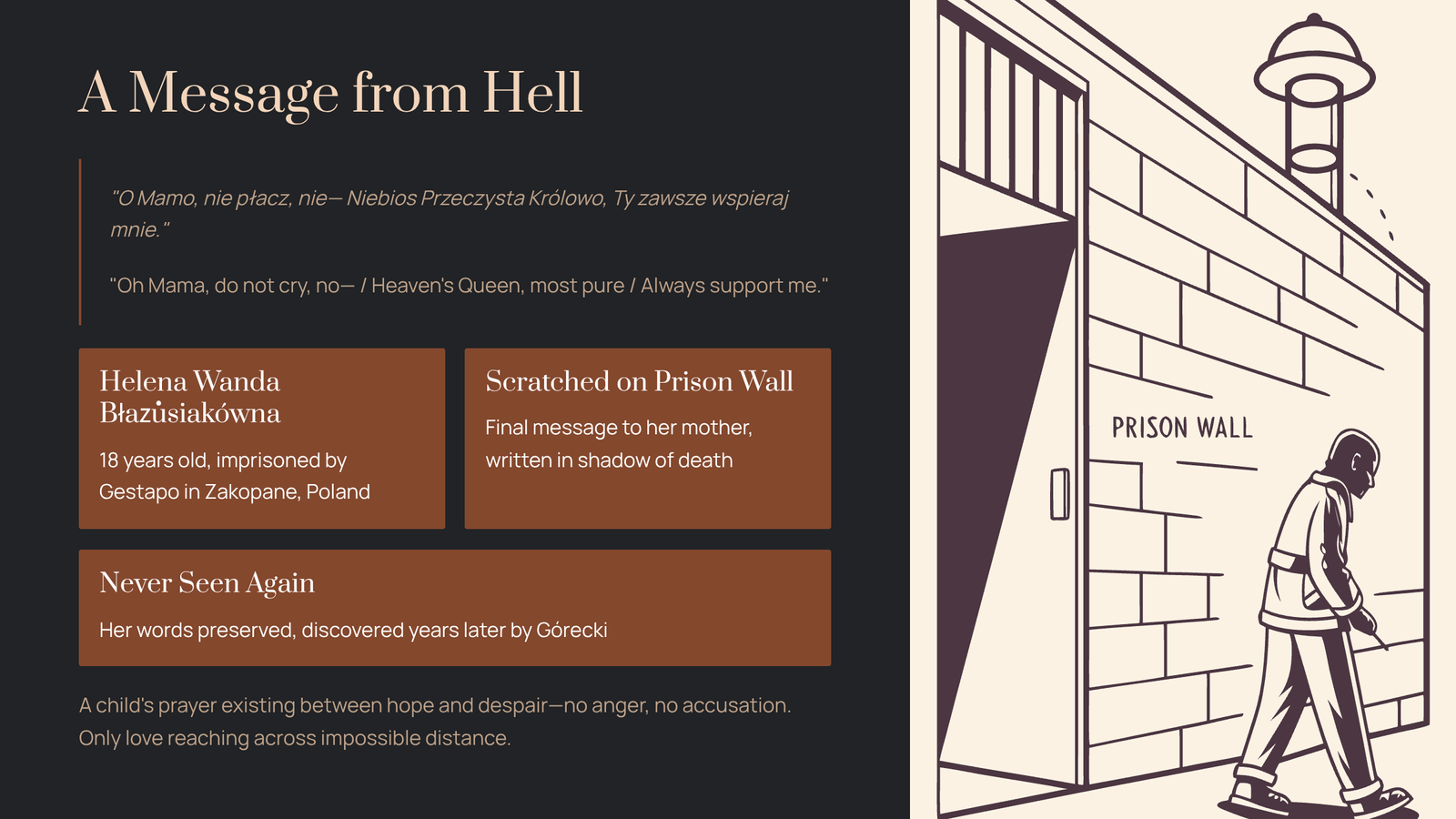
The second movement’s text is not the work of a poet. It was written by an eighteen-year-old girl named Helena Wanda Błażusiakówna, imprisoned by the Gestapo in the basement of their headquarters in Zakopane, Poland. She scratched these words into the wall of her cell:
“O Mamo, nie płacz, nie—
Niebios Przeczysta Królowo,
Ty zawsze wspieraj mnie.”
In English: “Oh Mama, do not cry, no— / Heaven’s Queen, most pure / Always support me.”
She was never seen again.
When Górecki discovered this inscription years later, preserved in a collection of wartime graffiti, he knew he had found something that demanded to be heard. Here was not a grand statement about war or ideology, but something far more devastating: a child’s final message to her mother, written in the shadow of death, asking only for strength and invoking both earthly and divine motherhood in the same breath.
The prayer exists in that liminal space between hope and despair. Helena does not ask to be saved. She asks only for the courage to endure what cannot be escaped. There is no anger, no accusation—only love reaching across an impossible distance.
The Architecture of Grief: How the Music Unfolds
The second movement begins with a single note in the strings—a low, sustained tone that seems to emerge from nothingness. For several measures, nothing else happens. The music simply breathes, establishing a tempo so slow it approaches stillness. Górecki marks the tempo Lento e largo (slow and broad), and adds the instruction Tranquillissimo—as peacefully as possible.
Then the soprano enters, and everything changes.
The vocal line rises and falls in gentle arcs, each phrase built from the simplest melodic fragments. There are no dramatic leaps, no virtuosic displays. The melody moves by steps, like a person walking slowly through fog, feeling their way forward. Underneath, the strings create a bed of sound that shifts almost imperceptibly, the harmonies changing so gradually that you cannot identify the moment of transition.
What makes this movement so devastating is its refusal to manipulate. There are no crescendos building to cathartic climaxes, no sudden shifts to minor keys to signal tragedy. The music maintains the same gentle dynamic throughout, the same unhurried pace. It trusts the weight of the words and the purity of the melody to carry the emotional truth. And somehow, this restraint makes the impact more powerful than any dramatic gesture could achieve.
The movement lasts approximately ten minutes, though time seems to lose meaning within it. The prayer is sung three times, each repetition slightly varied, each iteration allowing the words to sink deeper into consciousness. By the final statement, the soprano’s voice has become something more than human—a vessel for all the unnamed mothers and daughters separated by violence, all the prayers whispered into darkness.

The Unexpected Phenomenon: When Grief Went Mainstream
For sixteen years after its premiere, the Symphony of Sorrowful Songs remained an obscurity, performed occasionally but rarely recorded. Then, in 1992, a recording by soprano Dawn Upshaw and conductor David Zinman was released on the Nonesuch label. What happened next defied all expectations.
The album climbed to number six on the Billboard classical charts. In the United Kingdom, it reached number one on the pop charts—the first classical work to achieve this in decades. Radio stations played the second movement during late-night programming. Listeners who had never attended a symphony concert bought the CD in shopping malls. By 1993, it had sold over a million copies worldwide.
Why did this austere, slow, deeply religious work resonate with such a massive audience? Perhaps because it arrived at a moment when the world needed it. The early 1990s were a time of profound cultural dislocation—the Cold War had ended, old certainties had collapsed, and people were searching for something that spoke to the deeper currents of human experience. Górecki’s symphony offered no easy answers, but it offered presence. It offered the radical proposition that beauty can exist alongside suffering, that grief can be held without being fixed.

How to Listen: Three Approaches to This Sacred Space
Approaching this movement for the first time can be challenging. The extreme slowness, the lack of obvious musical events, can initially feel like an absence rather than a presence. Here are three ways to open yourself to what Górecki has created.
The First Way: Surrender to Duration. Before you press play, make a commitment: you will not skip ahead, you will not check the time remaining, you will not do anything else. Create a space of intentional stillness. Lie down if possible. Close your eyes. Let the music establish its own sense of time. The slowness is not a test of patience—it is the message. Only by inhabiting this expanded temporal space can you experience what the music offers.
The Second Way: Follow the Voice. Let the soprano be your guide through the darkness. Notice how each phrase rises and falls like breath. Pay attention to the moments of silence between phrases—these are not emptiness but pregnant pauses, spaces where the words continue to resonate. The voice is both Helena in her cell and every mother who has ever waited for news that will not come. Let it lead you into the depths of that universal experience.
The Third Way: Listen to the Spaces Between. Much of this movement’s power lies in what is not played. The long-held string tones create a field of sound, but within that field are subtle fluctuations, slight shifts in color and intensity. Listen for the moments when one harmony dissolves into another, so gradually that the transition seems impossible to locate. This is music that teaches you to hear differently, to find meaning in nuance rather than event.
Recommended Recordings: Voices in the Darkness
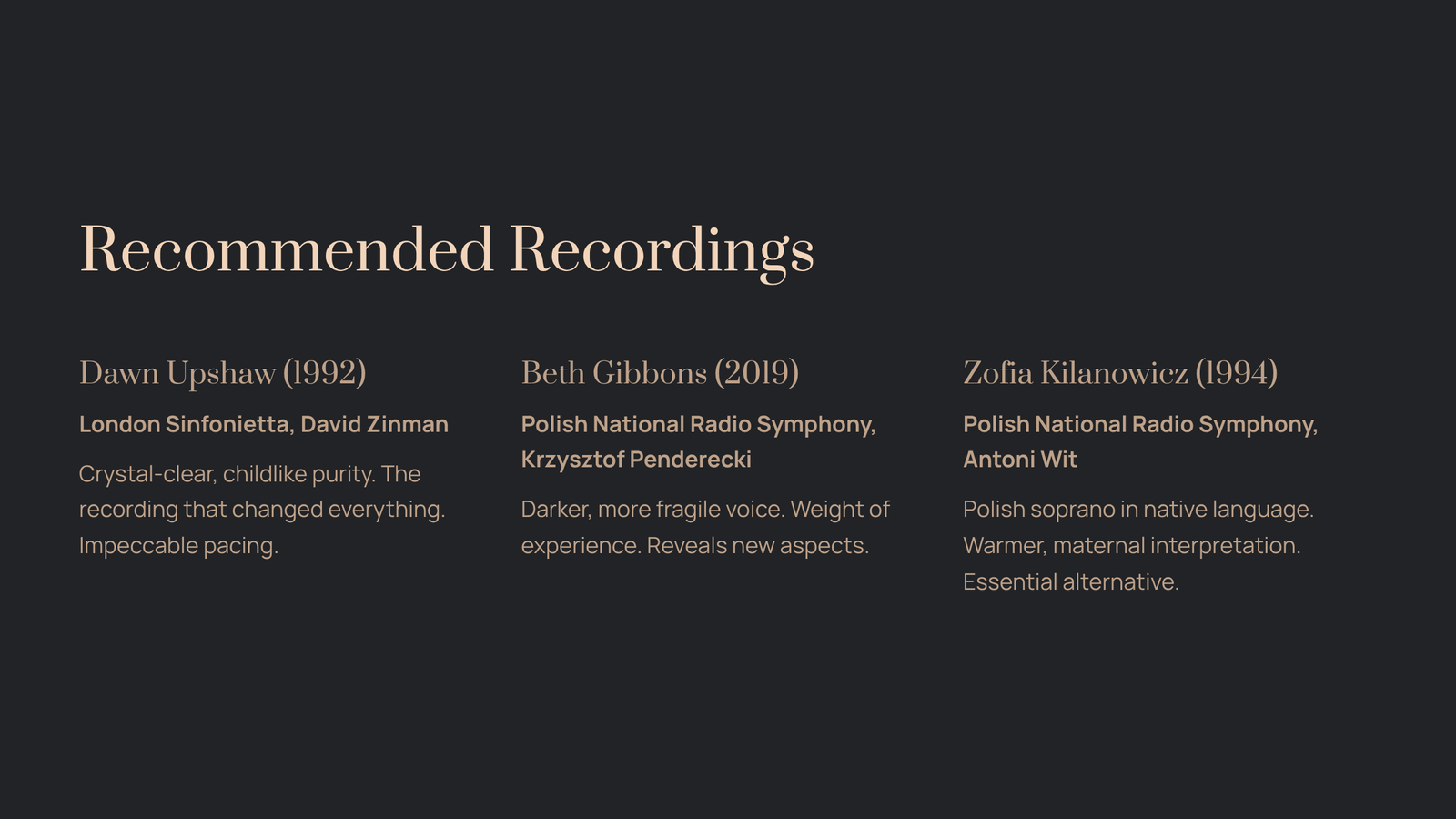
Dawn Upshaw with the London Sinfonietta, conducted by David Zinman (Nonesuch, 1992)
This is the recording that changed everything. Upshaw’s voice is crystal-clear, almost childlike in its purity, which makes the weight of the text even more devastating. Zinman’s pacing is impeccable—slow enough to feel suspended in time, but with enough forward motion to maintain coherence. If you listen to only one recording, let it be this one.
Beth Gibbons with the Polish National Radio Symphony Orchestra, conducted by Krzysztof Penderecki (Domino, 2019)
The Portishead vocalist’s interpretation brought Górecki to a new generation. Her voice is darker, more fragile, carrying the weight of experience rather than innocence. Penderecki, himself a Polish composer and friend of Górecki, conducts with deep understanding of the work’s spiritual dimensions. This recording reveals new aspects of a work you thought you knew.
Zofia Kilanowicz with the Polish National Radio Symphony Orchestra, conducted by Antoni Wit (Naxos, 1994)
A Polish soprano singing in her native language brings an authenticity that no translation can replicate. Kilanowicz’s interpretation is warmer, more maternal, emphasizing the prayer’s aspect of comfort rather than desperation. An essential alternative perspective.
What This Music Teaches Us
I return to this movement in moments when language fails. When someone I love is suffering and I cannot help. When the news brings stories of children separated from parents, of wars that seem to have no end. The music does not make these things easier. It does not offer resolution or redemption. But it offers something perhaps more valuable: the knowledge that others have stood in this same darkness and found a way to transform it into beauty.
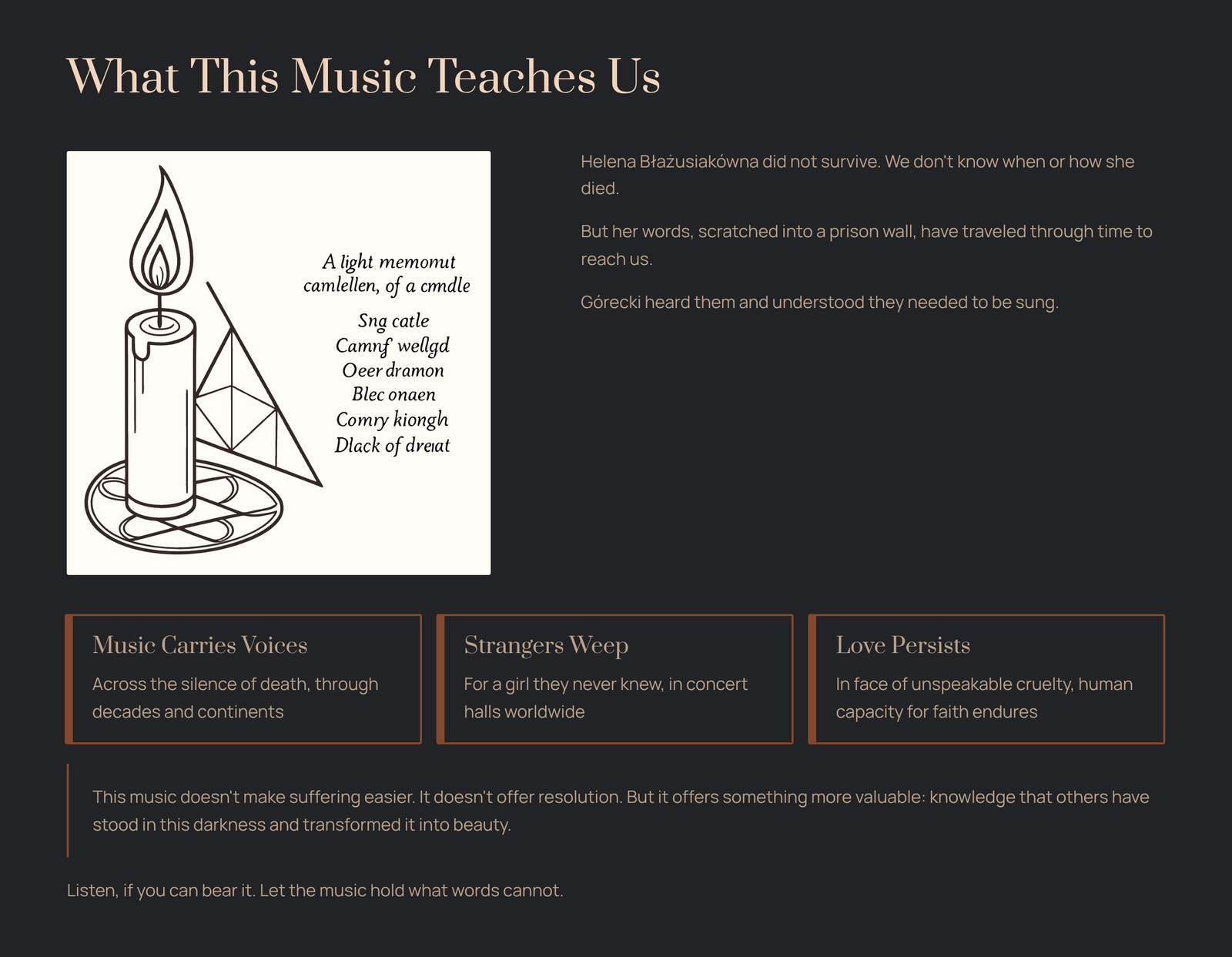
Helena Błażusiakówna did not survive her imprisonment. We do not know exactly when or how she died. But her words, scratched into a prison wall in a moment of ultimate extremity, have traveled through time to reach us. Górecki heard them and understood that they needed to be sung. And now, nearly fifty years after he composed this symphony, her prayer continues to be heard in concert halls around the world.
This is what music can do at its highest. It can carry voices across the silence of death. It can make strangers weep for a girl they never knew. It can remind us that in the face of unspeakable cruelty, the human capacity for love and faith persists.
Listen, if you can bear it. Let the music hold what words cannot.
#Górecki #SymphonyNo3 #SymphonyOfSorrowfulSongs #ClassicalMusicForHealing #MinimalistClassical #PolishComposer #MeditationMusic #GriefAndMusic #DawnUpshaw #SacredMinimalism #20thCenturyClassical #HolocaustRemembrance #ClassicalMusicBlog #DeepListening #HealingThroughMusic