📑 Table of Contents
There is a particular kind of sadness that has no name in English. It is not grief for something you have lost. It is grief for something you are still holding — but can already feel slipping. Hans Zimmer put that feeling into eight minutes of music, gave it to a Christopher Nolan film about dreams, and accidentally wrote one of the most emotionally precise compositions of the 21st century.
This is Time.
Who Is Hans Zimmer, and Why Should Classical Music Lovers Care?
If you have spent most of your listening life in the world of Beethoven, Debussy, or Chopin, Hans Zimmer might seem like a different universe entirely — a Hollywood composer who works with synthesizers and blockbuster budgets rather than concert halls and manuscript paper.
But here is the honest truth: Zimmer deserves a seat at the table.
Born in Frankfurt, Germany in 1957, Zimmer grew up absorbing two worlds simultaneously — the European classical tradition and the emerging electronic music scene of the 1970s. He was largely self-taught, a fact that allowed him to break rules he had never memorized in the first place. He moved to London, then to Los Angeles, and built a composing career defined by one radical belief: film music does not have to be background decoration. It can be architecture. It can carry the entire emotional weight of a story.
His credits include The Lion King, Gladiator, Interstellar, Dunkirk, and Dune. But long before those, there was Inception — and within it, a four-note motif so deceptively simple that you might listen to it three times before realizing it has already rearranged something inside you.
The Story Behind the Music: What Inception Needed
Christopher Nolan’s 2010 film Inception follows Dom Cobb (Leonardo DiCaprio), a professional thief who steals secrets from people’s dreams. He is a man defined by a wound he cannot reach — the memory of his dead wife, Mal, and the guilt of believing he destroyed her grasp on reality. The film’s emotional engine is not the heist plot. It is a father trying to find his way home.
Nolan gave Zimmer an unusual brief. He asked him to compose music for a film whose script he had not yet written — he gave Zimmer only a single paragraph describing Cobb’s emotional state. Zimmer took that paragraph and wrote a theme in secret, alone, before a single frame was shot.
The result was Time.
It was composed to answer one question: what does it feel like to want something so badly that the wanting itself has become a kind of suffering?
The Music Itself: A Listening Guide for First-Timers
Time is built on radical restraint. Where other film composers might reach for sweeping brass or dramatic percussion at a climactic moment, Zimmer builds this piece on almost nothing — and that is precisely what makes it devastating.
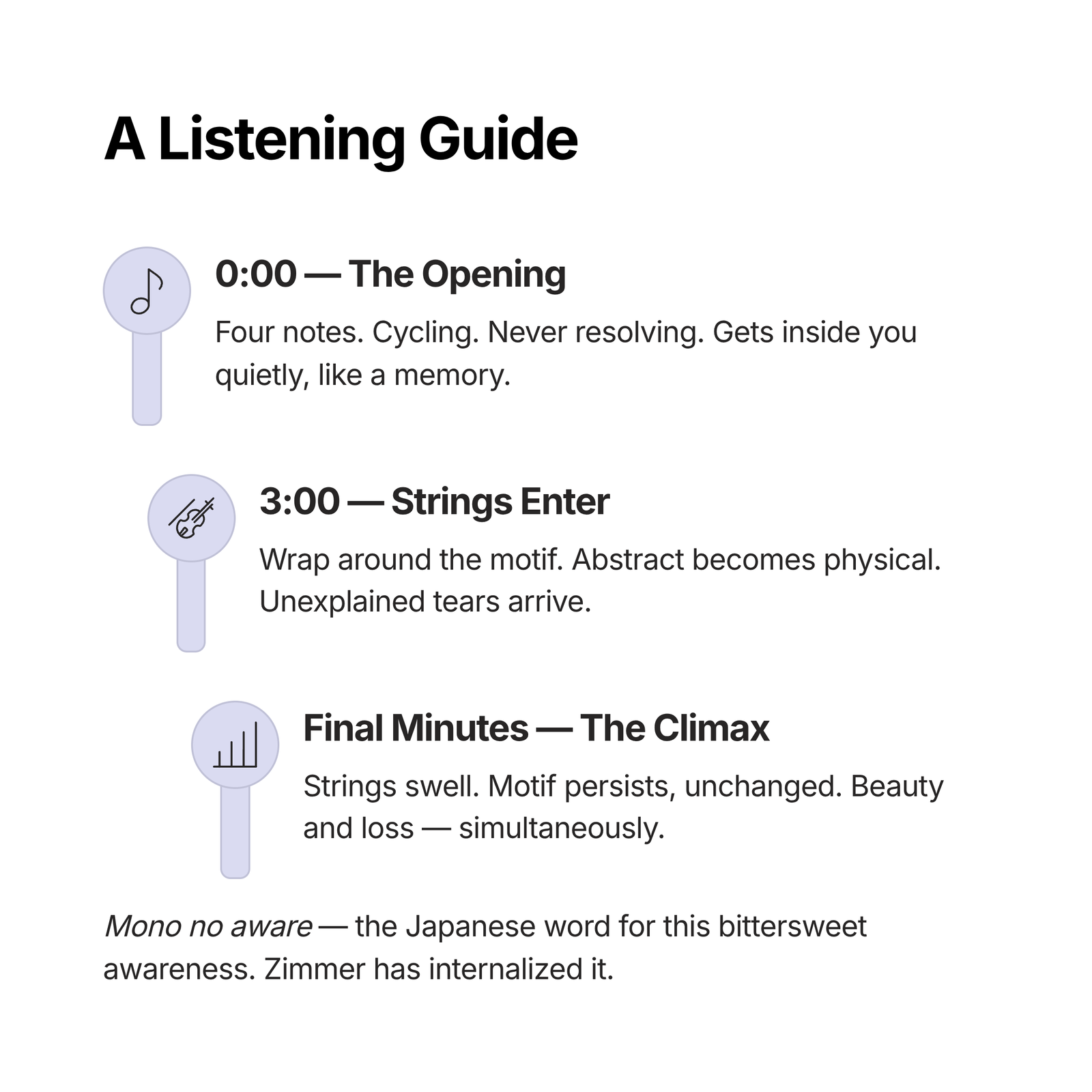
The Opening: A Seed Being Planted
The track begins with a single, cycling piano figure — four notes repeated in a slow loop. It is so unassuming that you might not notice it registering on you emotionally for the first minute or two. This is intentional. Zimmer is not trying to impress you. He is getting inside you quietly, the way a memory does.
The pattern is hypnotic but not relaxing. There is something about the slight harmonic tension in the cycle — it never quite resolves, never quite arrives anywhere — that mimics the feeling of a thought you cannot stop thinking.
The Middle: When Strings Enter
Around the three-minute mark, strings begin to appear. Softly at first, then with more presence. This is where most listeners report the first wave of unexplained emotion. You may feel the urge to cry without being entirely sure why. This is not a sign of sentimentality. It is Zimmer doing something technically sophisticated: he is layering emotional frequencies.
The strings do not introduce a new melody. They expand the piano motif, wrap around it, give it a body. What was abstract becomes physical. What was a thought becomes a feeling.
The Climax: Architecture of Grief
In the final minutes, the music reaches what can only be described as a controlled explosion. The strings swell. The piano motif persists beneath them, still cycling, unchanged. And here is the masterstroke: the emotional impact comes from the contrast between the unchanging motif and the swelling world around it.
It is the musical equivalent of watching time pass while you remain frozen. Which is exactly what Cobb experiences. Which is exactly what grief feels like.
The climax does not feel triumphant. It feels like being overwhelmed by beauty and loss simultaneously — the Japanese have a word for this: mono no aware, the bittersweet awareness that nothing lasts. Zimmer, apparently, has internalized it.
Why This Music Sits Alongside the Classical Canon
Some music critics dismiss film scores as functional rather than artistic — music made to serve pictures rather than to stand alone. Time dismantles that argument.
Stripped of the film, stripped of DiCaprio’s face and Nolan’s cinematography, Time works because its emotional logic is complete in itself. It moves through tension, accumulation, overwhelm, and — crucially — it does not offer resolution. It simply stops. The grief remains. The longing remains. You are left with it.
This is what the great composers do. Bach’s Chaconne does not resolve your suffering. Schubert’s Winterreise does not offer comfort. They hold the emotional truth of human experience without flinching, and they trust you to sit with it.
Zimmer does the same thing in Time. He just does it with fewer notes.
How to Listen: A Practical Guide
Where to find it:
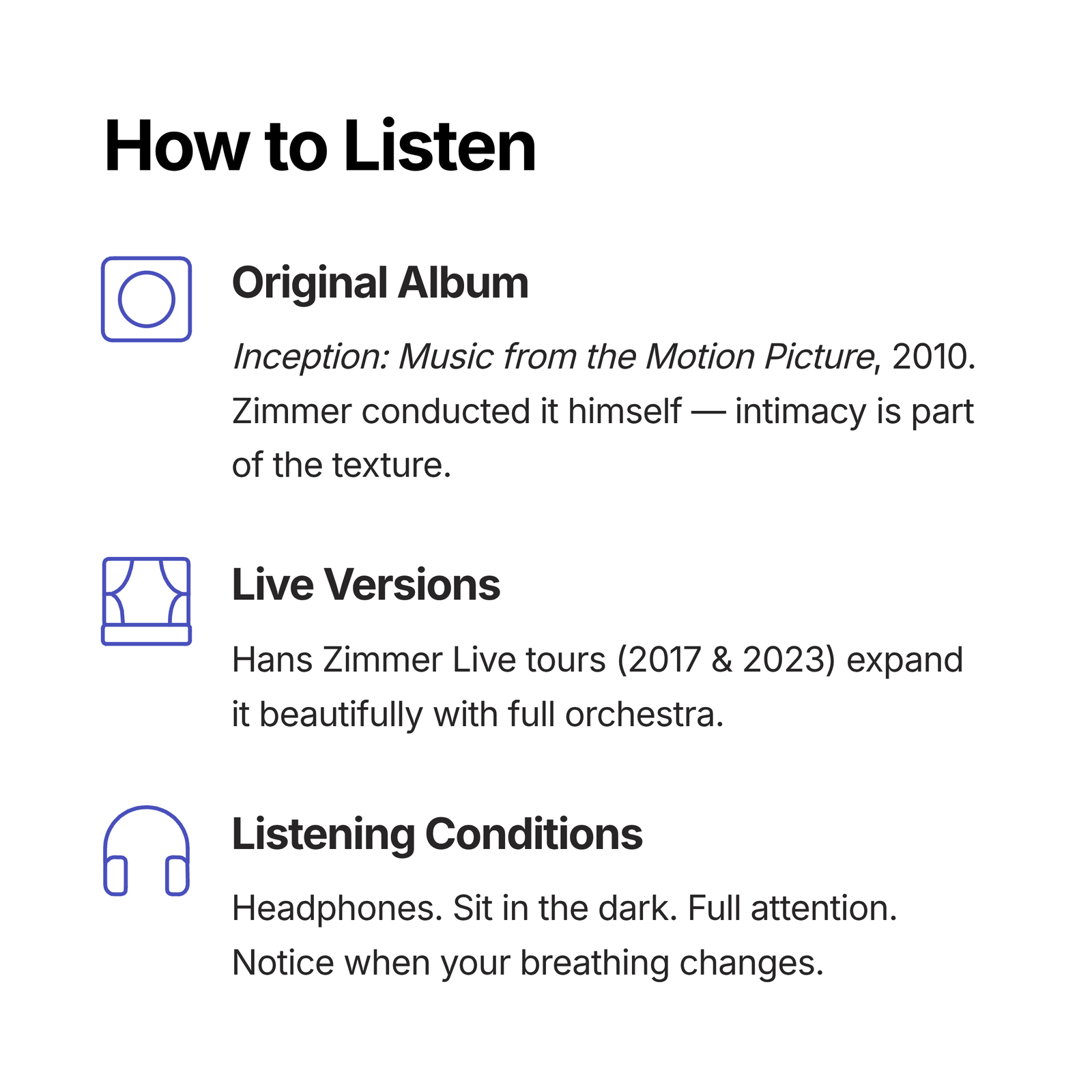
The piece appears at the end of the Inception film (during the final scene — avoid spoilers if you haven’t seen it) and as a standalone track on the official soundtrack album, simply titled Inception: Music from the Motion Picture (2010, Reprise Records).
Recommended versions:
– The original album recording remains definitive. Zimmer conducted it himself with a small ensemble, and the intimacy of the recording is part of the emotional texture.
– For live performance, seek out recordings from Hans Zimmer Live (his touring concert series), where the piece expands beautifully with a full orchestra. The 2017 and 2023 tour recordings are both excellent.
– Pianist Kyle Landry has posted a solo piano arrangement on YouTube that strips the piece to its melodic bones — worth hearing for what it reveals about the underlying structure.
Listening conditions:
This piece rewards focused, undistracted listening. Play it through headphones. Sit with it in the dark if you can manage it. Do not have it on in the background during dinner. Time is not background music — it is the main event.
Give it your full attention, especially the first time. Let the opening motif register before the strings arrive. Notice when your breathing changes. Notice what image or memory surfaces unbidden. That image is probably telling you something.
A Thought to Leave You With
There is a moment in Inception when a character explains the mechanics of a dream: time moves differently there. An hour in the real world might be days inside a dream. The deeper you go, the slower time becomes.
Time is built on this idea musically. The opening motif cycles at a pace that feels almost too slow — and as the piece builds, you gradually realize that Zimmer has been slowing you down along with it. By the climax, you are fully inside the dream logic. The world outside the music has receded.
That is the experience Zimmer was reaching for in that Frankfurt apartment, before he had ever seen a frame of Nolan’s film. He wanted to write music that made time feel precious precisely by making you feel it passing.
He succeeded.
If you have never wept over a piece of music you could not quite explain, put on Time tonight and give it eight uninterrupted minutes. You may discover that Hans Zimmer has already composed the soundtrack to something you have been carrying for years — something you did not yet have a name for.
You do now.