📑 Table of Contents
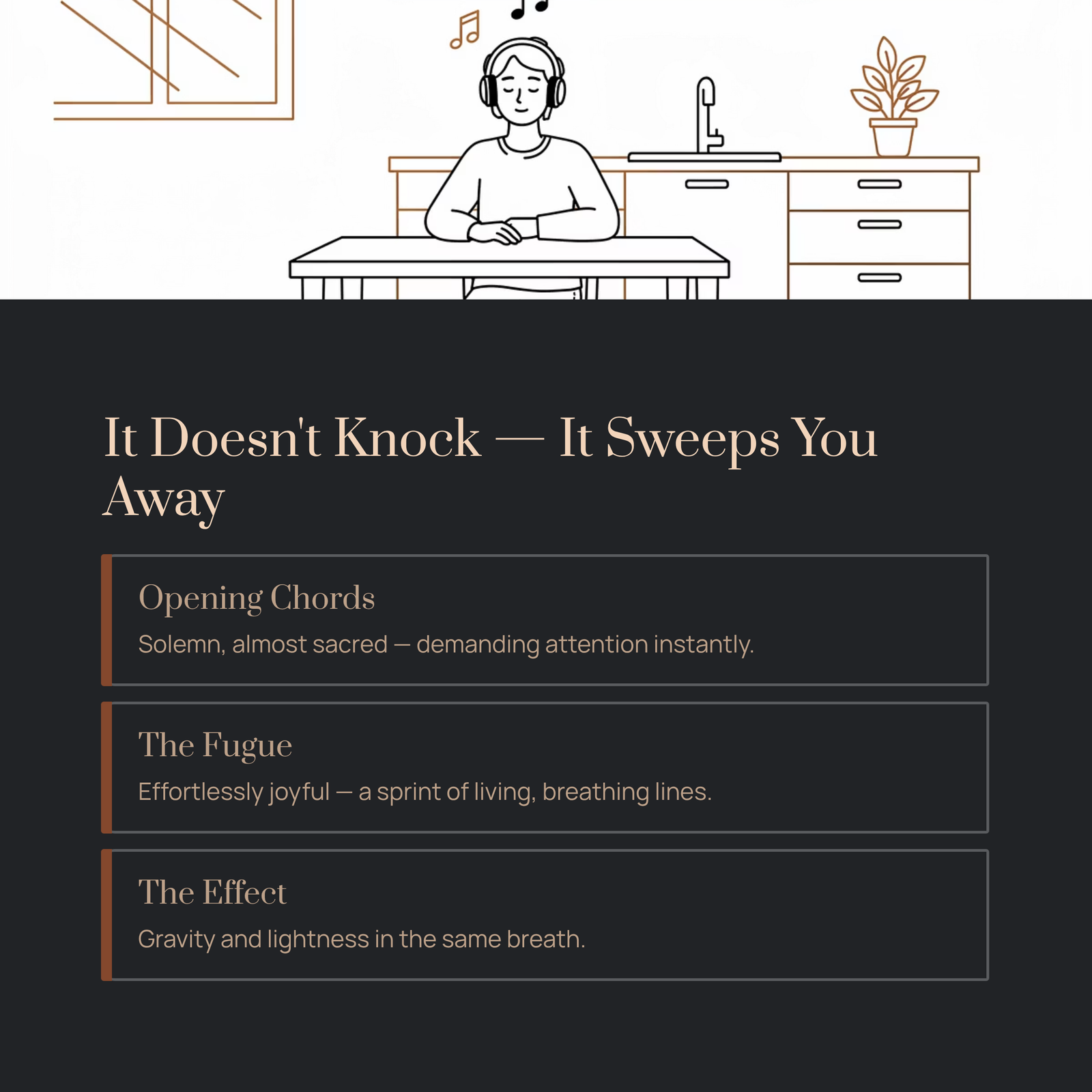
There are pieces of music that politely introduce themselves. They knock on the door, wait for you to answer, and gently step inside. Mozart’s overture to The Magic Flute is not one of them. It doesn’t knock — it sweeps you off your feet and carries you somewhere luminous before you’ve even had time to sit down.
I remember the first time I heard it. I wasn’t in a concert hall. I was in the kitchen, half-awake, scrolling through a playlist someone had labeled “orchestral energy.” The overture came on, and within thirty seconds I had stopped scrolling. Within a minute I had forgotten about coffee entirely. There was something in those opening chords — solemn, almost sacred — that demanded attention. And then, without warning, the music broke into a sprint of fugal lines so alive, so effortlessly joyful, that I couldn’t help but smile.
That morning changed the way I listen to Mozart. Not as a name on a textbook, but as a living, breathing mind that could contain both gravity and lightness in the same breath.
The Last Opera of a Dying Genius
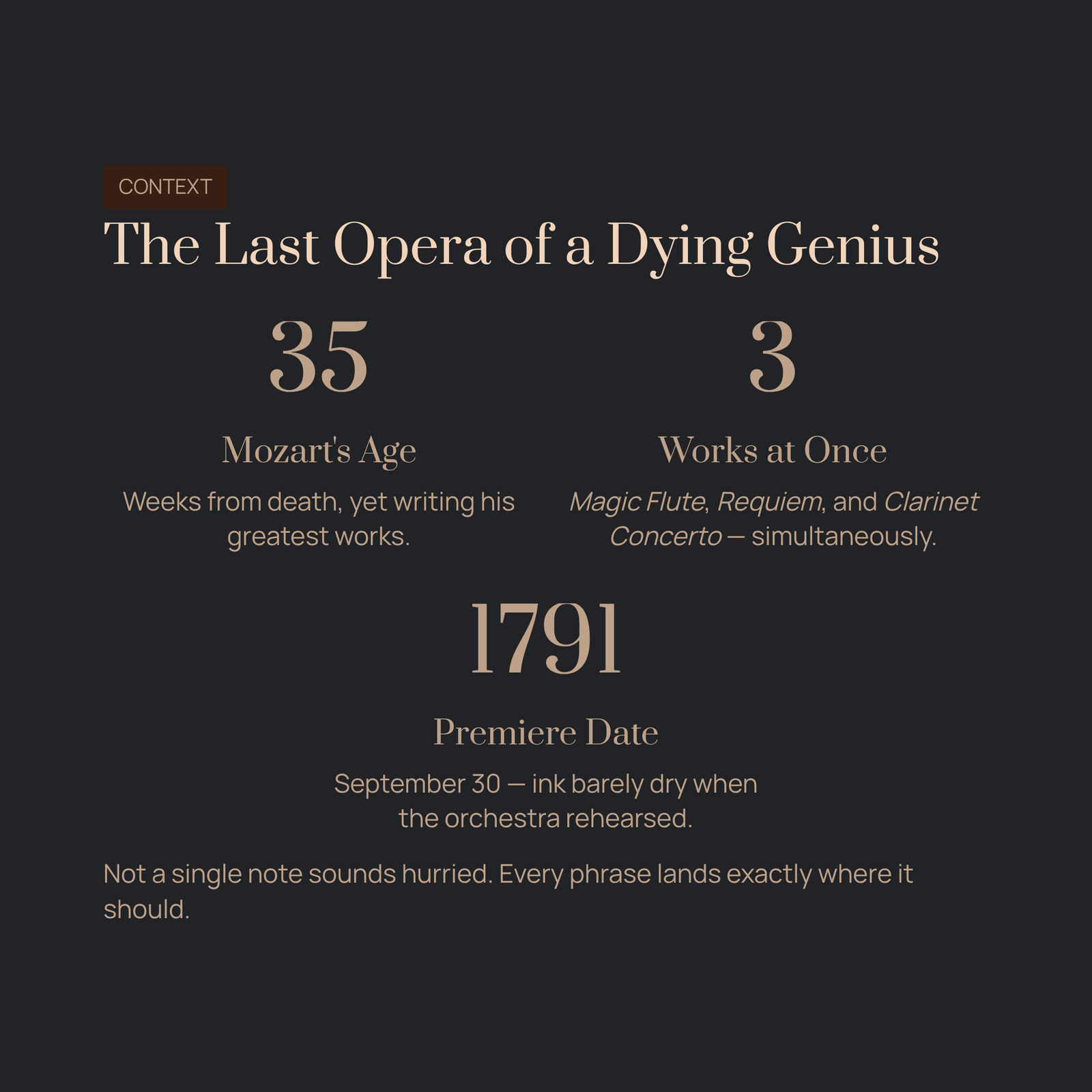
To understand this overture, you need to understand where Mozart was when he wrote it. The year was 1791. He was thirty-five years old, and though nobody — perhaps not even Mozart himself — fully knew it, he had only weeks to live.
That autumn was one of the most astonishing creative bursts in the history of Western music. Mozart was simultaneously working on The Magic Flute, his Requiem, and the Clarinet Concerto. He was financially strained, physically declining, and yet producing music that sounds like it was written by someone who had just discovered the meaning of life.
The Magic Flute premiered on September 30, 1791, at the Theater auf der Wieden in Vienna. Legend has it that Mozart finished the overture extraordinarily late — some accounts say merely two days before opening night, with the ink on the manuscript barely dry when the orchestra sat down to rehearse. Whether or not the timeline is precisely that dramatic, the fact remains: this overture was born under pressure. And yet there is not a single note that sounds hurried, anxious, or incomplete. Every phrase lands exactly where it should.
The opera itself was written for Emanuel Schikaneder’s theater company — a popular venue, not a royal court. Mozart was writing for everyday audiences, for people who came to be entertained, moved, and surprised. And he gave them something far deeper than entertainment.
Three Chords and a Secret Handshake
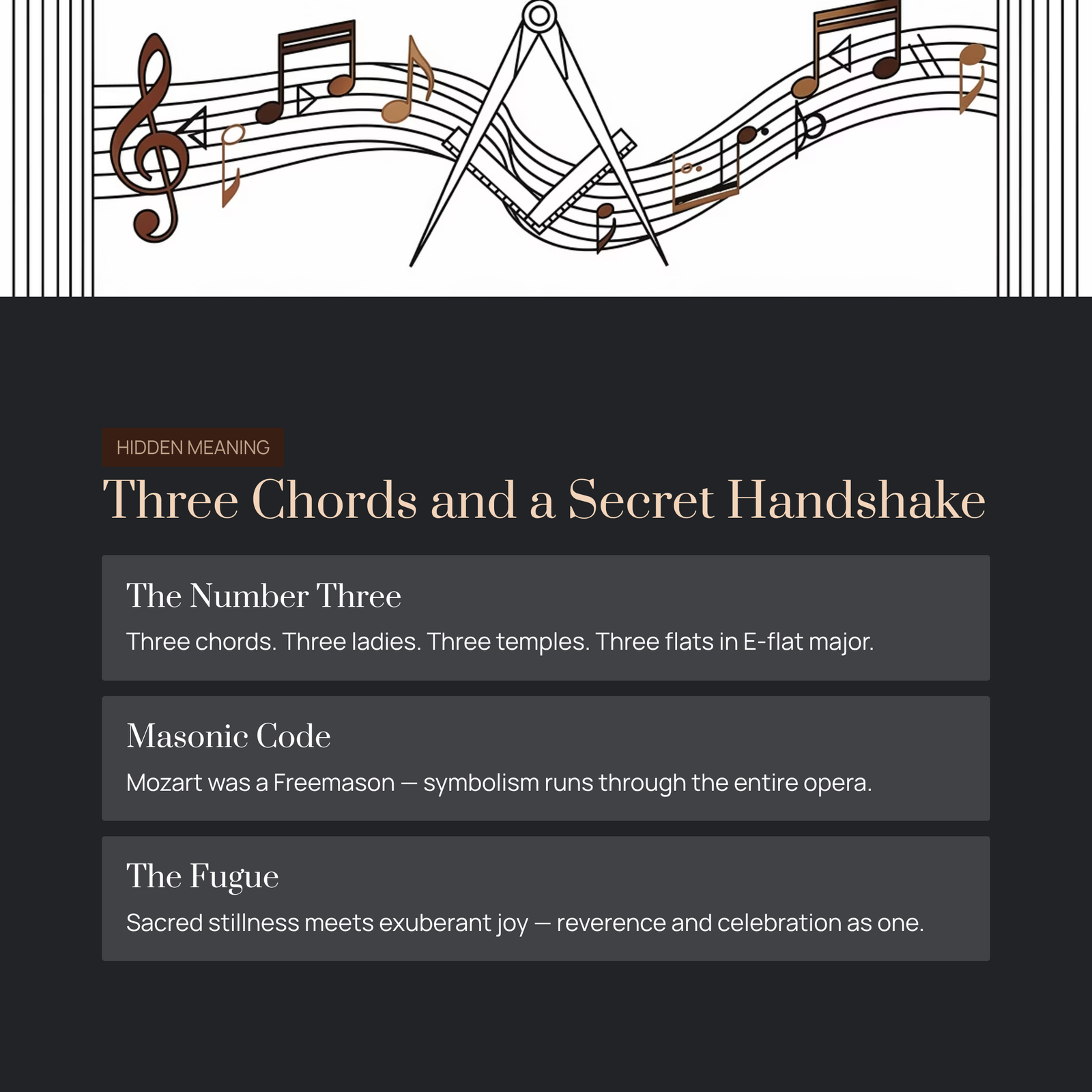
The overture opens with three majestic chords, played in a slow, deliberate rhythm. If you’re new to this piece, pay attention to these chords — they appear not once, not twice, but three times throughout the overture. The number three is no accident. Mozart was a Freemason, and Masonic symbolism runs through the entire opera like a hidden thread. Three chords. Three ladies. Three boys. Three temples. The key of E-flat major itself contains three flats.
You don’t need to know anything about Freemasonry to enjoy this music. But once you notice the pattern of three, it adds a quiet layer of intention beneath the surface — a sense that Mozart wasn’t just writing melodies, but encoding meaning.
After those solemn opening chords, the mood shifts entirely. A fugue begins — quick, bright, almost playful. Think of it as a conversation where everyone has something brilliant to say and nobody talks over each other. The violins introduce a theme, and then the other instruments pick it up one by one, weaving it into an increasingly complex tapestry that somehow never feels heavy. It feels like watching a group of friends build something together — each contribution making the whole thing more alive.
This contrast — between the sacred stillness of the opening and the exuberant energy of the fugue — is the emotional architecture of the entire overture. It’s as if Mozart is saying: life contains both reverence and joy, and you don’t have to choose between them.
What I Hear When I Listen Closely
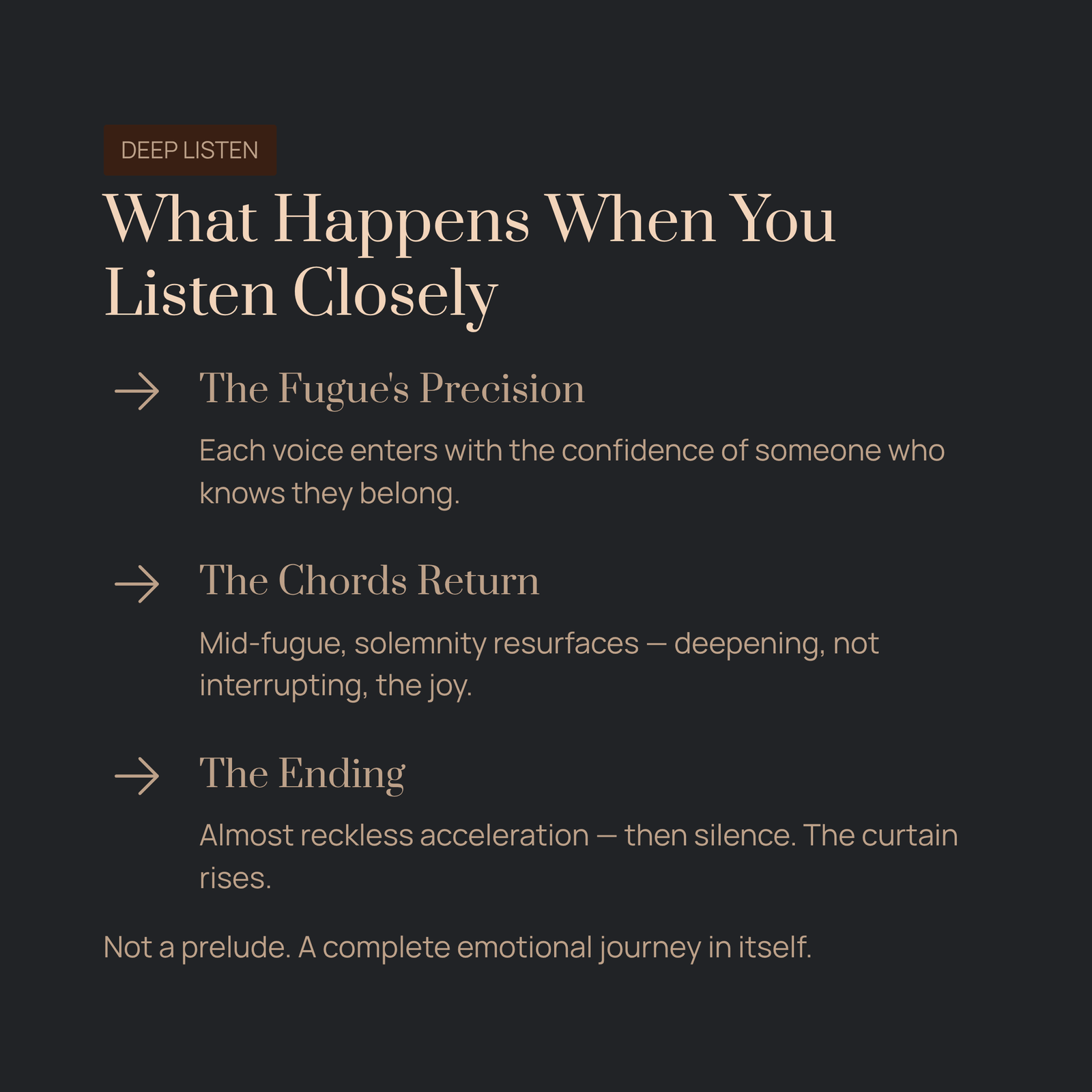
Every time I return to this overture, I hear something different. Some days I’m drawn to the rhythmic precision of the fugue, the way each voice enters at exactly the right moment with the confidence of someone who knows they belong. Other days, it’s the transition passages that catch me — those brief, shimmering moments where the music seems to hover between sections, suspended in possibility.
There’s a passage near the middle where the three solemn chords return, interrupting the fugue like a memory surfacing in the middle of laughter. It’s a stunning structural choice. Mozart reminds us that beneath all the brilliance and speed, something deeper is at work. The chords don’t slow the music down — they deepen it. And when the fugue resumes, it feels richer for having paused.
What strikes me most, though, is the ending. The overture doesn’t fade away or wind down gracefully. It accelerates. The final bars are almost reckless in their energy, as if Mozart is daring the orchestra to keep up. And then — silence. The curtain rises. The story begins.
It’s the kind of ending that makes you realize the overture wasn’t just a prelude. It was a complete emotional journey in itself.
How to Listen: A Few Suggestions
If this is your first time with this overture, here are a few ways to approach it.
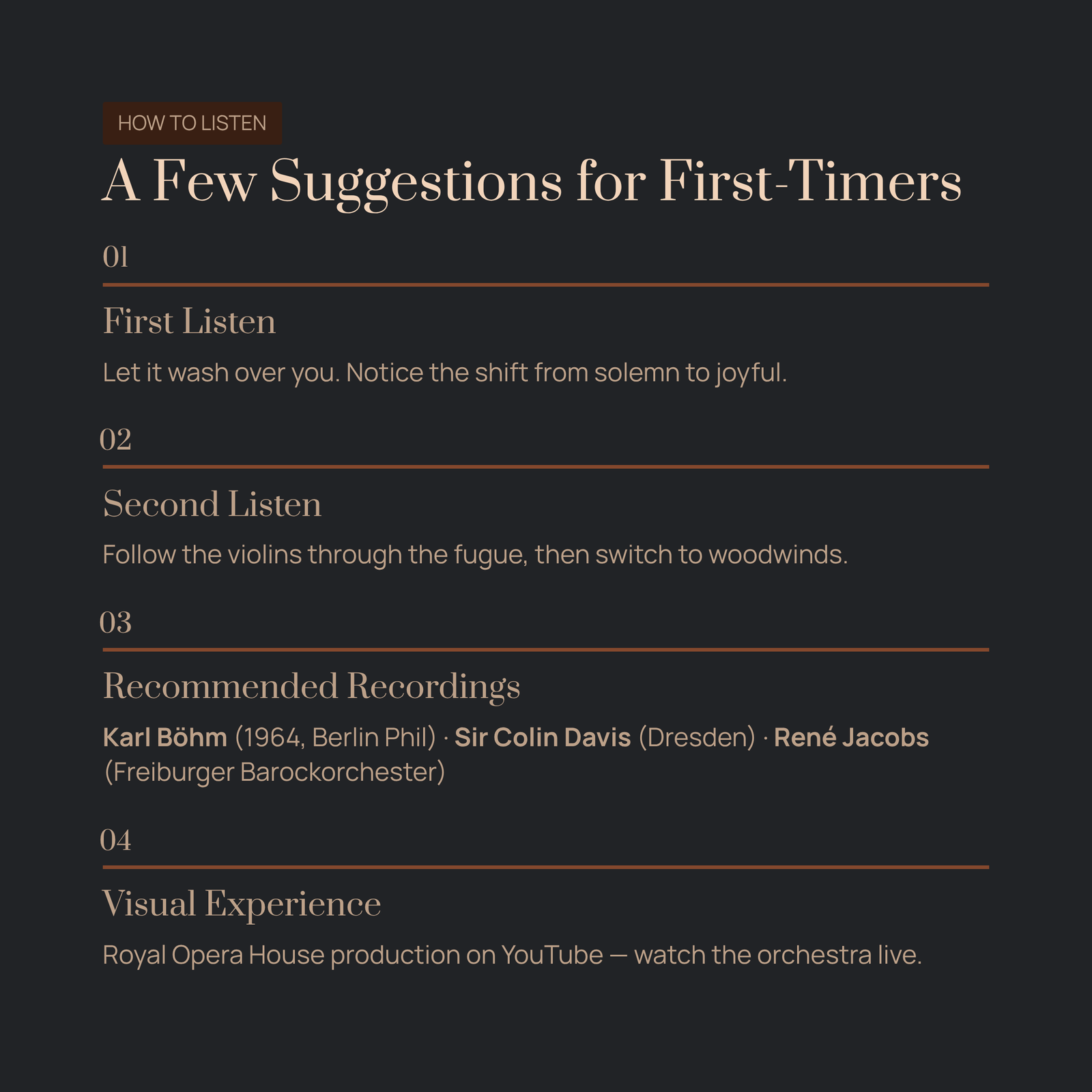
On your first listen, just let it wash over you. Don’t try to analyze anything. Notice how the mood shifts from solemn to joyful, and pay attention to how your body responds — do you sit up straighter during the fugue? Do you hold your breath during the opening chords?
On your second listen, try to follow the fugue. Pick one instrument — the violins are easiest — and track their melody as it weaves through the orchestra. Then listen again and follow the woodwinds instead. You’ll be amazed at how much is happening beneath the surface.
For recordings, I’d suggest starting with Karl Böhm’s 1964 recording with the Berlin Philharmonic — it captures the perfect balance of grandeur and lightness that this piece demands. Sir Colin Davis with the Staatskapelle Dresden offers a slightly warmer, more lyrical interpretation that brings out the Masonic solemnity beautifully. And if you want something historically informed, René Jacobs with the RIAS Kammerchor and Freiburger Barockorchester delivers a lean, transparent sound that reveals details often buried in larger orchestral textures.
For a visual experience, look for the Royal Opera House production on YouTube — watching the overture performed live, with the orchestra visible, adds a dimension that recordings alone can’t capture.
The Overture as a Way of Seeing
I keep coming back to this piece because it teaches me something about proportion. Mozart had every reason to write something dark, anxious, or desperate in the autumn of 1791. Instead, he wrote music that radiates clarity. Not naive optimism — something more earned than that. A kind of luminous acceptance that holds sorrow and celebration in the same hand.
There’s a word in music criticism — Heiterkeit — that German writers sometimes use to describe Mozart’s late works. It roughly translates to “serenity,” but it means something closer to a calm joy that has looked at the full weight of existence and chosen to sing anyway.
That’s what I hear in this overture. Not an escape from difficulty, but a response to it. A five-minute declaration that the world is complex, mysterious, and — if you listen carefully enough — astonishingly beautiful.
The curtain rises. And you’re not the same person you were when the music began.