📑 Table of Contents
There is a story I keep returning to whenever I listen to The Notebook’s Main Theme. It is the story of how this piece came to exist at all.
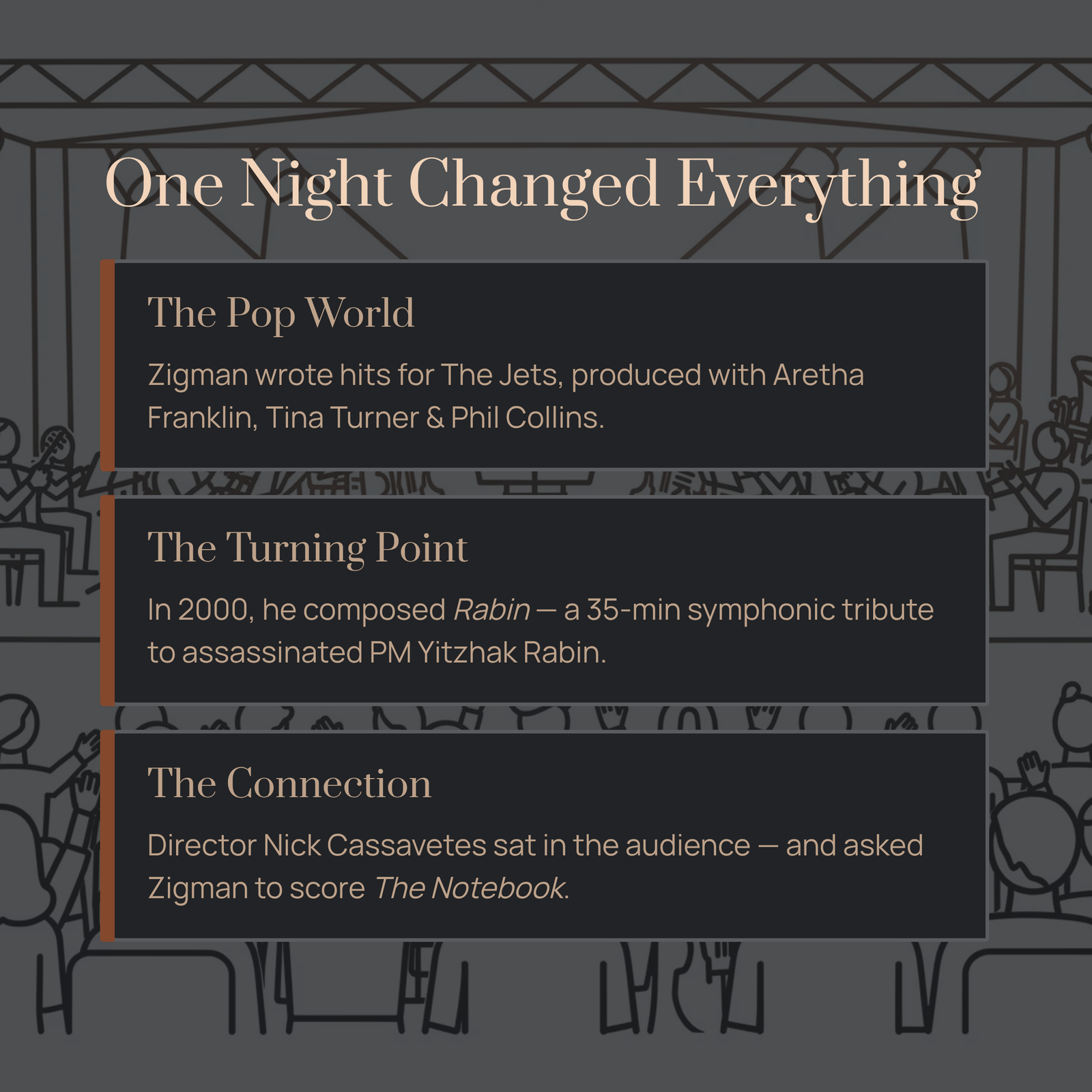
In the late 1990s, Aaron Zigman was not a film composer. He was a classically trained pianist who had taken a detour through the pop music industry, writing chart-topping hits for The Jets and producing records alongside legends like Aretha Franklin, Tina Turner, and Phil Collins. He lived in the world of three-minute radio singles and studio sessions. Hollywood was not part of the plan.
But in the year 2000, Zigman composed something deeply personal — a symphonic tone poem called Rabin, written in memory of the assassinated Israeli Prime Minister Yitzhak Rabin. It was a 35-minute orchestral work, heavy with grief, performed by the Los Angeles Jewish Symphony. In the audience that night sat a man named Nick Cassavetes — the director who would soon begin working on a little film called The Notebook. Cassavetes was so shaken by what he heard that he approached Zigman afterward and asked him to score his upcoming movie.
That single evening in a concert hall connected a pop songwriter’s buried classical heart to one of the most beloved romantic films of the 21st century. And it all begins with a quiet piano, playing alone.
A Composer Between Two Worlds
To understand why The Notebook’s Main Theme sounds the way it does, you have to understand who Aaron Zigman is — and more importantly, who he was before this film found him.
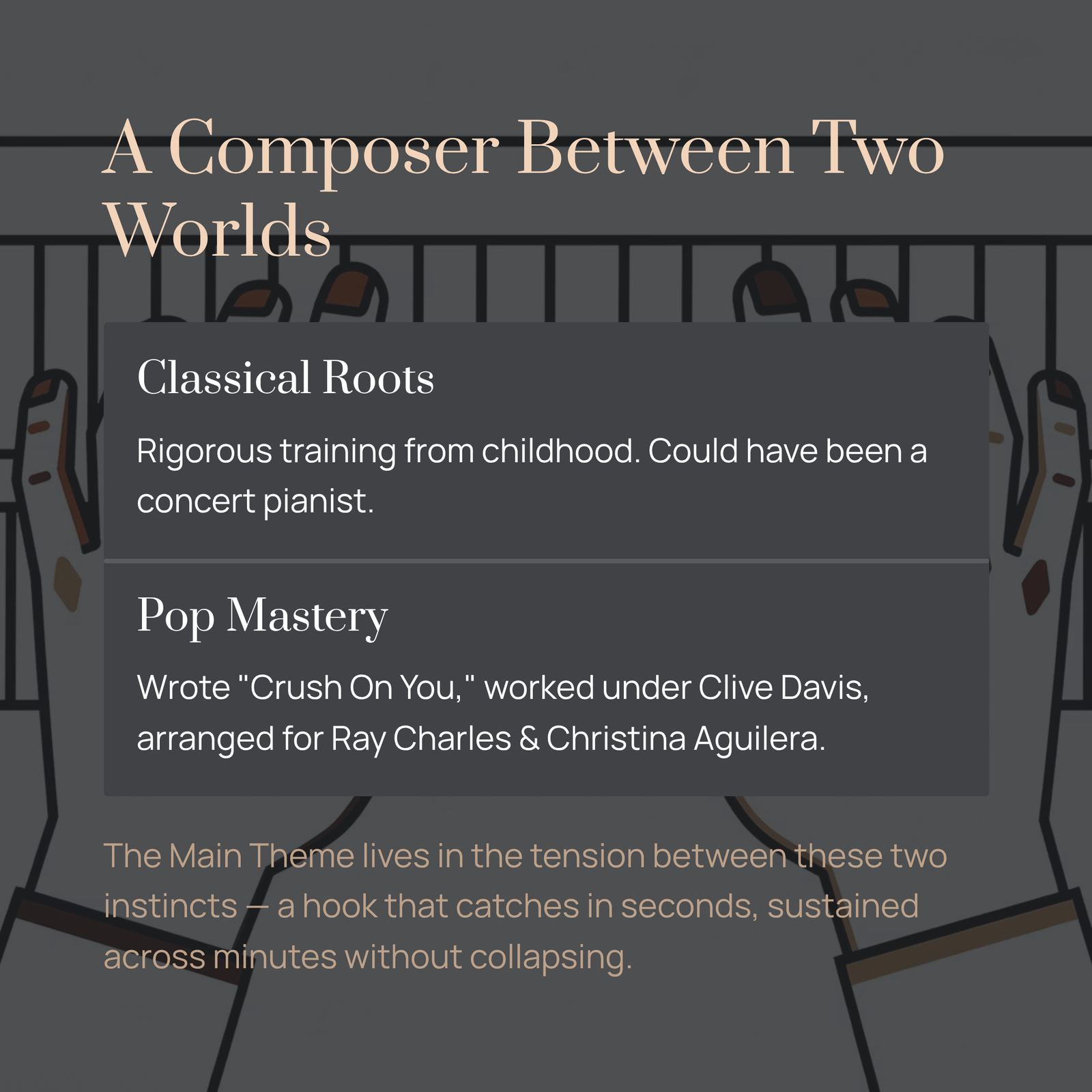
Born in 1963, Zigman received rigorous classical training from an early age. He could have pursued a career as a concert pianist. Instead, the 1980s pulled him into the gravitational orbit of pop music. He wrote “Crush On You” for The Jets, worked under the legendary Clive Davis, and arranged music for artists ranging from Ray Charles to Christina Aguilera. His fingerprints were on some of the decade’s biggest records.
But classical music never left him. It sat quietly in the background, like a melody you half-remember from childhood. When Zigman finally turned to film scoring — first with John Q in 2002, and then The Notebook in 2004 — he brought both worlds with him. The result is music that feels simultaneously sophisticated and emotionally naked. There is no hiding behind orchestral grandeur here. The Main Theme is just a piano, a pair of hands, and an enormous amount of feeling.
This dual identity is what makes Zigman’s voice so distinctive. He knows how to write a hook that catches the ear in three seconds — that is the pop songwriter in him. But he also knows how to sustain a single emotional idea across minutes of music without ever letting it collapse — that is the classical musician. The Notebook’s Main Theme lives in the tension between these two instincts.
What the Piano Is Actually Doing
Let me walk you through this piece the way I hear it, because I think there are layers here that are easy to miss if you only know it as “that sad song from the movie.”
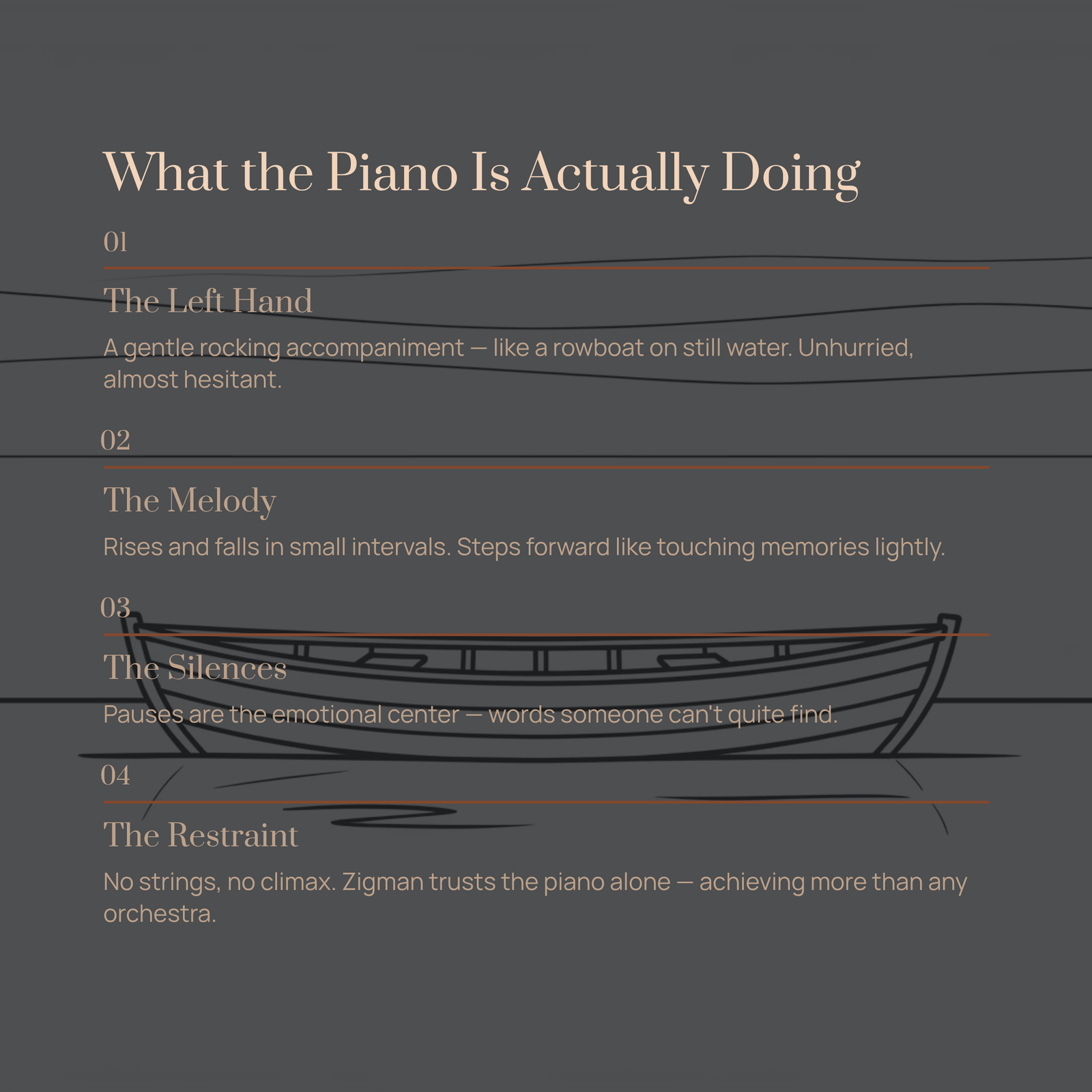
The theme opens with a simplicity that borders on silence. The left hand establishes a gentle, rocking accompaniment — imagine the slow, rhythmic movement of a rowboat on still water. It is unhurried, almost hesitant, as if the music is not entirely sure it wants to begin. Above this, the right hand introduces a melody that rises and falls in small, careful intervals. It does not leap. It does not shout. It steps forward like someone walking through a room full of memories, touching each one lightly.
What strikes me most is Zigman’s use of space. There are moments where the piano simply stops, and you are left with nothing but the echo of the last note hanging in the air. These silences are not emptiness — they are the emotional center of the piece. They are the pauses between sentences when someone is trying to say something important and cannot quite find the words.
As the theme develops, the melody becomes slightly more confident. The intervals widen. The left hand grows warmer, fuller. But Zigman never allows the music to build into anything like a climax. Just when you think the emotion might spill over, he pulls back. The piece ends the way it began — quietly, gently, with a faint trace of sadness woven into every note.
This restraint is what elevates the Main Theme beyond typical film music. A lesser composer might have added strings, swelling to a grand romantic peak. Zigman trusts the piano alone. And in that trust, he achieves something far more intimate than any orchestra could provide.
Why It Hurts in the Right Way
I want to be honest about something. The first time I heard this piece outside of the film, separated from Ryan Gosling’s face and Rachel McAdams’ tears, I was surprised by how much it still affected me. Film music often depends on the images it accompanies. Remove the visuals, and many scores lose their power. But The Notebook’s Main Theme stands entirely on its own.
I think this is because Zigman is not really writing about the characters in the movie. He is writing about the feeling of remembering someone you love. Not the dramatic, cinematic version of love — not the rain-soaked kisses or the passionate arguments. He is writing about the quiet, private act of sitting alone and thinking about a person who changed your life. The melody sounds like the inside of someone’s mind as they turn a memory over and over, examining it from every angle, knowing they can never go back to it.
This is why the piece works so well as standalone listening music. You do not need to have seen The Notebook to feel what this theme is about. You only need to have loved someone. You only need to have a memory that you return to when the house is quiet and the day is done.
There is a particular kind of sadness in this music that I find deeply comforting. It is not despair. It is not grief. It is the bittersweet recognition that the most beautiful moments of our lives exist only in the past tense. Zigman captures this feeling with a precision that still catches me off guard, even after dozens of listens.
How to Listen: A Few Suggestions
If you are approaching this piece for the first time — or revisiting it after years — here are some ways to deepen your experience.
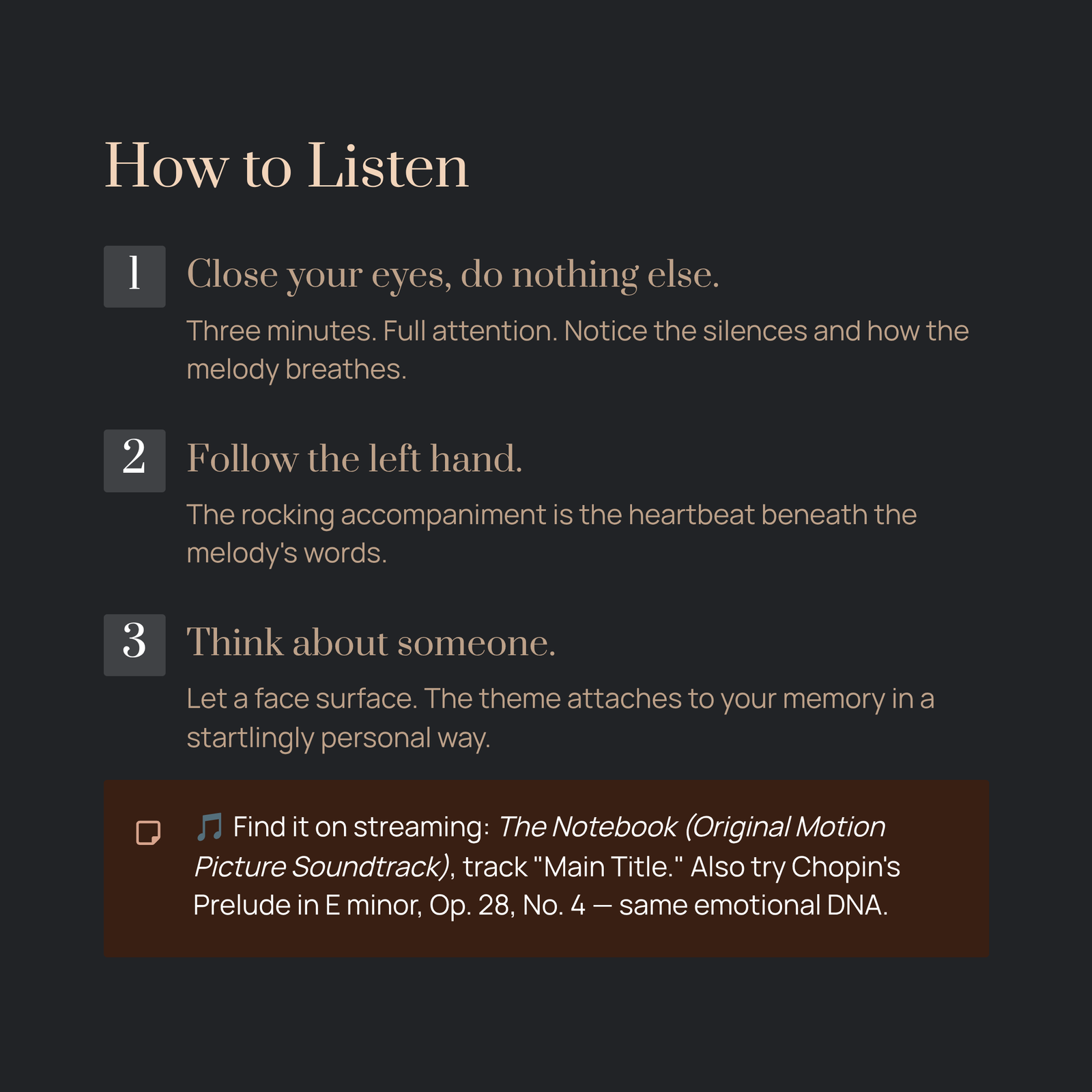
First listen: Close your eyes and do nothing else. This is not background music. It is only about three minutes long, and it rewards your full attention. Notice the silences. Notice how the melody seems to breathe. Let the piece set its own pace without rushing ahead to figure out what it “means.”
Second listen: Pay attention to the left hand. Most people follow the melody in the right hand, but the accompaniment tells its own story. Listen to how it rocks gently back and forth, creating a sense of movement that is almost physical. It is the heartbeat underneath the melody’s words.
Third listen: Think about someone. This is not a clinical instruction — it is simply what the music invites. Let a face or a name surface in your mind and see what the music does with that image. I suspect you will find that the theme attaches itself to your memory in a way that feels startlingly personal.
For recordings, the original soundtrack album released in 2004 remains the definitive version. Zigman himself performs the piano, and there is an intimacy in his playing that cover versions rarely capture. You can find it on most streaming platforms under The Notebook (Original Motion Picture Soundtrack). The track is listed as “Main Title.” If you enjoy this theme, I also recommend listening to Chopin’s Prelude in E minor, Op. 28, No. 4, which appears elsewhere in the film’s soundtrack and shares a similar emotional DNA — that same quality of restrained sorrow expressed through the simplest possible means.
The Quiet Power of Simplicity
I have spent a great deal of time with music that is technically complex — fugues that twist through five voices, concertos that demand superhuman virtuosity, symphonies that shake the walls of concert halls. And I love all of it. But there are moments when the most powerful thing music can do is to be simple.
Aaron Zigman’s Main Theme from The Notebook is one of those moments. It does not try to impress you. It does not display its craft. It sits down at the piano and plays something true, and it trusts that the truth will be enough.
What moves me most about this piece is its honesty. In a film industry that often equates emotion with volume, Zigman chose the opposite path. He wrote a theme that whispers. And somehow, that whisper has echoed for over two decades, finding its way into the hearts of millions of listeners who may never have set foot in a concert hall.
There is a lesson in that, I think — not just about music, but about the way we express the things that matter most. Sometimes the truest feelings are the ones we can barely bring ourselves to say out loud. Sometimes the most powerful sound is the one that comes just before silence.
And sometimes, a pop songwriter who spent years crafting three-minute radio hits sits down and writes a three-minute piano piece that says everything a lifetime of words cannot. That is The Notebook’s Main Theme. That is Aaron Zigman’s quiet, enduring gift.