📑 Table of Contents
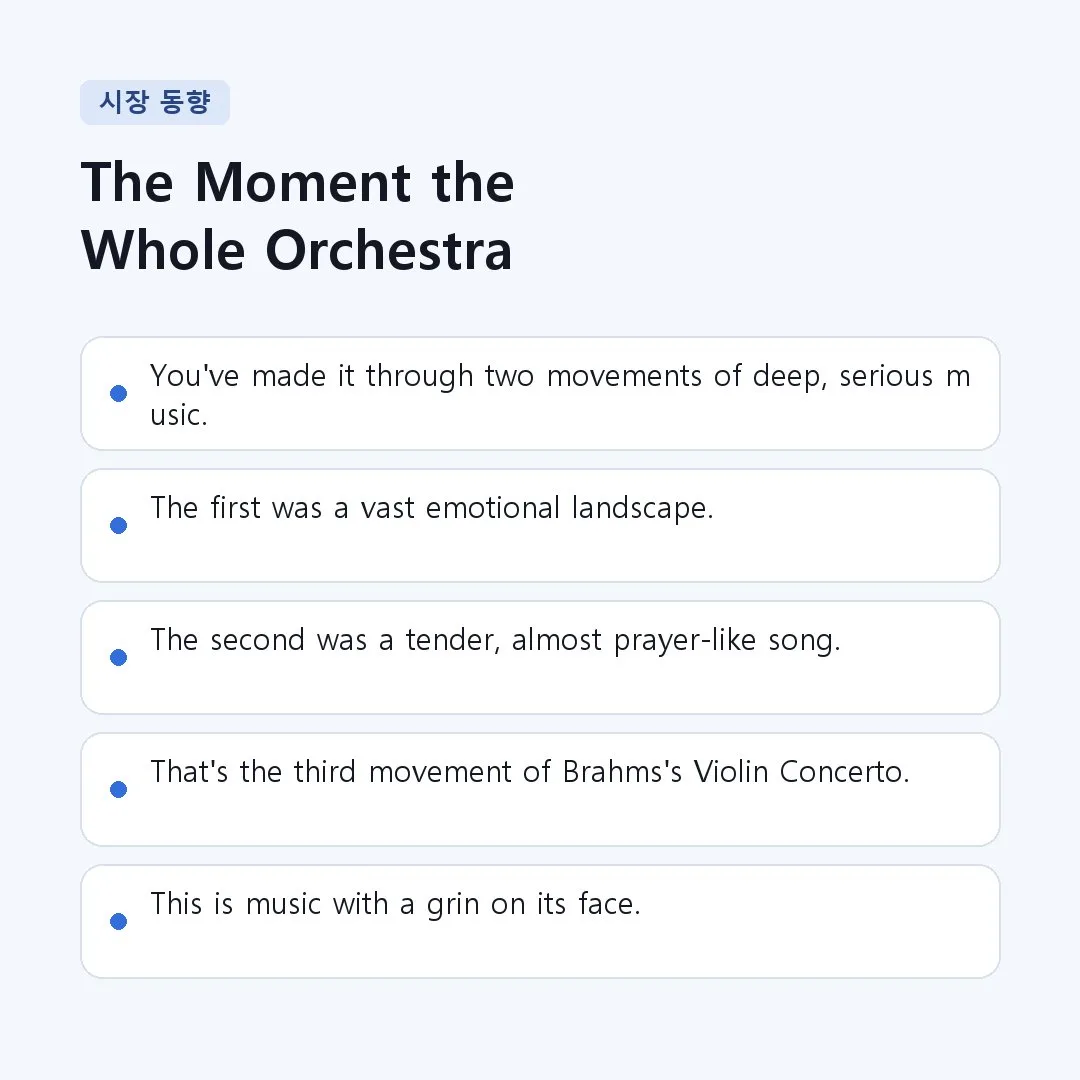
You’ve made it through two movements of deep, serious music. The first was a vast emotional landscape. The second was a tender, almost prayer-like song. And then—without warning—the violin kicks the door open and the whole room starts stomping its feet.
That’s the third movement of Brahms’s Violin Concerto. The marking is Allegro giocoso, which roughly means “fast and playful,” and Brahms means it. This is music with a grin on its face. After all the weight of what came before, the finale feels like the moment the formal dinner party turns into dancing in the kitchen.
If you’ve never connected with classical music because it felt too solemn, this is a perfect place to start. There’s nothing to decode here. The joy is right on the surface.
Who Was Brahms, and Why Does This Sound So Different?
Johannes Brahms (1833–1897) had a reputation, even in his own lifetime, as the serious one. While other composers were chasing drama and spectacle, Brahms was the careful craftsman—the man who reportedly spent over twenty years finishing his First Symphony because he felt the towering shadow of Beethoven looking over his shoulder.
So a foot-stomping, grinning dance finale might seem out of character. But here’s the thing about Brahms: he loved Hungarian and Roma (“gypsy”) folk music his whole life. As a young man, he toured with a Hungarian violinist and absorbed those wild, syncopated rhythms and fiery melodies. They show up all over his work, and in this finale, he lets them run completely free.
The concerto itself was written in 1878 for his close friend Joseph Joachim, one of the greatest violinists of the age. Brahms wasn’t a violinist himself, so he leaned on Joachim for advice on what was actually playable—and what would make the instrument sing.
A Concerto That Almost Started a Fight
Here’s a fun piece of history. When Brahms first showed the concerto to violinists, many of them grumbled that it was nearly impossible to play. One famous quip claimed Brahms had written a concerto not for the violin, but against it.
That’s because Brahms refused to treat the soloist as a flashy circus act floating above the orchestra. Instead, he wove the violin deep into the orchestral fabric—a true partnership rather than a showcase. It’s demanding precisely because the violinist has to be a musician, not just an acrobat.
The finale is where that tension finally releases. The technical fireworks are still there, but now they’re in service of pure fun. Joachim, for the record, loved the piece and championed it until it became one of the cornerstones of the entire violin repertoire.
How to Listen: Your Three-Minute Map
You don’t need a music degree to follow this. Here’s what to listen for:
The opening theme (right from the start): The violin bursts in with a bold, angular tune built on those Hungarian rhythms—short, punchy, and impossible to sit still to. Notice how it bounces between low growls and high leaps. That’s the “gypsy fiddler” energy Brahms loved.
The orchestra answers: Listen to how the orchestra catches the melody and throws it back, like dancers trading steps. The whole movement is a conversation, not a monologue.
The rhythmic games: Brahms loves to play tricks with the beat—accenting notes where you don’t expect them, so the music seems to stumble and recover playfully. If you find your head bobbing slightly off-kilter, that’s intentional.
The final stretch: As the movement races toward its end, Brahms shifts the rhythm into a triumphant march-like gallop. The tempo pushes, the energy builds, and the whole thing slams shut with a grin. It’s one of the most satisfying endings in the repertoire.
The whole movement runs around eight minutes, but it flies by.
Recordings Worth Your Time
A few interpretations stand out, each offering something different:
Jascha Heifetz (with Fritz Reiner and the Chicago Symphony) takes the finale at a breathtaking, almost reckless speed. If you want raw electricity and edge-of-your-seat virtuosity, this is the classic thrill ride.
Itzhak Perlman (with Carlo Maria Giulini) offers a warmer, more golden tone. His finale dances rather than races—rounded, generous, and deeply musical. A great choice for a first listen.
Anne-Sophie Mutter brings a vivid, characterful intensity that highlights the Hungarian fire in the rhythms. Her phrasing makes the dance elements leap out.
If you’re just starting, try Perlman first for warmth, then go to Heifetz when you want to feel your pulse race.
Why This Movement Stays With You
There’s something deeply human about ending a serious, searching work with unguarded joy. Brahms spent two movements exploring big feelings, and then he chose to leave us not with melancholy or grandeur, but with a dance.
It’s a reminder that depth and delight aren’t opposites. The same composer who agonized over Beethoven’s shadow could also write music that simply wants you to tap your feet and smile. Put this finale on when you need a lift—when the day has been heavy and you want to remember that joy is allowed. Brahms gives you permission, right there in the last eight minutes.