📑 Table of Contents
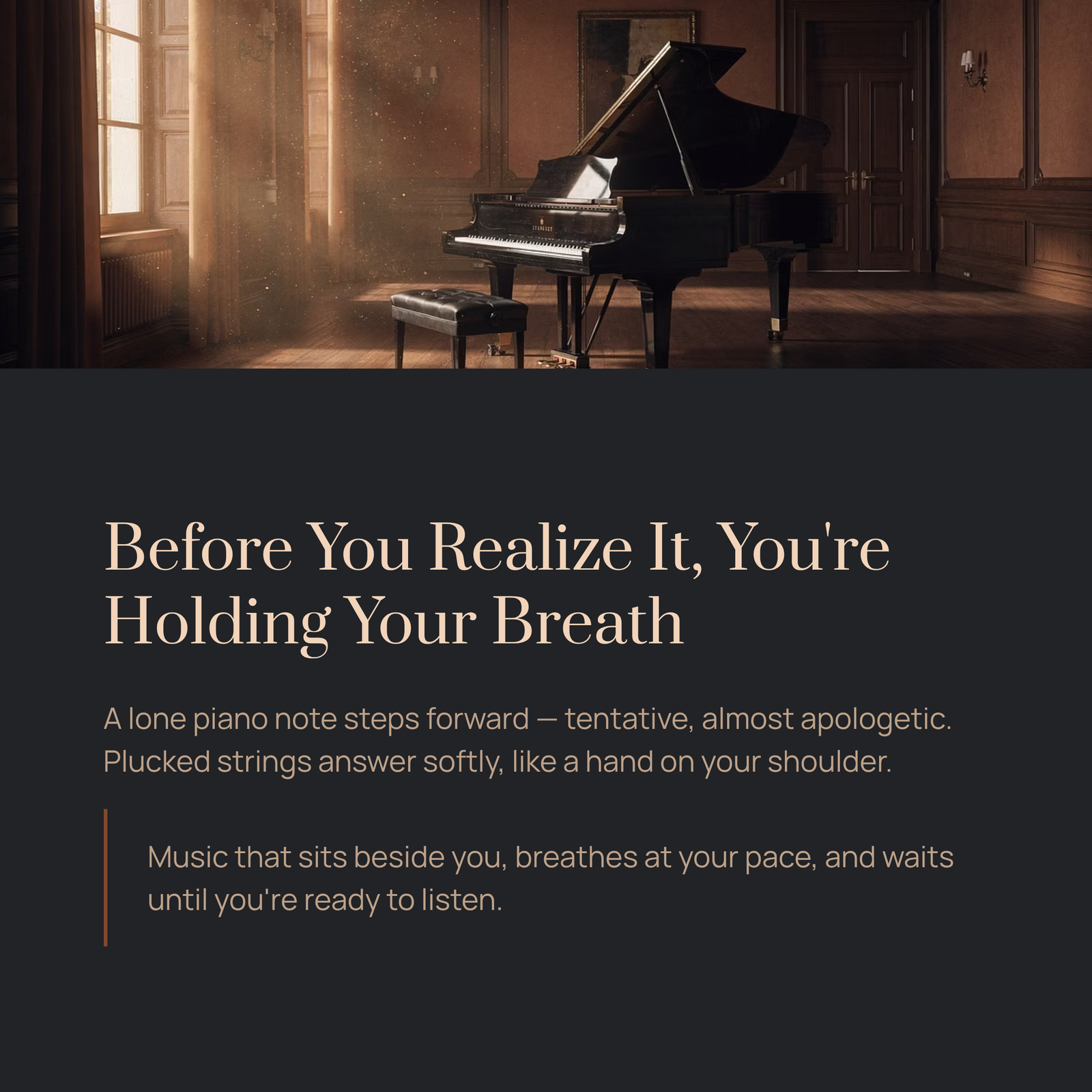
There is a moment, right at the start of The King’s Speech Main Theme, where a lone piano note steps forward — tentative, almost apologetic, as if unsure whether it has permission to speak. A few plucked strings answer softly from behind, like a friend placing a hand on your shoulder without saying a word. And just like that, before you even realize it, you’re holding your breath alongside the music.
I think about this opening often. Not when I’m analyzing scores or reading liner notes, but at quieter moments — when I’m sitting at my desk in the late afternoon, when the noise of the day has finally settled, and I need something that understands hesitation. Something that knows what it feels like to have words trapped behind a wall you didn’t build.
Alexandre Desplat’s Main Theme for The King’s Speech is that kind of music. It doesn’t try to be grand. It doesn’t demand your attention. It simply sits beside you, breathes at your pace, and waits until you’re ready to listen.
The Man Who Heard Star Wars and Changed His Life
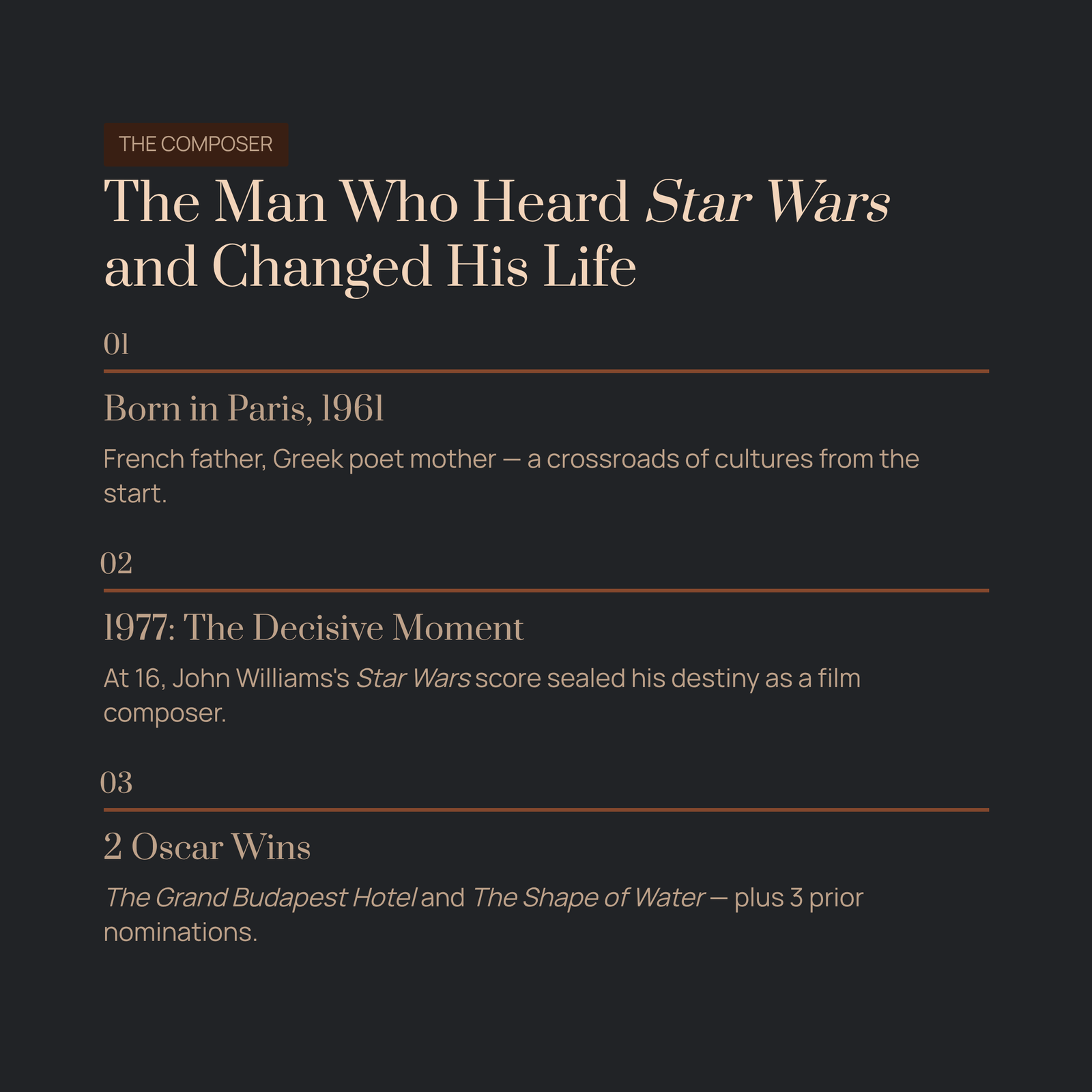
Before we step into the score itself, let me tell you about the person who wrote it. Alexandre Desplat was born in Paris in 1961 to a French father from the countryside of Sarlat-la-Canéda and a Greek mother who was a poet from Athens. His parents had met as students at the University of California, Berkeley, married in San Francisco, and then returned to France to raise their family. From the very beginning, Desplat’s world was a crossroads of cultures — Mediterranean warmth meeting Parisian elegance, American openness blending with European tradition.
He started playing the piano at five. By nine, he had moved on to the flute and trumpet, restless to explore every color an instrument could offer. Growing up, he absorbed the harmonic worlds of Ravel and Debussy alongside jazz records and world music from Brazil and West Africa. But the decisive moment came in 1977, when a sixteen-year-old Desplat sat in a darkened cinema and heard John Williams’s score for Star Wars. That was it. He knew, with the certainty that only teenagers possess, that he wanted to spend his life composing music for film.
He studied at the Conservatoire de Paris and the Royal College of Music in London, and then spent nearly two decades scoring French films — accumulating over fifty credits before the English-speaking world took notice. His breakthrough came with Girl with a Pearl Earring in 2003, a score so luminous and restrained that it announced a voice Hollywood had been waiting for without knowing it. By the time Tom Hooper called him for The King’s Speech in 2010, Desplat had already been nominated for the Academy Award three times — for The Queen, The Curious Case of Benjamin Button, and Fantastic Mr. Fox. He would eventually win two Oscars, for The Grand Budapest Hotel and The Shape of Water, and compose for directors as varied as Wes Anderson, Roman Polanski, Terrence Malick, and Guillermo del Toro.
But there is something about The King’s Speech that feels like a distillation of everything Desplat does at his most essential. Stripped of fantasy, stripped of spectacle, this is a score about one man’s struggle to find his own voice — and the composer who understood that the most powerful thing music can do is sometimes to barely be there at all.
Microphones Fit for a King — Literally
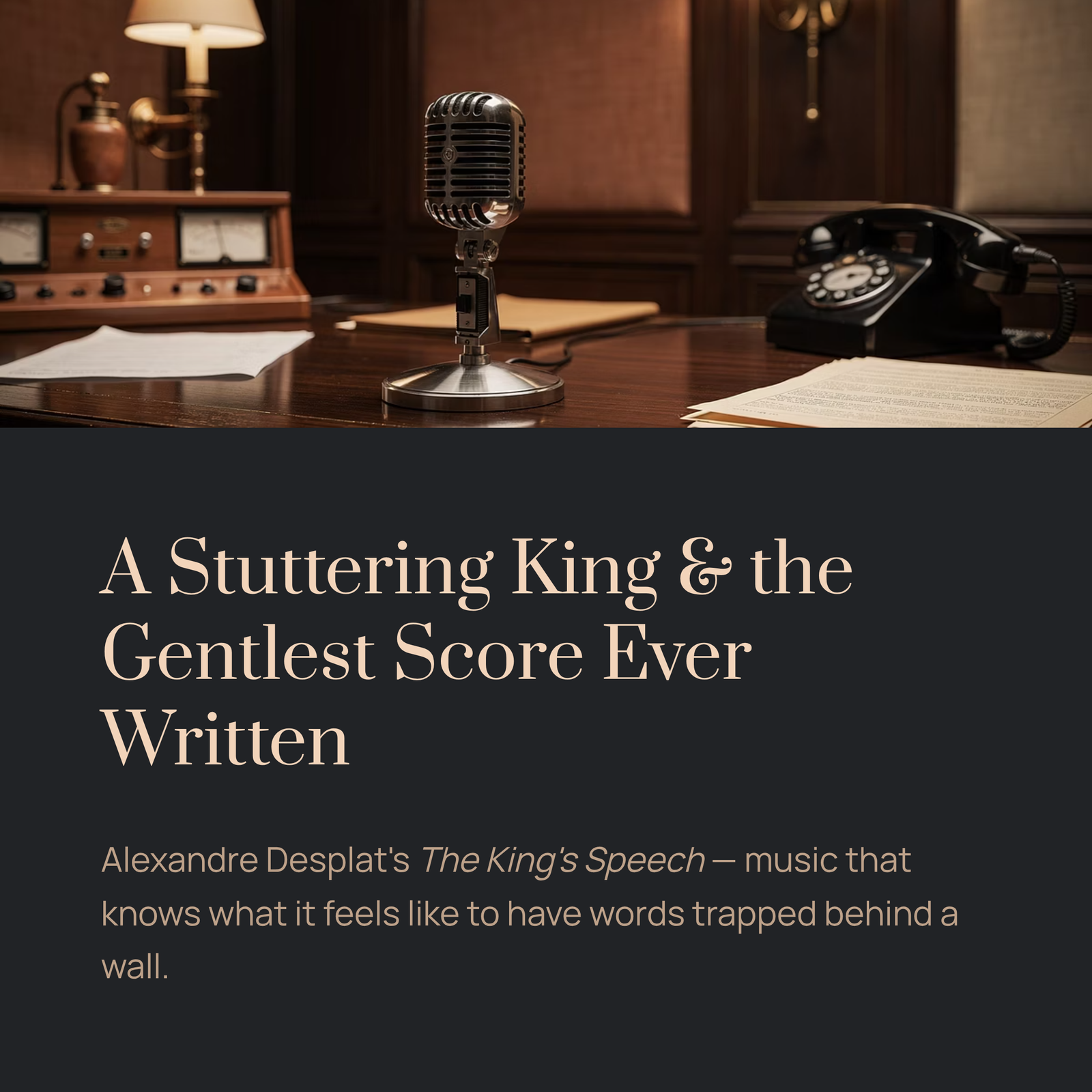
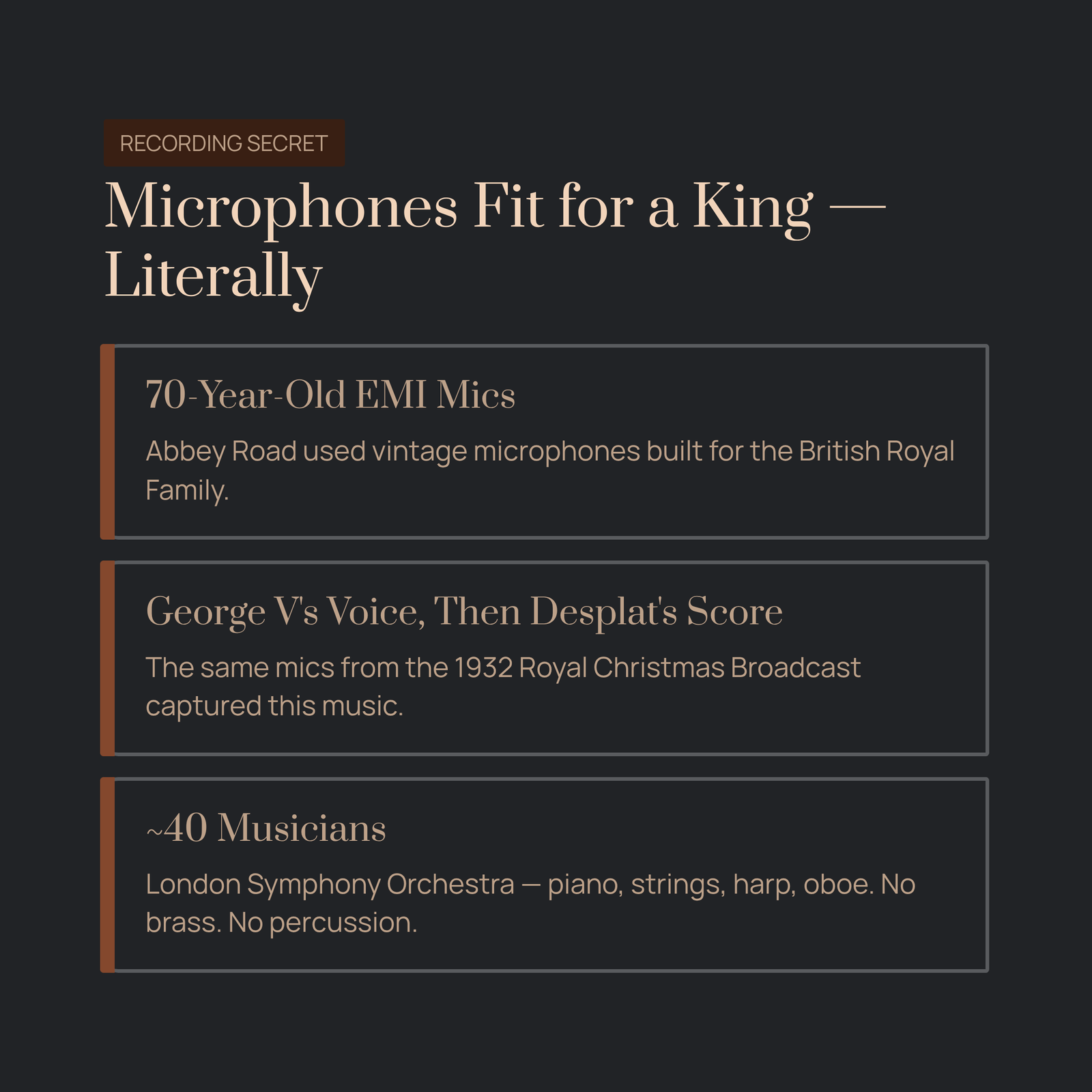
Here is a detail that still gives me chills. When the production team at Abbey Road Studios prepared to record Desplat’s score, mastering engineer Peter Cobbin made a remarkable suggestion: rather than using modern equipment, they would record through vintage EMI microphones that had been stored in the archives for over seventy years. These weren’t just any old microphones. They had been specifically designed and built for the British Royal Family — the very instruments through which King George V delivered the first-ever Royal Christmas Broadcast in 1932, and through which George VI himself would later address his nation.
Think about that for a moment. The microphones that once captured a real king’s voice, trembling under the weight of duty and fear, were now capturing the fictional echo of that same struggle. The result is an unmistakable warmth — a slight softness around the edges of each note, as if the music is reaching you not from a modern studio but from a wood-paneled room in the 1930s, where someone is trying very hard to say something that matters.
Terry Davies conducted the London Symphony Orchestra for these sessions, working with a deliberately small ensemble of around forty musicians. Desplat chose his palette with surgical precision: piano, strings, a gentle harp, and the occasional breath of oboe or clarinet. No brass fanfares. No percussion. Nothing that could shout. This was a score that needed to whisper, and the vintage microphones gave that whisper its own particular shade of amber.
Listening to Silence Between the Notes
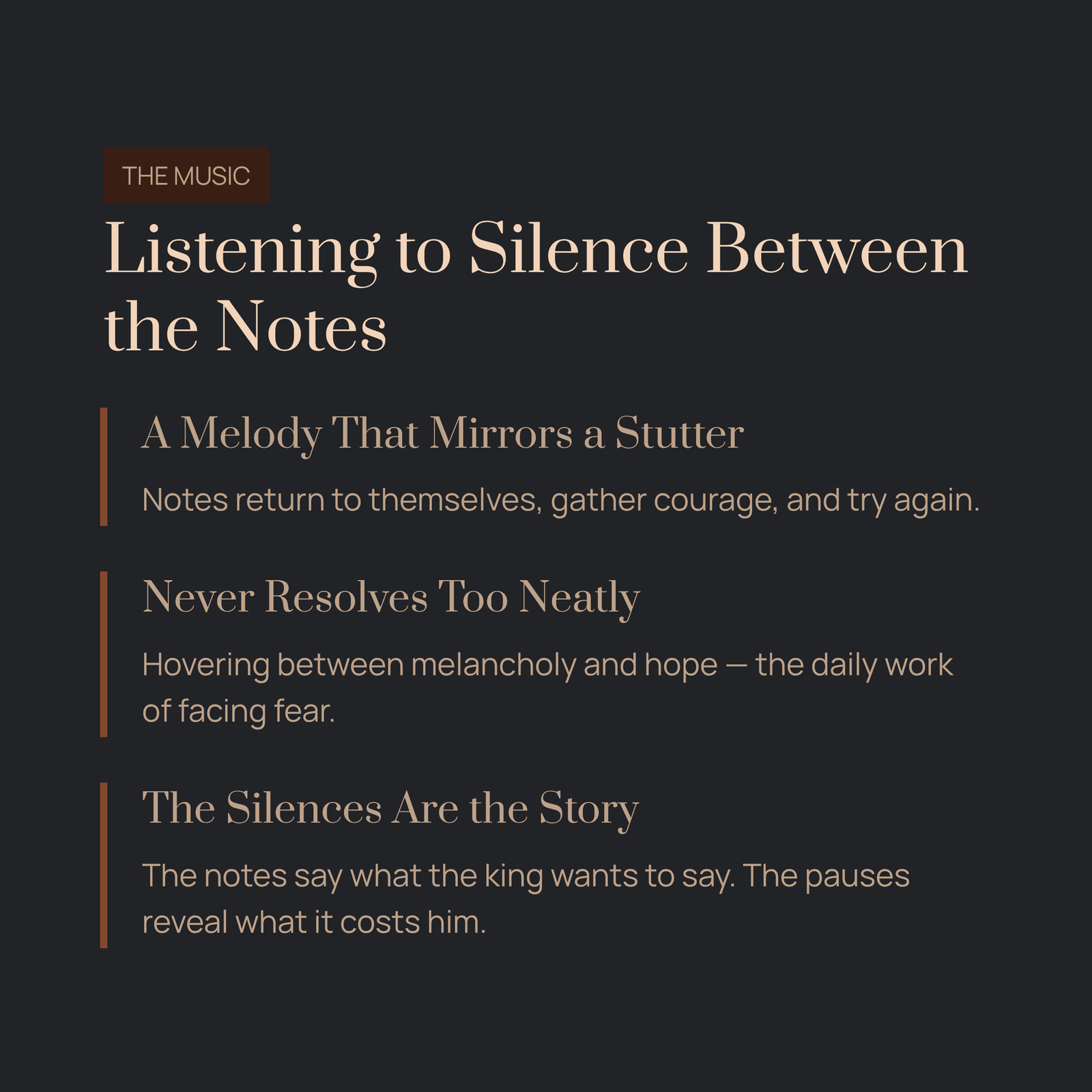
The Main Theme itself is a masterclass in what musicians sometimes call “the architecture of restraint.” It opens with that solitary piano figure — a simple, stepwise melody that moves with the careful deliberation of someone choosing each word before they speak. The rhythm is unhurried, almost halting, and if you listen closely, you can hear in its gentle repetitions something that mirrors the pattern of a stutter: a note that returns to itself, gathers courage, and tries again.
Pizzicato strings enter beneath the piano like soft footsteps joining a walk. They don’t lead; they accompany. And when the bowed strings finally arrive, they do so with a warmth that feels less like an orchestral entrance and more like an embrace. The melody never climbs to dramatic heights. It stays in a middle register, intimate and close, as if the music is speaking directly into your ear rather than projecting to the back of a concert hall.
What makes this theme so emotionally effective is its refusal to resolve too neatly. The harmonic language hovers in a space between melancholy and hope — never quite arriving at a triumphant conclusion, never collapsing into despair. It captures perfectly the emotional landscape of the film: the daily, unglamorous work of facing a fear that doesn’t disappear just because you’ve decided to be brave. There is dignity in this music, but it is the dignity of effort, not of arrival.
If you’re listening for the first time, I’d suggest this: don’t put it on as background music. Not yet. Give it one focused listen with your eyes closed. Pay attention to the spaces between the notes — the tiny silences where the piano seems to pause and gather itself. That’s where the real story lives. The notes tell you what the king wants to say. The silences tell you what it costs him to say it.
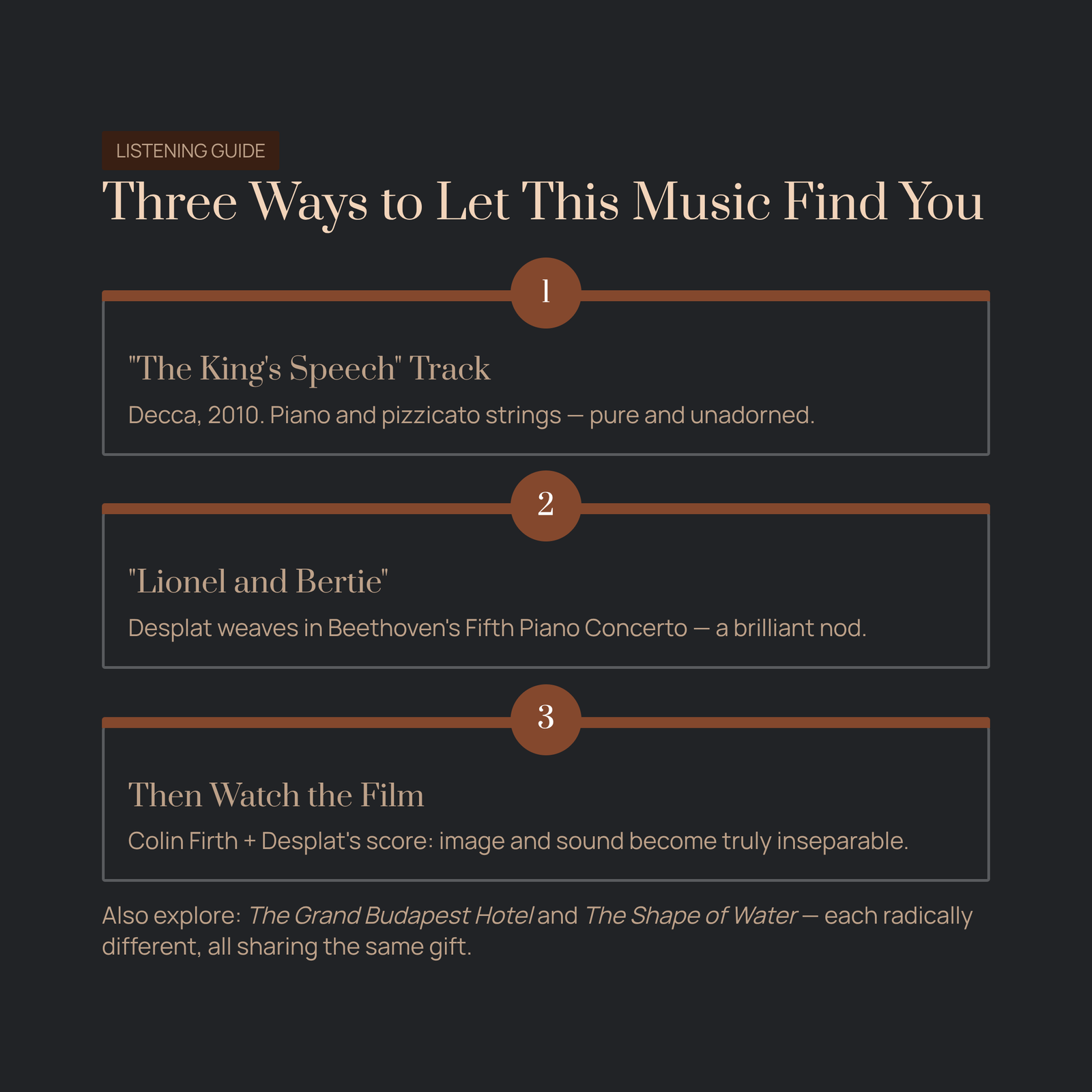
Three Ways to Let This Music Find You
For those who want to go deeper, here are a few listening paths I’d recommend.
Start with the original soundtrack album, released by Decca Records in 2010. The track titled “The King’s Speech” presents the Main Theme in its purest form — piano and pizzicato strings, intimate and unadorned. From there, move to “Lionel and Bertie,” the opening track, where Desplat subtly weaves in a reference to the slow movement of Beethoven’s Fifth Piano Concerto — a brilliant nod to the classical music that becomes so central to the film’s emotional climax. Then listen to “The Threat of War,” where the same compositional vocabulary transforms into something tense and foreboding, showing you just how much emotional range Desplat can achieve with the simplest materials.
If you enjoy the experience, seek out the film itself. Watching Colin Firth embody the physical struggle of speech while Desplat’s music breathes alongside him is one of those rare cases where image and sound become truly inseparable. The climactic scene — where the king delivers his wartime radio address accompanied by the second movement of Beethoven’s Seventh Symphony — is extraordinary, but it only works because Desplat has spent the entire film teaching us what courage sounds like when it’s quiet.
And finally, for a broader appreciation of Desplat’s artistry, I’d recommend exploring his scores for The Grand Budapest Hotel and The Shape of Water. Each is radically different in color and mood, yet all three share that signature quality: an ability to say the most with the least, to find the enormous inside the intimate.
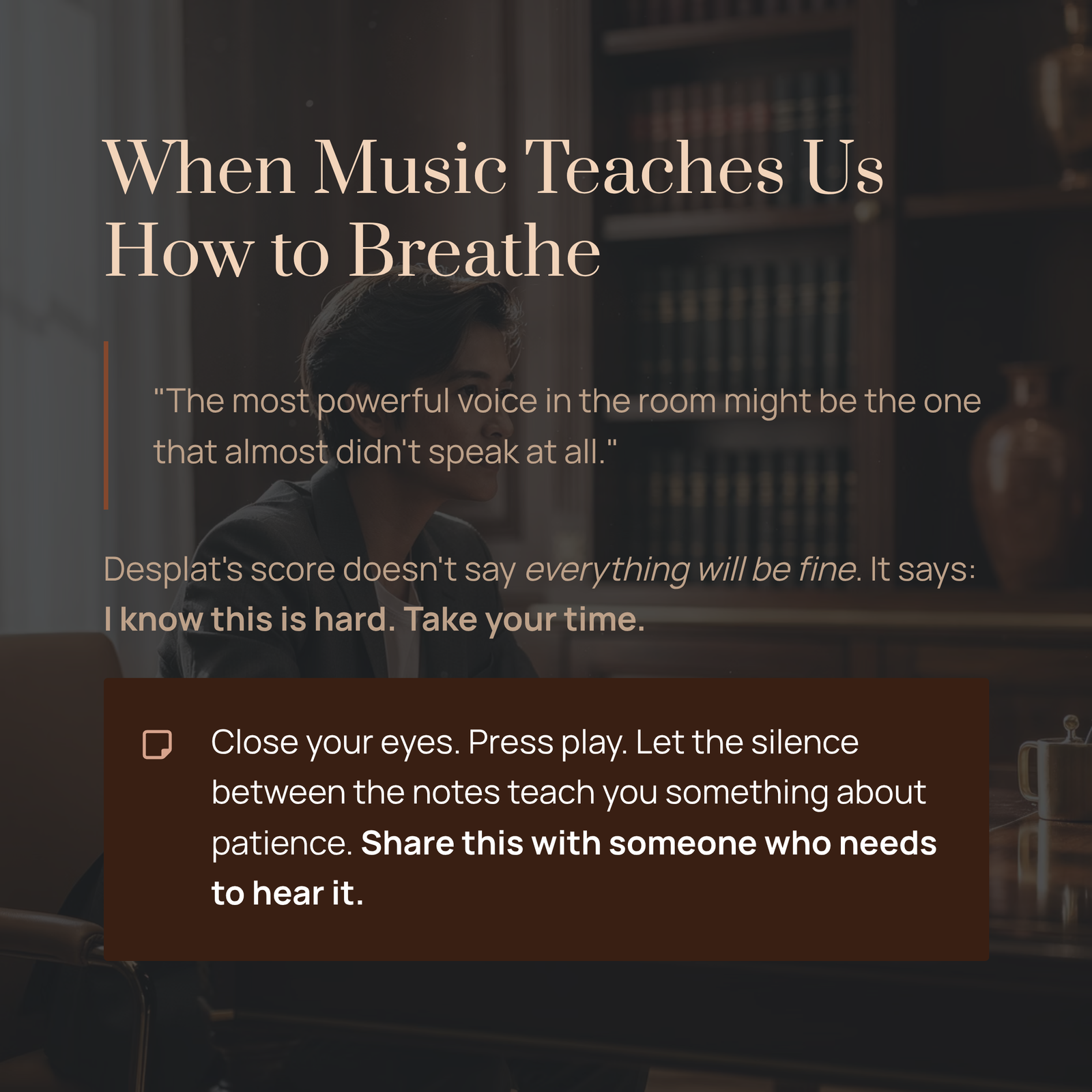
When Music Teaches Us How to Breathe
I keep returning to this score at moments when I feel overwhelmed by noise — not just the literal noise of the world, but the internal noise of expectations, deadlines, and the relentless pressure to perform. There is something deeply comforting about music that acknowledges difficulty without trying to fix it. Desplat’s Main Theme doesn’t say, “Everything will be fine.” It says, “I know this is hard. Take your time.”
Perhaps that’s why this piece has found its way into so many playlists labeled “focus” or “calm” or “deep work.” It creates a particular quality of attention — not the sharp, caffeinated focus of driving rhythms, but the softer focus of someone fully present in a quiet room. The piano’s gentle pulse becomes a kind of breathing exercise, a reminder that the next note will come when it’s ready, and not a moment before.
In the end, what Alexandre Desplat achieved with The King’s Speech goes beyond film scoring. He composed a meditation on the courage it takes to be heard — and on the grace it takes to listen. In a world that rewards volume, speed, and certainty, this small, careful piece of music makes a radical argument: that the most powerful voice in the room might be the one that almost didn’t speak at all.
Close your eyes. Press play. And let the silence between the notes teach you something about patience you didn’t know you needed to learn.