📑 Table of Contents
There is a scene in Good Will Hunting where Robin Williams sits on a park bench and tells Matt Damon that real loss is something you can only learn by loving someone more than you love yourself. No music swells beneath those words. Danny Elfman knew exactly when to stay silent. But everywhere else in the film, a thin, wandering melody carried on a pennywhistle does what dialogue cannot — it traces the outline of a young man’s loneliness before he even understands it himself.
The first time I pressed play on the Main Title, I expected Danny Elfman’s signature darkness. After all, this is the man who built the sonic cathedrals of Batman and gave The Nightmare Before Christmas its carnival-of-the-damned energy. What I got instead was something so fragile, so luminous, that I had to check the composer credit twice. A single pennywhistle, a murmur of strings, and a guitar gently picking its way through a theme that sounds like someone remembering a place they have never actually been. That quiet shock — the gap between expectation and what actually fills your ears — is precisely what makes this score unforgettable.
From Oingo Boingo to Oscar Night: An Unlikely Journey
Danny Elfman’s path to film music reads like a novel someone would call implausible if it were fiction. Born in Los Angeles in 1953, he dropped out of high school, followed his older brother Richard to France, busked violin on Parisian streets, and wandered through West Africa for a year absorbing the rhythms of Highlife music. Back in LA, he became the frontman of Oingo Boingo, a frenetic new-wave band built on ska, punk energy, and sheer theatrical chaos. They were massive in Southern California but never quite cracked the national mainstream — a detail that somehow makes the story better.
When Tim Burton, then a young director and a genuine Oingo Boingo fan, invited Elfman to score Pee-wee’s Big Adventure in 1985, Elfman had no formal training in orchestration. He could not read or write traditional notation fluently. What he did have was an ear shaped by Bernard Herrmann, Nino Rota, and years of performing music that refused to sit inside any single genre. With his Oingo Boingo bandmate Steve Bartek handling the orchestrations, Elfman delivered a score so inventive that it launched one of Hollywood’s most enduring composer-director partnerships.
By 1997, Elfman had already defined the sound of Burton’s gothic universe — Batman, Edward Scissorhands, Mars Attacks! But Good Will Hunting, his second collaboration with director Gus Van Sant, asked for something entirely different. No grand orchestral gestures. No dark whimsy. Just the emotional weather of a working-class kid from South Boston who happens to be a mathematical genius and has absolutely no idea what to do with his own heart. The score Elfman wrote for this story earned him his very first Academy Award nomination — a milestone that, by all accounts, caught even him off guard.
The Sound of Boston’s Unspoken Heart
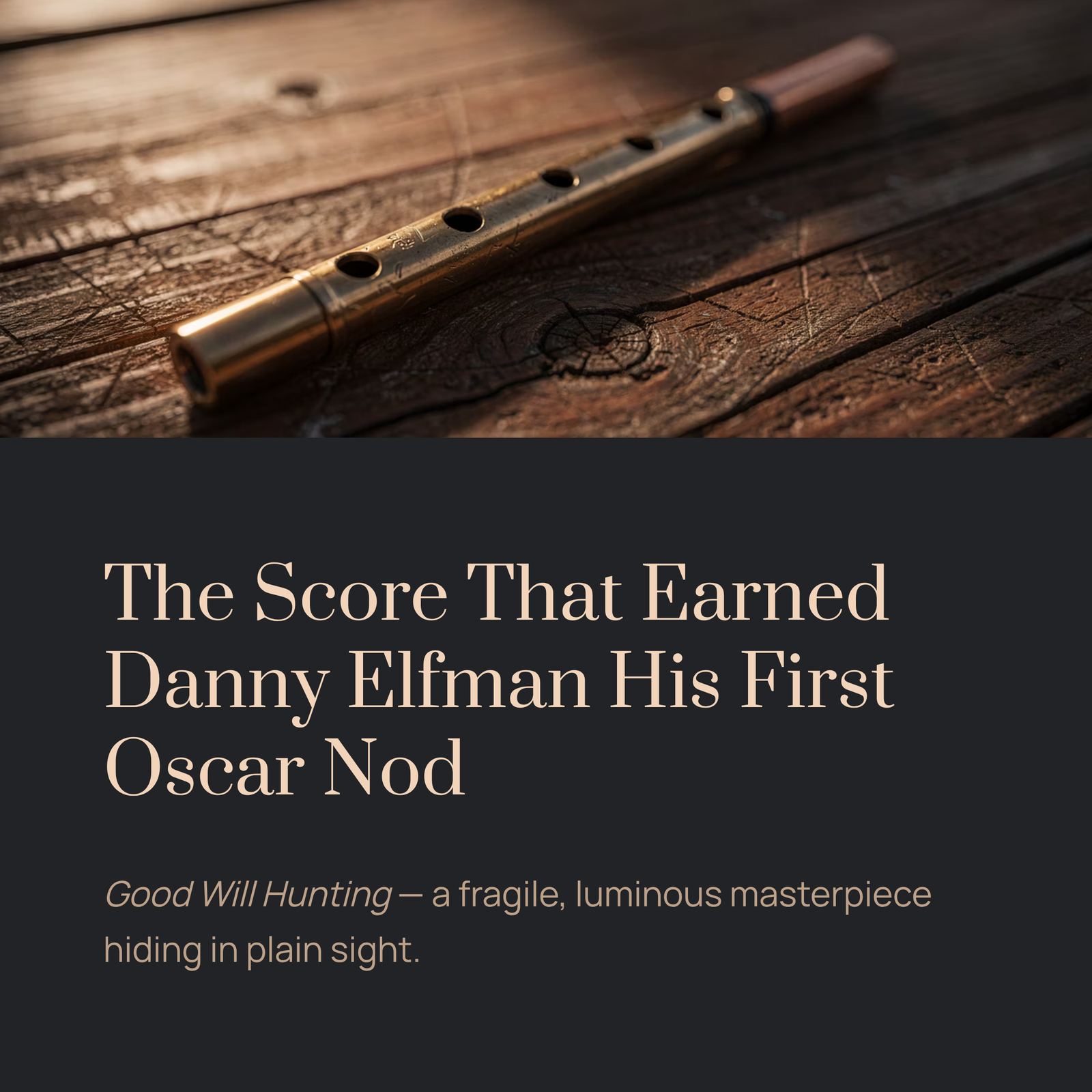
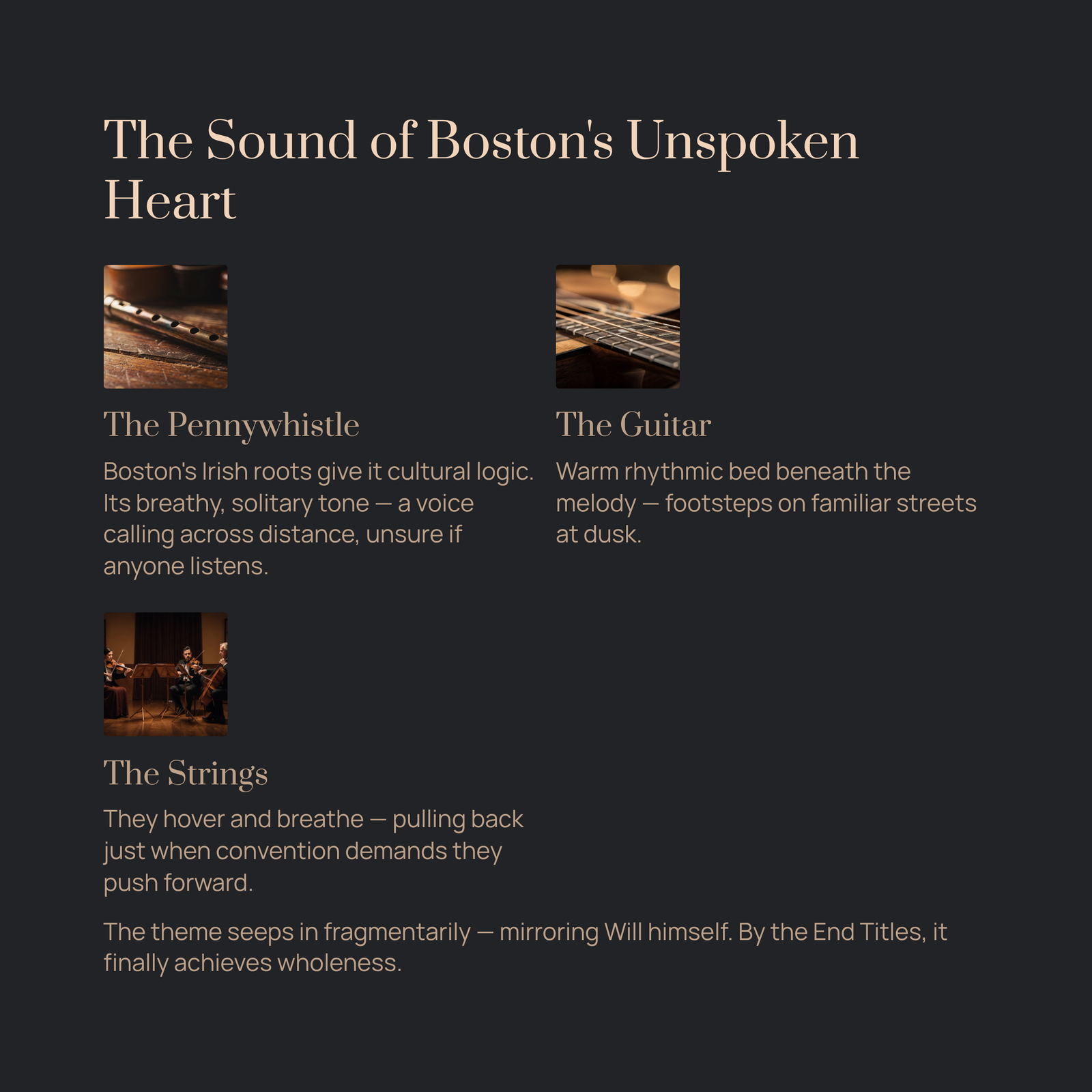
What makes the Good Will Hunting Main Theme so remarkable is its economy. Elfman strips his palette down to the essentials: an Irish pennywhistle carrying the main melodic line, acoustic guitar providing a warm rhythmic bed, a chamber-sized string section, gentle woodwinds, and the faintest whisper of choir hovering at the edges like morning fog that has not yet burned off.
The Irish tinge is deliberate and brilliant. Boston’s deep historical connection to Irish immigration gives the pennywhistle a geographic and cultural logic, but Elfman uses it for something beyond local color. The instrument’s breathy, slightly nasal tone has an inherently solitary quality — it sounds like a voice calling across a distance, never quite sure if anyone is listening. This is Will Hunting’s emotional signature translated into sound. The boy who can solve equations that stump MIT professors but cannot bring himself to knock on a girl’s door.
Listen to how the main theme unfolds in the opening titles. It does not announce itself. It seeps in, almost accidentally, with fragments of the melody scattered across different instruments before the pennywhistle gathers them into a coherent line. This fragmentary approach mirrors Will himself — a person whose extraordinary gifts exist in pieces, disconnected from any stable sense of self. Only gradually, across the film’s runtime, does the theme consolidate, grow warmer, allow the strings a fuller voice. By the End Titles, the melody finally achieves something close to wholeness, as if the music has undergone the same therapeutic journey as its protagonist.
A Listening Guide: What to Notice on Each Hearing
If you are approaching this score for the first time, here is how I would suggest building your relationship with it, because this is music that deepens enormously with repeated listening.
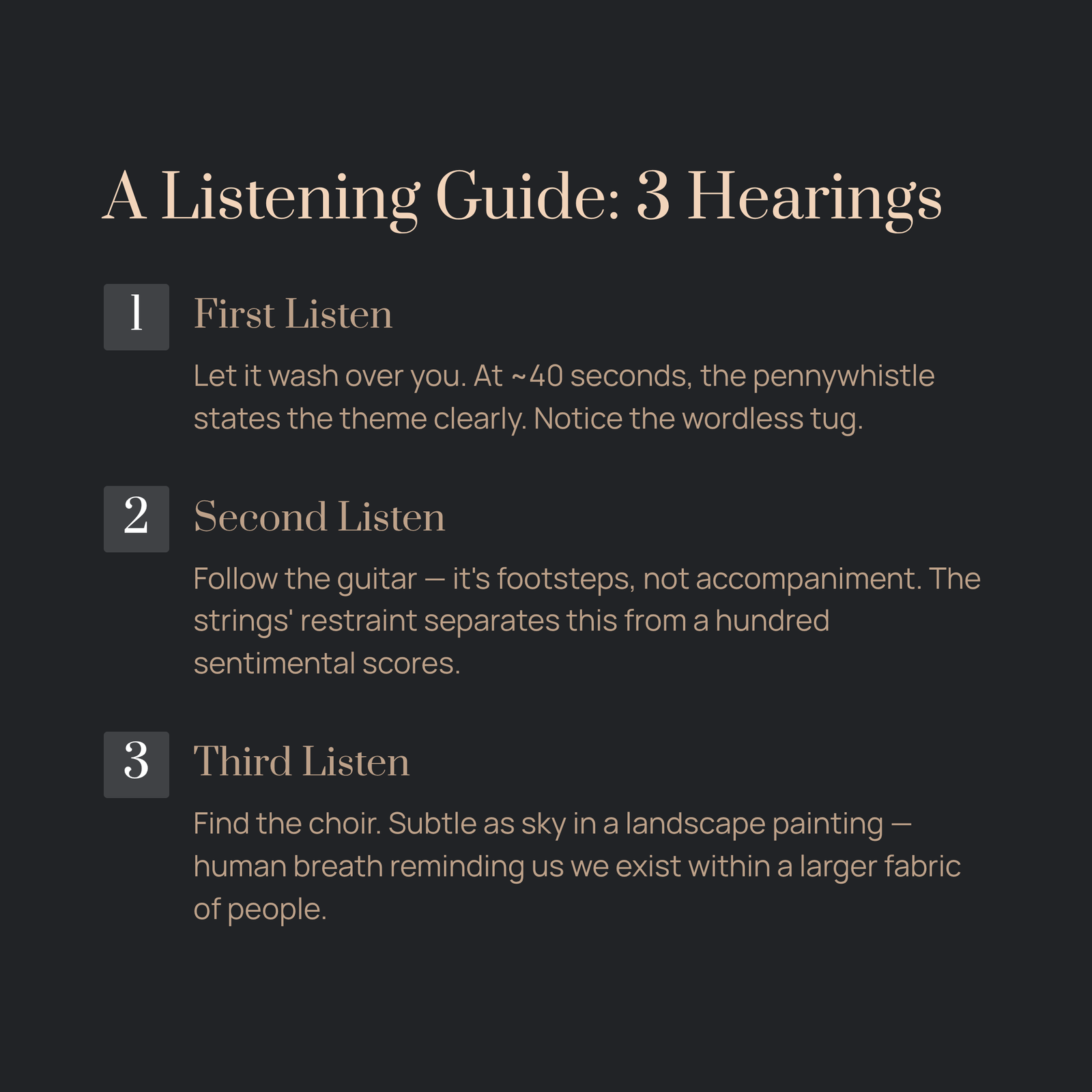
On your first listen, simply let the Main Title wash over you without analysis. Pay attention to how your body responds. There is a particular moment, roughly forty seconds in, where the pennywhistle states the theme’s central phrase for the first time with complete clarity. Notice what you feel in that instant — a tug, a pang, something difficult to name. That wordless recognition is exactly what Elfman designed the music to produce.
On a second hearing, shift your attention to the texture beneath the melody. The acoustic guitar is doing far more than simple accompaniment. It creates a rhythmic pulse that feels like footsteps — like someone walking through familiar streets at dusk, neither rushing nor dawdling, just moving through space and thought simultaneously. Meanwhile, the strings do not soar the way Hollywood convention demands. They hover, they breathe, they pull back just when you expect them to push forward. This restraint is what separates Elfman’s work here from a hundred other sentimental film scores.
On a third listen, try following the choir. It appears so subtly that many listeners miss it entirely on first exposure. It functions almost like the sky in a landscape painting — you do not consciously look at it, but without it the entire scene would feel claustrophobic. Elfman’s choir in this score is not singing words or even distinct vowels. It is simply a texture of human breath, a reminder that even in loneliness, we exist within a larger fabric of people.
Recommended Recordings and Versions
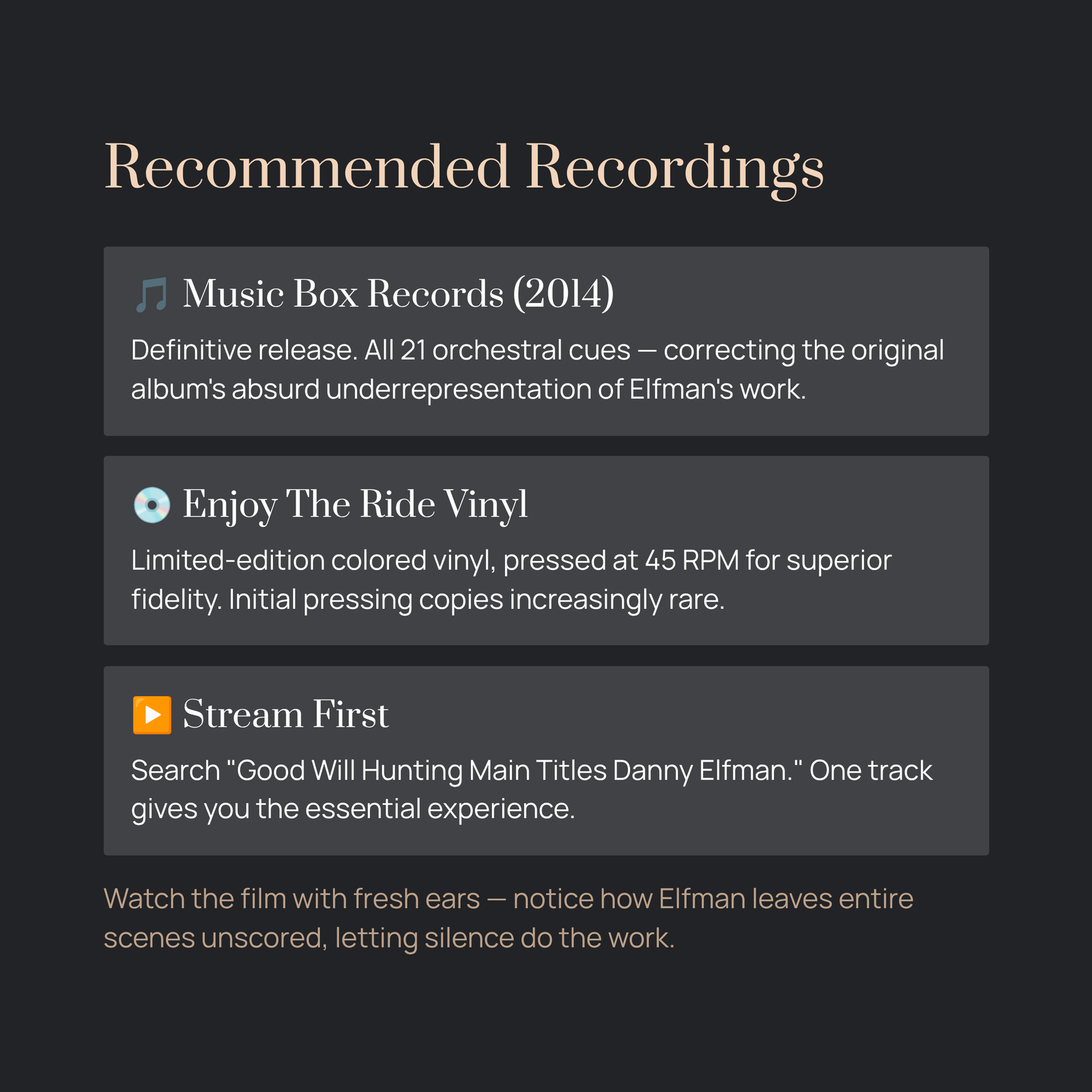
The definitive release of this score is the 2014 Music Box Records album, which presents Elfman’s complete score for the first time alongside Elliott Smith’s songs from the film. For years, the original 1997 soundtrack album featured mainly Smith’s contributions with only two of Elfman’s cues — an absurd underrepresentation given the score’s quality. The Music Box edition corrects this, offering all twenty-one tracks of Elfman’s orchestral work in pristine sound.
If you are a vinyl collector, Enjoy The Ride Records released the score on limited-edition colored vinyl, pressed at 45 RPM for superior audio fidelity. It is a beautiful object and sounds gorgeous, though copies from the initial pressing are increasingly difficult to find.
For a quick entry point, search for “Good Will Hunting Main Titles Danny Elfman” on your preferred streaming platform. This single track gives you the essential experience — the pennywhistle theme, the gentle guitar, the gradually expanding orchestration. If it moves you, the full score album will feel like a conversation you did not want to end.
It is also worth watching the film itself with fresh ears tuned to the score. Notice how Elfman leaves entire scenes unscored, allowing silence and Elliott Smith’s folk songs to carry the more intimate moments, while his orchestral writing handles the wider emotional landscape — the passages of time, the shifting seasons of Will’s internal world, the slow accumulation of trust between patient and therapist.
The Quiet Genius of Restraint
There is something profoundly instructive about the fact that Danny Elfman — a man who built his reputation on maximalism, on music that filled every corner of the room with color and shadow and kinetic energy — wrote his most emotionally devastating work by taking almost everything away. The Good Will Hunting score contains no bombastic brass fanfares, no thundering percussion, no gothic organ swells. It is music made of breath and wood and string, as simple and as complex as the act of one person finally allowing another person to see them clearly.
I return to this Main Theme on evenings when the world feels louder than I can handle. Not because it is relaxing in the way that ambient playlists promise relaxation, but because it does something harder and more valuable: it sits with discomfort. It acknowledges that vulnerability is terrifying and does not pretend otherwise. And then, measure by measure, it walks you toward something that is not resolution exactly, but readiness. A willingness to step outside the walls you have built. A melody that says, without a single word, that it is not your fault — and that the real courage is in letting someone else believe that on your behalf.
If you have never given film scores a serious listen as standalone music, this is the place to start. Not because it is easy, but because it is honest. And in classical and orchestral music, as in life, honesty is the rarest and most rewarding thing you will ever find.