📑 Table of Contents
There is a particular kind of music that doesn’t wait for you to be ready. It doesn’t knock politely at the door of your attention. It crashes through the hull of your concentration like a cannonball, and before you know it, you’re standing a little taller, your heart is pounding a little faster, and some reckless, unnameable part of you wants to do something daring.
That is exactly what happens when the opening bars of “He’s a Pirate” hit your ears.
I remember the first time I heard it — not in a concert hall, not through careful study, but in a darkened movie theater in 2003, watching Johnny Depp stumble onto a sinking boat. The music didn’t just accompany the scene. It became the scene. It told me, in the space of a few seconds, that this story was going to be fun, reckless, and completely unapologetic about it. Two decades later, that feeling hasn’t faded one bit. If anything, it has only grown stronger with time, as the theme has taken on a life far beyond the film that birthed it.

The Man Who Scores in Colors, Not Notes
To understand “He’s a Pirate,” you first need to understand the mind behind it. Hans Zimmer is not your typical film composer — if such a thing even exists. Born in Frankfurt, Germany, in 1957, Zimmer never followed the traditional conservatory path. He was largely self-taught, a restless experimentalist who cut his teeth in the London pop and electronic music scene of the 1970s and 80s before ever stepping foot in a Hollywood scoring stage.
This background is crucial. Where classically trained composers might reach for counterpoint and fugue, Zimmer reaches for texture, rhythm, and raw emotional force. His orchestral writing doesn’t sound like Mozart or even John Williams — it sounds like a wall of feeling, built from layers of synthesizers, percussion, and live orchestra fused together into something that hits you in the chest before it reaches your brain.
By the time Pirates of the Caribbean: The Curse of the Black Pearl came along in 2003, Zimmer was already a titan of film music, with an Oscar for The Lion King and landmark scores for Gladiator and The Thin Red Line under his belt. But the Pirates project presented a unique challenge — and a unique opportunity.
It’s worth noting that the score’s creation has an interesting backstory. Klaus Badelt is officially credited as the composer, but the theme was developed within Zimmer’s studio at Remote Control Productions (then called Media Ventures), with Zimmer’s deep involvement in shaping the musical identity. The collaborative, workshop-style environment of Zimmer’s studio means that the line between mentor and collaborator often blurs — but the sonic DNA of “He’s a Pirate” is unmistakably Zimmer’s.
Inside the Storm: What Makes This Theme Work
So what is it about this piece that makes it so electrifying? Let me walk you through it, no music degree required.
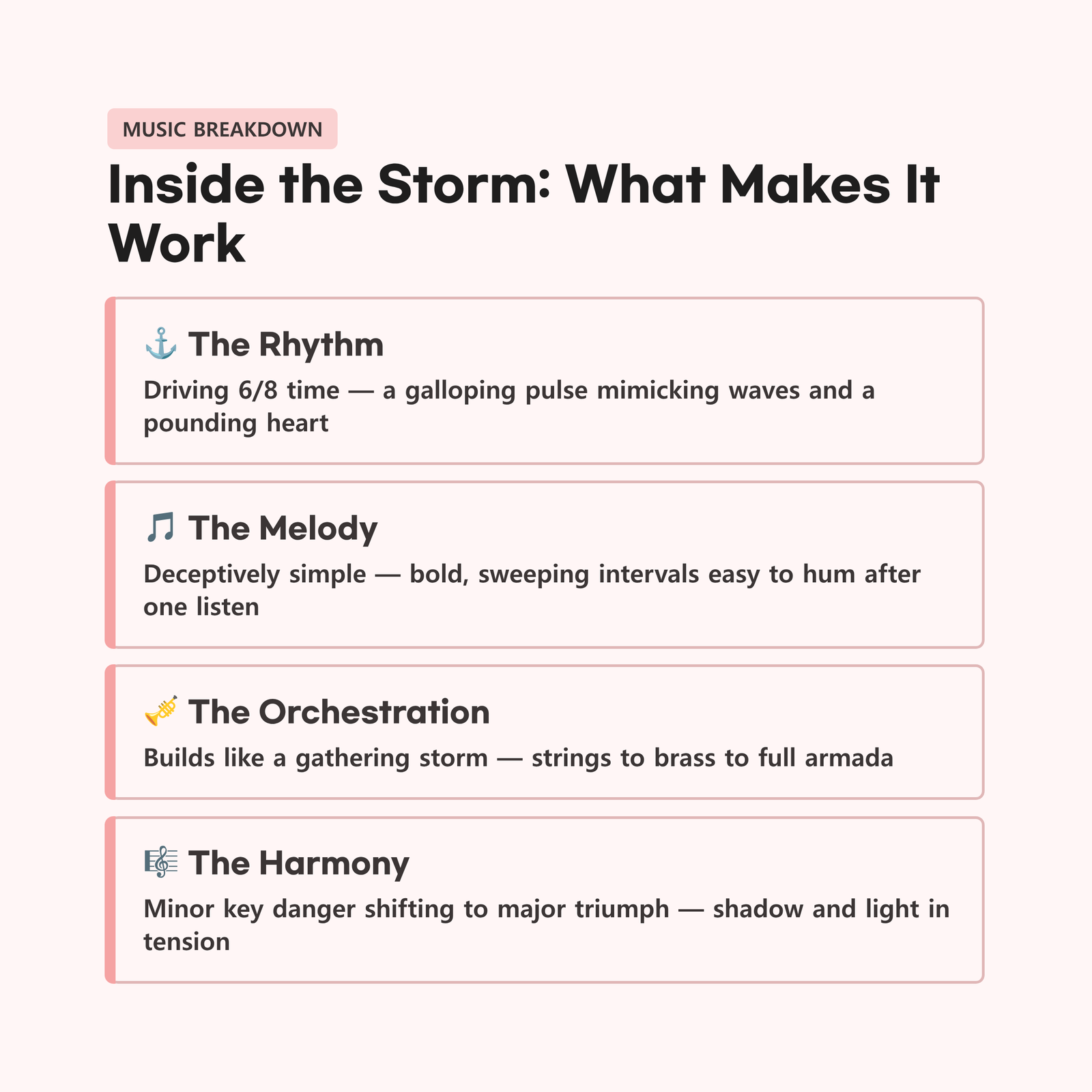
The rhythm is the engine. Before you even register the melody, your body responds to the driving 6/8 time signature — a galloping, surging pulse that mimics the roll of waves and the pounding of a heart in pursuit. This isn’t a waltz; it’s a chase. The relentless rhythmic energy underneath everything is what gives the piece its unstoppable forward momentum. If you tap your foot or bob your head while listening, that’s the 6/8 doing its work.
The melody is deceptively simple. Here’s a secret about great themes: they’re almost always simpler than you think. The main melody of “He’s a Pirate” uses a handful of notes, moving in bold, sweeping intervals that are easy to hum after a single listen. This is intentional. Zimmer understands that a theme needs to be memorable above all else — complexity can come in the arrangement, but the core idea must be as sharp and immediate as a sword being drawn from its scabbard.
The orchestration builds like a gathering storm. Listen to how the piece begins with strings carrying the melody, then gradually layers in brass, percussion, and finally the full orchestra in a triumphant blaze. Each new instrument that enters is like another ship joining the fleet. By the time the brass section takes over the main theme, you feel as though you’ve gone from watching a single sail on the horizon to standing in the middle of an entire armada.
The harmony walks a tightrope between minor and major. This is subtle but powerful. The piece lives primarily in a minor key, which gives it that edge of danger and darkness — these are pirates, after all, not Sunday school teachers. But at key moments, the harmony shifts toward major, flooding the music with heroism and triumph. This constant tension between shadow and light is what makes the theme feel adventurous rather than simply aggressive.
Why This Piece Matters Beyond the Movies
I’ll be honest with you: there was a time when I might have dismissed film music as somehow “lesser” than concert hall classical music. Many purists still do. But pieces like “He’s a Pirate” have thoroughly dismantled that prejudice for me.
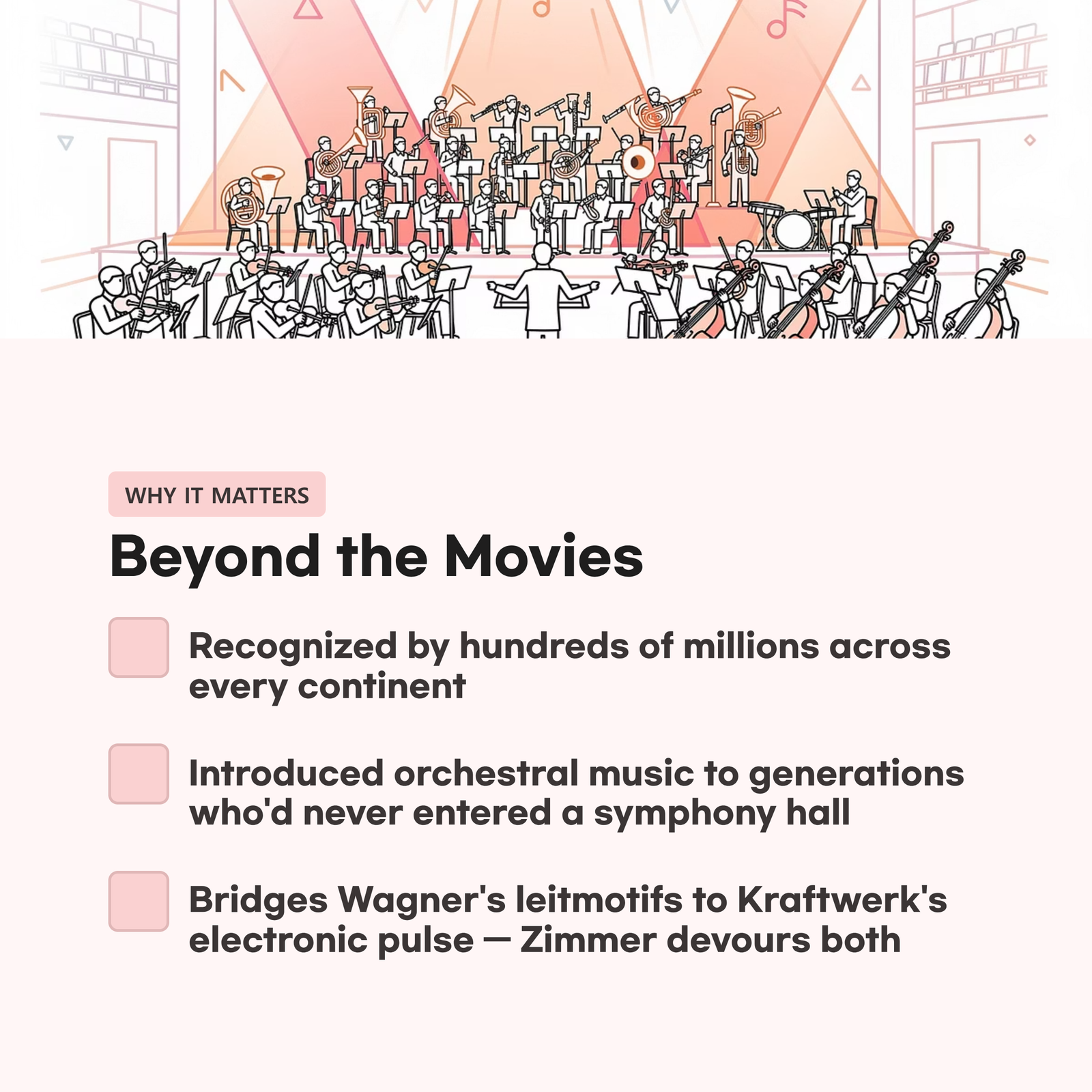
Consider what this theme actually accomplishes. It communicates character, setting, mood, and narrative arc in under three minutes. It is recognized by hundreds of millions of people across every continent. It has introduced orchestral music to entire generations who might never have set foot in a symphony hall. And it does all of this while being genuinely, thrillingly good music — music that rewards repeated listening, that reveals new details in its orchestration each time, that stands on its own even when separated from the images it was written to accompany.
Hans Zimmer occupies a fascinating position in the broader landscape of Western music. He is a bridge figure — connecting the traditions of orchestral composition that stretch back centuries to the electronic and popular music of our own time. When you listen to the thundering brass of “He’s a Pirate,” you’re hearing echoes of Wagner’s leitmotifs and Holst’s planetary suites. When you feel that driving electronic pulse underneath the strings, you’re hearing the legacy of Kraftwerk and Tangerine Dream. Zimmer doesn’t choose between these traditions. He devours them all.
How to Really Listen: A Practical Guide
If you want to move beyond simply enjoying this piece — though there’s absolutely nothing wrong with that — here are some ways to deepen your experience.
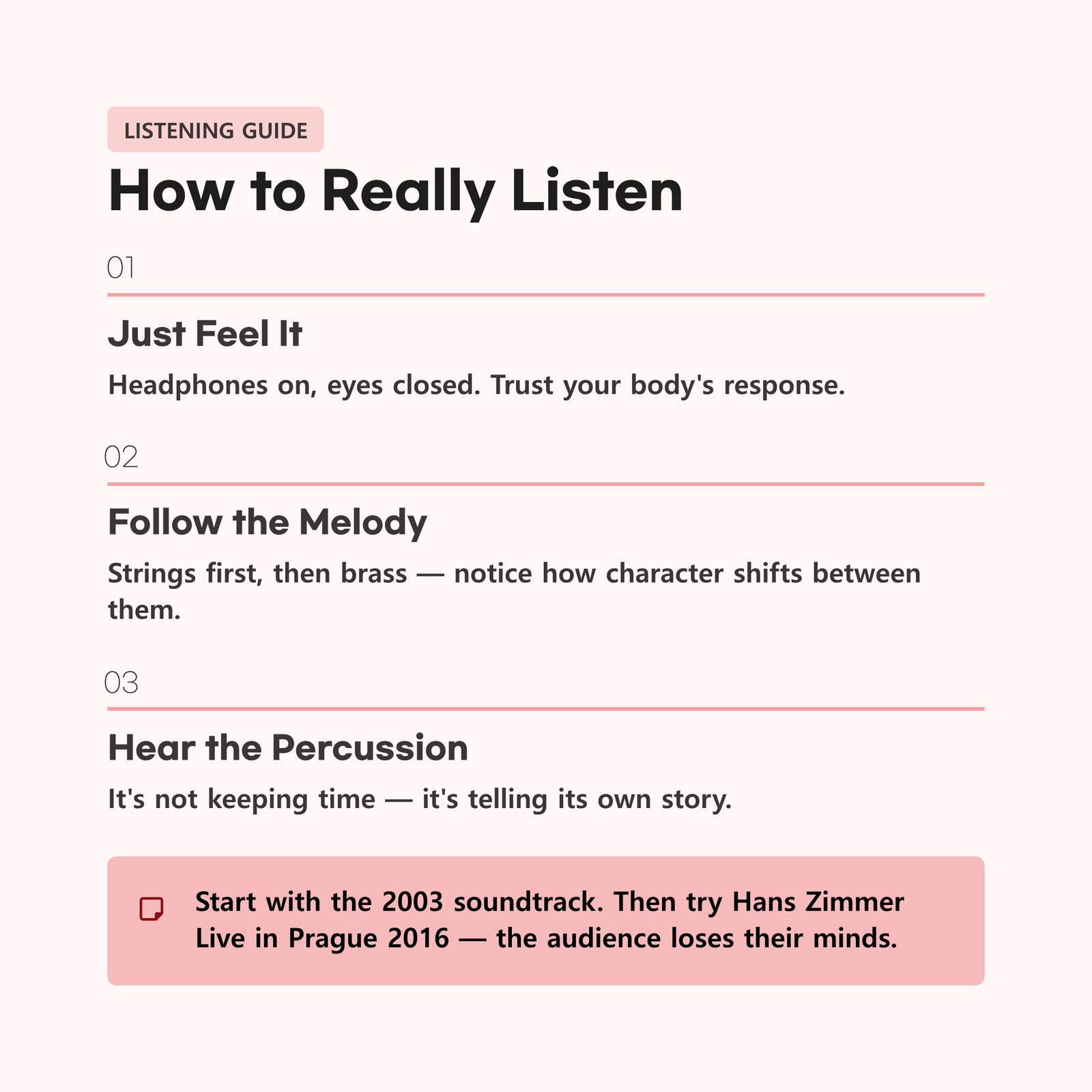
First listen: Just feel it. Don’t analyze. Don’t think. Put on a good pair of headphones, close your eyes, and let the music wash over you. Notice where your pulse quickens, where you feel a swell of emotion, where you involuntarily smile. Your body already knows what this music is doing. Trust it.
Second listen: Follow the melody. Track the main theme as it passes from instrument to instrument. Strings carry it first, then the brass takes over. Notice how the melody changes character depending on who’s playing it — lighter and more nimble in the strings, bold and declarative in the brass.
Third listen: Pay attention to the percussion. This is where Zimmer’s genius for rhythm really shines. The percussion section isn’t just keeping time — it’s telling its own story, building intensity, creating moments of tension and release that drive the entire piece forward.
For recordings, I’d recommend starting with the original 2003 soundtrack album, which captures the raw energy of the initial recording sessions. For a live experience, search for any of the “Hans Zimmer Live” concert recordings — hearing this piece performed by a full orchestra and band in an arena setting is an entirely different and magnificent experience. The 2016 Live in Prague performance is particularly electric, with Zimmer himself on stage conducting and the audience visibly losing their minds.
If you enjoy “He’s a Pirate,” let it be a gateway. Explore the rest of Zimmer’s Pirates scores — “The Kraken” and “Up Is Down” are personal favorites. Then venture further: the meditative power of Interstellar, the controlled fury of The Dark Knight, the shimmering beauty of Inception. Each score is its own world, built by the same restless, brilliant mind.
The Freedom in the Music
There’s a reason pirate stories never go out of style. They speak to something deep and ungovernable in the human spirit — a longing for freedom, for adventure, for a life unbound by the rules that normally constrain us. Hans Zimmer understood this instinctively, and he poured that understanding into every note of “He’s a Pirate.”
What strikes me most, after all these years of listening, is how generous this music is. It doesn’t demand expertise or education. It doesn’t require you to know the difference between a sonata and a sonatina. It simply grabs you by the collar and says: Come with me. There’s a horizon out there, and it’s worth chasing.
That, I think, is the highest compliment you can pay any piece of music. Not that it is technically perfect. Not that it satisfies the critics. But that it makes you feel, for a few blazing minutes, utterly and completely alive.