📑 Table of Contents
There is a moment, about fifteen minutes into a piece most people have never heard of, when the entire orchestra seems to take a breath at the same time. The piano enters quietly, almost shyly, and then the strings rise underneath it like a tide coming in. If you have ever heard music in a film during the scene where two people finally admit they love each other, you have probably heard this melody without knowing its name.
This is Variation 18 from Rachmaninoff’s Rhapsody on a Theme of Paganini. It lasts barely three minutes. And it carries one of the strangest secrets in all of classical music: it was built by taking a sharp, almost sinister little tune and flipping it completely upside down.
Who Was Rachmaninoff?
Sergei Rachmaninoff was a Russian composer and pianist, born in 1873, who lived right at the seam between two musical worlds. While much of Europe was breaking music apart into dissonance and experiment, Rachmaninoff kept writing long, sweeping, deeply emotional melodies of the kind people associate with the great Romantic era. For a long time critics treated this as old-fashioned. Audiences disagreed, and audiences won.
He had enormous hands, said to span well beyond an octave, which is part of why his piano music can feel so full and resonant. But he was also famously self-doubting. After the disastrous premiere of his First Symphony, he fell into a depression so severe that he could barely compose for years, and only recovered with the help of a therapist who used what amounted to early hypnotherapy.
By 1934, Rachmaninoff was living in exile from his homeland following the Russian Revolution, splitting his life between America and a villa in Switzerland. It was at that villa, in a single inspired summer, that he wrote the Rhapsody.
What the “Theme of Paganini” Actually Means
To understand Variation 18, you need to know the thing it grew out of.
Niccolò Paganini was a violinist in the early 1800s so dazzlingly, terrifyingly skilled that rumors spread he had sold his soul to the devil to play that way. His most famous tune, the theme of his 24th Caprice, is quick, angular, and a little menacing. Generations of composers have used it as raw material, like a chef returning again and again to the same difficult ingredient.
A “rhapsody,” in this case, simply means a free-flowing set of variations. Rachmaninoff takes Paganini’s devilish little theme and runs it through twenty-four transformations, each one a different mood, speed, and character. Some are playful, some thunderous, one even quotes the medieval chant of the dead, the Dies irae, that Rachmaninoff loved to weave into his music.
And then, more than halfway through, comes the variation that stopped everyone cold.
The Trick Hidden Inside Variation 18
Here is the secret, and it is genuinely beautiful once you hear it.
Rachmaninoff took Paganini’s theme and inverted it. In plain terms: every place the original melody jumped up, his new version goes down, and every place it dropped, his version rises. He turned the tune into its own mirror image. The sharp, restless original becomes, when flipped, something tender, yearning, and wide open.
Rachmaninoff himself was wry about it. He reportedly said he wrote this variation “for my agent,” knowing a melody this gorgeous would help sell the whole piece. He was right. Variation 18 became so beloved it now lives a second life entirely on its own, in films, weddings, and countless quiet evenings.
There is something quietly profound in the trick, too. A theme associated with the devil, turned upside down, becomes a melody that sounds like pure love. As if Rachmaninoff were saying that what we hear as darkness only needs to be looked at from the other side.
How to Listen: A Three-Minute Guide
You do not need any training to feel this. But here are a few anchors so you know what is happening.
The shy opening (0:00–0:25). The piano states the melody alone, gently, almost as if testing whether it is safe to say something out loud. Stay with this restraint. It matters because of what comes next.
The first swell (around 0:30–1:00). The strings take the melody and lift it. You will feel the music begin to open outward, like a room filling with light.
The great climax (around 1:30–2:00). This is the moment everything has been building toward. The full orchestra and piano pour out the theme together at full strength. If a single passage in classical music has ever given you goosebumps, there is a good chance it lives somewhere in this minute.
The quiet farewell (final 30 seconds). The music doesn’t end in triumph. It withdraws, softening back down to almost nothing, like a wave pulling away from the shore. That bittersweet retreat is what makes the whole thing feel like a memory rather than a fantasy.
Recordings Worth Your Time
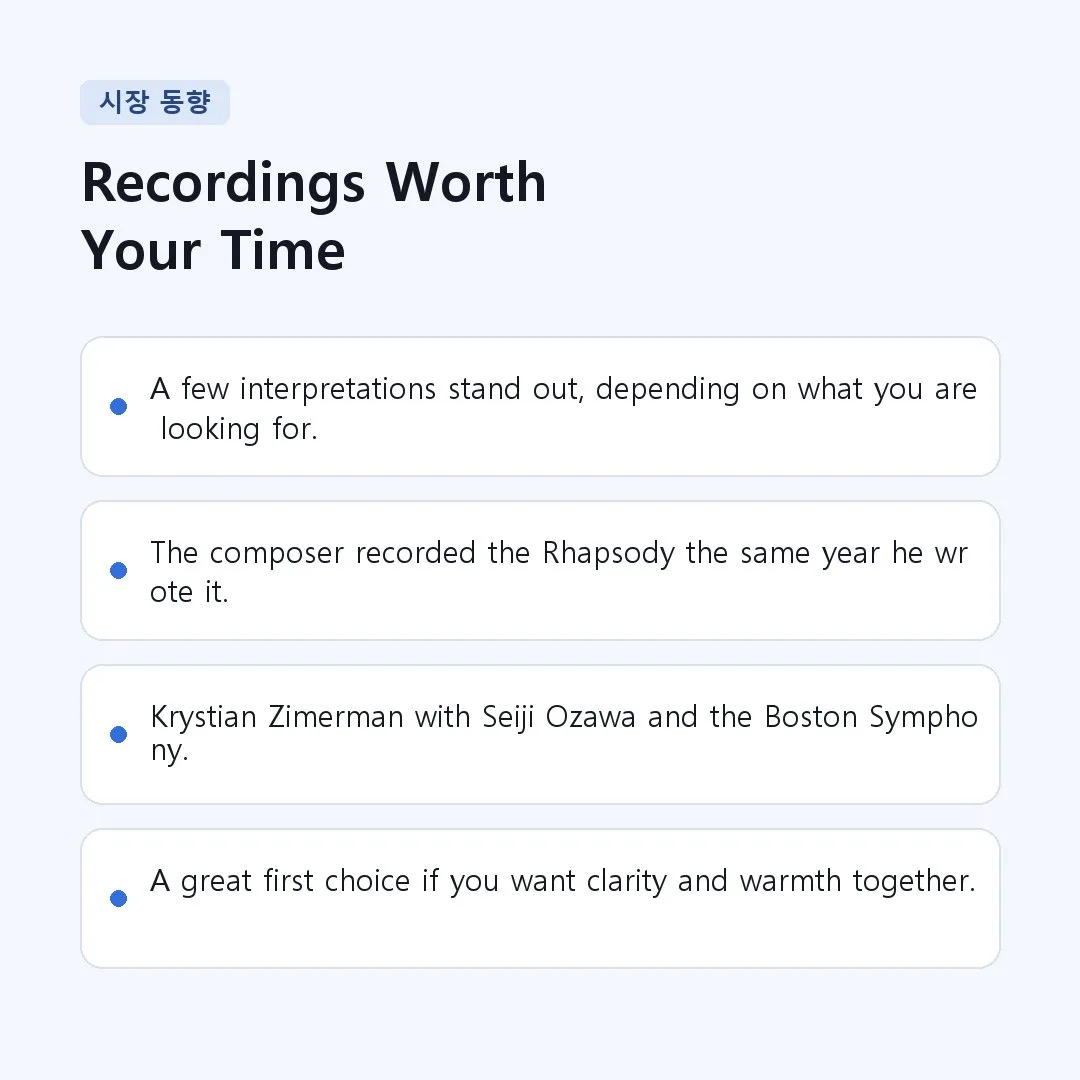
A few interpretations stand out, depending on what you are looking for.
Rachmaninoff himself, with Leopold Stokowski and the Philadelphia Orchestra (1934). The composer recorded the Rhapsody the same year he wrote it. The sound is old and a little crackly, but there is something irreplaceable about hearing the man who turned that melody upside down play it with his own hands.
Krystian Zimerman with Seiji Ozawa and the Boston Symphony. A modern reference recording for many listeners, with crystalline piano tone and a beautifully balanced orchestra. A great first choice if you want clarity and warmth together.
Daniil Trifonov. For listeners who want the most intensely romantic, almost cinematic reading, Trifonov leans fully into the emotion of Variation 18. His account of the whole Rhapsody is also a thrilling way to hear the famous variation in its proper context.
If you only have three minutes, search for “Variation 18” alone and let it surprise you. If you have twenty-five, listen to the full Rhapsody and arrive at Variation 18 the way Rachmaninoff intended, as a sudden clearing of sky after a storm.
Why This Small Piece Endures
Most music tries to overwhelm you. Variation 18 does something rarer. It withholds, then gives, then gently takes itself back, all inside the length of a pop song. It asks for almost nothing from you except that you sit still and let it happen.
That a melody this open and tender was hiding all along inside a devil’s tune, just waiting to be turned over, feels like the most human thing about it. We carry our own difficult themes around with us. Rachmaninoff suggests, in a little over three minutes, that they might be more beautiful than we think, if only we had the courage to look at them upside down.