📑 Table of Contents
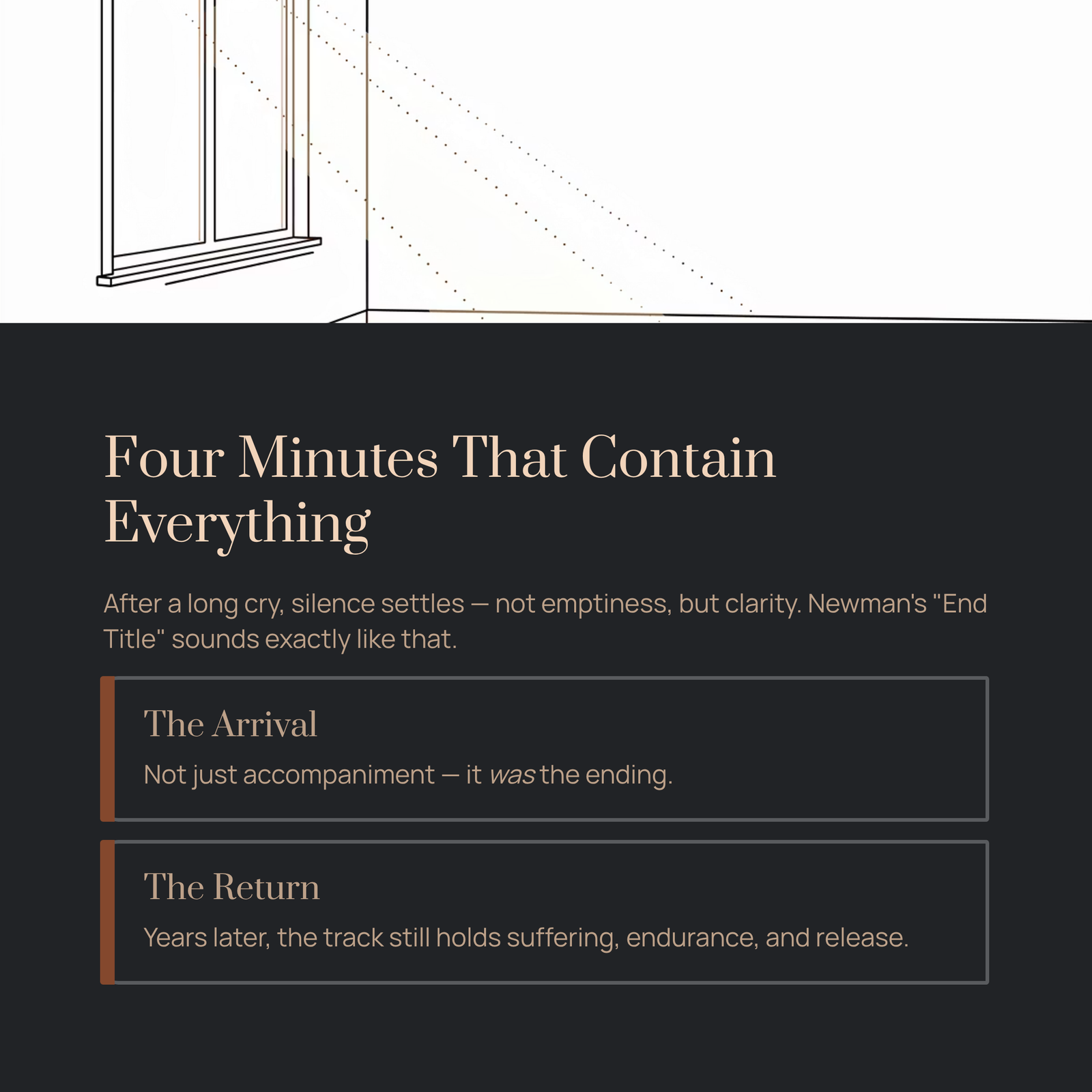
There is a particular kind of silence that settles over you after a long cry — not the emptiness of exhaustion, but something closer to clarity. Your chest still aches, your eyes still sting, but somewhere deep in the center of your body, something has loosened. A knot you forgot you were carrying has quietly come undone.
That silence — that exact, luminous stillness — is what Thomas Newman’s “End Title” from The Shawshank Redemption sounds like.
I first heard this piece the way most people did: as the final credits rolled after watching Andy Dufresne walk free. I was young enough to not fully understand the weight of what I had witnessed, but old enough to feel something crack open inside me. The music didn’t just accompany the ending. It was the ending — the emotional arrival point that the entire film had been quietly building toward for two and a half hours.
Years later, I find myself returning to this track not because of the movie, but because of what it does to me. Four minutes of orchestral music that somehow contains the entire arc of suffering, endurance, and release. It is, in the most unassuming way, one of the most powerful pieces of music I know.

The Newman Dynasty and Its Quietest Rebel
To understand the “End Title,” you first need to understand the man who wrote it — and the extraordinary musical family he was born into.
Thomas Newman arrived in the world in 1955, in Los Angeles, the youngest son of Alfred Newman, the legendary music director of 20th Century Fox who shaped the sound of Hollywood’s Golden Age. His uncle Lionel was also a studio music director. His cousin is Randy Newman, the singer-songwriter behind beloved Pixar soundtracks. Music was not a career choice for the Newman family; it was the air they breathed.
But Thomas took a different path than his father’s sweeping, golden-era romanticism. After studying at USC and Yale — where he worked under the mentorship of Broadway titan Stephen Sondheim — the younger Newman developed a style that was deliberately quieter, more interior, more strange. Where his father painted in bold orchestral strokes, Thomas preferred watercolors. He blended acoustic instruments with electronic textures, favored unusual timbres like marimbas, prepared pianos, and plucked strings, and had an almost uncanny ability to find the emotional undercurrent of a scene rather than its surface drama.
His early career was slow to ignite. Newman himself once admitted that it took him eight years of scoring films before he stopped feeling like a fraud. But in 1994, everything changed. That year, he received not one but two Academy Award nominations — for Little Women and for a prison drama that nobody expected to become one of the most beloved films in history.
Inside the Walls of Shawshank
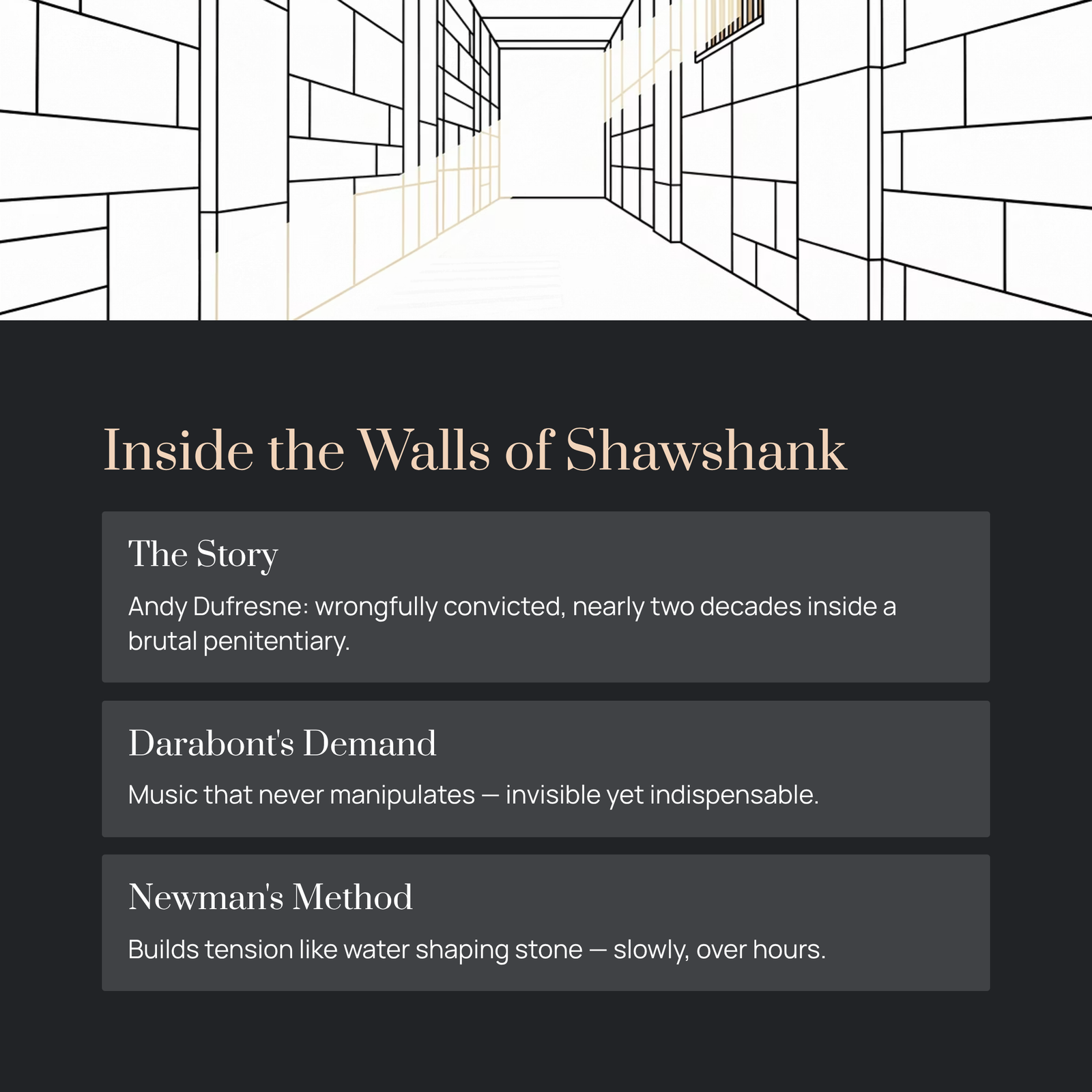
The Shawshank Redemption is, of course, based on Stephen King’s novella about Andy Dufresne, a banker wrongfully convicted of murder who spends nearly two decades inside the brutal Shawshank State Penitentiary. It is a story about time — the crushing, corrosive weight of time — and about the stubborn, irrational persistence of hope in a place designed to destroy it.
Director Frank Darabont understood something crucial: the film’s emotional architecture needed music that would never manipulate the audience, never push them toward tears or triumph with heavy hands. He needed a composer who could be both invisible and indispensable.
Newman’s score for The Shawshank Redemption is a masterclass in restraint. Throughout the film, the music operates almost subliminally — gentle piano figures, muted strings, the occasional shimmer of a high harmonic, like light filtering through a dirty window. You barely notice it. But remove it, and the film collapses. Newman builds emotional tension the way water shapes stone: slowly, persistently, over the course of hours.
And then comes the end.
When the Music Finally Breathes
The “End Title” arrives at the moment when everything the film has held back is finally allowed to pour forth. Andy has escaped. Red has been paroled. And in the film’s final, wordless sequence, Red rides a bus toward the Mexican border, toward the Pacific Ocean, toward his friend — toward freedom in its most absolute and terrifying form.
Newman’s “End Title” begins with a gentle, almost hesitant piano figure — a simple rising phrase that sounds like the first breath after surfacing from deep water. It doesn’t announce itself. It doesn’t declare victory. It simply opens, the way a hand unclenches after being closed for too long.
Then the strings enter, and something extraordinary happens. The melody begins to expand, to breathe, to fill the space the way sunlight fills a room when you pull back the curtains. There is no dramatic climax in the traditional sense — no crashing cymbals, no triumphant fanfare. Instead, Newman builds a slow, luminous crescendo that feels less like an arrival and more like a release. The music doesn’t celebrate freedom. It exhales it.
What makes this piece so devastating is its refusal to be grandiose. Newman understood that after everything Andy and Red have endured — decades of violence, degradation, loneliness, and loss — the appropriate emotional response is not jubilation but something quieter and infinitely more profound. It is the feeling of standing in open air after years of confinement. It is the sound of a soul remembering what it feels like to be whole.
Listen carefully to the middle section, where the oboe carries a lonely, singing line above the strings. There is grief in that melody — a mourning for all the years that were stolen, all the life that was lived inside walls. The music does not pretend that freedom erases suffering. It holds both truths simultaneously: the joy of release and the sorrow of what was lost. This is what separates Newman’s work from lesser film composers. He never simplifies. He layers.
How to Listen: Finding Your Own Shawshank Moment
If you are coming to this piece for the first time — or if you have heard it only as background to the film’s credits — I want to suggest a different way of listening.
First, find a quiet space. Put on headphones if you can. And resist the urge to watch the film while you listen. Let the music exist on its own terms, independent of images.
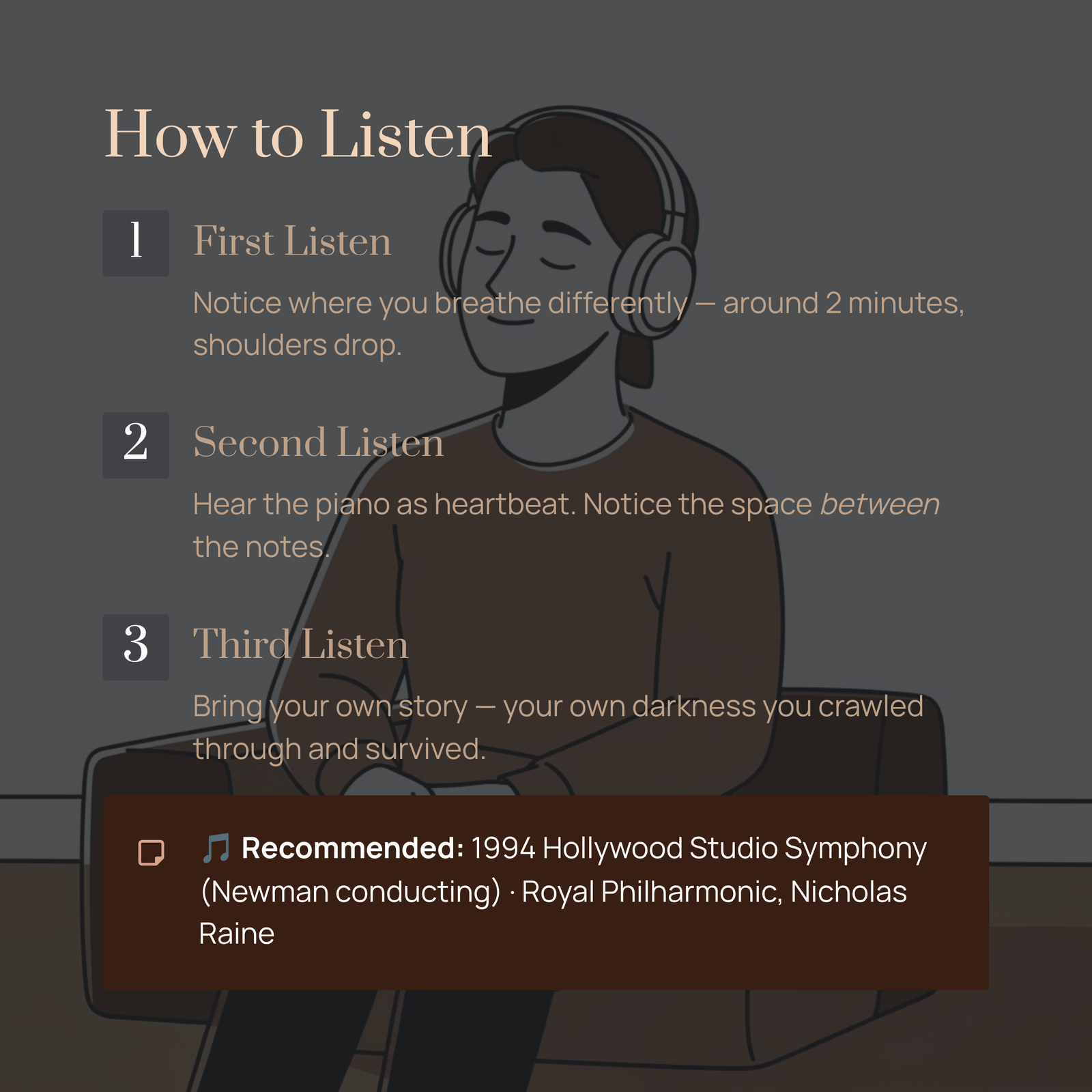
On your first listen, simply notice where the music makes you breathe differently. There will be a moment — usually around the two-minute mark, when the strings begin their slow, widening ascent — where your shoulders drop and your chest opens. Don’t analyze it. Just feel it.
On your second listen, pay attention to Newman’s orchestration. Notice how he uses the piano not as a lead instrument but as a kind of heartbeat — a steady, gentle pulse underneath the strings. Notice how the woodwinds enter and exit like thoughts passing through a quiet mind. Notice the space between the notes. Newman is as much a composer of silence as he is of sound.
On your third listen, bring your own story to it. Think of a time when you emerged from something — a difficult relationship, a period of illness, a season of grief, a job that was slowly hollowing you out. Think of the moment you realized you were on the other side. This piece is not just about Andy Dufresne. It is about anyone who has ever crawled through darkness and come out clean on the other side.
For recordings, the original 1994 soundtrack album performed by the Hollywood Studio Symphony remains the definitive version — Newman himself conducted it, and every nuance of the performance reflects his intimate understanding of the film’s emotional world. If you want a slightly different perspective, the Royal Philharmonic Orchestra’s rendition, conducted by Nicholas Raine, brings a broader, more concert-hall warmth to the piece that reveals details the original’s more intimate production sometimes tucks away.
Hope Is a Quiet Thing
There is a line in The Shawshank Redemption that has become one of the most quoted in cinema: “Hope is a good thing, maybe the best of things, and no good thing ever dies.”
It is a fine sentiment, and it has moved millions. But I have always felt that Newman’s “End Title” expresses the same idea more truthfully than words ever could — because it captures not just the idea of hope, but the sensation of it. Not hope as a concept or a motto, but hope as a physical experience: the warmth that spreads through your body when you realize, against all evidence, that things might actually be okay.
Thomas Newman received his first Academy Award nomination for this score. He lost to Hans Zimmer’s The Lion King. In the decades since, he has been nominated fifteen times without a single win — a record he shares with the late Alex North as the most nominated living composer to never take home the statue. There is a painful irony in this: the man who scored cinema’s greatest story about patience and perseverance has himself been made to wait, and wait, and wait.
But perhaps Newman understands something that the Academy does not. Awards are loud. They are momentary. They fill a room for an evening and then they are forgotten. But a piece of music that lives in someone’s chest — that returns to them unbidden on difficult nights, that makes them feel, for four quiet minutes, that the world contains more mercy than cruelty — that is something else entirely.
That is the kind of thing that does not die.