Sibelius’s Symphony No. 5 grew out of a period when a serious health scare had made the future feel uncertain. Its composition history also includes a celebrated sighting of swans and years of revision, which help explain why the finale can feel so hard won.
The connection is tempting to hear as a story with a simple ending: illness, birds in flight, triumph. The music gives you something more interesting. It gathers energy, loses its footing, finds a broad new melody, and finally asks you to sit through silence between its last six chords.
📑 Table of Contents
Sibelius health crisis and the years that followed
In 1908, Jean Sibelius underwent surgery for a tumor in his throat. He feared that it might be cancer, and the experience cast a long shadow over the years that followed. By the time he began working on the Fifth Symphony, he was living with the memory of a genuine threat to his life.
That history can sharpen your hearing without turning the symphony into a medical diary. The score does not assign a sound to illness or offer a written account of recovery. What it does show is a composer intensely concerned with time: how a small musical idea grows, how momentum can falter, and how a destination can emerge only after a long search.
The symphony arrived at a public turning point, too. Sibelius composed it for celebrations of his fiftieth birthday in 1915, when he was already a major figure in Finnish music. He conducted its first performance in Helsinki on December 8 of that year. An occasion that called for a confident new work met a composer still testing what that work should become.
That tension is useful to keep in mind as you listen. The Fifth has moments of striking assurance, especially when the horns take up the finale’s great melody. Yet its sense of arrival depends on all the movement and uncertainty around those moments.
Sibelius Symphony No 5 composition history: a work in motion
The symphony heard most often today is the final version, completed in 1919. Sibelius had first presented it in 1915, then returned to it repeatedly. These were substantial revisions: the familiar final version has three movements, while the original had four.
One of his boldest decisions was to join the opening movement’s broad beginning to music that had previously stood as a separate, faster movement. Listen to the finished opening and you can hear why this matters. Its pace changes gradually enough that the later rush feels as if it has grown from the earlier music, even as the change takes you by surprise.
This process makes the symphony’s confident finish more remarkable. Its shape was worked out across several years, through second thoughts and new solutions. Knowing that need not make every passage sound strained. It lets you hear the clarity of the final version as something Sibelius achieved through patient attention.
Try following the opening without worrying about where one theme ends and another begins. Notice instead how the music seems to widen its view. Calls pass through the orchestra; quiet activity gathers force; eventually the movement moves with an urgency that seemed distant at the start. That long transformation is one of the pleasures of the piece.
The Sibelius swan hymn and the view from the finale
During the period when he was composing the symphony, Sibelius recorded an encounter with swans in his diary. The association between those birds and the broad horn theme in the finale has become part of the work’s story. You will often hear the melody called the “swan hymn.”
You can enjoy the image without trying to make the horns imitate a birdcall. The theme moves in large, steady arcs, while other parts of the orchestra keep the air around it alive. It can suggest flight because it feels spacious and sustained, with motion continuing beneath the melody.
Its first appearance is especially effective because the finale does not begin at that pace. Quick, busy string music sets things moving before the horns open out the sound. When their melody arrives, it changes your sense of scale: what seemed restless suddenly has room to breathe.
The swan sighting happened years after Sibelius’s surgery, so it is too neat to treat it as a single moment of recovery that produced the whole finale. The birds gave him an image he valued while the symphony was taking shape. His earlier fear, his attention to nature, and his long work on the score all belong to the background of what you hear.
If you enjoy the way an encounter with nature can change how you hear a symphony, our guide to Beethoven’s Pastoral Symphony offers another place to start.
Hearing pressure and release across three movements
The first movement rewards patient listening. Its opening has the space of a beginning that has yet to choose a direction, then its ideas begin to press forward. As the tempo quickens, you may realize that you have crossed into a different kind of music without a firm boundary marking the way.
The middle movement gives your ear a lighter surface. Short figures pass around the orchestra, and the music proceeds through variations, meaning that a recognizable idea returns in altered forms. Its gentleness is active rather than still: small changes keep drawing you onward.
Then comes the finale’s swift opening and the horn melody that gives the movement its center. Hear what happens when that melody returns. Familiarity makes it welcome, but the surrounding music changes the weight it carries. By the end, Sibelius has prepared you for a grand close while keeping you alert to the possibility of interruption.
That is why the last six chords are so memorable. They are separated by silences long enough to feel deliberate. You hear each chord as its own event, then wait to discover whether another will follow. The ending has force, but it also makes you experience the time between sounds.
For another Fifth Symphony that asks what an ending can mean after a struggle, read our guide to Tchaikovsky’s Symphony No. 5.
What the Symphony No 5 revisions leave you with
Sibelius could have left the birthday performance as the work’s final statement. Instead, he kept reconsidering its proportions and transitions until he reached the version we know today. That history makes the symphony feel less like a sudden burst of inspiration and more like an answer he had to keep refining.
It also leaves room for you to hear more than one emotion in the finale. The horn theme can sound elated, but its breadth can carry tenderness as well. The closing chords can feel decisive, even while their separating silences make you wait and wonder. None of those responses needs to cancel the others.
Tonight, start with the whole symphony if you can. Keep one question in mind: when does movement begin to feel like arrival? You may find your answer in the opening’s growing speed, in the first sweep of the swan hymn, or only after the final silence has passed.
Listen to This Piece
Frequently Asked Questions
Did Sibelius write Symphony No. 5 after his illness?
Yes. Sibelius underwent surgery for a throat tumor in 1908 and worked on the symphony in the following decade. His health scare is part of its biographical background, though no single passage can be identified as a direct account of that experience.
What is the swan hymn in Sibelius’s Fifth Symphony?
The “swan hymn” is the broad horn melody in the finale. Its name reflects the well-known connection between the symphony and Sibelius’s diary account of seeing swans while he was composing it.
Why are there different versions of Symphony No. 5?
Sibelius revised the symphony after its 1915 first performance and completed the final version in 1919. The version normally performed today has three movements; the original had four.
Sources
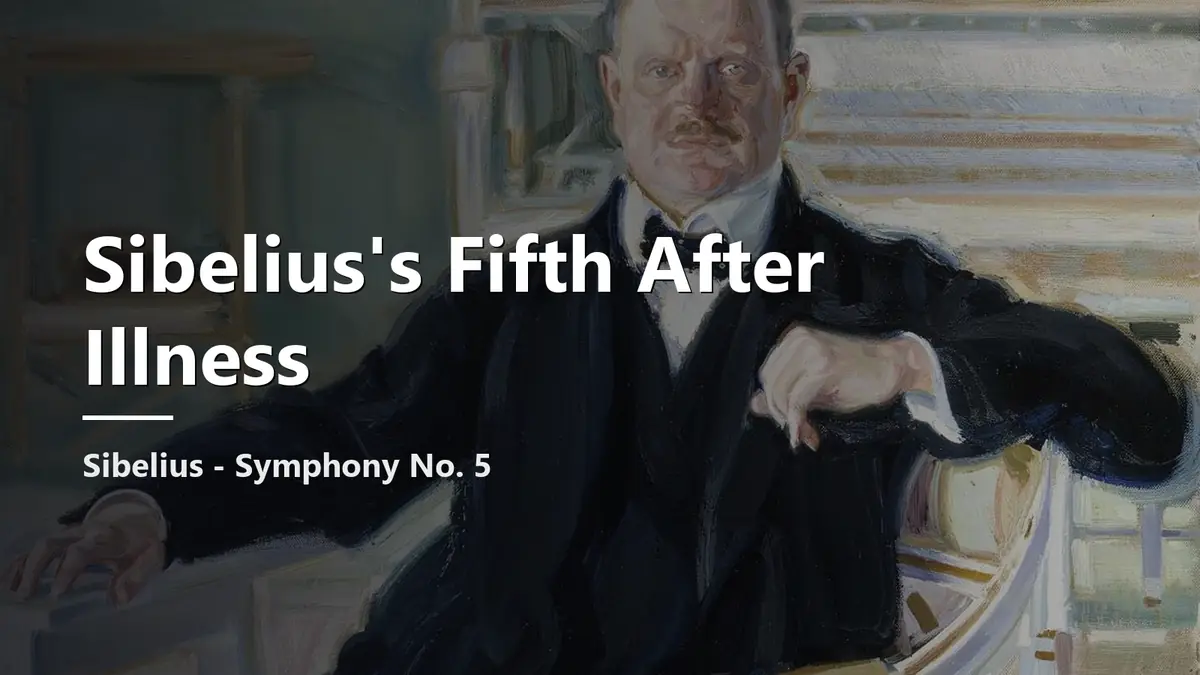
Cover art: Antti Favén – Portrait of Jean Sibelius (1913), Antti Favén, 1913date QS:P571,+1913-00-00T00:00:00Z/9. Wikimedia Commons (public domain).