📑 Table of Contents
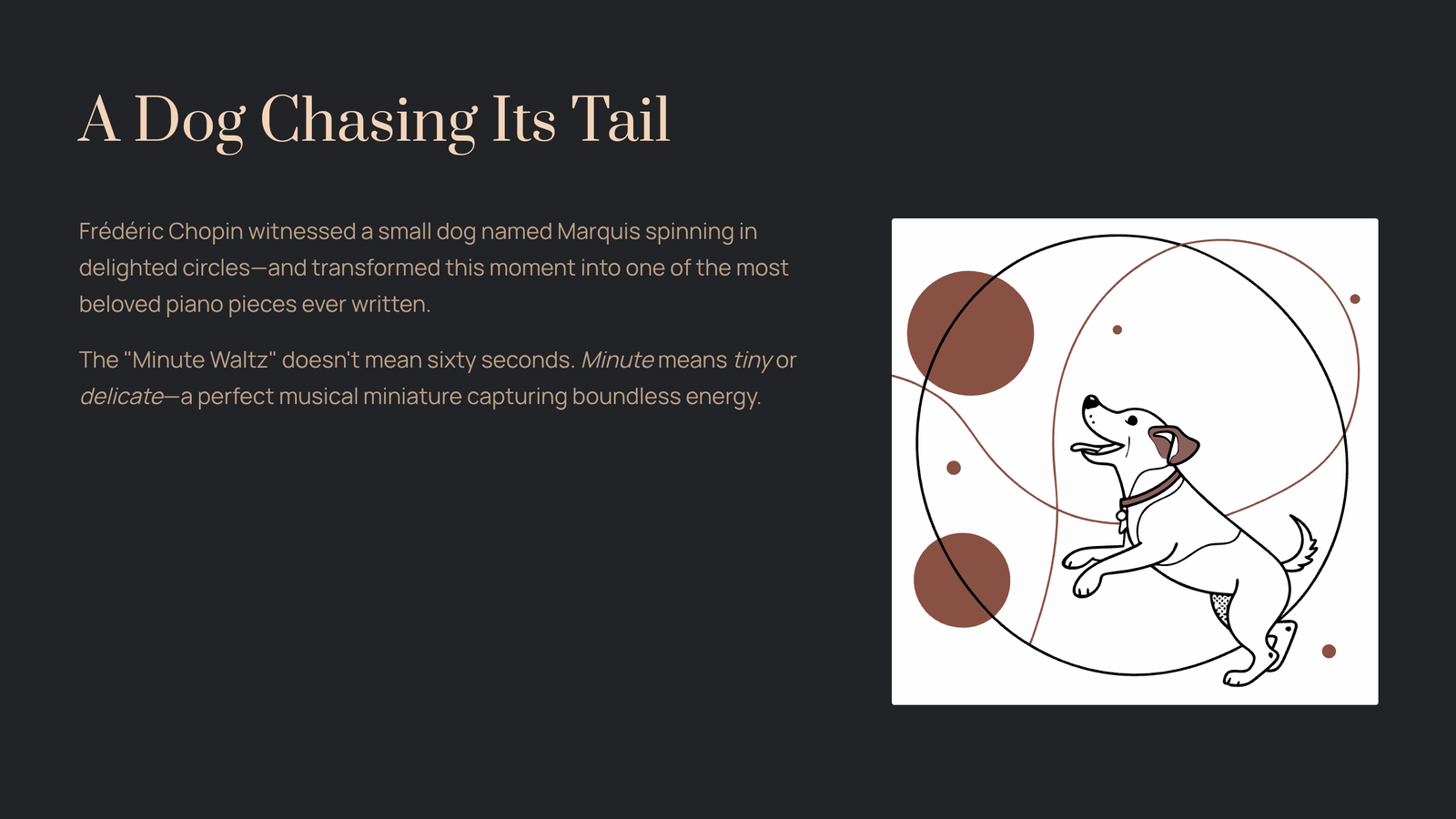
Have you ever watched a small dog chase its own tail, spinning in delighted circles, utterly absorbed in a moment of pure, innocent joy? Frédéric Chopin once witnessed exactly this scene—and transformed it into one of the most beloved piano pieces ever written. The Waltz in D-flat major, Op. 64 No. 1, affectionately known as the “Minute Waltz,” isn’t meant to be played in sixty seconds. Instead, “minute” here means tiny or delicate—a perfect musical miniature capturing the boundless energy of a little dog named Marquis.
The Story Behind the Music
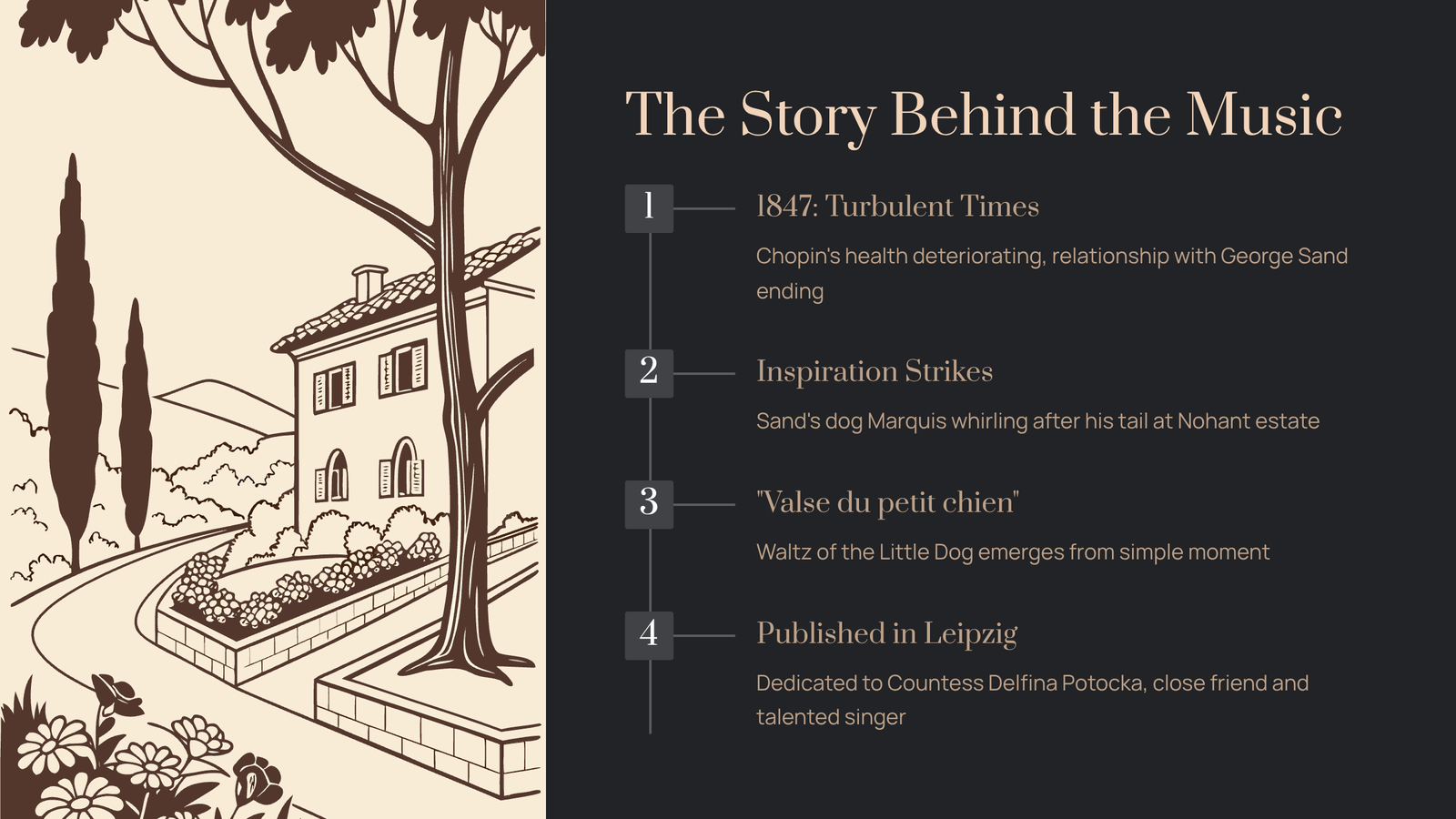
The year was 1847, and Chopin was living through one of the most turbulent periods of his life. His health was deteriorating, and his nine-year relationship with the novelist George Sand was coming to a painful end. Yet amid this personal turmoil, Chopin found inspiration in the simplest of moments: Sand’s small dog, Marquis, whirling after his own tail in her country estate at Nohant.
Legend has it that Sand remarked to Chopin that if she possessed his talent, she would compose something for this amusing little creature. Whether the story is entirely true or embellished over time, what emerged was a piece Chopin himself called “Valse du petit chien”—the Waltz of the Little Dog.
The work was published in Leipzig as the first of three waltzes in Op. 64, dedicated to Countess Delfina Potocka, a close friend and talented singer who would later sing at Chopin’s bedside just two days before his death. In this dedication, we glimpse the deep bonds of friendship that sustained Chopin during his final years.
What Makes This Waltz So Special
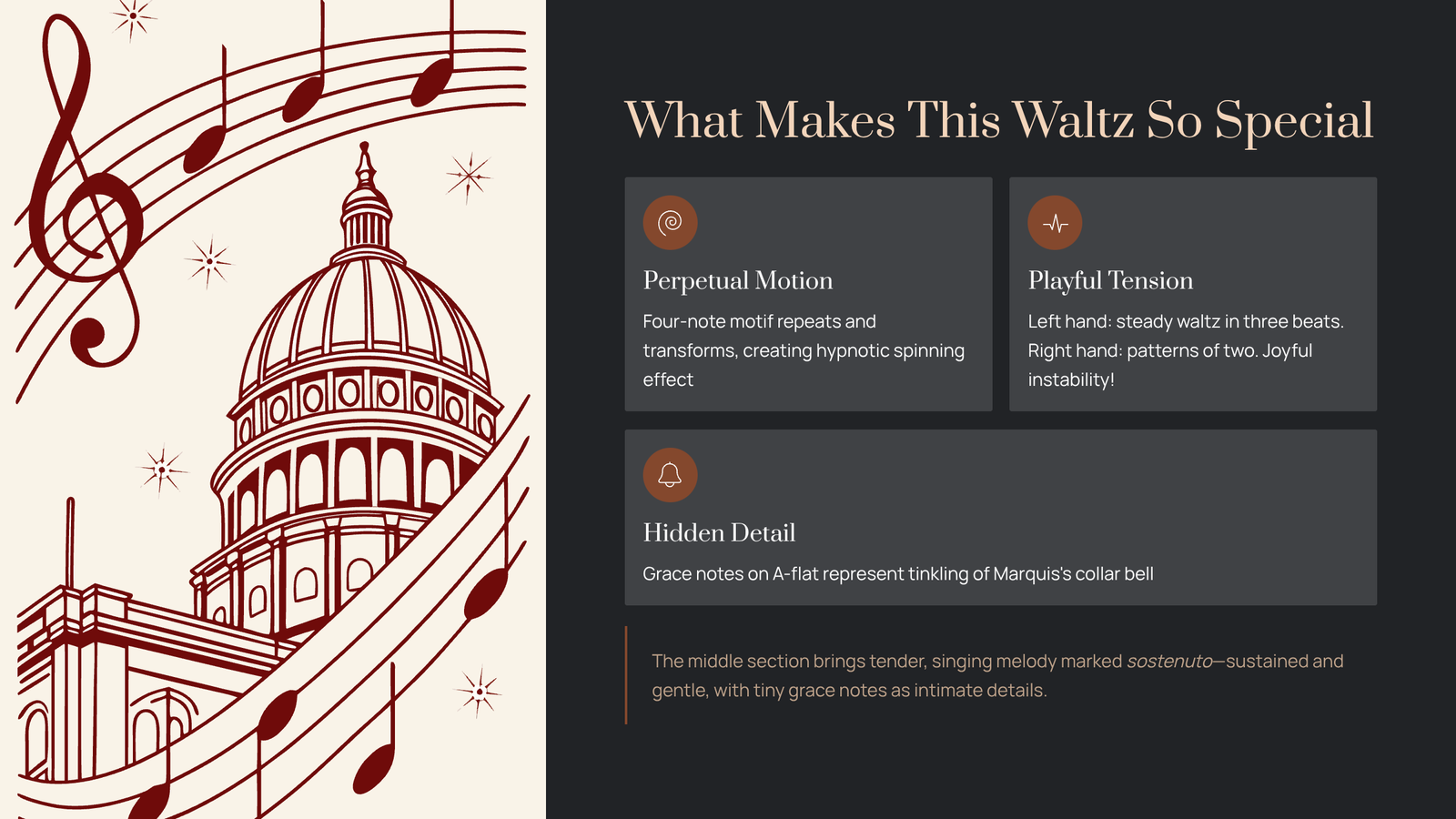
From its very first notes, the Minute Waltz sweeps you into its circular, spinning motion. The right hand’s melody climbs and descends in continuous waves, mimicking a dog’s playful pursuit of something perpetually just out of reach. Chopin achieves this effect through a deceptively simple four-note motif that repeats and transforms, creating an almost hypnotic sense of perpetual motion.
But there’s more sophistication here than meets the ear. Listen carefully, and you’ll notice a subtle rhythmic tension: while the left hand maintains a steady waltz rhythm in three beats, the right hand’s melody often groups itself into patterns of two. This playful clash—called a hemiola—creates that sense of joyful instability, as if the little dog might tumble over at any moment in his enthusiastic spinning.
The middle section brings a welcome contrast. The music slows into a more tender, singing melody, marked sostenuto—sustained and gentle. Here, Chopin includes tiny grace notes on the note A-flat, and according to those who knew the piece’s origins, these delicate ornaments represent the soft tinkling of the bell on Marquis’s collar. It’s a remarkably intimate detail, a private joke between composer and listener, hidden in plain sight.
How to Listen: Three Approaches
First Listen: Follow the Dog
On your initial hearing, simply let the music carry you. Imagine that spirited little dog: the breathless opening chase, the brief pause in the middle section where perhaps he stops to catch his breath, and the return to his exuberant pursuit. Don’t worry about technical details—just enjoy the ride.
Second Listen: Feel the Architecture
Now pay attention to the piece’s elegant three-part structure. The energetic opening section (A) gives way to the calmer middle section (B), before the opening material returns. Notice how the ending differs from the beginning—Chopin extends the final descent across three octaves instead of two, giving the conclusion a greater sense of arrival, as if the dog has finally, triumphantly, caught his tail.
Third Listen: Discover the Details
Focus on those grace notes in the middle section—the tiny bell on Marquis’s collar. Listen for the rhythmic interplay between the hands. Notice how Chopin uses dynamics, swelling and fading, to give shape and breath to each phrase. These subtle touches transform a charming miniature into a genuine masterpiece.
A Note on Tempo and the “Minute” Misconception
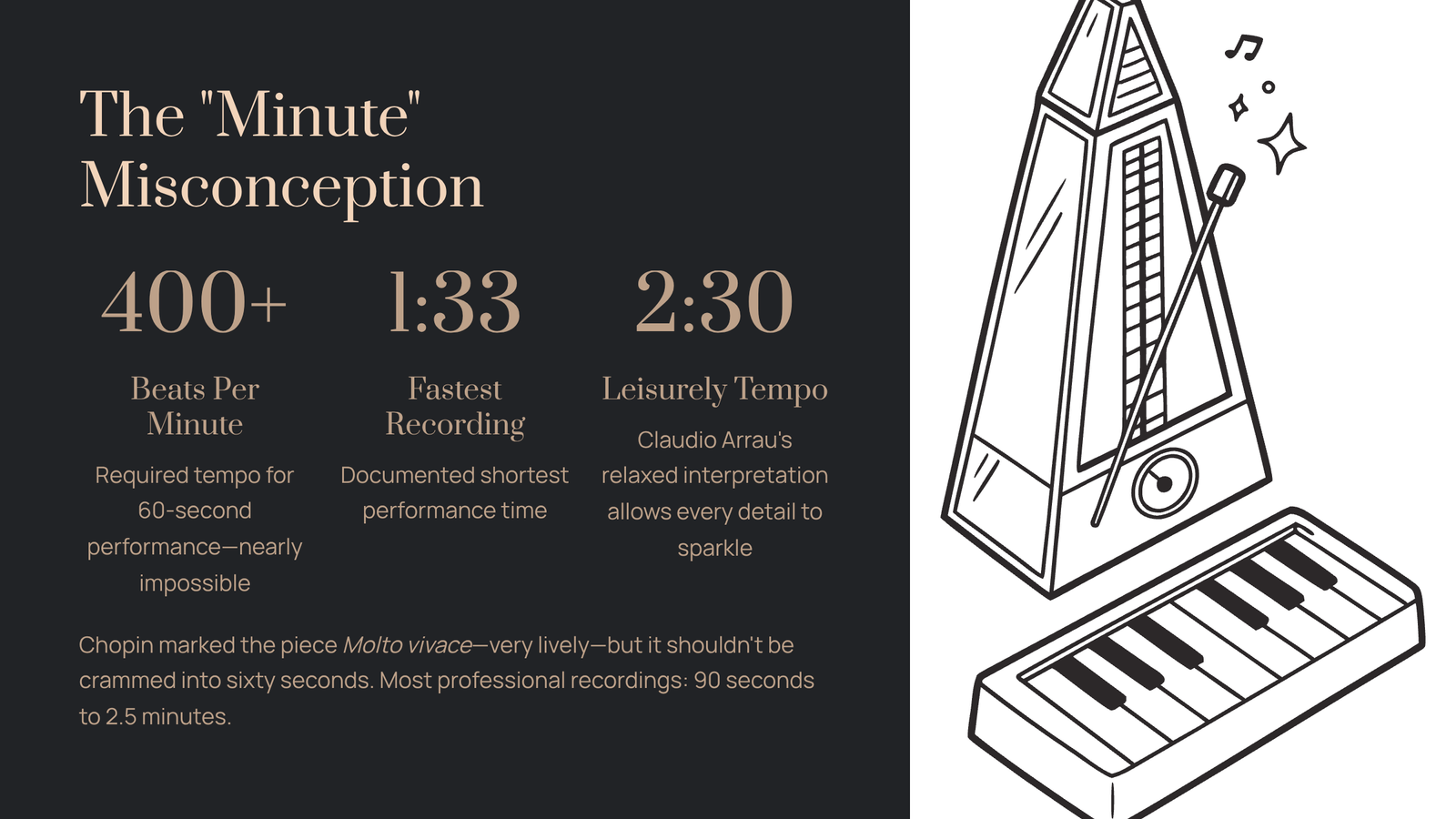
For decades, pianists and audiences alike have debated whether this waltz can truly be performed in one minute. The short answer: it shouldn’t be. Chopin marked the piece Molto vivace—very lively—but attempting to cram it into sixty seconds requires a nearly impossible tempo of over 400 beats per minute. Most professional recordings fall between ninety seconds and two-and-a-half minutes.
The fastest documented recording clocks in at around one minute and thirty-three seconds, while the most leisurely—by the legendary Claudio Arrau—stretches to nearly two-and-a-half minutes. Neither approach is wrong; they simply reveal different facets of the music. A brisk performance captures the breathless excitement of the chase, while a more relaxed tempo allows every detail to sparkle.
Recommended Recordings
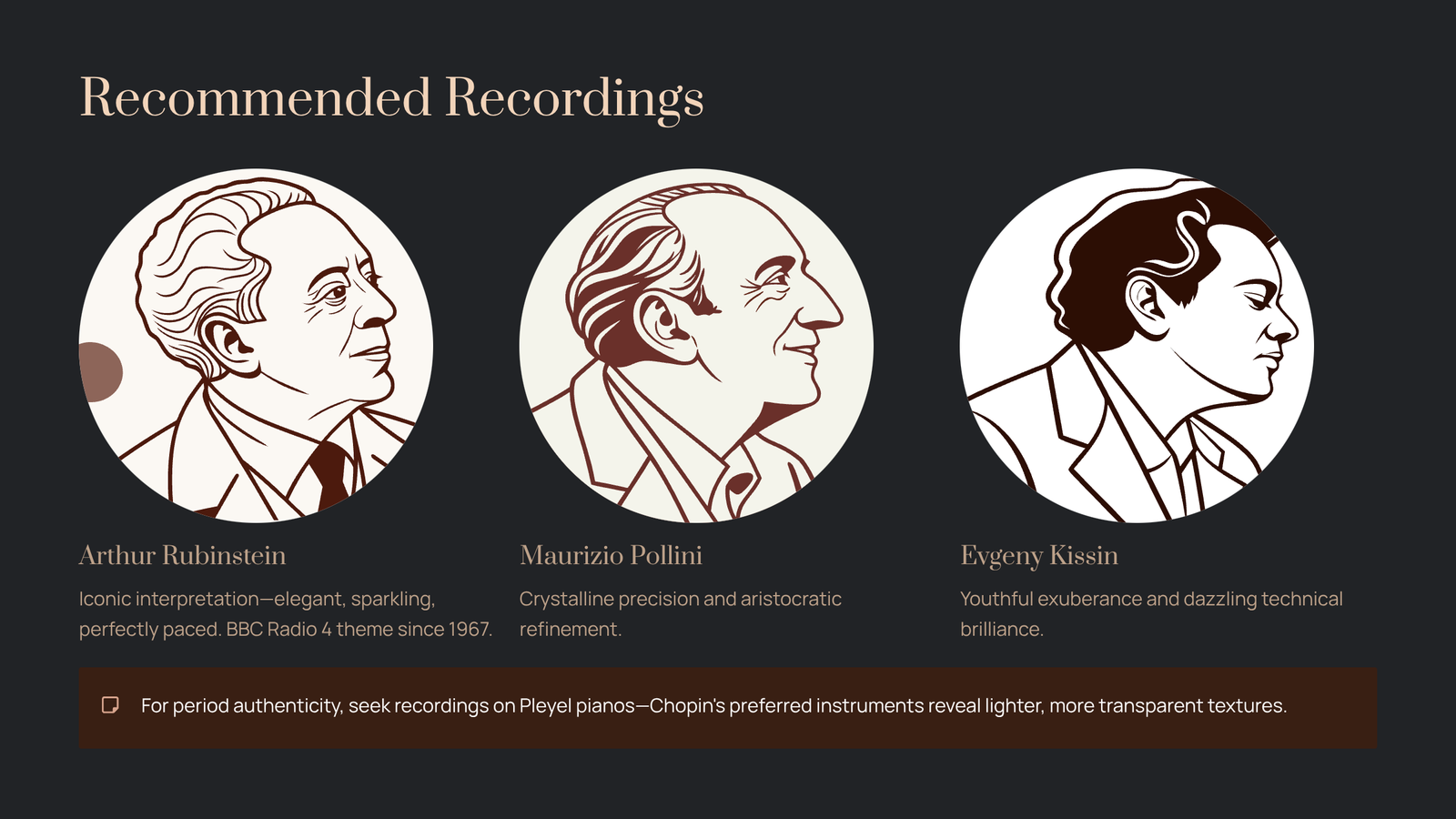
Arthur Rubinstein delivers perhaps the most iconic interpretation—elegant, sparkling, and perfectly paced. His version became so famous that it was adopted as the theme music for BBC Radio 4’s long-running comedy panel show “Just a Minute,” which has used it since 1967.
Maurizio Pollini offers crystalline precision and aristocratic refinement, while Evgeny Kissin brings youthful exuberance and dazzling technical brilliance.
For those curious about the piece on period instruments, seek out recordings on Pleyel pianos—the instruments Chopin himself preferred. The lighter, more transparent sound reveals textures that can get lost on modern concert grands.
Why This Piece Still Matters
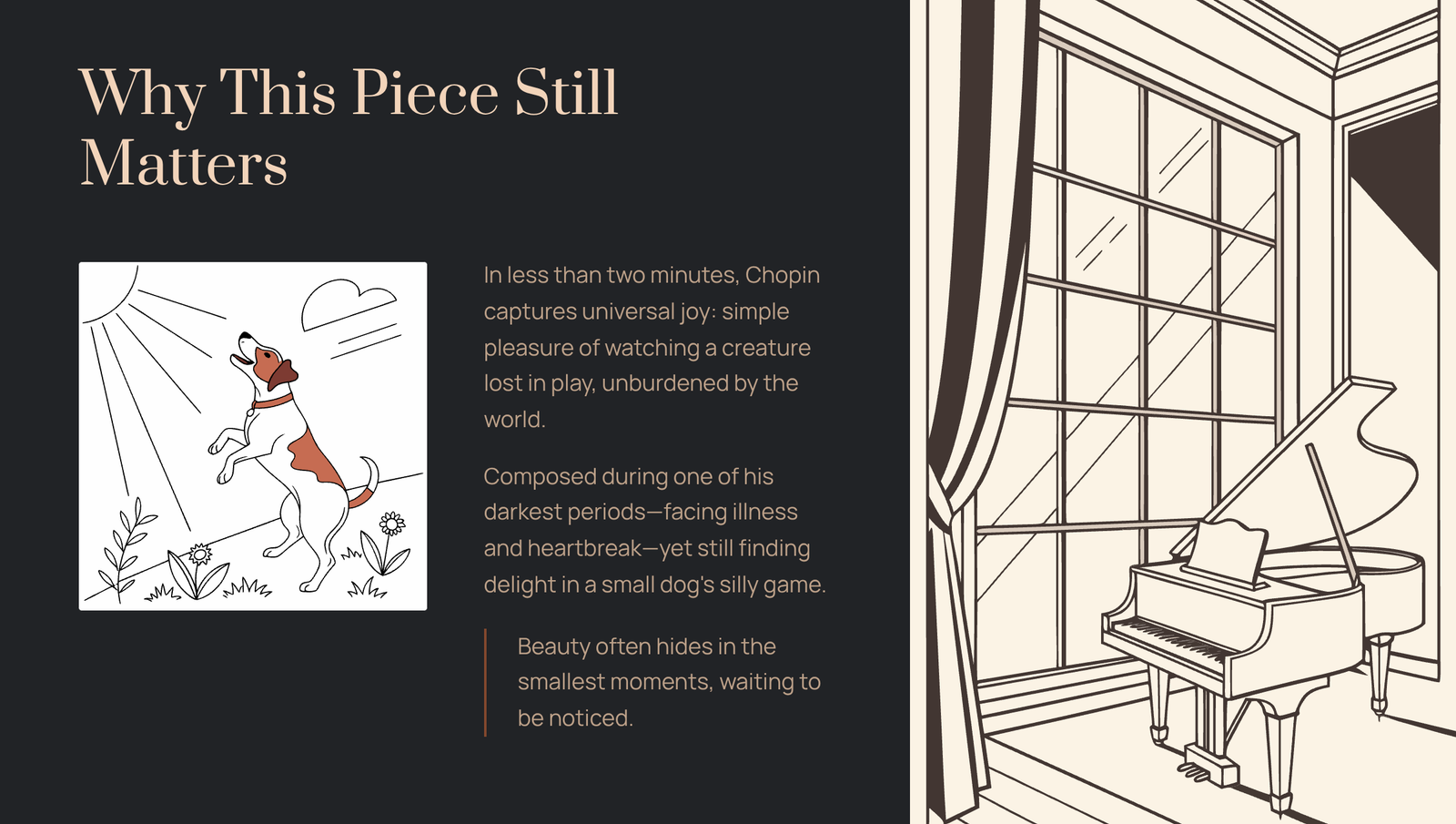
There’s something deeply comforting about the Minute Waltz. In less than two minutes, Chopin captures a universal moment of joy: the simple pleasure of watching a creature lost in play, unburdened by the weight of the world. That Chopin composed this during one of the darkest periods of his life makes it all the more poignant. Here was a man facing illness and heartbreak, yet still capable of finding delight in a small dog’s silly game.
Perhaps that’s the real magic of this miniature masterpiece. It reminds us that beauty often hides in the smallest moments, waiting to be noticed. The next time life feels heavy, put on the Minute Waltz. Close your eyes. And let a little dog named Marquis spin you back to joy.
The Waltz in D-flat major, Op. 64 No. 1 remains one of Chopin’s most performed and recorded works, a testament to its timeless appeal. Whether you’re new to classical music or a lifelong devotee, this tiny gem offers something precious: two minutes of pure, uncomplicated happiness.