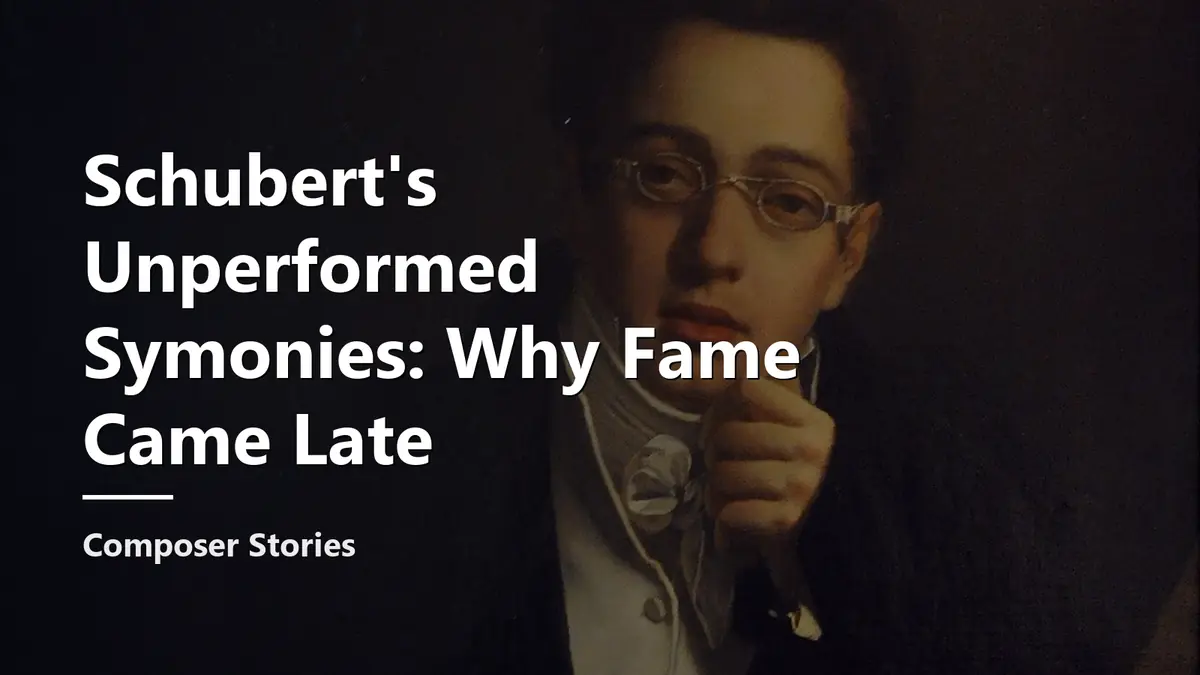
Most of Franz Schubert’s symphonies had no documented public performance while he was alive because they belonged to private musical circles, remained incomplete, or struggled to find a place on a concert program. The Unfinished and Great reached public audiences after his death, though their stories are quite different.
That does not mean Schubert spent his life writing music nobody heard. His songs and chamber music circulated among friends and admirers, and some of his early orchestral music was suited to amateur players. The surprise is the gap between that lively musical life and the lasting public reputation of his symphonies.
📑 Table of Contents
- Why Schubert’s symphonies went unheard in public
- Symphony No. 5 and the world of private music making
- When was Schubert’s Unfinished Symphony first performed?
- The Great Symphony’s delayed path to the concert hall
- What to hear in the gap between Schubert’s life and fame
- Frequently Asked Questions
- Sources
Why Schubert’s symphonies went unheard in public
Schubert lived in Vienna, a city with abundant music making, but access to a major orchestra was another matter. A composer could hear a work played at home or in an amateur gathering without securing a public concert, a publisher, or repeated performances. Those were separate steps, and Schubert did not live long enough to see many of his orchestral scores through them.
His shorter songs were easier to share. A singer and pianist could bring one to life in a room; a large symphony required many players, rehearsal time, and someone willing to program it. Schubert was productive and known within his circle, yet the practical demands of a symphony made its path to listeners slower.
It helps to be precise about the word unheard. We cannot establish that Schubert never heard a note of every symphony later performed after his death. Private readings and rehearsals leave uneven records. What we can say is that several works now central to his reputation had no documented complete public performance during his lifetime.
Symphony No. 5 and the world of private music making
Schubert wrote his Fifth Symphony in 1816, when he was still a young composer. Its light orchestral sound and modest scale make it easier to imagine in the amateur musical world around him than the much larger Great Symphony. But “easier to imagine” is not proof of a particular performance: the surviving record does not let us confidently place Schubert in the audience for the Fifth.
The distinction matters because his early symphonies were not simply failed bids for the grand concert hall. Writing for capable players close to home was a real musical opportunity. A private performance could test a new idea and give a composer the immediate pleasure of hearing it, even if the score never became widely known.
To hear that side of Schubert, start the Fifth at its opening. Notice how lightly the music moves and how clearly you can follow an idea as it passes through the orchestra. Then try the slow movement, where a gentle phrase gains warmth through small changes; our guide to the Fifth Symphony’s Andante con moto offers a closer way in.
The Fifth also keeps the larger story honest. Schubert’s symphonies did not all vanish for the same reason. Some grew out of music making that was meaningful at the time, even when it produced little lasting evidence of who played what and when.
When was Schubert’s Unfinished Symphony first performed?
Schubert composed the two completed movements of the work now called Symphony No. 8, the Unfinished, in 1822. He also left sketches for another movement, but the symphony did not become a completed four movement work. Why he stopped remains uncertain; an attractive explanation is still only a guess unless the evidence supports it.
The manuscript survived with Anselm Hüttenbrenner, a musician in Schubert’s circle. Its first public performance came in Vienna in 1865, conducted by Johann Herbeck—well after Schubert’s death in 1828. That long delay was not the result of listeners rejecting the music after hearing it. For decades, most listeners had no chance to hear it at all.
Start with the first movement’s quiet opening. The low strings set out an idea that seems to hold something back before the full orchestra enters. In the second movement, listen for the contrast between still, delicate passages and sudden weight. Our closer look at the Unfinished Symphony follows that contrast in more detail.
It is tempting to turn the title into a story about Schubert’s feelings or his approaching death. The title tells us something narrower and more useful: this is a work he left incomplete, with two fully composed movements powerful enough to sustain performances on their own. Its eventual popularity cannot tell us why he set it aside.
The Great Symphony’s delayed path to the concert hall
Symphony No. 9, known as the Great, followed a different route. Schubert completed this expansive work, but it did not receive a documented complete public performance before he died. Its length and demands on players made it a substantial undertaking, even in a city with an active musical life.
Robert Schumann encountered the score after Schubert’s death and helped bring it to wider attention. Felix Mendelssohn conducted its first public performance in Leipzig in 1839. Those events explain part of how a completed symphony could move from a surviving manuscript into the concert repertory: musicians had to find it, recognize what it offered, and persuade an orchestra to play it.
Start the Great at the broad horn opening. Keep listening as that spacious beginning gives way to a more driving pulse. For a different view of its scale, begin the second movement and follow the steady walking rhythm; the music builds a sense of distance without needing a story attached to it.
The Great makes Schubert’s late fame easier to understand without making it seem inevitable. A finished score does not perform itself. The people who preserved, shared, and championed his music shaped what later audiences came to know as “Schubert.”
What to hear in the gap between Schubert’s life and fame
These three symphonies offer three different pictures of the same composer. The Fifth points toward music made among players near him. The Unfinished shows how a remarkable score could remain out of public hearing for decades. The Great shows that even a completed work needed advocates and an orchestra.
Try their openings in that order: the Fifth’s ease, the Unfinished’s restraint, then the Great’s breadth. You do not need to hear them as a simple march toward bigger and better music. Each asks for a different kind of attention, and each had a different path to its first listeners.
Schubert died at 31. The symphonic reputation familiar to us was assembled partly after his lifetime, as manuscripts became performances and performances became regular parts of concert life. Knowing that history can make tonight’s listening feel less like a visit to a fixed monument and more like meeting music that once waited a long time to be heard.
Frequently Asked Questions
Did Schubert hear any of his symphonies performed?
Schubert’s early symphonies were connected to private and amateur music making, so a lack of documented public concerts does not mean he heard none of them. The evidence is too uneven to say with confidence that he heard every early symphony performed—or that he never heard music from the later ones rehearsed.
Why did Schubert leave the Unfinished Symphony unfinished?
No single explanation has been established. He completed two movements and left further sketches, but the surviving evidence does not tell us why he stopped working on the symphony.
When did audiences first hear Schubert’s Great Symphony?
Its first public performance was in Leipzig in 1839, conducted by Felix Mendelssohn. That was more than a decade after Schubert’s death, following Robert Schumann’s efforts to bring the score to attention.
Sources
- Franz Schubert — Encyclopaedia Britannica
- Symphony No. 5 (Schubert) — Wikipedia
- Symphony No. 8 (Schubert) — Wikipedia
- Symphony No. 9 (Schubert) — Wikipedia
Cover art: Possible portrait of the young Franz Schubert, Josef Abel, circa 1814date QS:P571,+1814-00-00T00:00:00Z/9,P1480,Q5727902. Wikimedia Commons (public domain). Image: Student at a Table by Candlelight, Salomon Savery, 1642/65. Art Institute of Chicago (public domain).