📑 Table of Contents
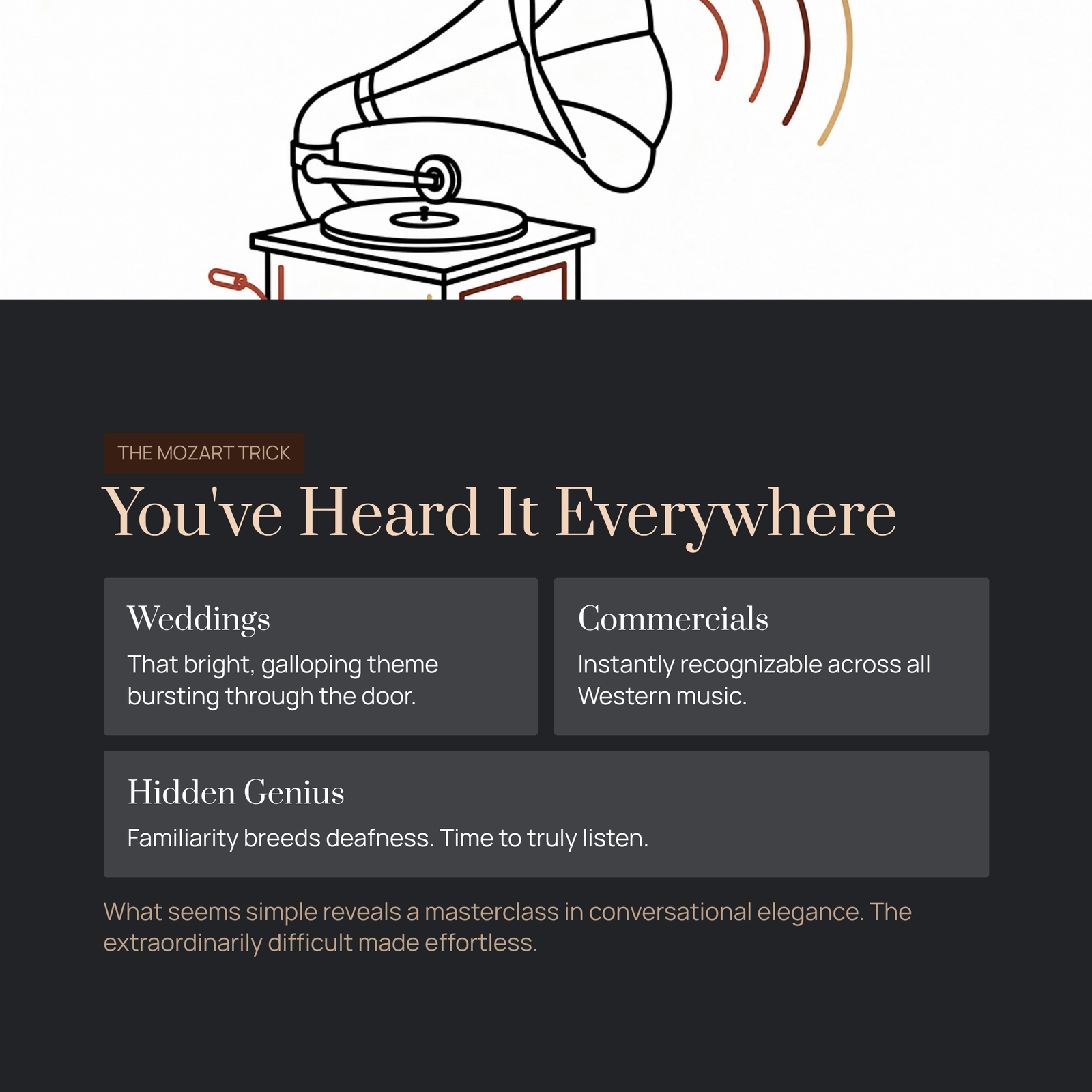
You’ve heard it at weddings. You’ve heard it in commercials. You’ve probably hummed it without knowing what it was called. That bright, galloping theme that seems to burst through the door like someone arriving at a party with the best possible news — that’s Mozart’s Eine kleine Nachtmusik, and its opening Allegro is one of the most instantly recognizable passages in all of Western music.
But here’s the thing: familiarity can be a kind of deafness. We hear something so often that we stop actually listening to it. And when you stop and truly listen to this first movement, something remarkable happens. What seemed like a simple, cheerful tune reveals itself to be a masterclass in conversational elegance — a piece so perfectly constructed that it makes the extraordinarily difficult look effortless. That, more than anything, is the Mozart trick.
So let’s hit pause on everything we think we know, and hear this piece again — maybe for the first time.
Mozart in the Summer of 1787: Between Laughter and Shadows
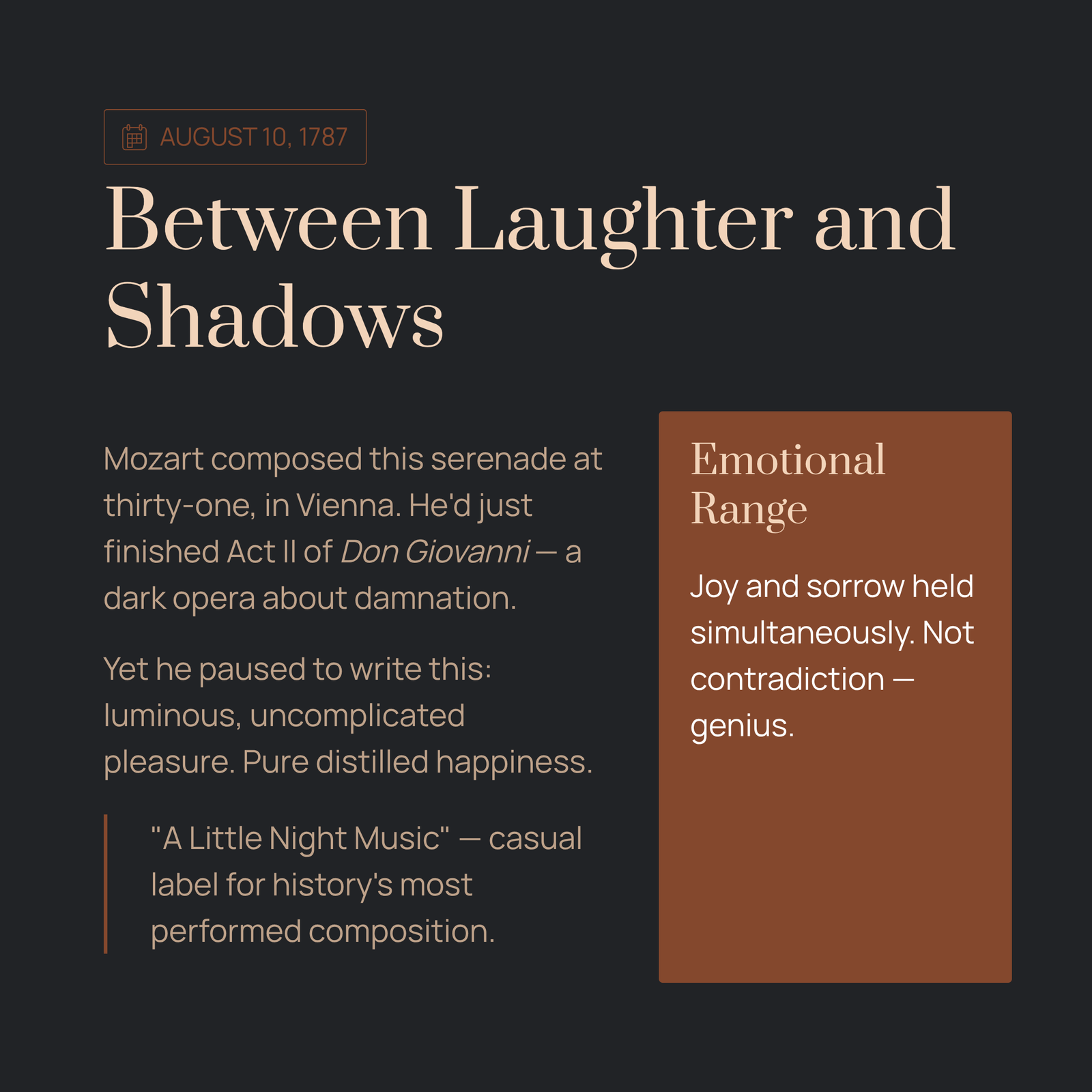
Mozart composed Eine kleine Nachtmusik (Serenade No. 13 in G major, K.525) on August 10, 1787, in Vienna. He was thirty-one years old. To place this moment in context: he had just finished the second act of Don Giovanni, one of the darkest and most psychologically complex operas ever written — a work about a seducer dragged to hell by a stone statue.
And yet, in the middle of that brooding creative labor, he set it aside and wrote this: a serenade so luminous, so full of uncomplicated pleasure, that it feels like sunlight pouring through an open window.
This contrast tells us something essential about Mozart. He didn’t compartmentalize joy and sorrow — he held them simultaneously. The same mind that was composing the Commendatore’s terrifying descent into the underworld could pivot, on the very same afternoon, to crafting a piece of music that feels like the purest distillation of human happiness. That emotional range isn’t contradiction. It’s genius.
The title itself is disarmingly modest. Eine kleine Nachtmusik translates roughly to “A Little Night Music” — a casual label for what was essentially social background music, a serenade meant to accompany an evening gathering. Mozart jotted it in his personal catalog almost as an afterthought. He could not have known he was writing one of the most performed compositions in history.
Inside the Allegro: A Conversation Disguised as a Song
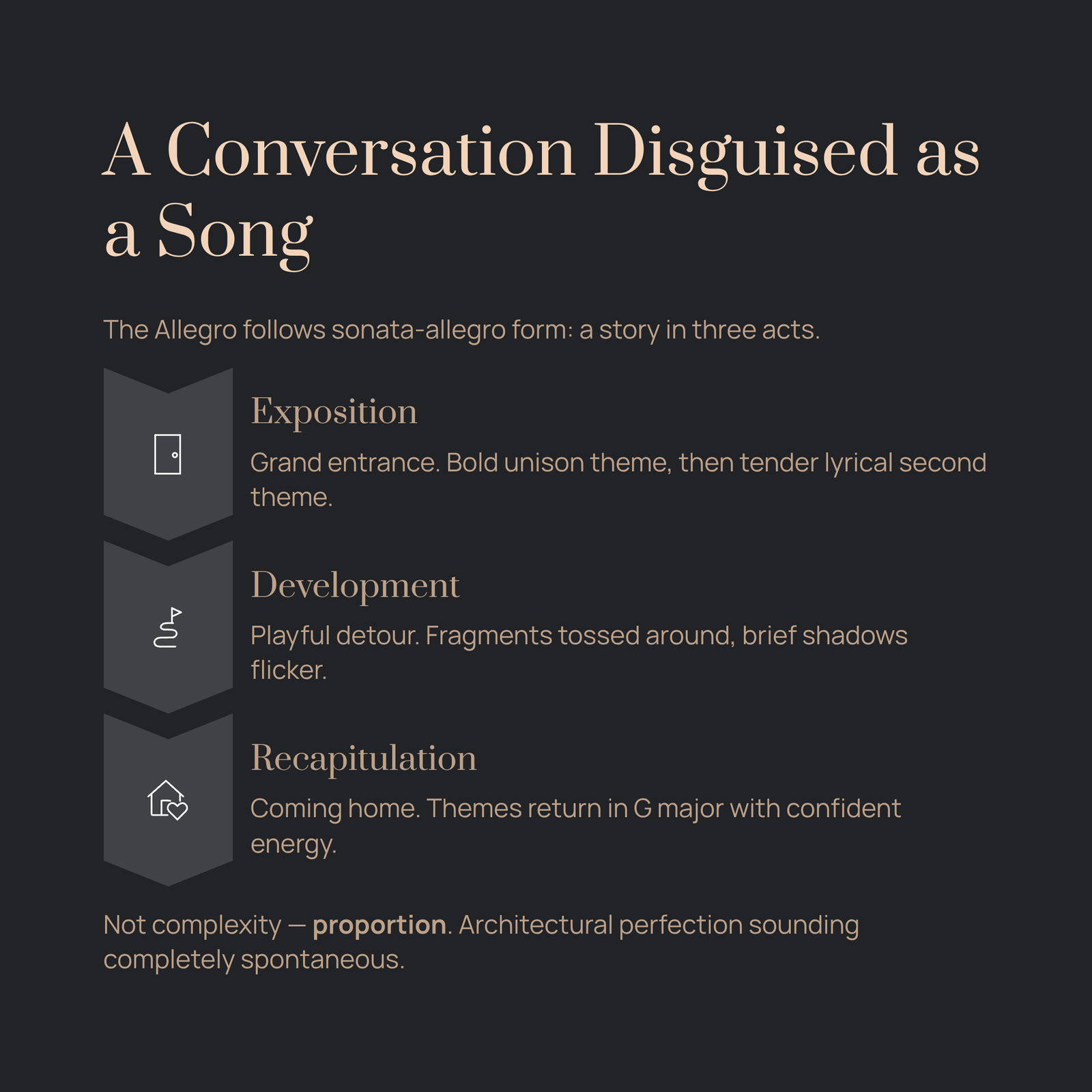
The first movement follows sonata-allegro form, the structural backbone of Classical-era music. But don’t let the textbook terminology intimidate you. Think of it as a story told in three acts: a bold introduction of characters, a journey into unexpected territory, and a satisfying homecoming.
The Exposition — A Grand Entrance. The movement opens with that famous unison theme: all the strings playing the same ascending figure together, like a group of friends calling out in unison, “We’re here!” It’s assertive, rhythmic, and almost militarily precise. But within seconds, Mozart softens the energy with a lyrical second theme — gentler, more song-like, as if the same group has settled into comfortable conversation. This contrast between the bold and the tender is the engine of the entire movement.
The Development — A Playful Detour. Here, Mozart takes fragments of his opening material and tosses them around like a juggler. Themes appear in unexpected keys. The music wanders through minor tonalities — brief shadows that flicker across the surface before dissolving. It’s remarkably short, almost teasing, as if Mozart is saying: “I could make this complicated, but why would I?”
The Recapitulation — Coming Home. The original themes return, now in the home key of G major, and the movement closes with confident, celebratory energy. There’s a deep satisfaction in this return — the musical equivalent of a story that ends exactly where it should.
What makes this movement extraordinary isn’t complexity. It’s proportion. Every phrase is exactly the right length. Every transition feels inevitable. Mozart achieves a kind of architectural perfection that, paradoxically, sounds completely spontaneous — like someone telling a joke with flawless timing.
Listening with Fresh Ears: What to Notice This Time
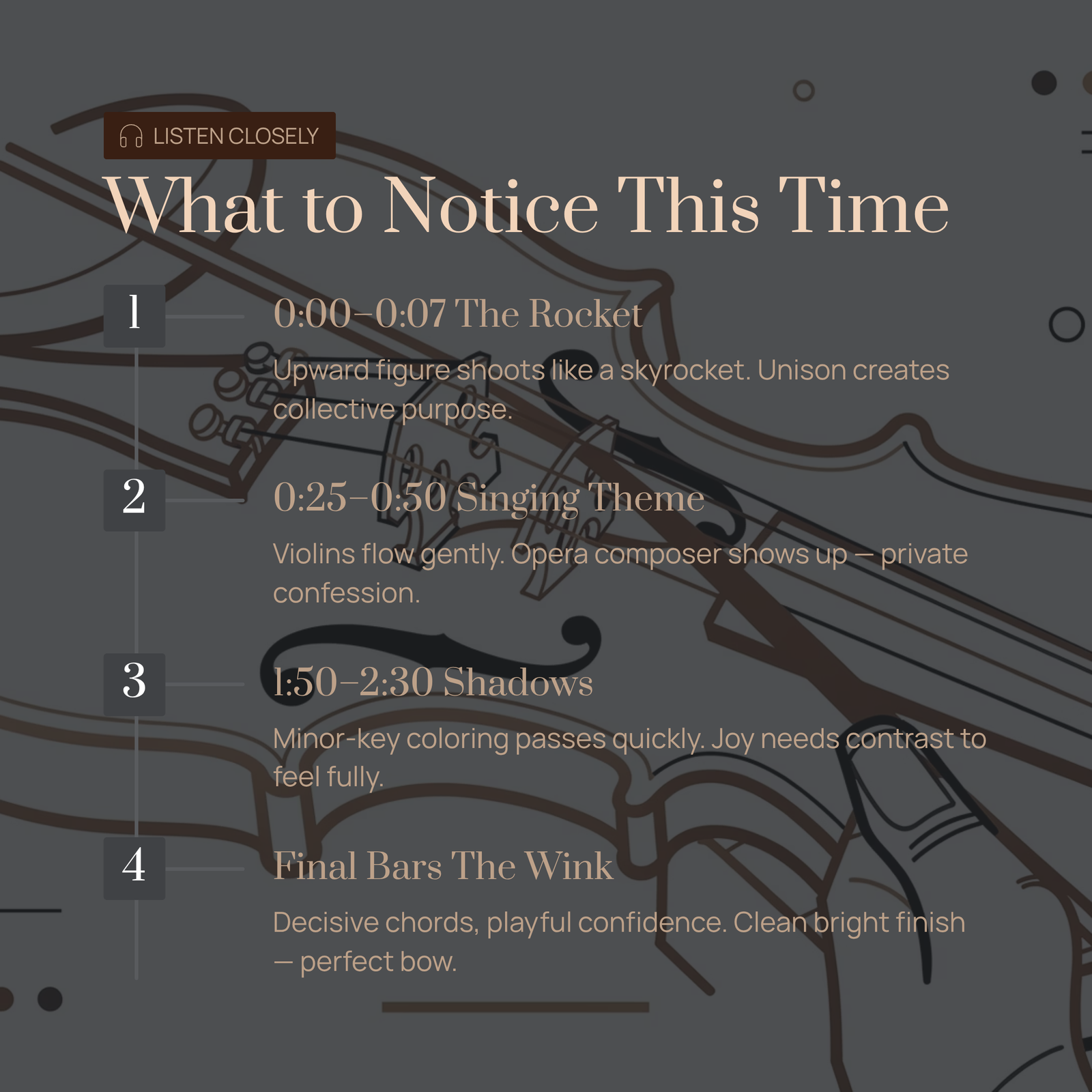
If you’ve heard this piece a hundred times, try listening for these details — they might change the way you experience it entirely.
0:00–0:07 — The Rocket. That opening figure shoots upward like a skyrocket. Notice how every instrument plays the exact same rhythm in unison. This unanimity creates a sense of collective purpose, almost like a declaration. It’s not one voice speaking — it’s an entire community agreeing on something at once.
0:25–0:50 — The Singing Second Theme. After all that bold energy, listen for the moment the texture shifts. The violins begin a gentler, more flowing melody while the lower strings provide a walking bass line underneath. This is where Mozart the opera composer shows up — this theme sings. If the first theme is a public announcement, the second is a private confession.
1:50–2:30 — Shadows in the Development. Brief as it is, the development section introduces a touch of minor-key coloring. It passes quickly, but it’s important. Without these fleeting moments of tension, the return to the major key wouldn’t feel nearly as satisfying. Mozart understood that joy needs contrast to be felt fully.
The Final Bars — The Wink. The movement ends with a series of decisive chords that feel almost playful in their confidence. There’s no drama, no lingering unresolved emotion. Just a clean, bright finish — like a bow after a perfectly executed performance.
Recordings That Let You Hear This Piece Anew
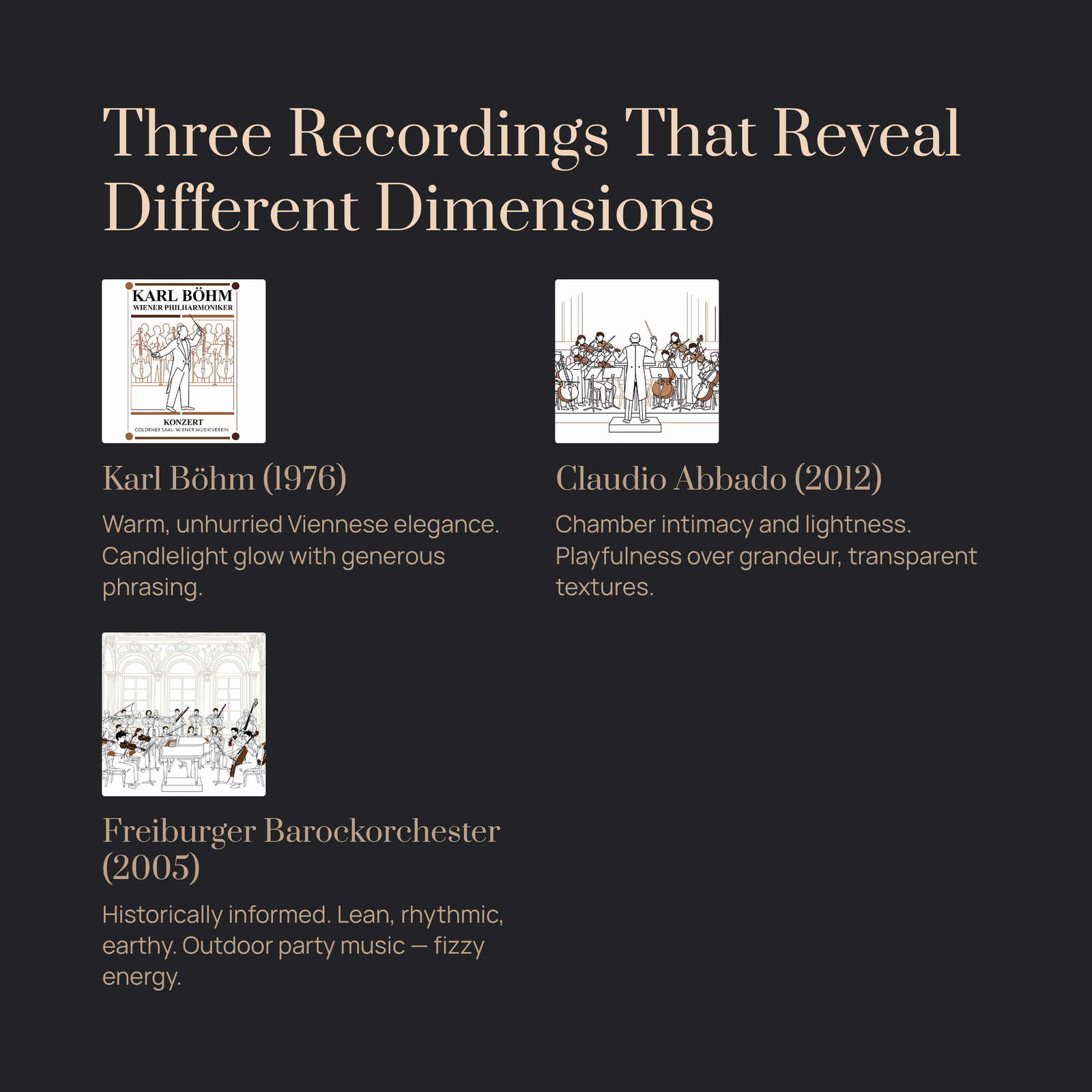
The beauty of Eine kleine Nachtmusik is that it responds to radically different interpretive approaches. Here are three recordings that each reveal a different dimension of the work.
Karl Böhm with the Wiener Philharmoniker (1976) — This is the golden standard of the old Viennese school. Warm, unhurried, with a glow that feels like candlelight. If you want to understand why this piece became synonymous with elegance, start here. The phrasing is generous, and the string tone has a richness that modern period-instrument ensembles deliberately avoid.
Claudio Abbado with the Orchestra Mozart (2012) — A chamber-sized orchestra gives this performance an intimacy and lightness that feels revelatory. Abbado finds playfulness where Böhm found grandeur. The tempos are quicker, the textures more transparent, and there’s a wonderful sense of musicians genuinely enjoying the conversation.
Freiburger Barockorchester (2005) — For those curious about historically informed performance, this recording strips away Romantic-era weight and reveals a leaner, more rhythmically driven Mozart. The gut strings and natural horns add an earthy quality that reminds you this was, originally, outdoor party music. It’s fizzy, energetic, and surprisingly modern-sounding.
Each of these recordings is a valid portrait of the same piece — and listening to all three in sequence is one of the great pleasures of classical music exploration.
Why This Piece Still Matters
There’s a temptation to dismiss Eine kleine Nachtmusik precisely because it’s so popular. Serious classical listeners sometimes treat it the way food critics treat a perfect croissant — too simple, too familiar, too pleasant to merit real attention.
But simplicity that sounds this effortless is among the hardest things to achieve in any art form. Mozart didn’t write this piece because he couldn’t write something more complex. He wrote it because he understood something that many composers forget: music doesn’t have to be difficult to be profound. Sometimes the most radical act is to simply make people feel, without reservation, a moment of uncomplicated delight.
The Allegro of Eine kleine Nachtmusik is a four-minute reminder that joy is not shallow. That clarity is not the same as simplicity. And that a melody written on a summer evening in 1787, by a man who was simultaneously composing an opera about damnation, can still — 237 years later — make a stranger smile before they even realize they’re doing it.
That’s not background music. That’s a small miracle, hiding in plain sight.