📑 Table of Contents

Here’s an experiment. Close your eyes and hum the first melody that comes to mind when someone says “classical music.” Chances are, something suspiciously close to Pachelbel’s Canon in D just played in your head. It drifts through wedding ceremonies, lingers in smartphone ringtones, hides inside pop ballads, and echoes through coffee shop playlists. You know this piece. You’ve always known it.
But here’s the strange truth: most people have never actually listened to it. They’ve heard fragments — a few bars at a cousin’s wedding, a sample in a commercial — but they’ve never sat down and followed the music from its quiet, almost shy opening to its luminous, spiraling climax. When you do, something unexpected happens. A piece you assumed was simple reveals itself as one of the most elegant architectural feats in Western music.
Today, I want to invite you to hear this piece as if for the very first time.
Who Was Johann Pachelbel? The Organist History Almost Forgot
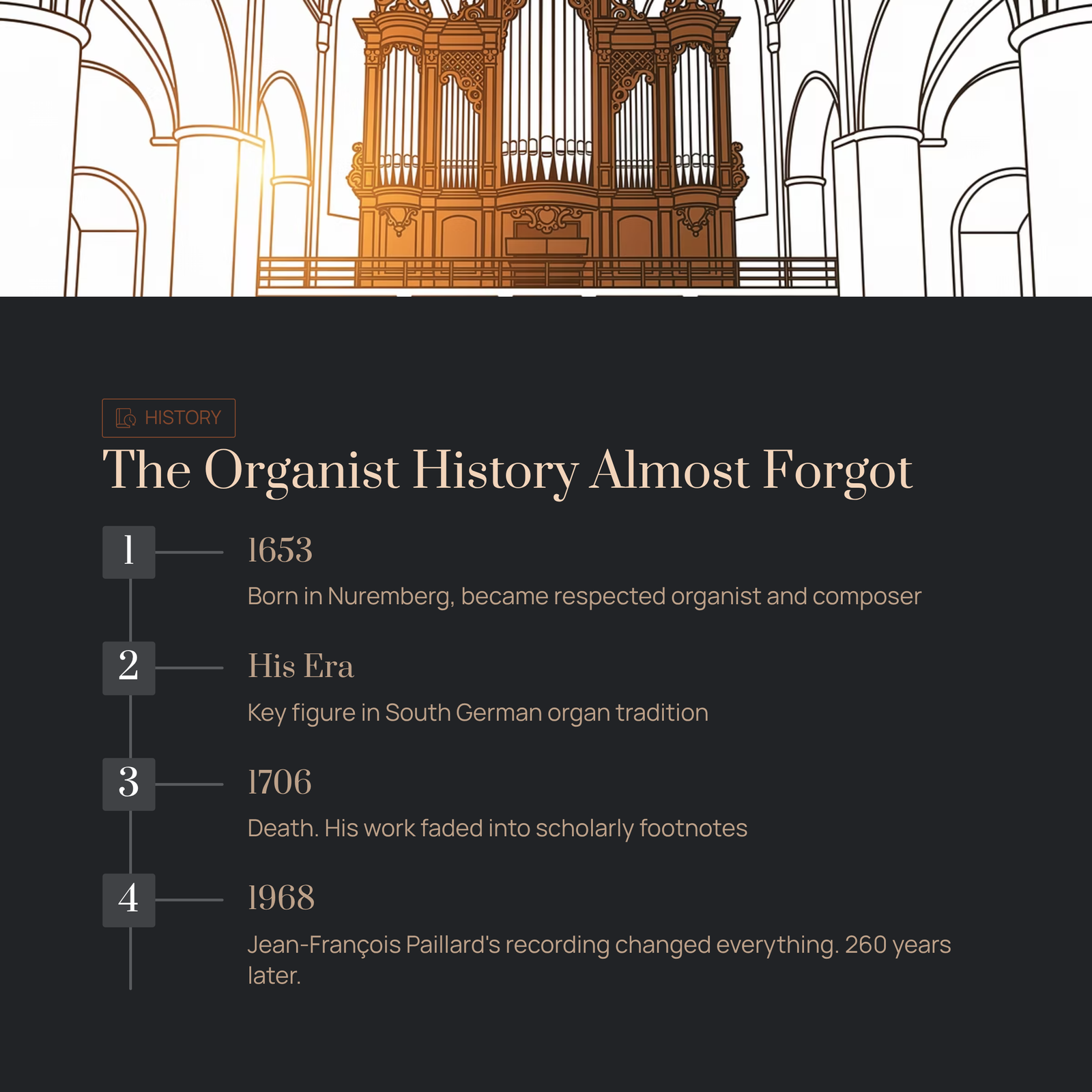
Johann Pachelbel was born in 1653 in Nuremberg, Germany — a city already humming with the energy of Baroque culture. He became one of the most respected organists and composers of his era, holding prestigious positions in churches across German-speaking lands. His reputation was enormous during his lifetime; he was a key figure in developing the South German organ tradition, and he even taught Johann Christoph Bach, the older brother of a certain Johann Sebastian Bach.
Yet despite his significance, history has a peculiar sense of irony. Almost everything Pachelbel wrote faded into scholarly footnotes after his death in 1706. For nearly three centuries, his name gathered dust in music history textbooks, known mainly to specialists. It wasn’t until 1968 — more than 260 years later — that a conductor named Jean-François Paillard recorded the Canon in D with his chamber orchestra, and everything changed. That single recording ignited a rediscovery that transformed Pachelbel from an academic footnote into a household name.
The lesson? Sometimes a masterpiece just needs the right moment to find its audience.
What Makes a Canon? Understanding the Musical Architecture
Before diving into the music itself, let’s demystify the word “canon.” It has nothing to do with cannons or warfare. In music, a canon is a compositional technique where a melody is introduced by one voice, then imitated by other voices entering one after another, each echoing the original line at a set interval. Think of it like singing “Row, Row, Row Your Boat” in rounds — except infinitely more sophisticated.
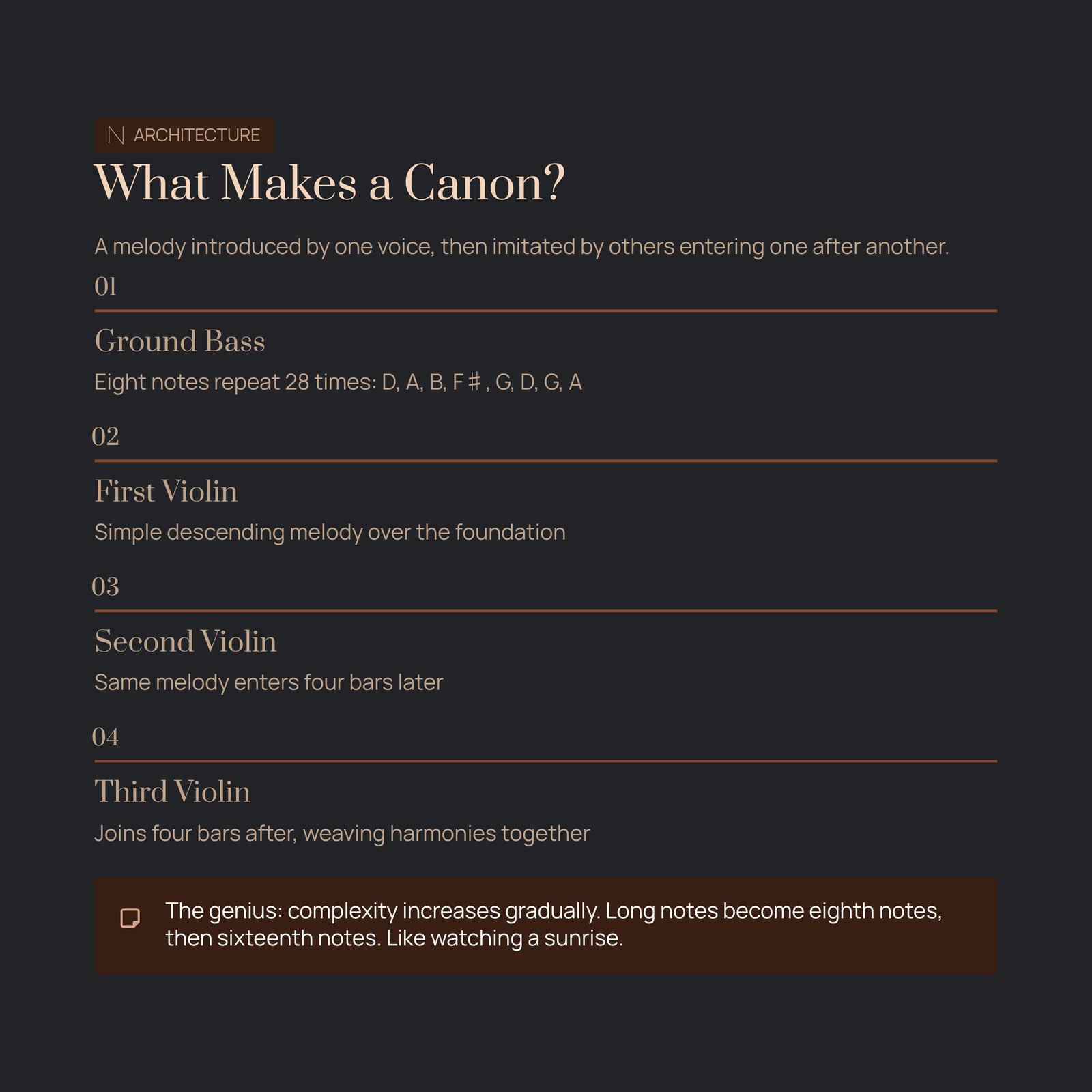
Pachelbel’s Canon in D begins with three violins and a basso continuo (typically a cello and harpsichord). The cello establishes the foundation first: a sequence of eight bass notes — D, A, B, F♯, G, D, G, A — that repeat throughout the entire piece without ever changing. This repeating bass line is called a ground bass or ostinato, and it cycles twenty-eight times from start to finish.
Over this unwavering foundation, the first violin enters with a simple, descending melody. Four bars later, the second violin enters with the exact same melody. Four bars after that, the third violin joins. Each violin plays the same musical line, but because they start at different times, the melodies weave around each other, creating harmonies that seem to bloom organically — like watching three rivers converge into a single, widening stream.
What makes the Canon quietly brilliant is how Pachelbel gradually increases the complexity. The opening melodies are spare and unhurried, using long, sustained notes. As the piece progresses, the rhythms tighten — eighth notes give way to sixteenth notes, and the violins begin to dance with increasing agility. The emotional temperature rises not through dramatic key changes or sudden bursts, but through a slow, patient accumulation of energy. It’s the musical equivalent of watching a sunrise: nothing seems to change from one moment to the next, but suddenly, everything is different.
Why Does This Piece Move Us? A Personal Reflection
I’ve spent a long time thinking about why the Canon in D affects people so deeply, and I believe the answer lies in its relationship with repetition and expectation.
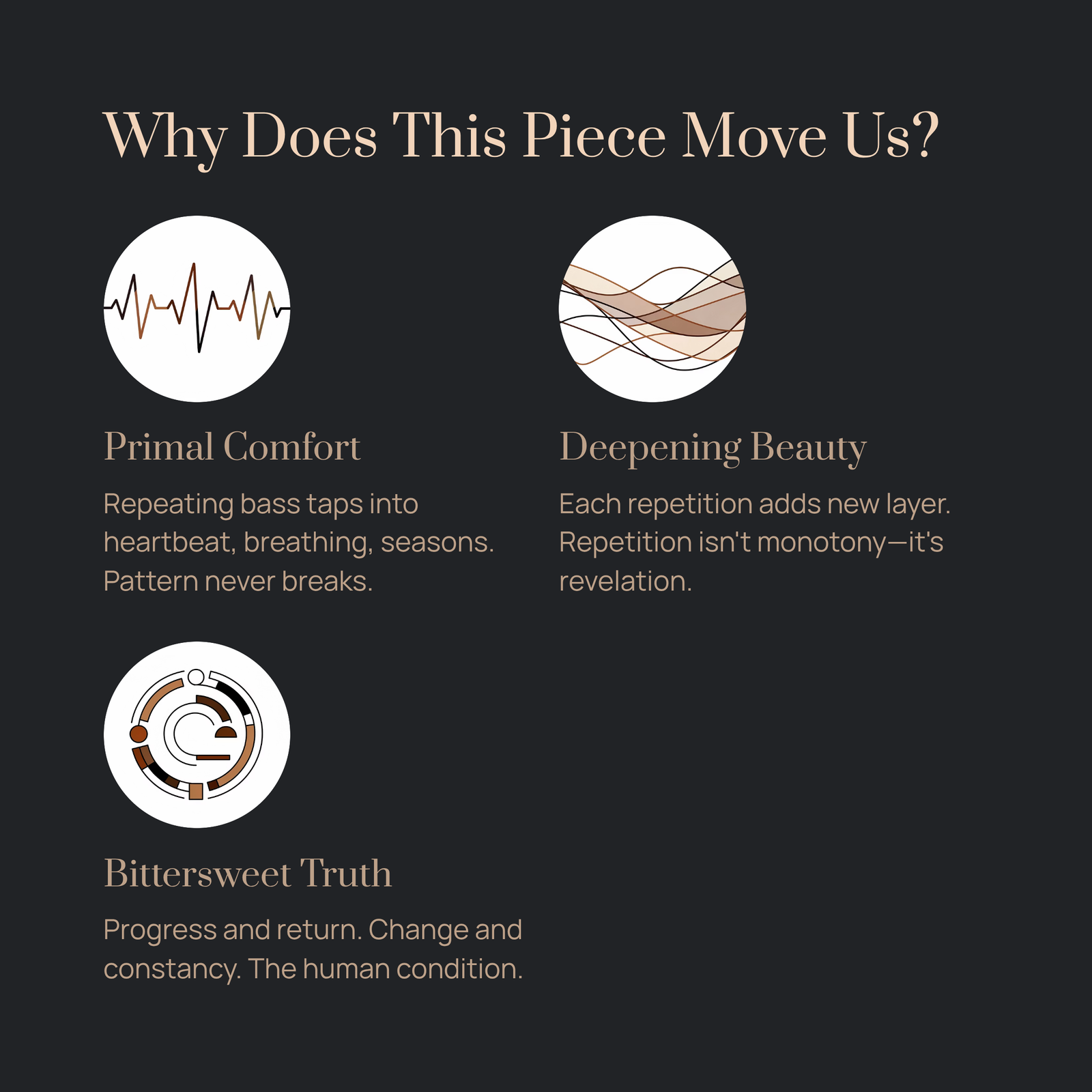
Human beings are wired to find comfort in patterns. Our heartbeats are rhythmic. Our breathing is cyclical. The seasons return. Pachelbel’s ground bass taps into something primal — the reassurance that comes from a pattern that never breaks. No matter how elaborate the violin melodies become, no matter how intricate the counterpoint grows, that bass line remains, steady and faithful, like the heartbeat beneath everything.
But comfort alone doesn’t explain the tears people shed at weddings when this piece plays. There’s something else: the way each repetition of the melody adds a new layer of beauty to what came before. It’s like looking at someone you love and realizing, for the hundredth time, something new about them. The Canon teaches us that repetition isn’t monotony — it’s deepening. Each pass through the same harmonic progression reveals a new facet, a new color, a new conversation between the voices.
There’s also a bittersweet quality hiding in all that warmth. The piece moves relentlessly forward, each variation more elaborate than the last, and yet it’s built on a circle that returns to its starting point again and again. Progress and return, change and constancy — these tensions live at the heart of the Canon, and perhaps at the heart of what it means to be human.
How to Listen: A Practical Guide for First-Time Listeners
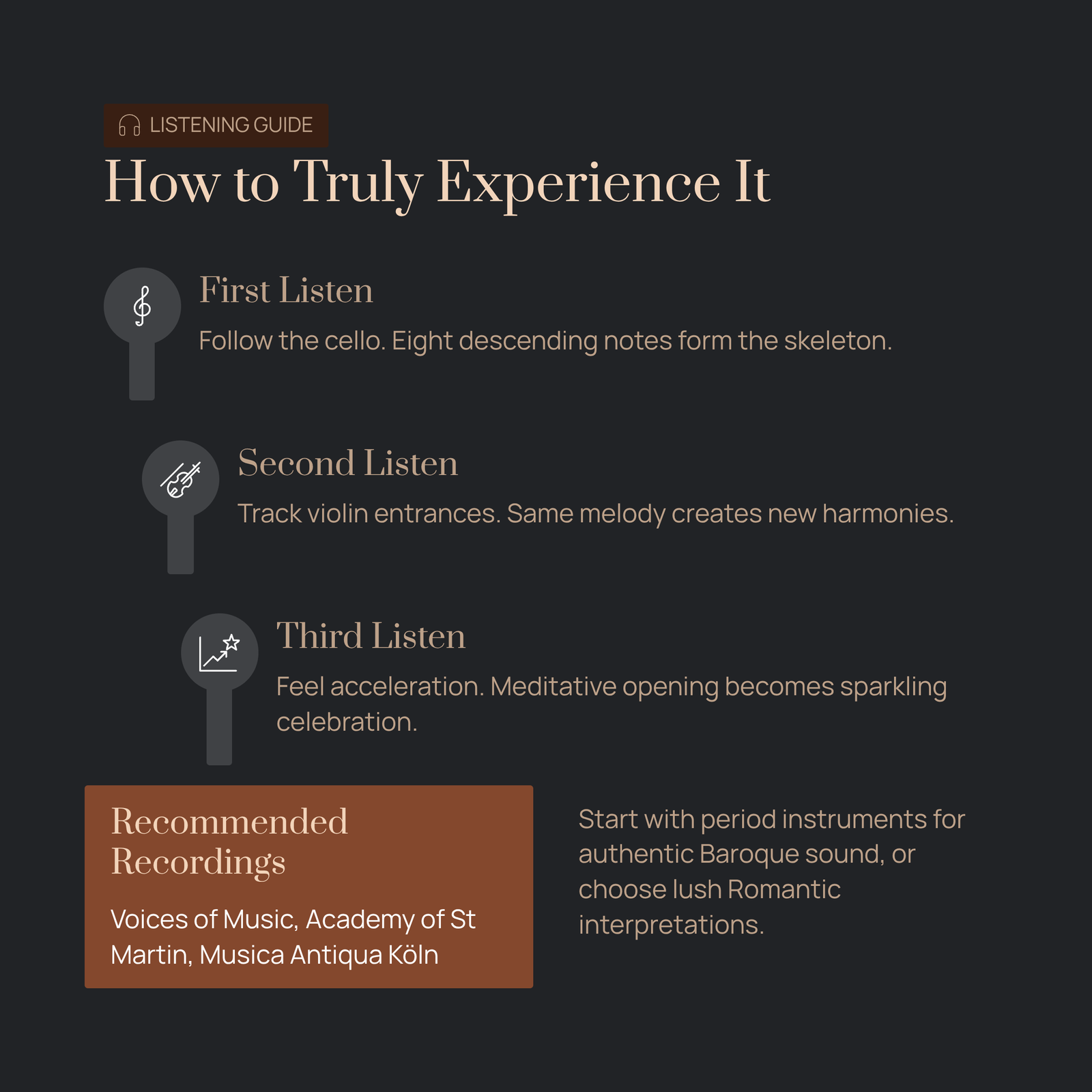
If you’d like to truly experience the Canon in D rather than simply let it wash over you, here are a few ways to engage with it more actively.
First listen — Follow the cello. Before anything else, try to isolate the bass line in your ear. Those eight descending notes form the skeleton of everything. Once you can hear them clearly, you’ll notice how the entire piece is a series of creative responses to this single, unchanging question.
Second listen — Track the entrances. Pay attention to the moment each violin enters. Notice how the same melody, when layered on top of itself, creates harmonies that didn’t exist in any single line alone. This is the magic of counterpoint: the whole becomes far greater than the sum of its parts.
Third listen — Feel the acceleration. Start noticing how the rhythmic activity increases over time. The opening is meditative, almost still. By the middle section, the violins are moving in flowing eighth notes. By the final third, there’s a sparkling energy in the sixteenth-note passages that feels almost celebratory. The genius is that this acceleration feels completely natural — there’s no jarring shift, just a gentle, inevitable blossoming.
For recordings, I’d suggest starting with the Voices of Music ensemble’s historically informed performance, which captures the Baroque-era sound with period instruments and a transparent, intimate texture. If you prefer a fuller, more Romantic sound, the Academy of St Martin in the Fields recording under Neville Marriner is lush and beautifully shaped. And for a deeply personal, almost contemplative take, seek out Musica Antiqua Köln under Reinhard Goebel — their version strips away sentimentality and lets the architecture speak.
The Quiet Revolution of Eight Notes
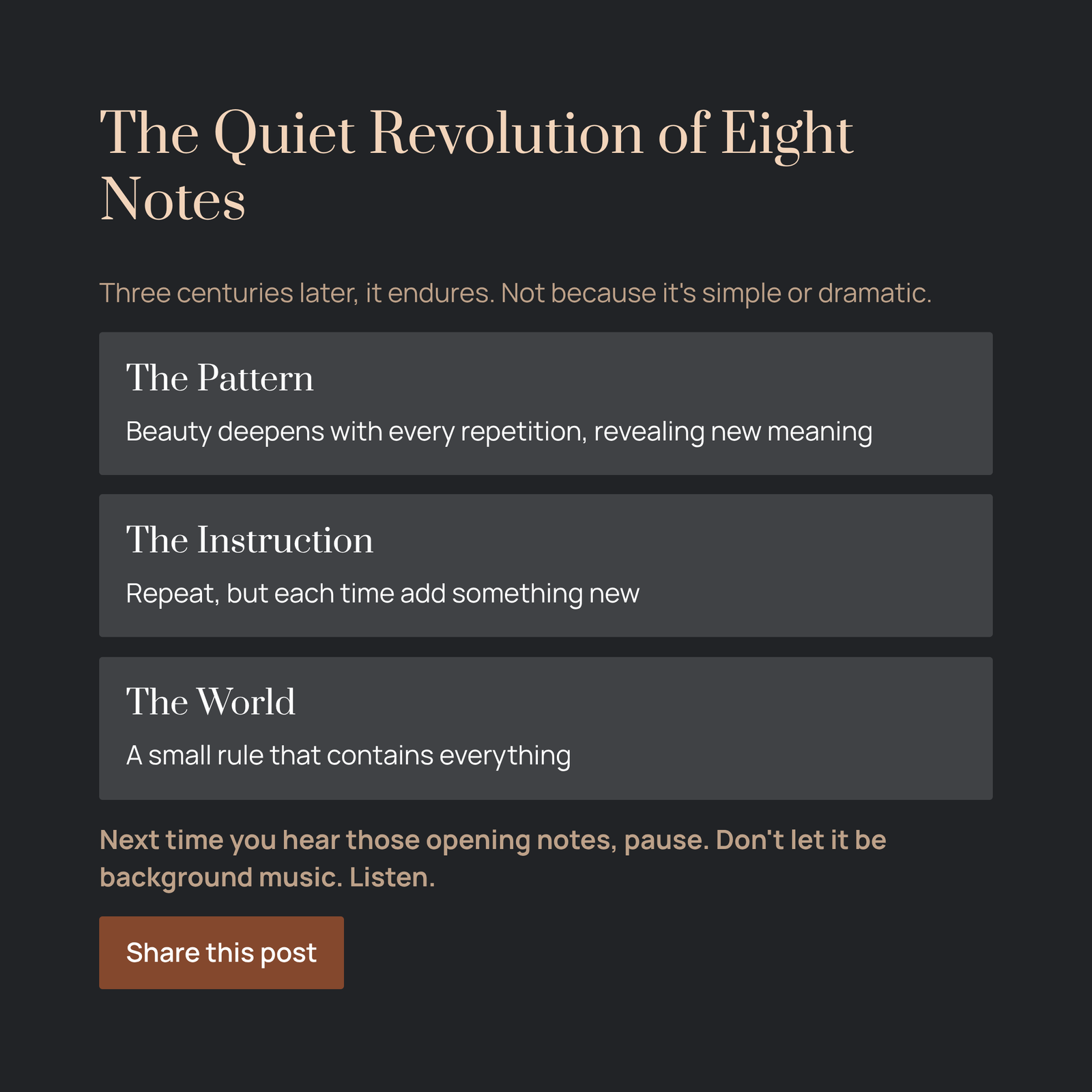
There’s a reason Pachelbel’s Canon in D has endured for over three centuries and shows no sign of fading. It isn’t because it’s simple — though it sounds effortless, its construction is remarkably precise. It isn’t because it’s dramatic — there are no thundering climaxes or tragic outbursts. It endures because it captures something essential about the way beauty works in the world: not as a single, overwhelming moment, but as a pattern that deepens with every repetition, revealing new meaning each time you return to it.
The next time you hear those familiar opening notes — at a wedding, in a film, drifting from a café speaker — pause for a moment. Don’t let it be background music. Listen to the cello’s quiet insistence. Follow the violins as they weave their patient tapestry. Feel the slow bloom of something that was always there, waiting for you to notice.
Three hundred years ago, an organist in Nuremberg wrote a piece built on eight bass notes and a single rule: repeat, but each time, add something new. It’s a small instruction. But somehow, it contains the whole world.