📑 Table of Contents
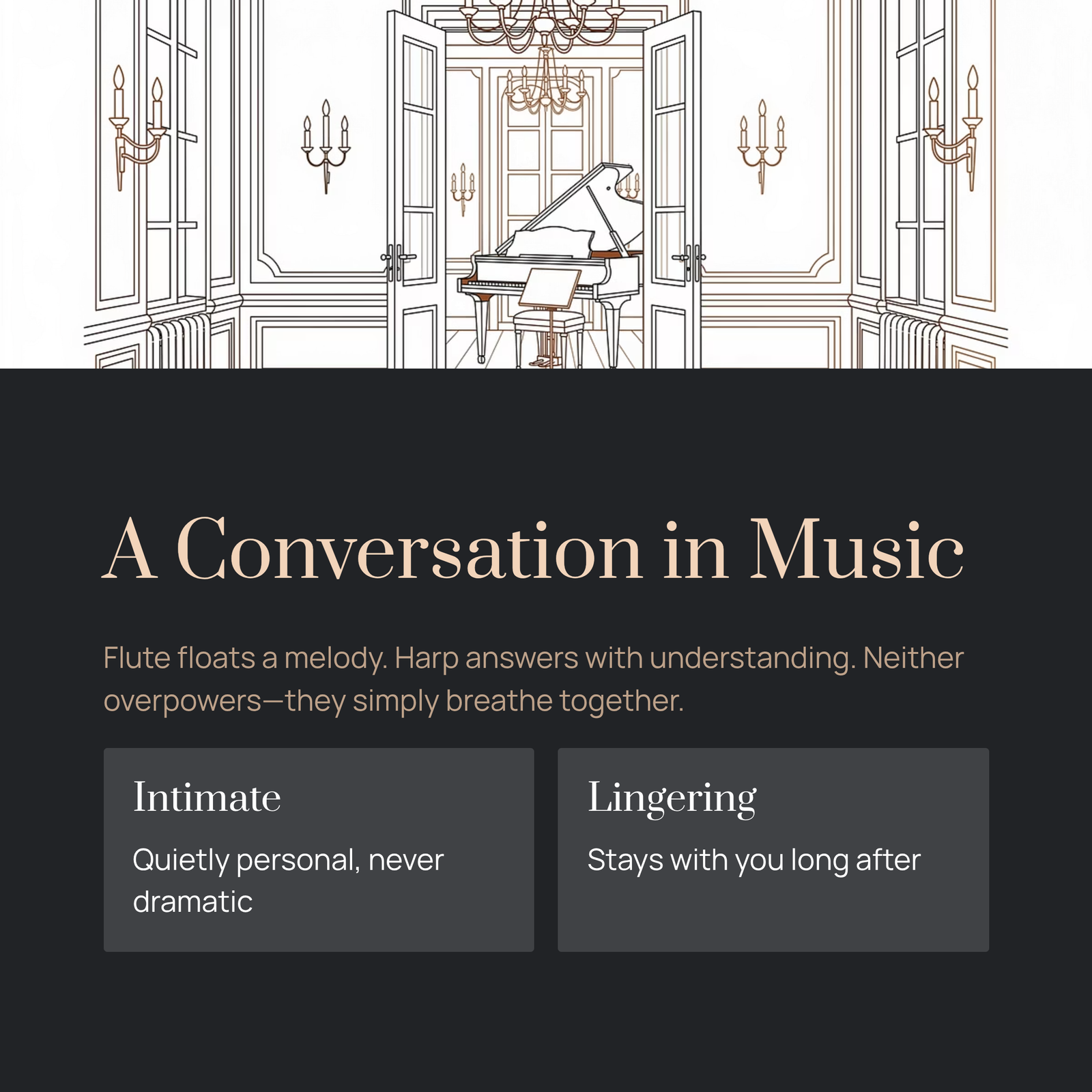
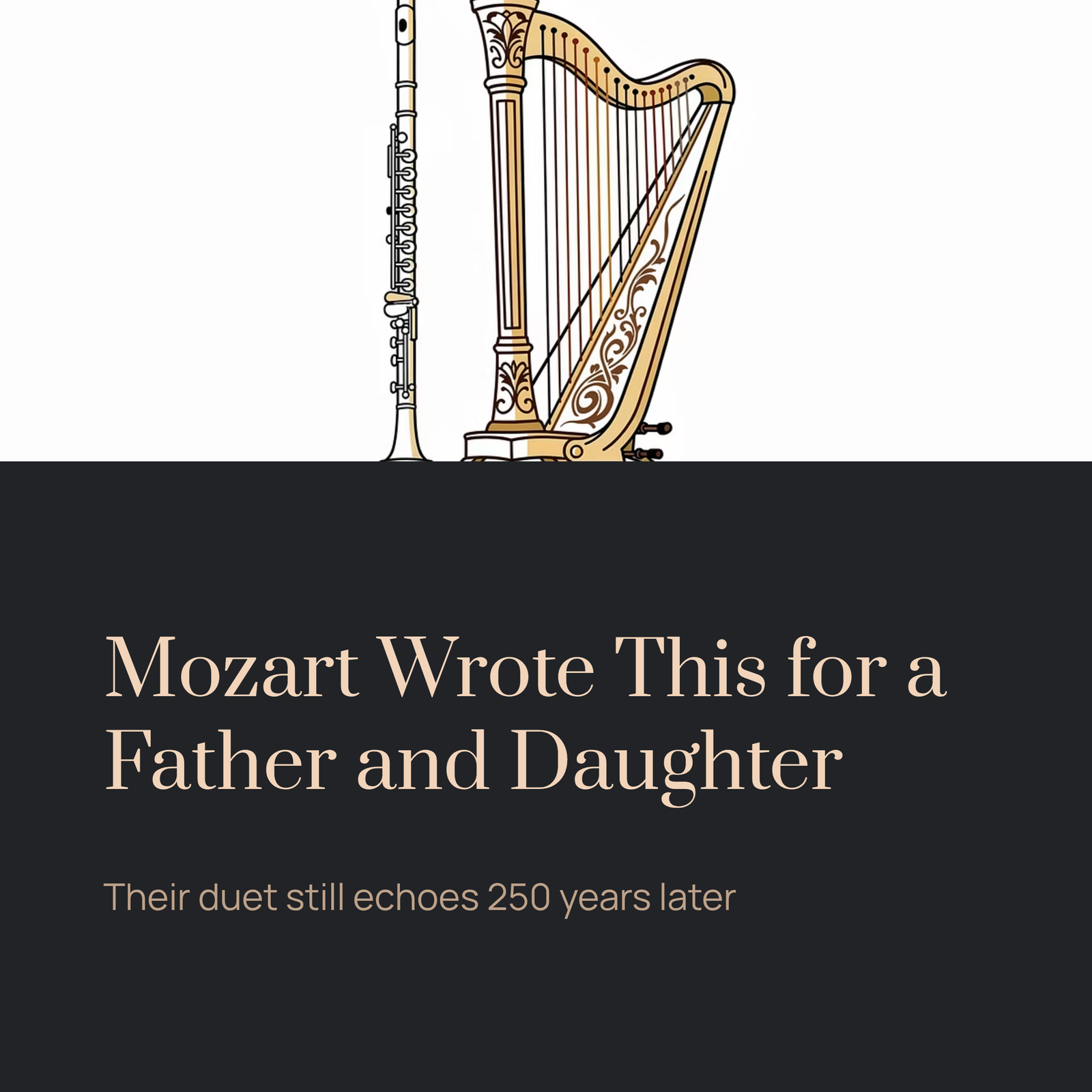
Imagine walking through the corridors of an 18th-century Parisian mansion and catching, through a half-open door, the sound of a father and daughter playing music together. The flute floats a melody — unhurried, almost confessional. The harp answers, not with argument, but with understanding. Neither instrument tries to overpower the other. They simply breathe together.
That is the second movement of Mozart’s Concerto for Flute and Harp in C Major, K.299 — one of the most quietly intimate pieces he ever wrote. It is not dramatic. It does not shout. And yet, once it finds you, it lingers in a way that louder music never could.
The Story Behind the Notes: Paris, 1778
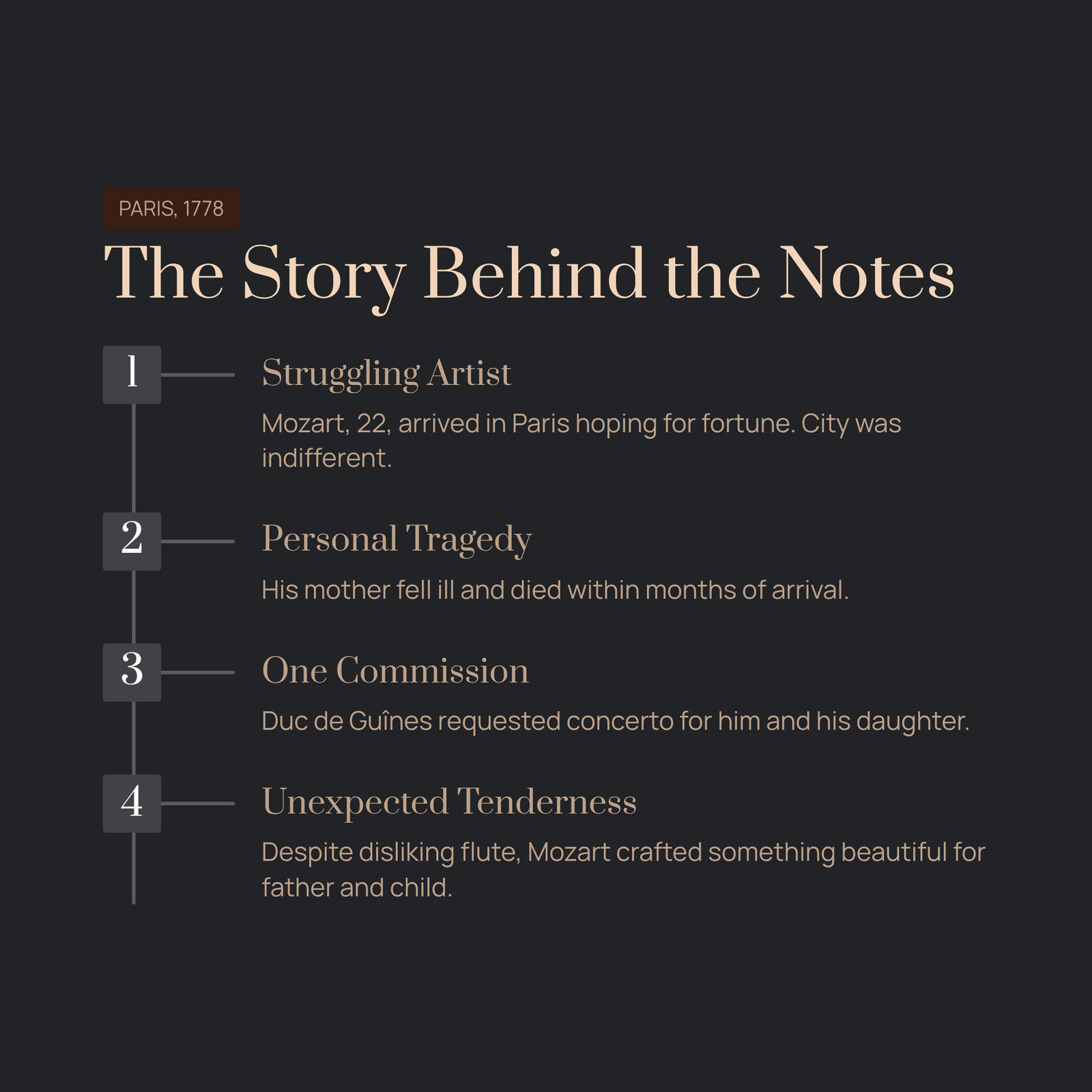
Mozart was twenty-two years old and struggling. He had arrived in Paris hoping to make his fortune, but the city was indifferent to his genius. Commissions were scarce, money was tight, and within months, his mother — who had accompanied him on the journey — would fall gravely ill and die.
Against this bleak backdrop, one small opportunity appeared. Adrien-Louis de Bonnières, the Duc de Guînes, was an accomplished amateur flutist. His daughter played the harp. The duke commissioned Mozart to write a concerto that would allow them to perform together — a private piece of music for a father and his child.
Mozart, it must be said, was not particularly fond of the flute. He once wrote in a letter that he could hardly stand the instrument. But the task itself — crafting a musical space where two people who loved each other could share something beautiful — seemed to draw out a tenderness in him that went beyond personal taste.
The result was K.299, the only concerto Mozart ever wrote for this combination of instruments. And while all three movements have their charms, it is the second movement, marked Andantino, that holds the emotional center of the work.
What Makes the Andantino So Special
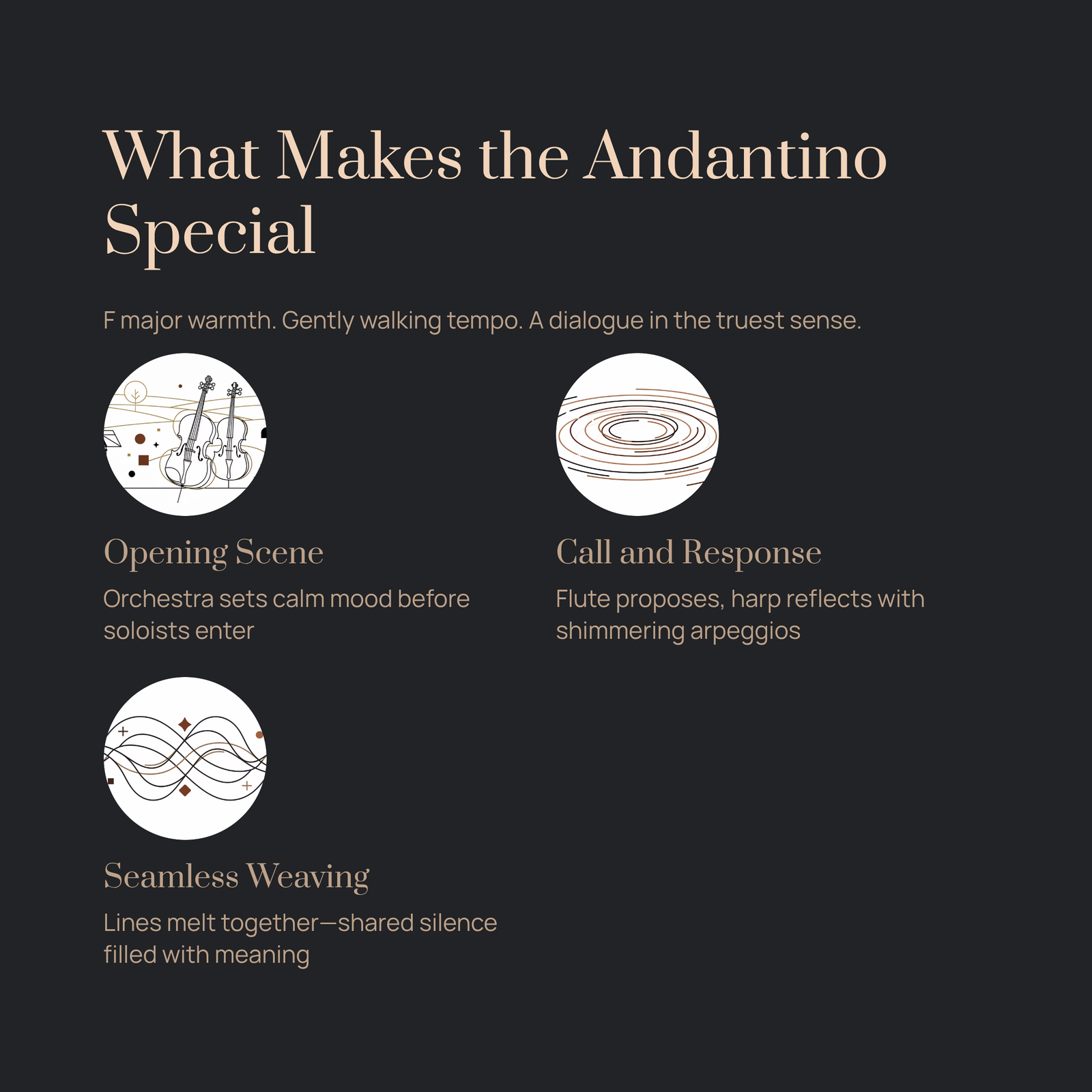
The Andantino unfolds in F major, a key that Mozart often reached for when he wanted warmth without heaviness. The tempo marking itself — Andantino, a little faster than Andante — suggests something gently walking forward, unhurried but never stagnant.
Here is what to listen for:
The movement opens with the orchestra setting a calm, almost pastoral scene — a soft cushion of strings that establishes the mood before either soloist enters. When the flute arrives, it does so with a melody so simple and singable that you might mistake it for a lullaby. But then the harp responds, not by repeating the melody exactly, but by ornamenting it, adding delicate arpeggios that shimmer around the flute’s line like light on water.
This call-and-response pattern is the heartbeat of the movement. The flute proposes; the harp reflects. The harp ventures forward; the flute gently follows. Neither instrument dominates. It is a dialogue in the truest sense — two voices that listen to each other as carefully as they speak.
Pay particular attention to the moments where both instruments play simultaneously. Mozart weaves their lines together so seamlessly that you almost forget you are hearing two separate instruments. The flute’s sustained tones melt into the harp’s plucked notes, creating a texture that is neither fully melodic nor fully harmonic, but something in between — something that sounds like shared silence filled with meaning.
There is no virtuosic fireworks here, no cadenza demanding applause. The beauty is in the restraint. Mozart seems to understand that some emotions are too fragile for grand gestures.
A Piece That Teaches You How to Listen
One of the quiet gifts of this movement is that it slows you down. In a world saturated with music designed to grab your attention in the first three seconds, the Andantino asks for a different kind of listening — the kind where you stop reaching for the next thing and simply stay with what is here.
Try this: the first time you listen, close your eyes and follow only the flute. Notice how its phrases rise and fall like calm breathing. The second time, follow only the harp. You will hear how it fills the spaces the flute leaves behind, like someone finishing your sentences — not because they are impatient, but because they know you that well.
The third time, listen to both together. That is when the magic happens. You start to hear the piece not as two separate parts, but as a single conversation — the kind that only happens between people who have long since stopped needing to explain themselves to each other.
For a first listen, I recommend starting around the moment the flute enters after the orchestral introduction. Let yourself settle into the tempo. There is no rush. The movement runs roughly seven to eight minutes, and every one of those minutes earns its place.
Recommended Performances
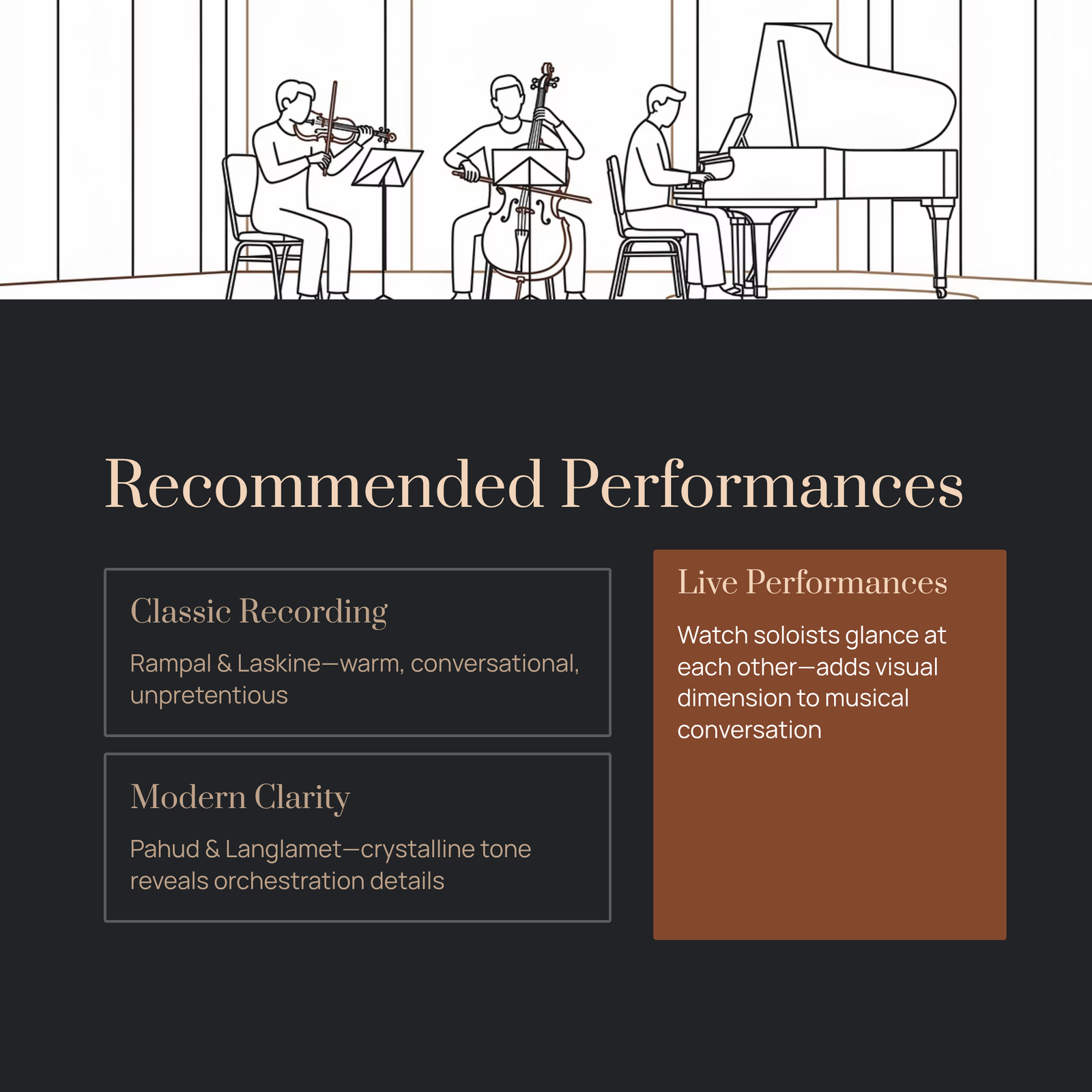
Several recordings capture this movement beautifully. The pairing of Jean-Pierre Rampal on flute and Lily Laskine on harp, with the Orchestre de Chambre conducted by Karl Ristenpart, remains a classic — warm, conversational, and unpretentious. For a more modern take, Emmanuel Pahud and Marie-Pierre Langlamet with the Berliner Philharmoniker bring crystalline clarity and a slightly more luminous tone that reveals details in Mozart’s orchestration you might otherwise miss.
If you prefer video, searching for live performances of K.299 on YouTube will turn up several excellent options. There is something particularly moving about watching the two soloists glance at each other during the Andantino — it adds a visual dimension to the musical conversation that a recording alone cannot provide.

Why This Music Still Matters
The Duc de Guînes never paid Mozart for the concerto. The composer complained about it bitterly in letters to his father. And the duke’s daughter, for all we know, may have moved on to other hobbies within a year.
But the music remains. It remains because Mozart, even when irritated, even when grieving, even when broke and far from home, could not help writing something true. The Andantino is not a grand statement about the human condition. It is something smaller and, in its own way, more powerful: a record of what it sounds like when two people are simply present with each other, saying nothing that needs to be said aloud.
In a catalog filled with operas and symphonies and concertos that shake the rafters, this quiet movement stands apart. It does not demand that you love it. It simply waits — patient, luminous, unhurried — for the moment when you are ready to hear it.
And when that moment comes, it feels less like discovering a piece of music and more like remembering something you somehow already knew.