📑 Table of Contents
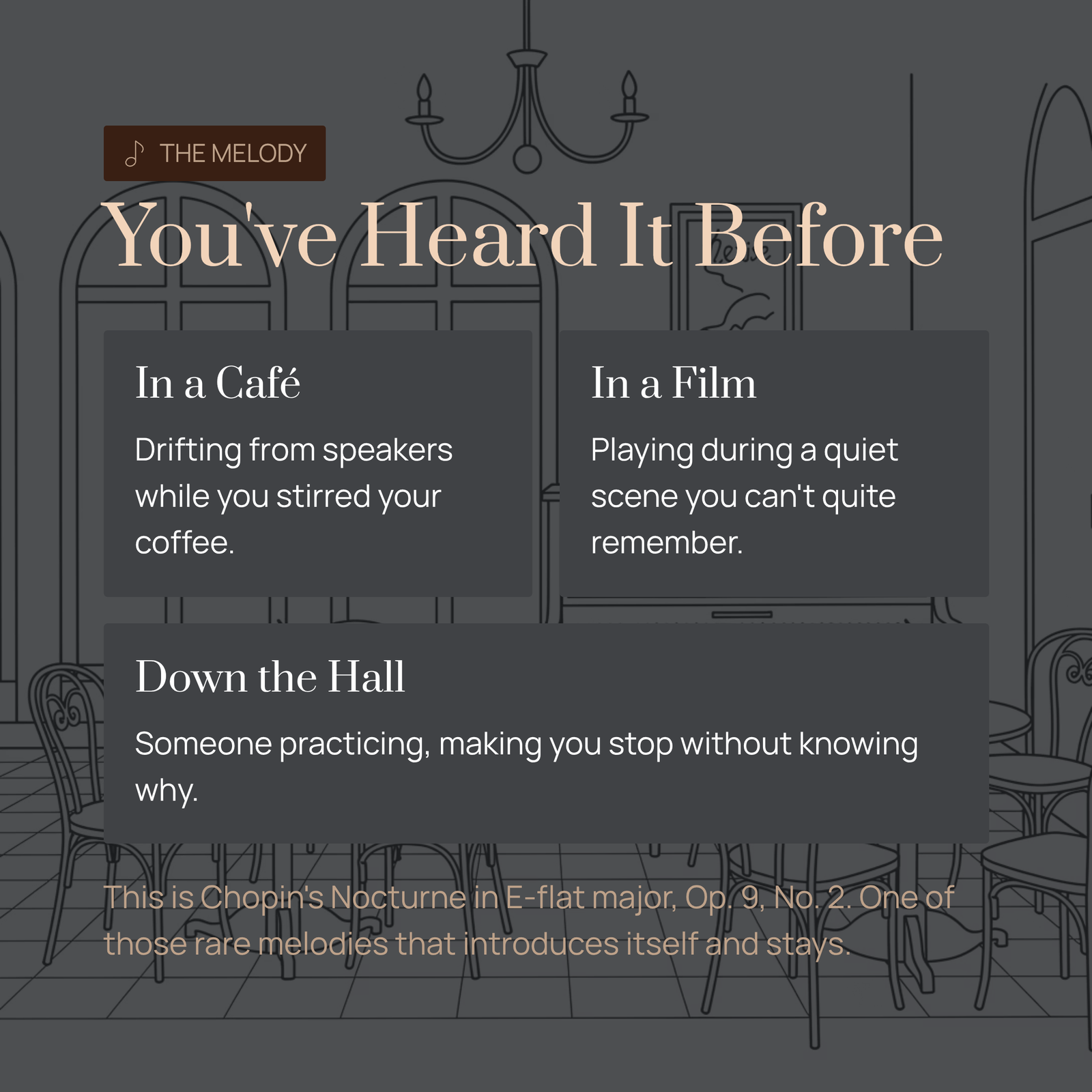
You’ve heard it before — you just might not know its name yet.
Maybe it drifted from a café speaker while you were stirring your coffee. Maybe it played during a quiet scene in a film you can’t quite remember. Or maybe someone practiced it in a room down the hall, and you stood still without knowing why.
That piece is almost certainly Chopin’s Nocturne in E-flat major, Op. 9, No. 2. It’s one of those rare melodies that doesn’t need an introduction — it introduces itself. And once it does, it tends to stay.
What makes this particular Nocturne so magnetic isn’t complexity or grandeur. It’s something far simpler: the feeling that someone is singing to you through a piano, late at night, with no audience in mind.
The Young Exile Who Wrote Night Songs
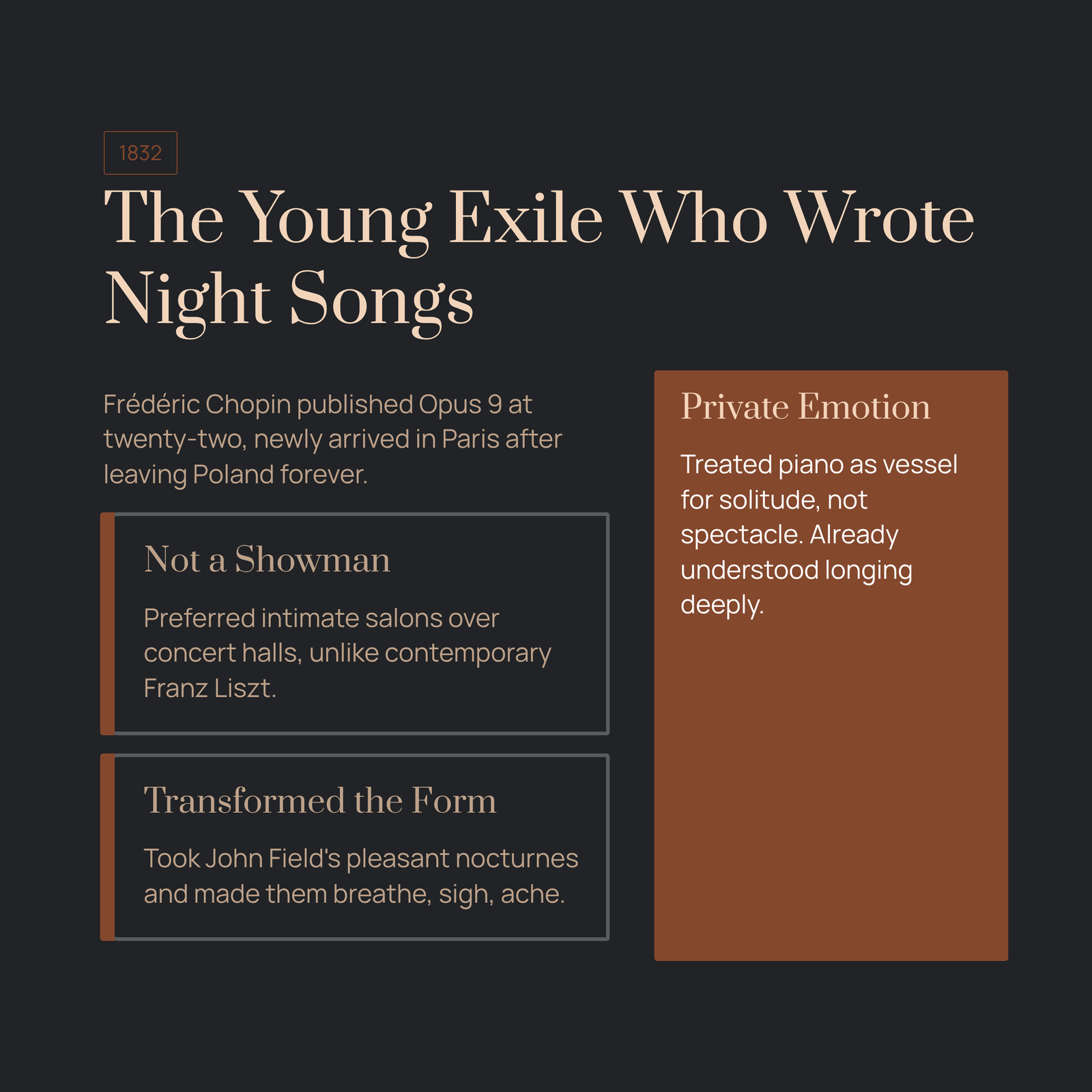
Frédéric Chopin published the three Nocturnes of Opus 9 in 1832, when he was just twenty-two years old. He had recently left his homeland of Poland — a departure that would turn out to be permanent — and settled in Paris, a city teeming with artists, aristocrats, and ambition.
But Chopin wasn’t a showman. While his contemporary Franz Liszt dazzled concert halls with thundering virtuosity, Chopin preferred smaller rooms, intimate gatherings, candlelit salons. He composed almost exclusively for the piano, treating it not as an instrument of spectacle but as a vessel for private emotion.
The nocturne as a form wasn’t Chopin’s invention. The Irish composer John Field had pioneered the genre — short, lyrical piano pieces inspired by the stillness of night. But Chopin took the idea and transformed it entirely. Where Field’s nocturnes were pleasant and decorative, Chopin’s breathed. They sighed. They ached. He turned a charming miniature into something that could hold the full weight of human longing.
Op. 9, No. 2 was among his earliest published nocturnes, yet it already sounds like the work of someone who understood solitude on a deeply personal level.
What You’re Actually Hearing: A Guided Listen
Don’t worry — you don’t need to read music or know any theory to appreciate what’s happening in this piece. Here’s a simple roadmap for your ears.
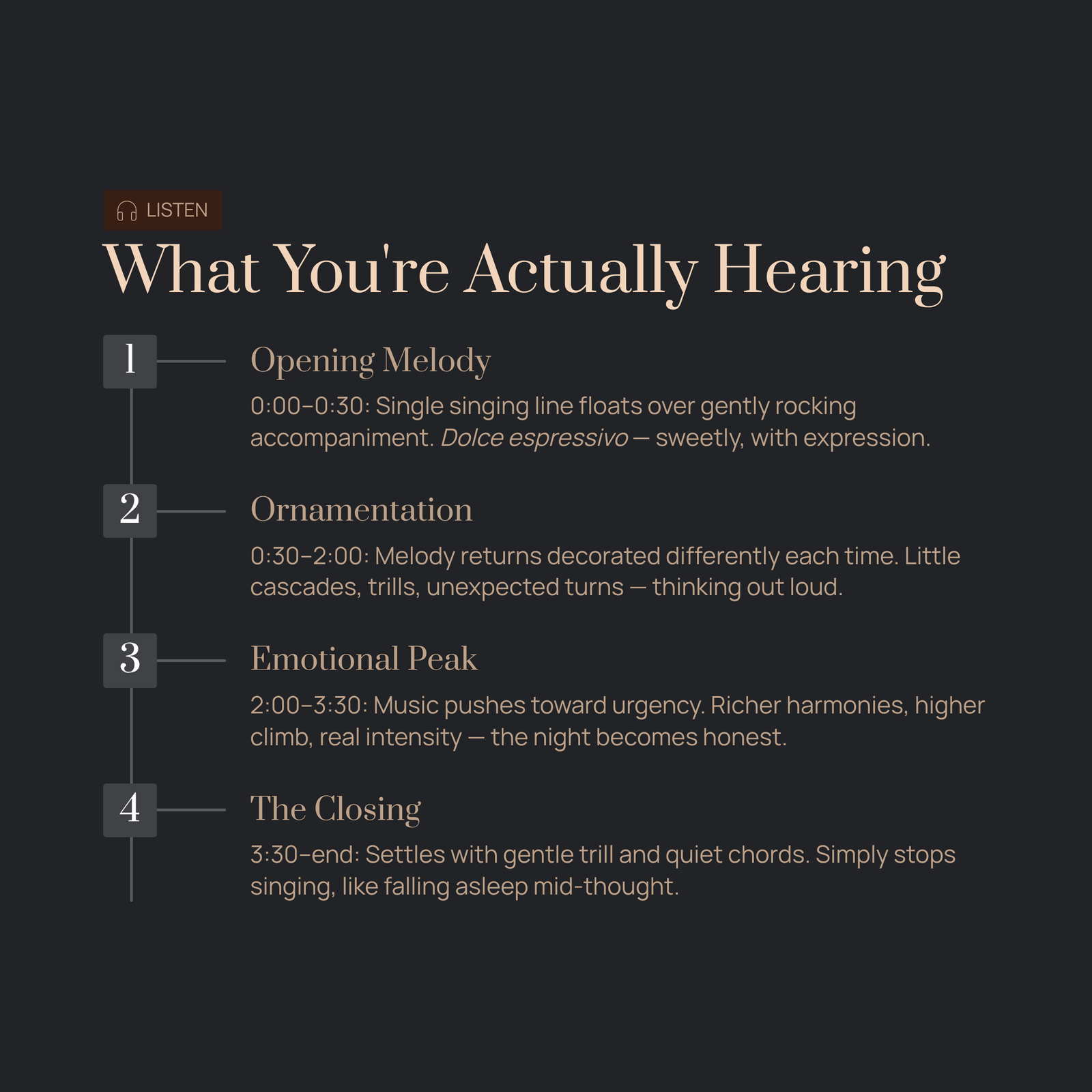
The Opening Melody (0:00–0:30)
The piece begins with a single, singing line in the right hand over a gently rocking accompaniment in the left. That left hand creates a kind of cradle — a soft, swaying rhythm in triple meter that never demands attention but holds everything together. The melody floats above it like a voice in a quiet room. Notice how it rises and falls in long, graceful arcs. Chopin marks it dolce espressivo — sweetly, with expression.
Ornamentation and Variation (0:30–2:00)
Here’s where the magic deepens. Each time the melody returns, Chopin decorates it differently. Little cascades of notes, gentle trills, unexpected turns — the tune you heard at the beginning starts to shimmer and evolve, the way a memory changes slightly each time you revisit it. These ornaments aren’t showing off. They’re the melody thinking out loud, discovering new shades of the same emotion.
The Emotional Peak (2:00–3:30)
Around the two-minute mark, the music begins to push toward something more urgent. The harmonies grow richer, the melody climbs higher, and there’s a brief moment of real intensity — a swell of feeling that Chopin doesn’t try to resolve neatly. It’s the emotional center of the piece, the moment where the night stops being peaceful and becomes honest.
The Closing (3:30–end)
After that climax, the music settles back down with a gentle trill and a series of quiet chords. It doesn’t end dramatically. It simply stops singing, the way someone falls asleep mid-thought. The silence that follows feels like part of the composition.
Why This Piece Refuses to Age
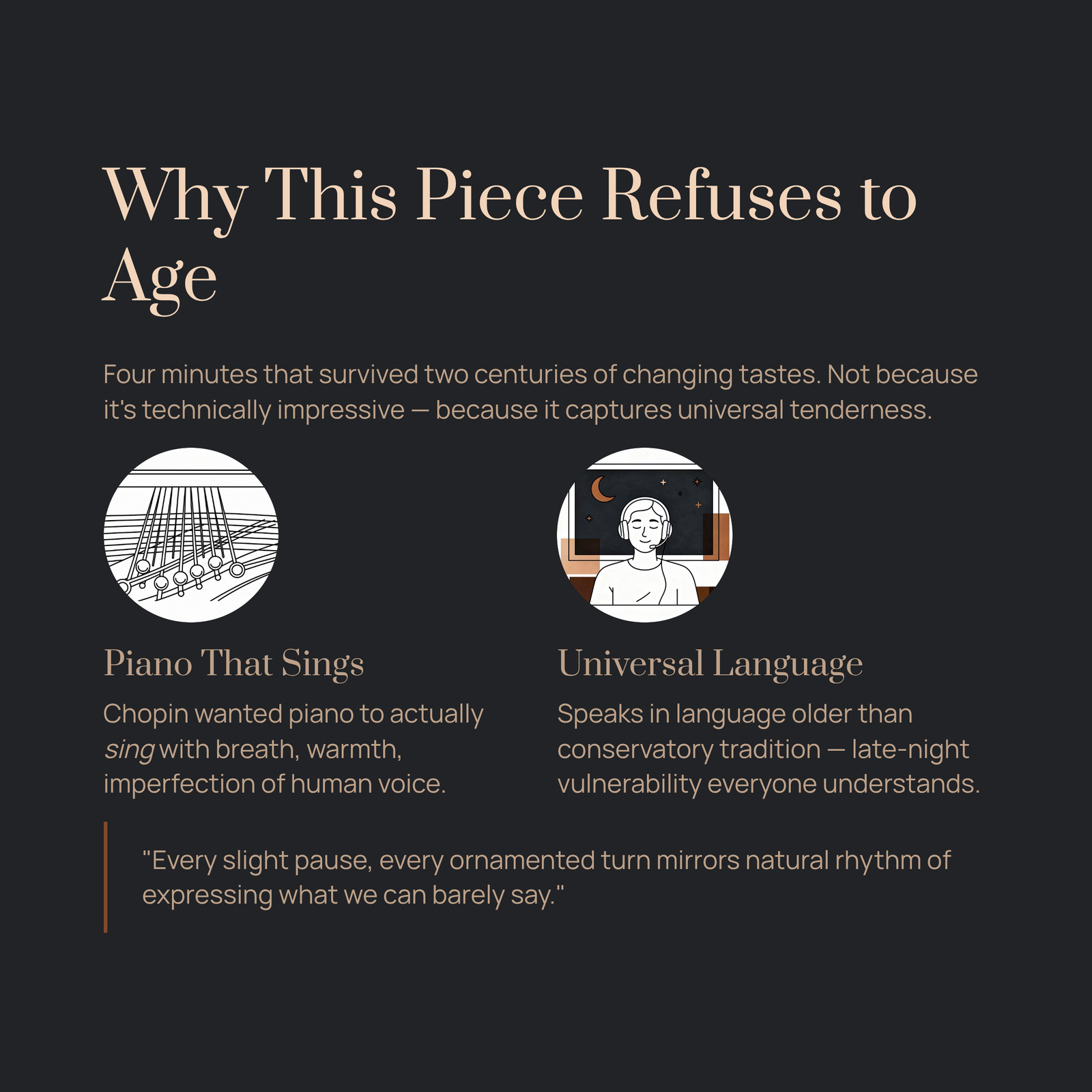
There’s a reason this four-minute work has survived nearly two hundred years of changing tastes, technologies, and musical revolutions. It’s not because it’s technically impressive (though it is, beneath its apparent simplicity). It’s because it captures something universal: the particular tenderness that only comes out at night, when pretenses fall away.
Chopin once said he wanted the piano to sing. Not imitate singing — actually sing, with all the breath and warmth and imperfection of a human voice. In this Nocturne, he accomplished exactly that. The right hand doesn’t play notes so much as it phrases them, the way a vocalist would shape a line of poetry. Every slight pause, every ornamented turn, every dynamic swell mirrors the natural rhythm of someone expressing something they can barely put into words.
This is also why the piece resonates with people who have never studied classical music. You don’t need context to understand it. The melody speaks in a language older than any conservatory tradition — the language of late-night vulnerability.
How to Listen: Three Ways In
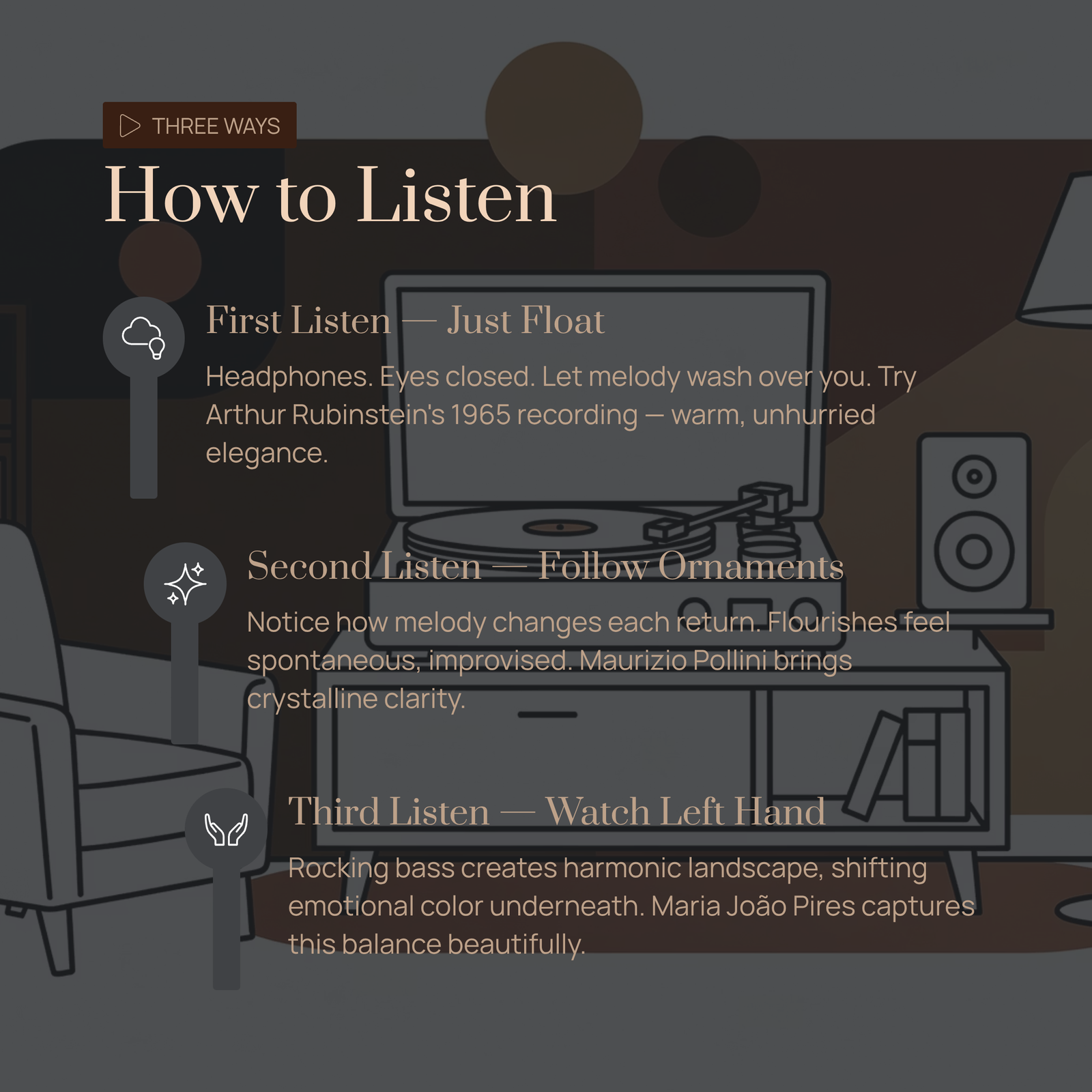
First listen — just float. Put on headphones. Close your eyes. Don’t try to analyze anything. Let the melody wash over you the way it was designed to: as a private serenade. Arthur Rubinstein’s 1965 recording is a wonderful starting point. His tone is warm and unhurried, and he plays with the kind of understated elegance that lets the music speak for itself.
Second listen — follow the ornaments. This time, pay attention to how the melody changes each time it returns. Notice the little flourishes Chopin adds — how they feel spontaneous, almost improvised, as if the pianist is discovering them in real time. For this, try Maurizio Pollini’s recording, which brings crystalline clarity to every decorative detail.
Third listen — watch the left hand. It’s easy to get lost in the melody, but the accompaniment is doing quiet, essential work. That rocking bass pattern isn’t just keeping time — it’s creating a harmonic landscape, shifting the emotional color underneath the melody without you noticing. Maria João Pires captures this balance beautifully, giving weight to the accompaniment without ever overshadowing the song above.
The Night Has Its Own Language
There’s a reason we whisper in the dark. Something about nighttime strips away the noise — literal and emotional — and leaves us closer to what we actually feel. Chopin understood this intuitively. He didn’t write nocturnes as lullabies or background music. He wrote them as confessions.
Op. 9, No. 2 is perhaps the most accessible of all those confessions. It asks nothing of you — no musical training, no historical knowledge, no patience for complexity. It simply offers a melody, and trusts that the melody is enough.
Nearly two centuries later, it still is.
The next time you find yourself awake at midnight, restless and searching for something you can’t name — press play. You might discover that Chopin already named it for you, in a language that doesn’t need translation.