📑 Table of Contents
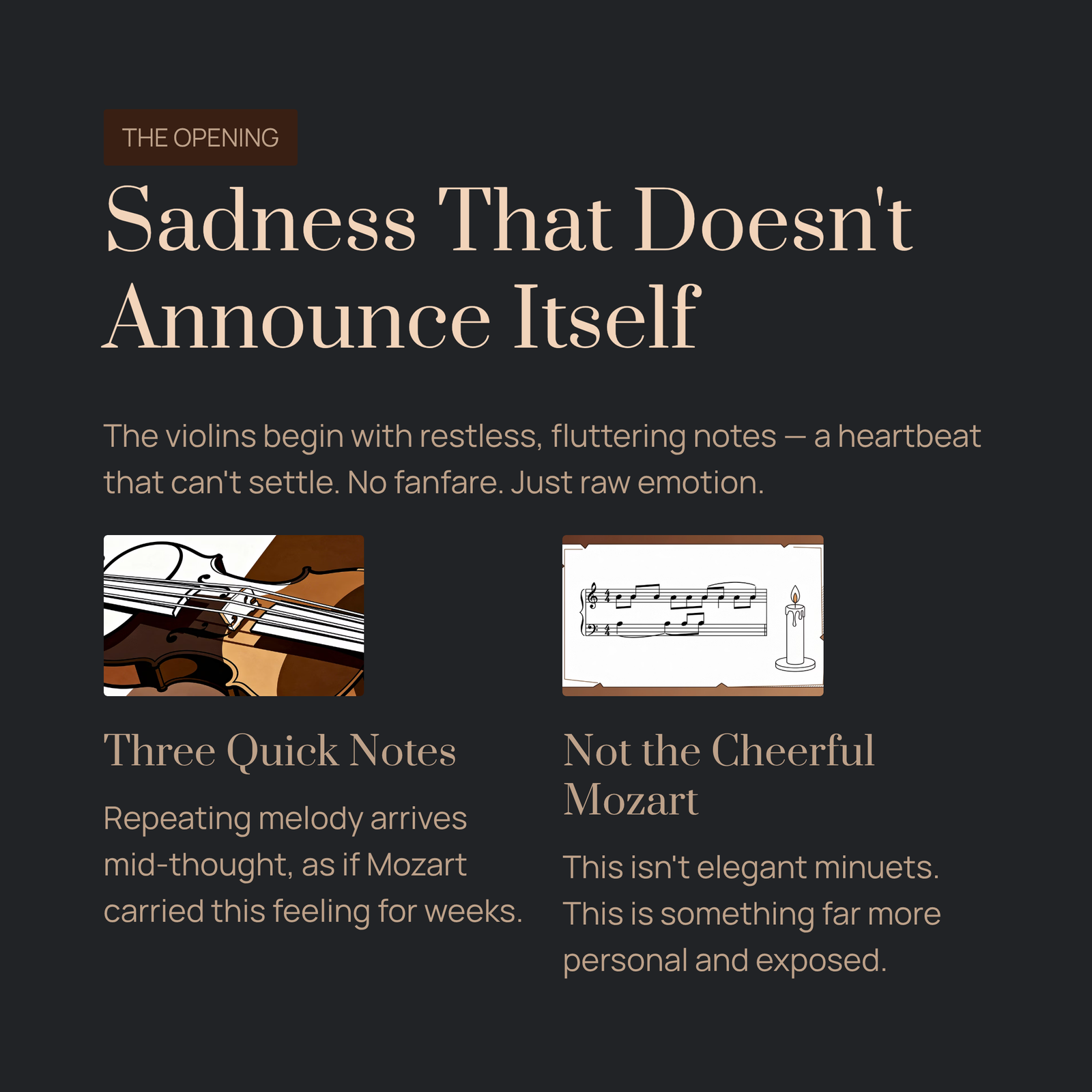
There’s a particular kind of sadness that doesn’t announce itself. It doesn’t slam doors or raise its voice. It sits quietly at the dinner table, laughing at all the right moments, then falls apart in the car on the way home. That’s what the opening of Mozart’s Symphony No. 40 sounds like.
The violins begin with a restless, fluttering figure — three quick notes repeating over and over, like a heartbeat that can’t quite settle. No grand introduction, no fanfare. Just a melody that arrives already mid-thought, as if Mozart had been carrying this feeling around for weeks before he finally sat down to write it. Within seconds, you understand that this isn’t the Mozart of cheerful serenades and elegant minuets. This is something far more personal.
The Summer of 1788: When Everything Fell Apart
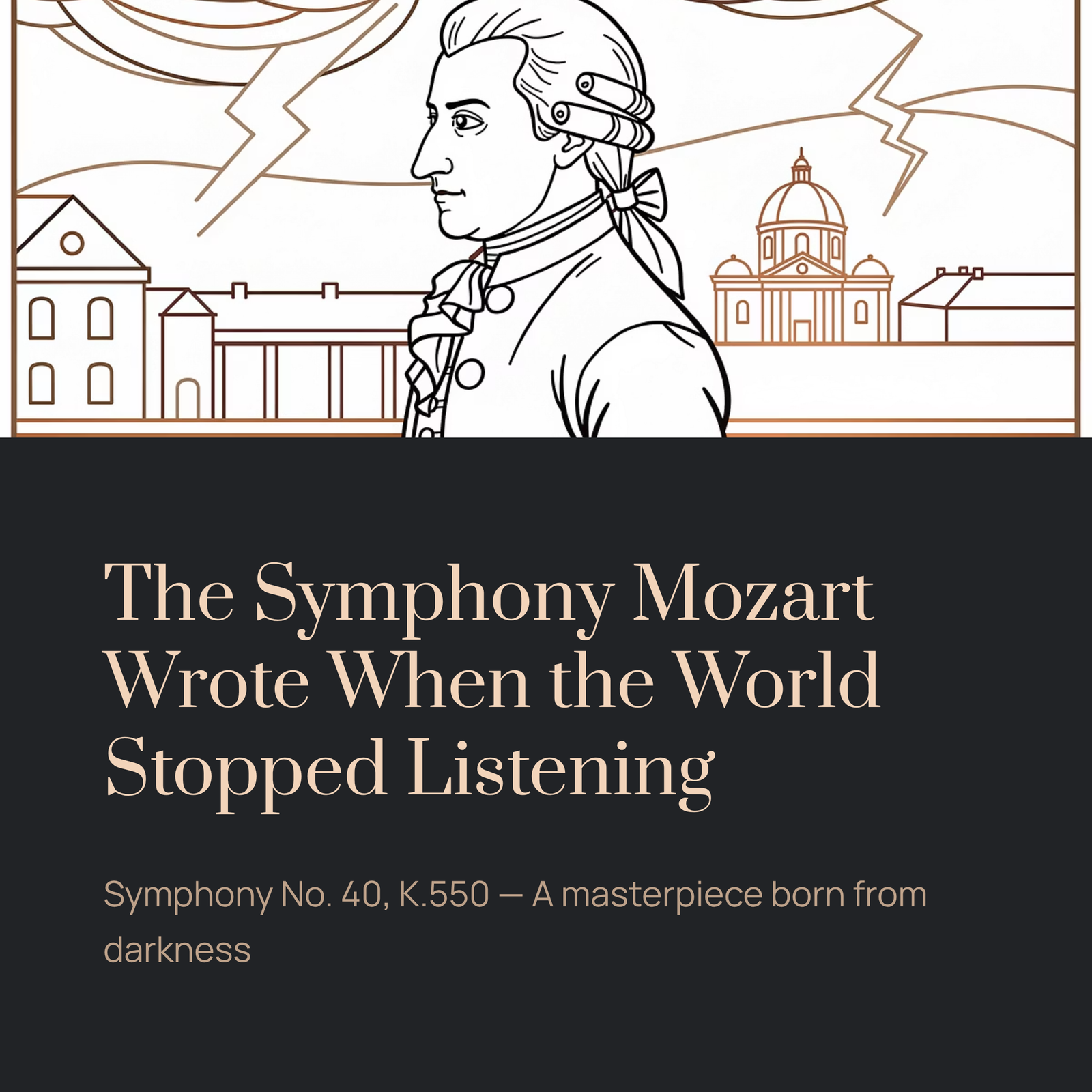
To understand why this symphony cuts so deep, you need to know what was happening in Mozart’s life when he composed it. The summer of 1788 was one of the darkest periods he ever faced.
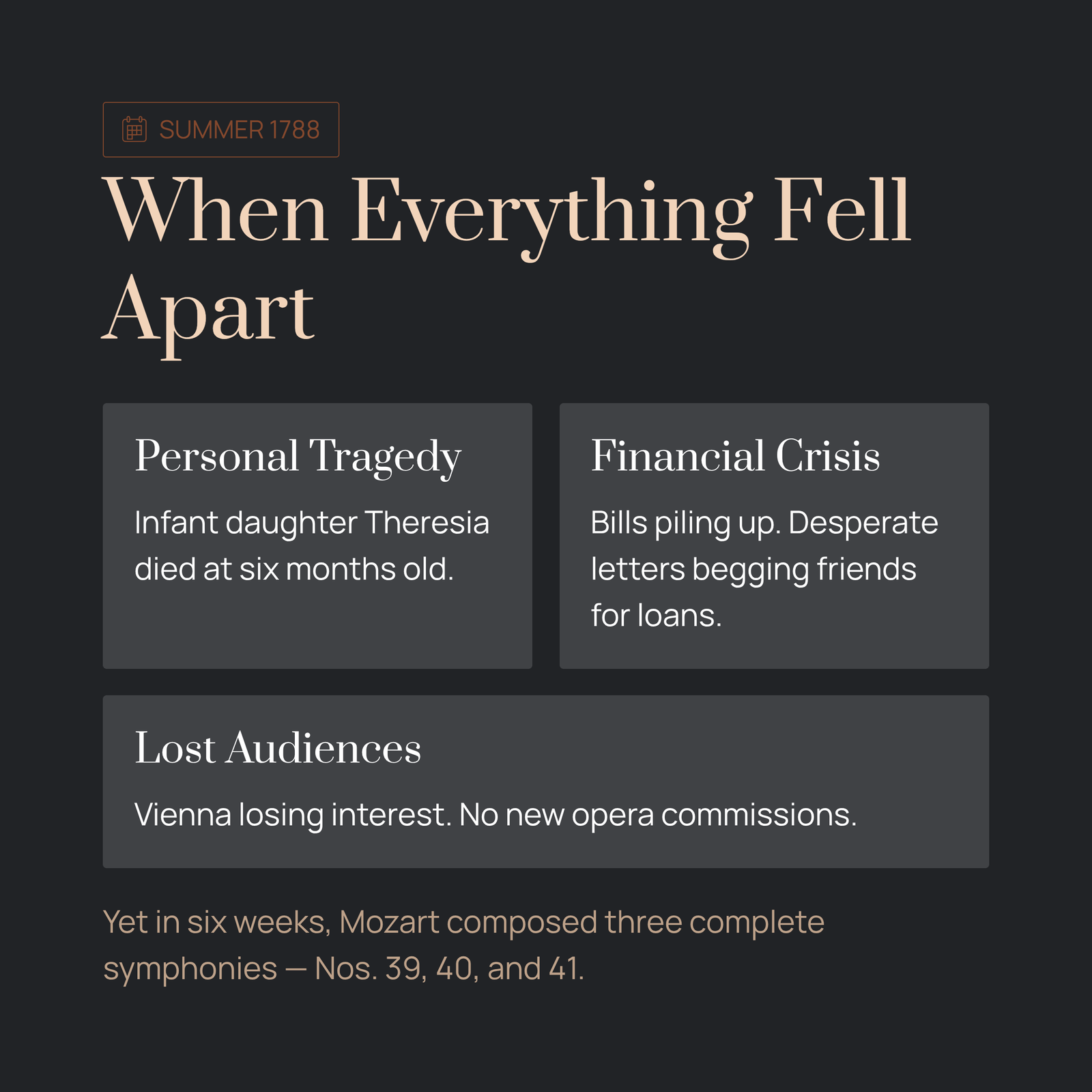
Mozart was thirty-two years old. His infant daughter Theresia had just died at six months. Audiences in Vienna — the same audiences that had once celebrated him as a prodigy — were losing interest. The opera house wasn’t commissioning new works. Bills were piling up. He wrote desperate letters to his friend and fellow Freemason Michael Puchberg, begging for loans with a vulnerability that is almost painful to read centuries later.
And yet, in the span of just six weeks that summer, Mozart composed three symphonies — Nos. 39, 40, and 41. Three complete, monumental works written in rapid succession, possibly without any guarantee they would ever be performed. Symphony No. 40 in G minor, K.550, stands at the center of this trilogy, and its first movement — marked Molto allegro — is arguably the most emotionally exposed music Mozart ever wrote.
Why G Minor Changes Everything
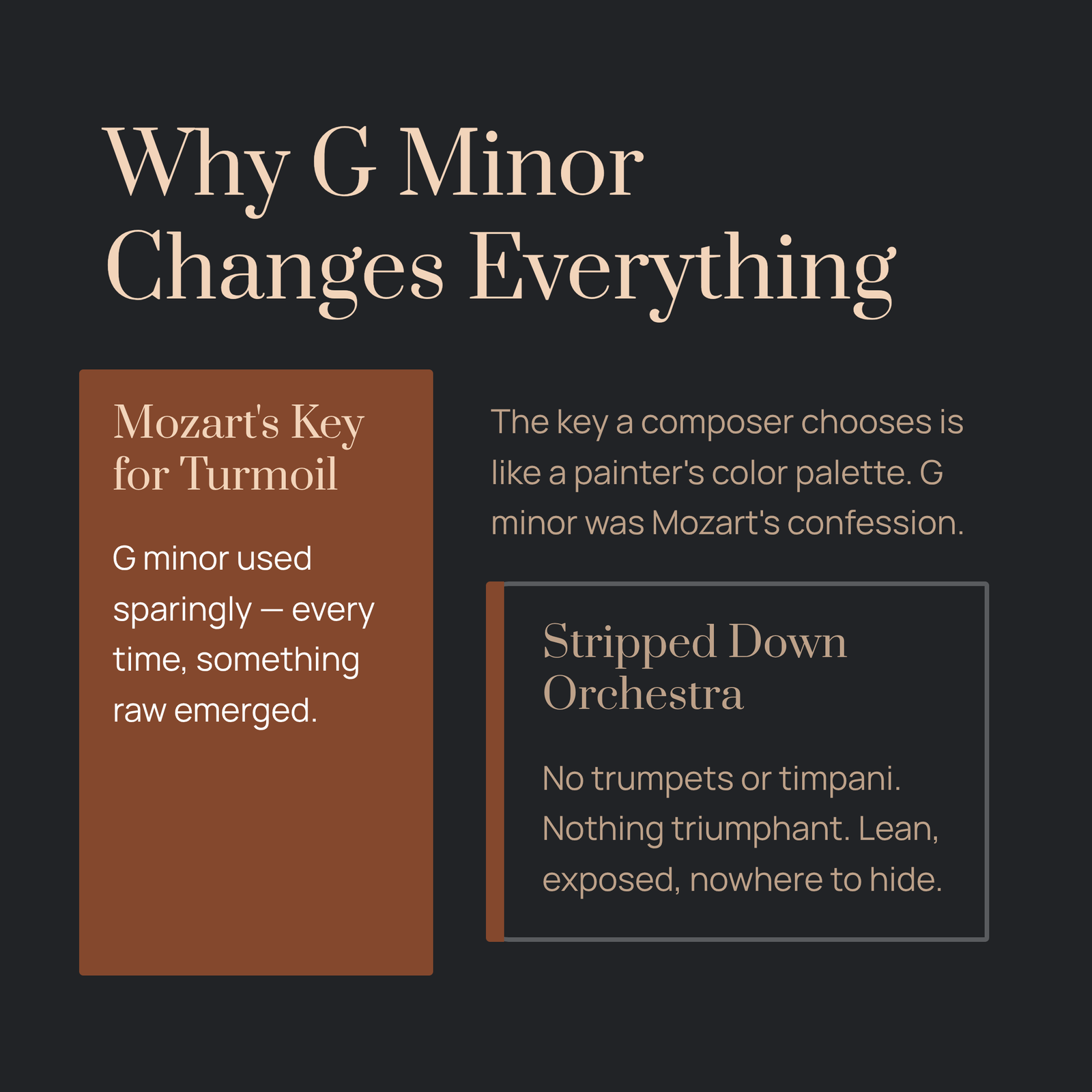
Here’s something worth knowing if you’re newer to classical music: the key a composer chooses matters enormously. It’s like the color palette a painter selects before touching the canvas.
G minor was Mozart’s key for turmoil. He used it sparingly throughout his career, but every time he did, something raw and unsettled emerged. His String Quintet in G minor, his Piano Quartet in G minor — these aren’t polite, courtly pieces. They’re confessions.
Symphony No. 40 is scored for a relatively modest orchestra: strings, one flute, two oboes, two clarinets, two bassoons, and two horns. Notably absent are trumpets and timpani — the instruments of celebration and military grandeur. Mozart deliberately stripped away anything that might sound triumphant. What remains is lean, exposed, and nowhere to hide.
Inside the First Movement: A Guided Listen
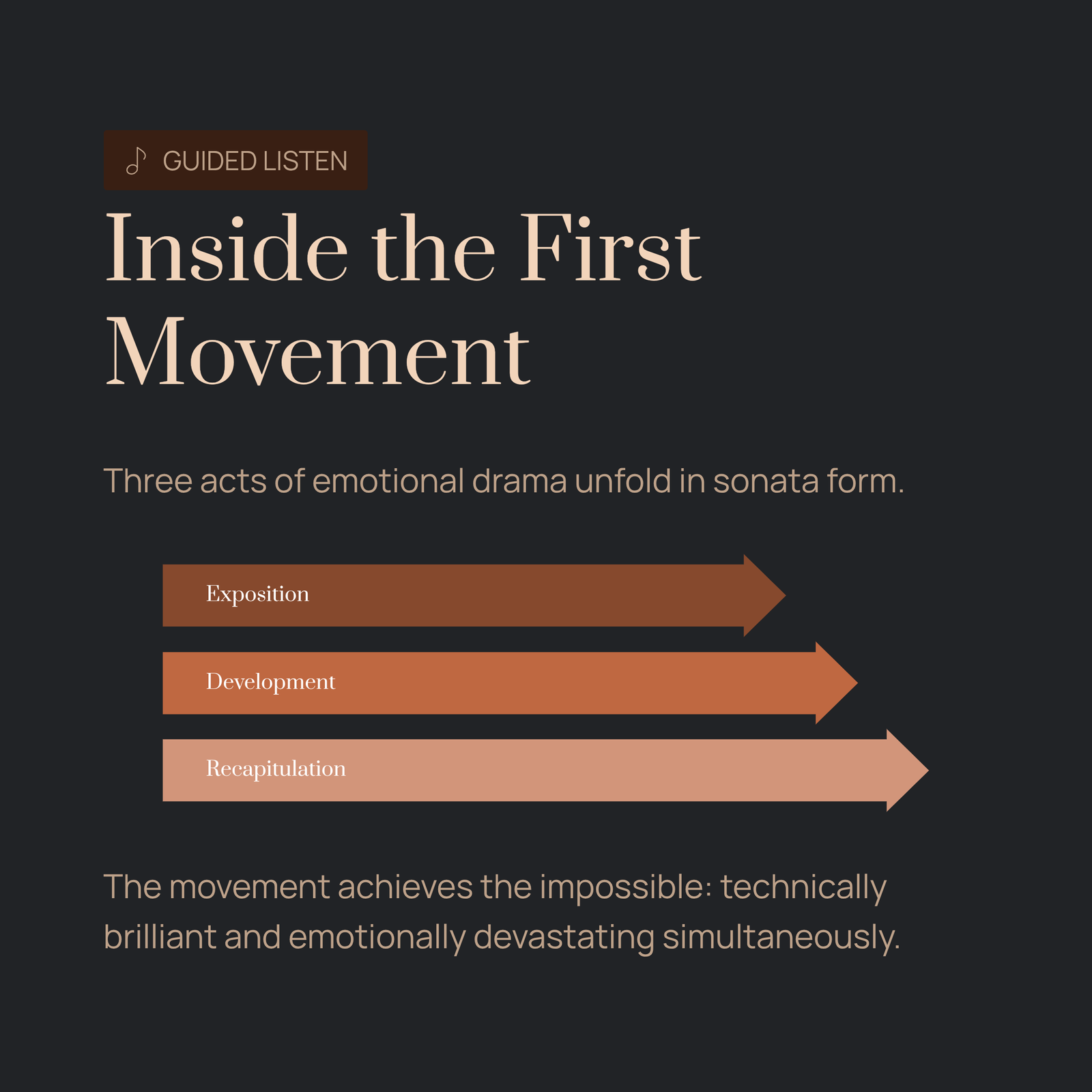
The Molto allegro unfolds in sonata form, the structural backbone of classical-era first movements. But don’t worry about the technical label. Think of it as a three-act drama.
The Exposition (0:00–3:00 approximately)
That famous opening theme enters immediately — no slow introduction, no warm-up. The violas provide a pulsing accompaniment while the violins spin out a melody that somehow manages to be both graceful and anguished. Listen for the sighing intervals, those falling phrases that sound like someone trying to say something important but not quite finding the words.
Around the one-minute mark, a second theme arrives in B-flat major, the relative major key. It’s gentler, almost hopeful. But Mozart doesn’t let you rest there for long. Tension keeps creeping back in through unexpected harmonic shifts and restless rhythmic energy.
The Development (3:00–5:00 approximately)
This is where Mozart takes his themes apart and puts them through emotional pressure. The opening motif gets passed between different instruments and pushed through distant, unstable keys. There are moments here that sound almost modern in their intensity — sudden dynamic contrasts, grinding dissonances that resolve only to create new tension. If the exposition was someone describing their pain, the development is the moment they stop holding back.
The Recapitulation (5:00–end)
The opening theme returns, but it’s not a simple repeat. Mozart brings it back in the home key of G minor, and the second theme — which had offered that brief glimpse of warmth — now also appears in minor. Whatever hope existed earlier has been absorbed into the larger emotional landscape. The movement ends without resolution, without comfort. Just a final, definitive statement in G minor.
What Makes This Movement Unforgettable
There’s a reason this symphony has remained in the standard repertoire for over two centuries while thousands of other eighteenth-century works have faded into obscurity. The first movement achieves something remarkably difficult: it is technically brilliant and emotionally devastating at the same time.
Mozart doesn’t use complexity as a shield. Every contrapuntal detail, every chromatic inflection serves the emotional narrative. The music never shows off. It never wastes a note. And because of that economy, every note lands with weight.
Pianist and conductor Daniel Barenboim once observed that Mozart’s music is like a person who smiles while telling you something heartbreaking. The Symphony No. 40 is perhaps the purest example of that paradox. The elegance of the writing makes the pain sharper, not softer.

Recommended Recordings to Start With
If this is your first time with the piece, here are three recordings that offer distinctly different experiences:
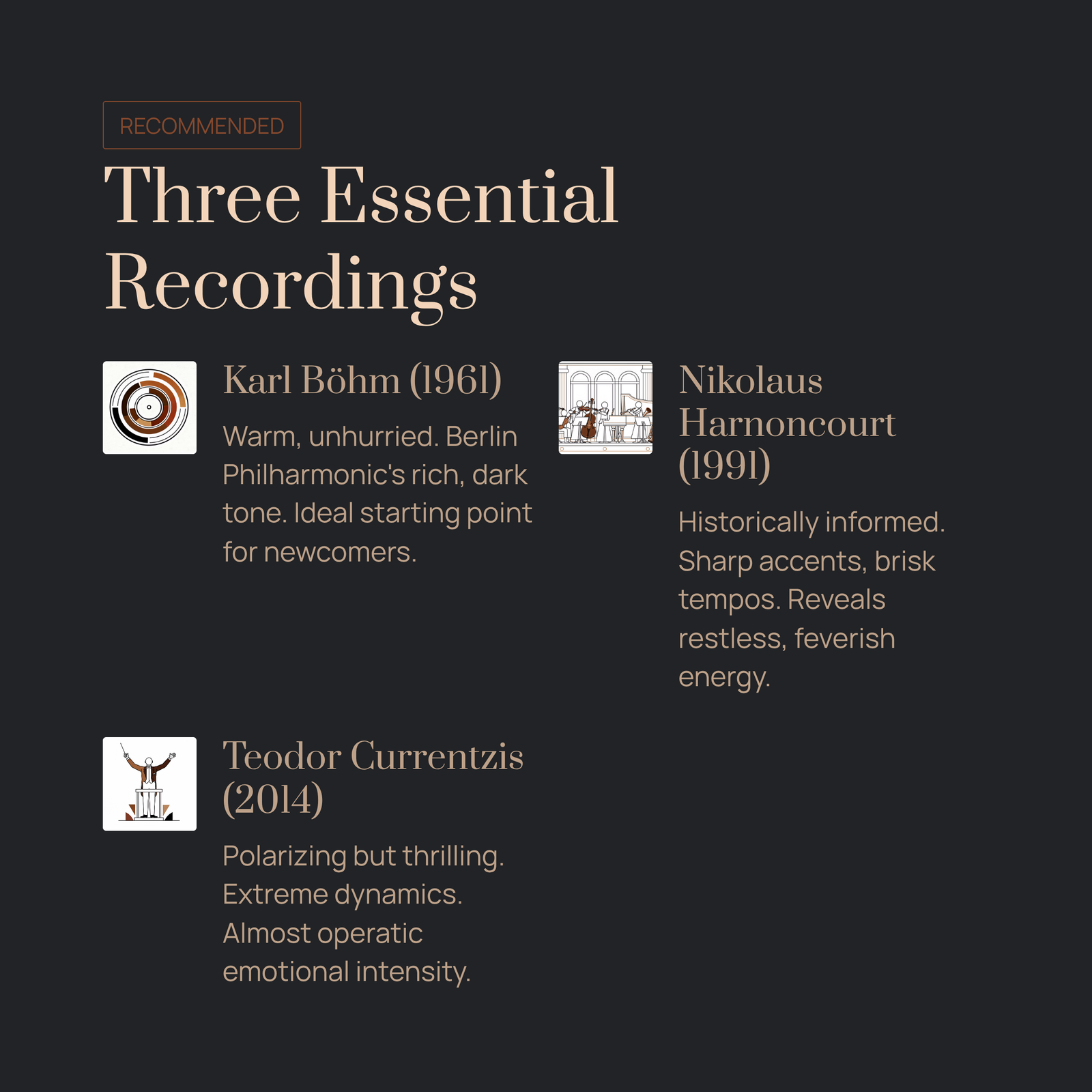
Karl Böhm with the Berlin Philharmonic (1961) — A warm, unhurried reading that lets every phrase breathe. Böhm treats the symphony with the seriousness of late Beethoven, and the Berlin strings produce a rich, dark tone perfectly suited to G minor. An ideal starting point.
Nikolaus Harnoncourt with the Chamber Orchestra of Europe (1991) — A historically informed performance with sharper accents, brisker tempos, and a transparency that reveals inner voices you might miss in larger-scale recordings. This version emphasizes the music’s restless, almost feverish energy.
Teodor Currentzis with MusicAeterna (2014) — A polarizing but thrilling interpretation. Currentzis pushes extremes of dynamics and tempo, turning the first movement into something almost operatic in its emotional intensity. Not everyone’s taste, but worth hearing at least once.
Why This Piece Still Speaks to Us
Mozart didn’t write program music. He didn’t attach stories or titles to his symphonies. And yet the emotional specificity of this first movement is unmistakable. You don’t need to know about his debts, his grief, or the silence of the Viennese public to feel what this music communicates. It’s all there in the notes.
What makes the Symphony No. 40 so enduring is that it captures a universal human experience: the attempt to maintain composure while something inside is breaking. We’ve all been in that space — at work, at family gatherings, on ordinary Tuesday afternoons. Mozart gave that feeling a voice in 1788, and it hasn’t lost a fraction of its power since.
If you’ve never listened to classical music before, or if you’ve always found it distant and formal, start here. Press play, close your eyes, and let that opening melody find you. It will.