📑 Table of Contents
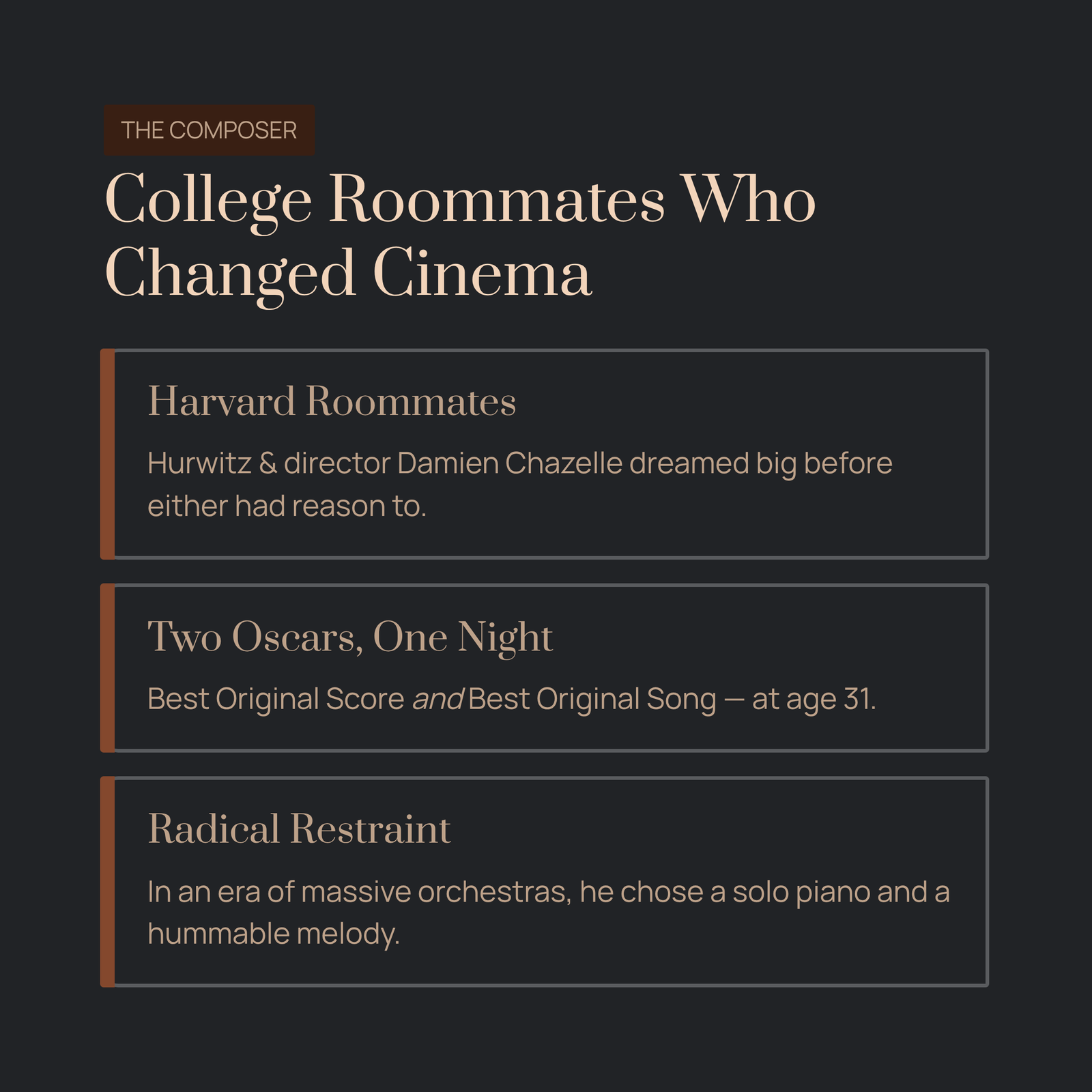
There’s a strange thing that happens when you hear Mia & Sebastian’s Theme outside of the movie theater. Maybe it drifts from a café speaker while you’re stirring your coffee. Maybe it surfaces in a playlist late at night when you’re doing nothing in particular. And suddenly, without warning, you feel a pinch somewhere behind your ribs — not quite sadness, not quite happiness, but the ache of remembering something you didn’t realize you’d lost.
That’s what Justin Hurwitz wrote into this piece. Not a love theme. Not really. He wrote the sound of looking back.
Who Is Justin Hurwitz? The Roommate Behind the Music
Here’s a detail that makes this story feel almost too cinematic to be real: Justin Hurwitz and Damien Chazelle — the director of La La Land — were college roommates at Harvard. They played together in a band. They dreamed together before either of them had any business dreaming that big.
Hurwitz isn’t a household name the way John Williams or Hans Zimmer might be, but his work on La La Land (2016) earned him two Academy Awards in a single night — one for Best Original Score, another for Best Original Song. He was 31 years old. What makes him remarkable isn’t just talent; it’s restraint. In an era where film scores often swell with massive orchestras and synthesized drama, Hurwitz chose a solo piano. A melody you could hum. A theme so simple it almost feels like it always existed, like he didn’t compose it so much as uncover it.
The Story Behind the Notes
Mia & Sebastian’s Theme was not born easily. Hurwitz reportedly wrote over 1,900 pieces of music during the development of La La Land before the final selections were made. Think about that number for a moment. Nearly two thousand attempts to find the right emotional frequency.
The theme first appears early in the film, when Sebastian — a struggling jazz pianist played by Ryan Gosling — sits down at a restaurant piano and plays what he truly loves instead of the Christmas setlist he’s been hired to perform. He gets fired for it. But the melody escapes into the night air, and Mia, passing by on the sidewalk, hears it. She doesn’t know him yet. She just knows this music made her stop walking.
That scene tells you everything about what the theme means. It’s the sound of something calling to you before you understand why.
How to Listen: Three Layers You Might Have Missed
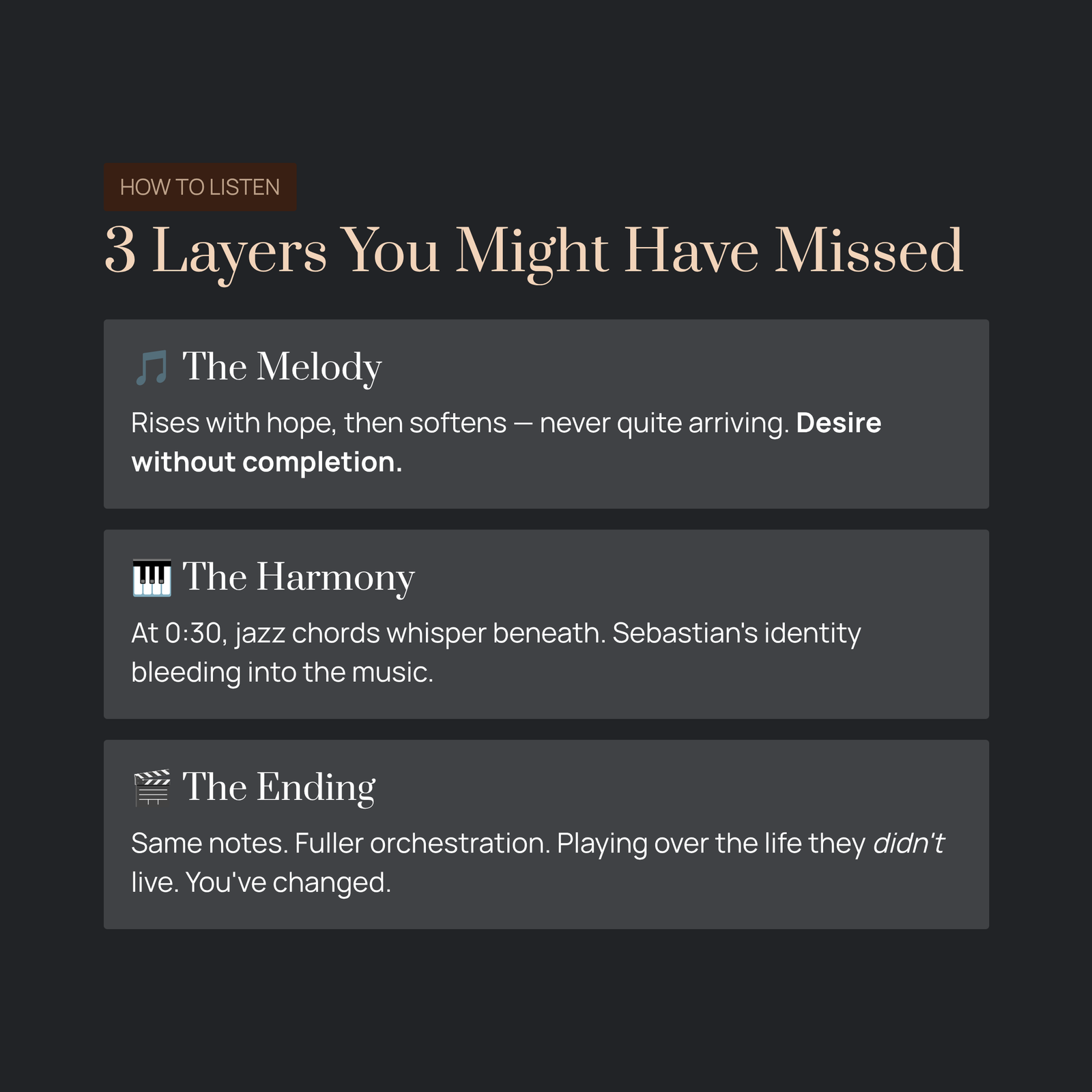
If you’ve only heard this piece as pleasant background piano, try listening again with these focal points. The music opens up in surprising ways.
The first layer is the melody itself. It moves in a gently ascending pattern, like someone reaching for something just out of grasp. Notice how it rises with hope, then softens — never quite arriving where you expect. Hurwitz keeps the resolution slightly elusive, and that’s precisely what gives the theme its emotional pull. It’s desire without completion.
The second layer is the harmony underneath. Pay attention around the 0:30 mark in most recordings. The left hand introduces chords that carry a jazz inflection — not full jazz, but a whisper of it. This is Sebastian’s world bleeding into the music. The classical structure holds the romance; the jazz colorings hold his identity. The two coexist beautifully, just as Mia and Sebastian do — for a while.
The third layer only becomes clear if you’ve seen the film’s ending. In the final sequence, this theme returns in a completely different orchestration — fuller, more cinematic, almost overwhelmingly lush. But it’s playing over a montage of the life they didn’t live together. The same notes now carry an entirely different weight. What began as attraction has become elegy. The melody hasn’t changed. You have.
Why This Piece Hits Differently Than Other Film Scores
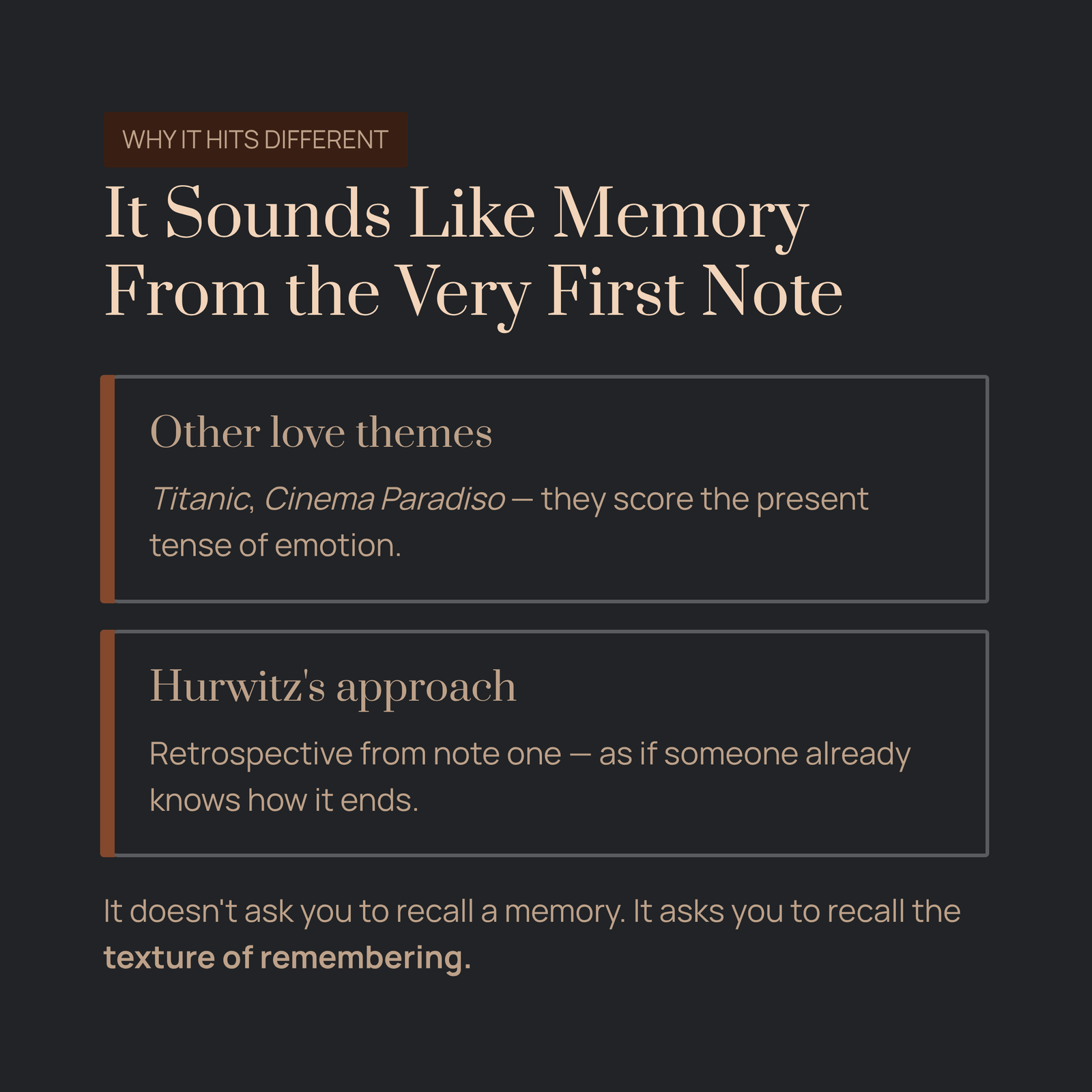
Most movie love themes are designed to make you feel the love as it’s happening. Think of the sweeping strings in Titanic or the tender woodwinds in Cinema Paradiso. They soundtrack the present tense of emotion.
Hurwitz did something more unusual and, arguably, more honest. He wrote a theme that sounds like memory from the very first note. Even when Mia and Sebastian are falling in love on screen, the music already carries the faint shadow of an ending. It’s composed in a way that feels retrospective — as if someone is sitting alone years later, replaying the whole story in their mind, knowing exactly how it turns out.
This is why the piece resonates so deeply even for listeners who haven’t seen the film. We all have a version of this feeling. A relationship, a city, a period of our lives that was luminous and impermanent. The theme doesn’t ask you to recall a specific memory. It asks you to recall the texture of remembering.
Recommended Recordings and Versions
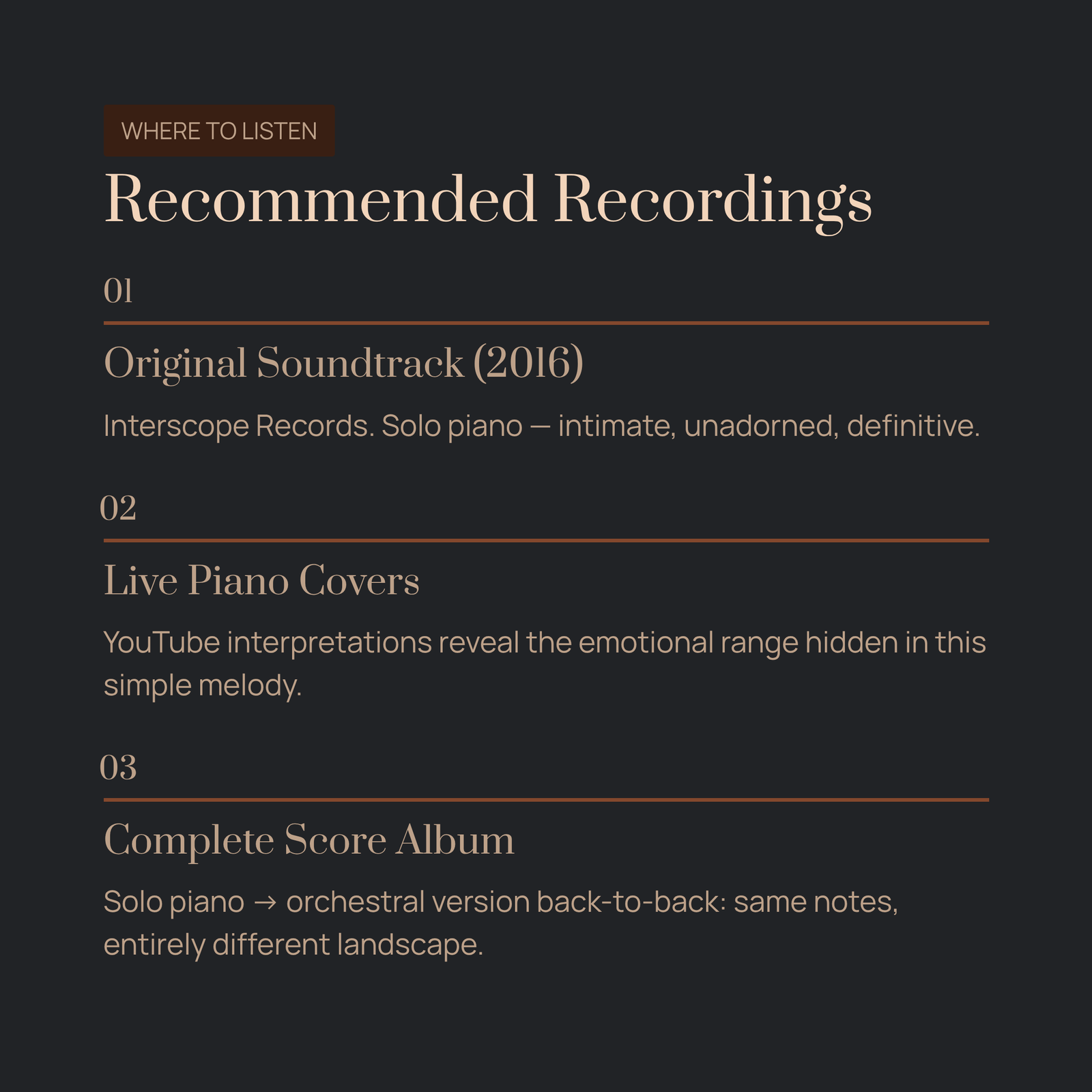
The original film soundtrack (2016, Interscope Records) remains the definitive version. The solo piano arrangement captures the intimacy Hurwitz intended, unadorned and direct.
For a different perspective, search for live piano covers on YouTube — many skilled pianists have recorded their own interpretations, and the subtle differences in tempo and touch reveal how much emotional range lives inside this deceptively simple melody. Some slow it down into something meditative; others add rubato that pulls at the rhythm like a conversation between longing and acceptance.
If you enjoy the orchestral version from the film’s epilogue, the complete score album includes the expanded arrangement that accompanies the “what could have been” montage. Listening to the solo piano version and the orchestral version back to back is a remarkable experience — same notes, entirely different emotional landscape.
Closing Your Eyes at the End
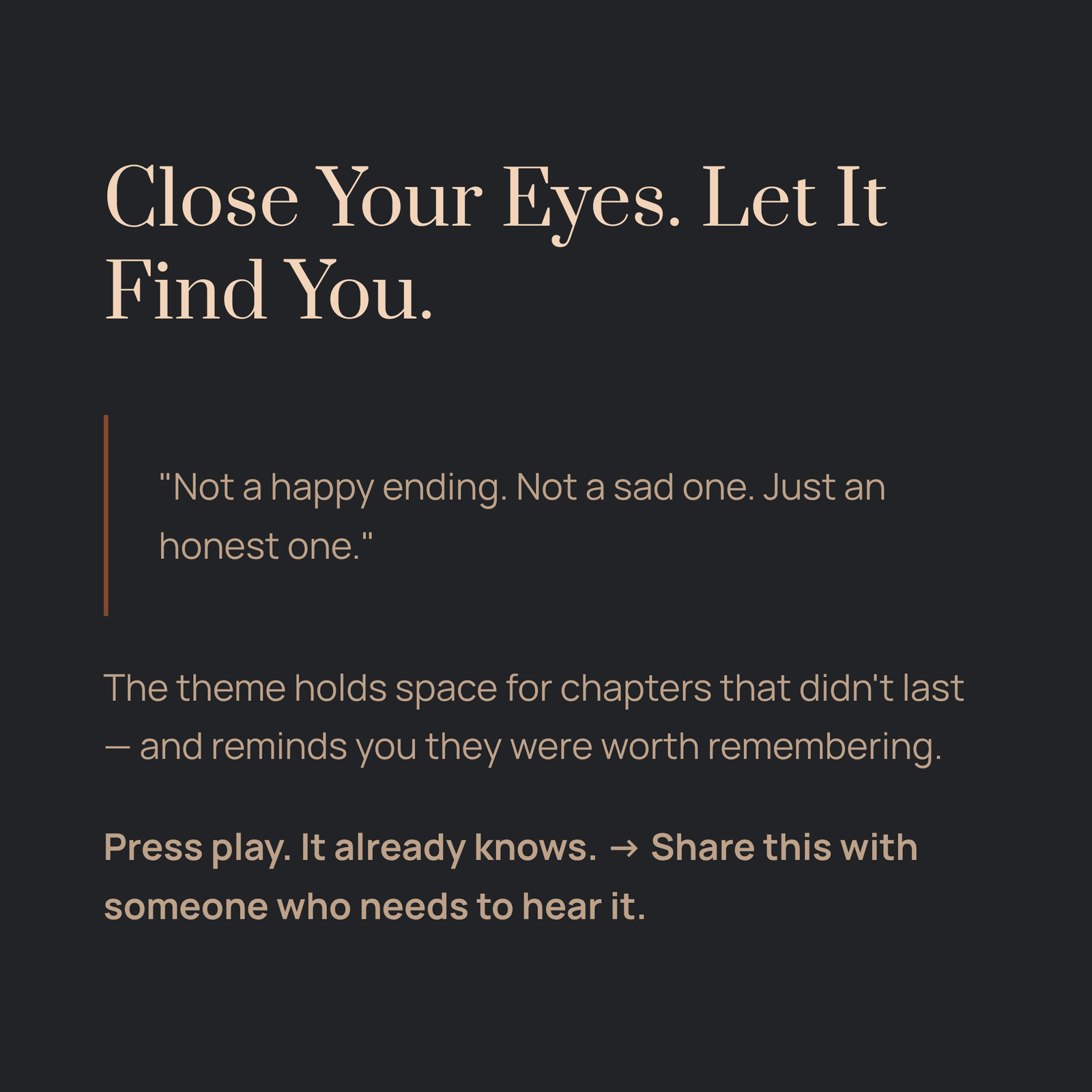
There’s a moment near the close of the film where Mia and Sebastian find themselves in the same room after years apart. Their eyes meet. The theme plays. And then — a small, quiet smile. Not a happy ending. Not a sad one. Just an honest one.
That’s the real genius of Mia & Sebastian’s Theme. It doesn’t tell you how to feel. It sits with you in the ambiguity. It holds space for the truth that some of the most meaningful chapters of our lives are also the ones that didn’t last — and that this doesn’t make them any less worth remembering.
Press play. Close your eyes. And let yourself remember whatever it is this melody brings back to you. It already knows.