📑 Table of Contents
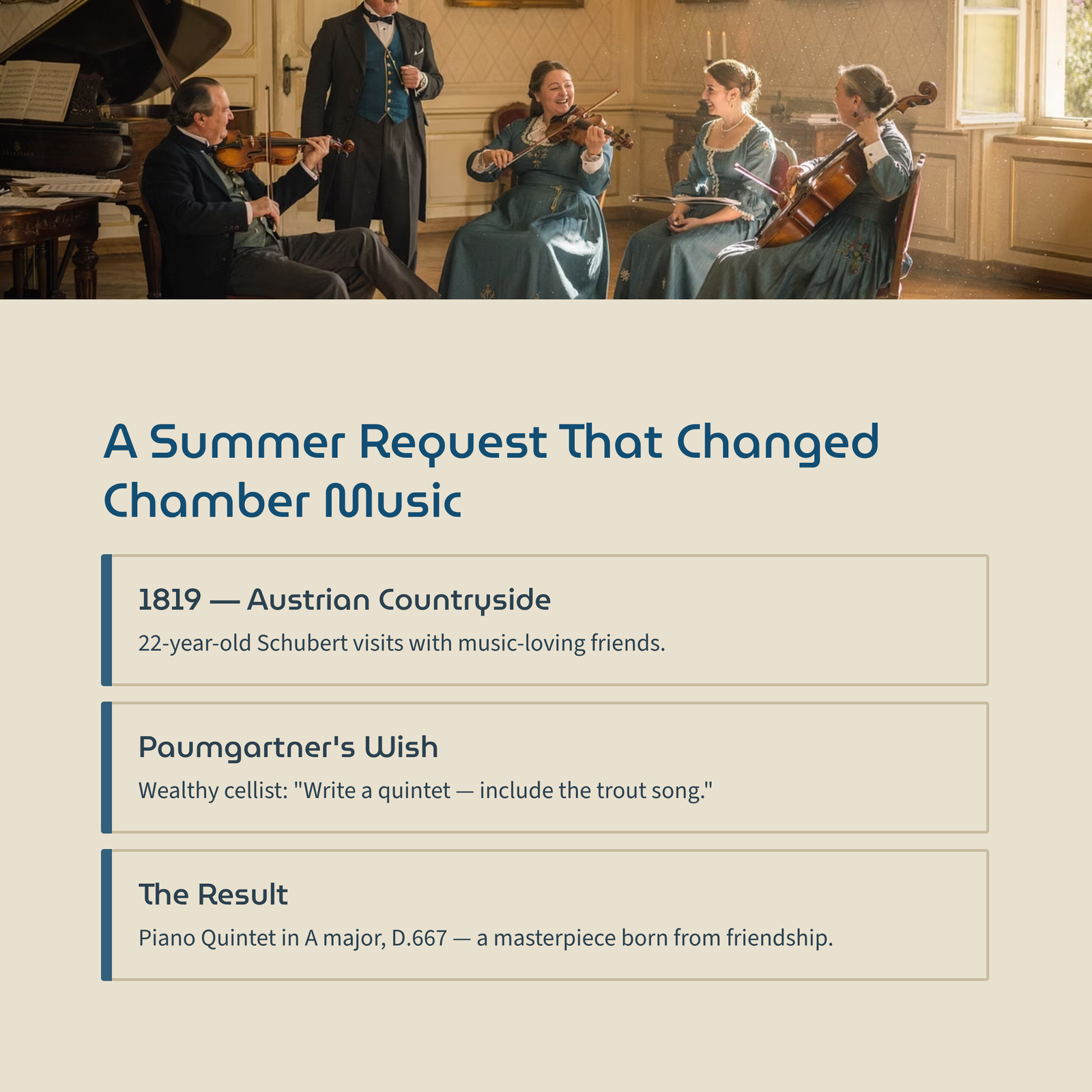
In 1819, a twenty-two-year-old Franz Schubert spent his summer in the Austrian countryside with a group of music-loving friends. One of them, a wealthy amateur cellist named Sylvester Paumgartner, made a request that would change chamber music forever: write a quintet — and make sure it includes that delightful song about the trout.
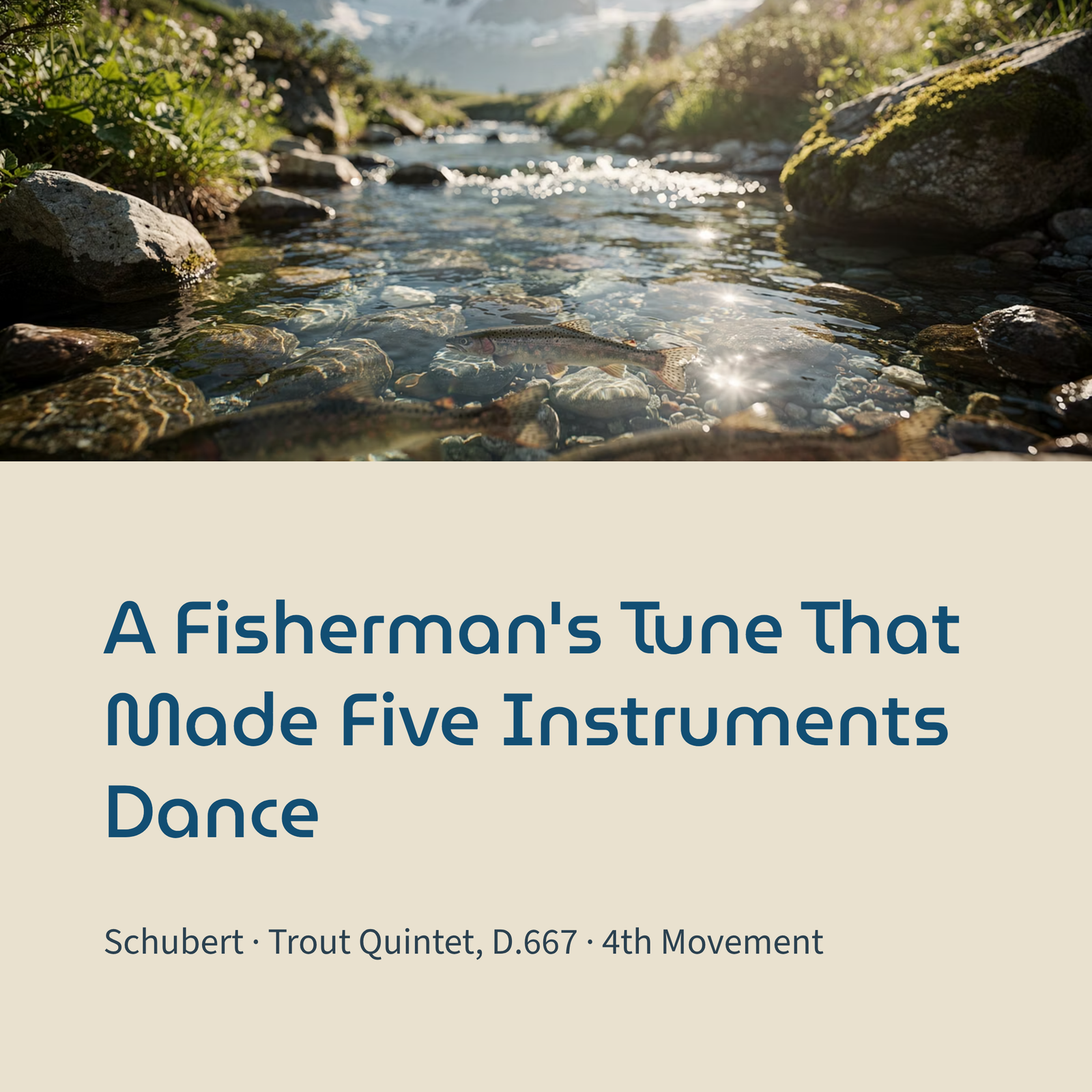
That song was “Die Forelle” (The Trout), a lied Schubert had composed two years earlier. Its melody was irresistibly catchy — the kind that hums itself into your head and refuses to leave. Paumgartner wanted to hear it again, not from a single voice and piano, but expanded, multiplied, passed between five instruments like a story retold by different friends around a campfire.
The result was the Piano Quintet in A major, D.667, and its fourth movement — Tema con variazioni — is where Schubert grants that wish in the most generous way imaginable.
Who Was Schubert, and Why Does a Fish Matter?
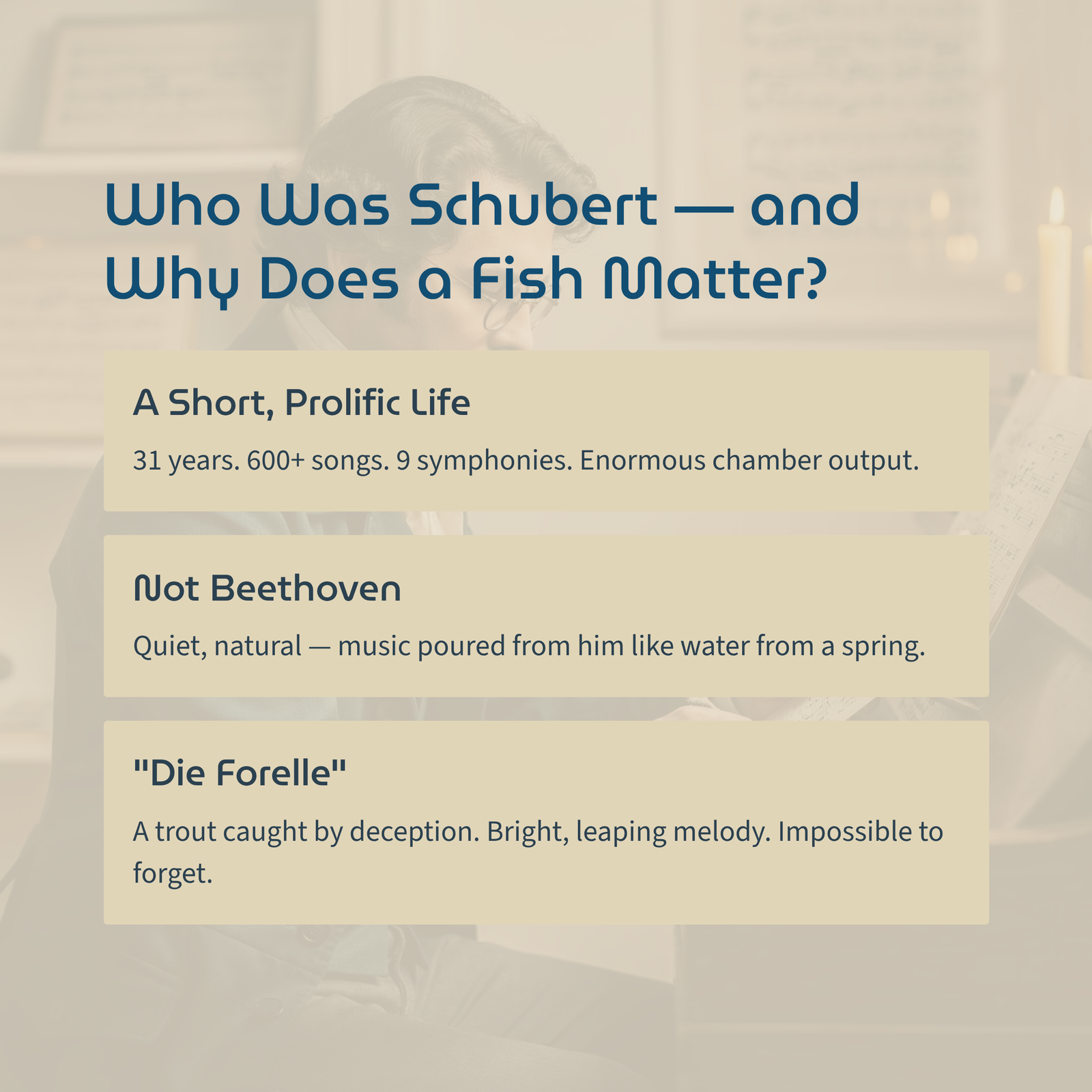
Franz Schubert lived only thirty-one years, yet he composed over six hundred songs, nine symphonies, and an enormous body of chamber and piano music. He was not the tortured genius shouting at destiny like Beethoven. Schubert was the quiet one at the party who happened to write music so naturally it seemed to pour out of him like water from a spring.
His original song “Die Forelle” tells a simple story: a narrator watches a trout darting through a clear stream, then a fisherman muddies the water and catches it. There is a moral buried in there about innocence and deception, but what people remember is the melody — bright, leaping, unmistakably alive. It mimics the flicker of a fish in sunlight, and once you hear it, you understand why Paumgartner wanted more of it.
What Makes This Movement Special
The fourth movement is structured as a theme followed by six variations and a finale. If you have never listened to a theme-and-variations form before, think of it this way: Schubert gives you a melody, then asks, “What if we told this story differently each time?”
The ensemble itself is unusual. Instead of the standard string quartet plus piano, Schubert uses piano, violin, viola, cello, and double bass. That double bass anchors the sound with a warmth and depth you rarely hear in chamber music. It gives the whole piece an earthy, grounded quality, as if the music is rooted in the landscape where Schubert spent that summer.
Here is what to listen for as you move through the variations:
The Theme — The piano introduces the familiar trout melody, gentle and unhurried. The strings join in, and you hear the tune in its purest form. Notice how transparent and simple it sounds. Schubert is not showing off. He is laying the foundation.
Variation I — The piano takes the lead with ornamental runs while the strings sustain the harmonic framework beneath. The melody is still recognizable, but now it sparkles with decoration, like sunlight catching ripples on the surface of a stream.
Variation II — The viola steps forward. This is a rare and wonderful moment. The viola, so often overshadowed in chamber music, gets to sing the theme with its rich, warm tone. Pay attention to how the texture shifts — the melody feels deeper, more contemplative.
Variation III — Here the mood darkens. The double bass and cello take over, and the harmonies grow more complex. Schubert dips into minor keys, and for the first time, you sense the shadow of the fisherman in the original poem. The playfulness gives way to something more serious.
Variation IV — A dramatic turn. The music moves into D minor, and the piano unleashes powerful, almost stormy passages. This is Schubert at his most intense within this piece. The trout is struggling now, and you can feel it.
Variation V — The clouds part. The cello sings a long, lyrical melody while the other instruments provide gentle accompaniment. It is one of the most beautiful passages in all of Schubert’s chamber music — tender, unhurried, and deeply human.
The Finale — The original theme returns in full, restored and joyful. After all the transformations, the trout melody swims back into clear water, unchanged and free. The accompaniment pattern from the original song reappears in the piano, a wink to listeners who know where this melody began.
How to Listen: Three Approaches for Different Moods
If this is your first time, try one of these approaches depending on where you are today.
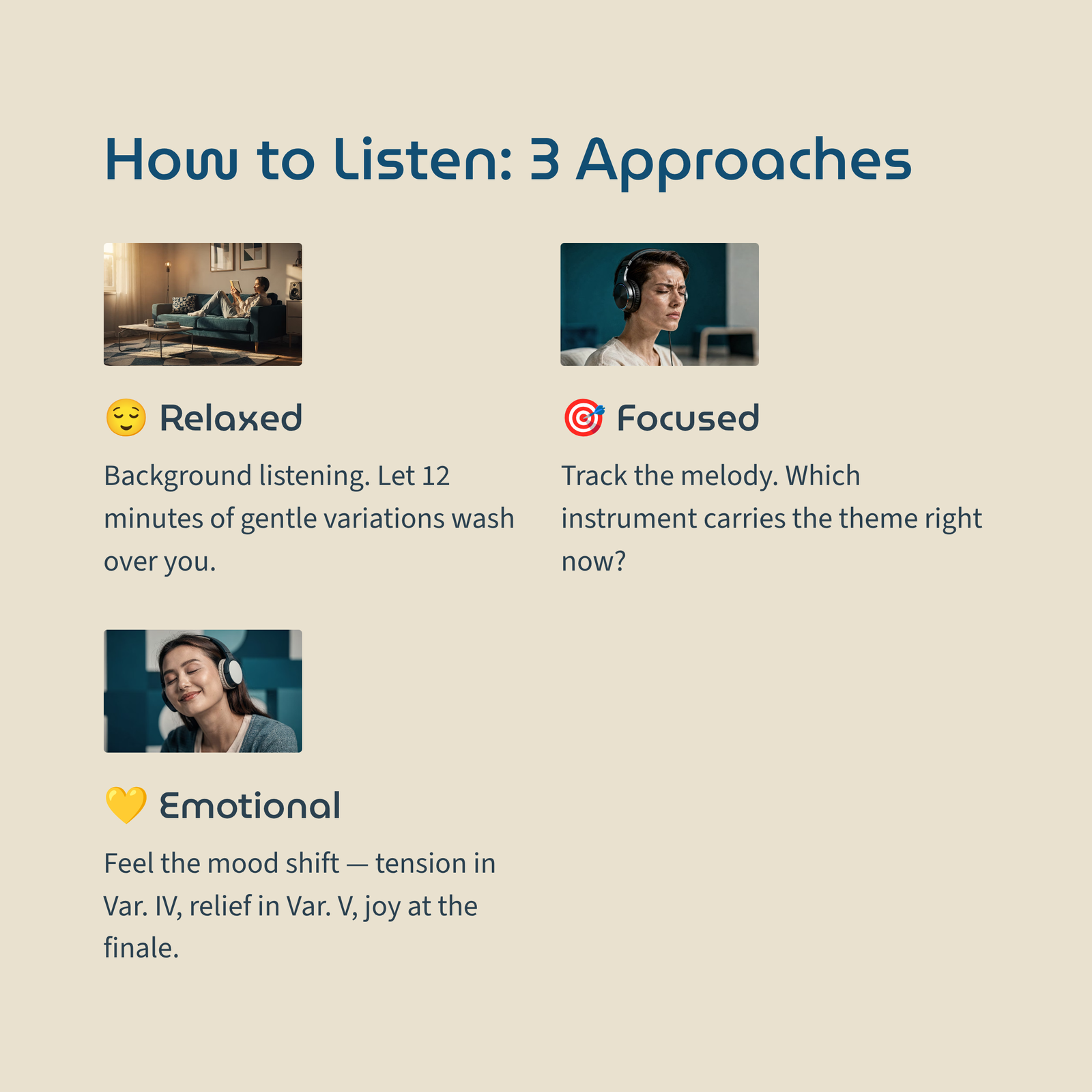
The Relaxed Listen — Put it on in the background while you work or read. Let the variations wash over you without trying to analyze anything. The movement is about twelve minutes long, and its gentle pulse makes it surprisingly effective as ambient music with substance.
The Focused Listen — Follow the melody through each variation. Try to identify which instrument carries the theme at any given moment. This is like watching a conversation unfold — each voice has something different to say about the same subject.
The Emotional Listen — Close your eyes and pay attention to how the mood shifts. Notice the moment in Variation III when the warmth cools, the tension in Variation IV, and the relief when Variation V arrives. Then feel the satisfaction when the original theme returns at the end, as if everything has come full circle.
Recommended Recordings
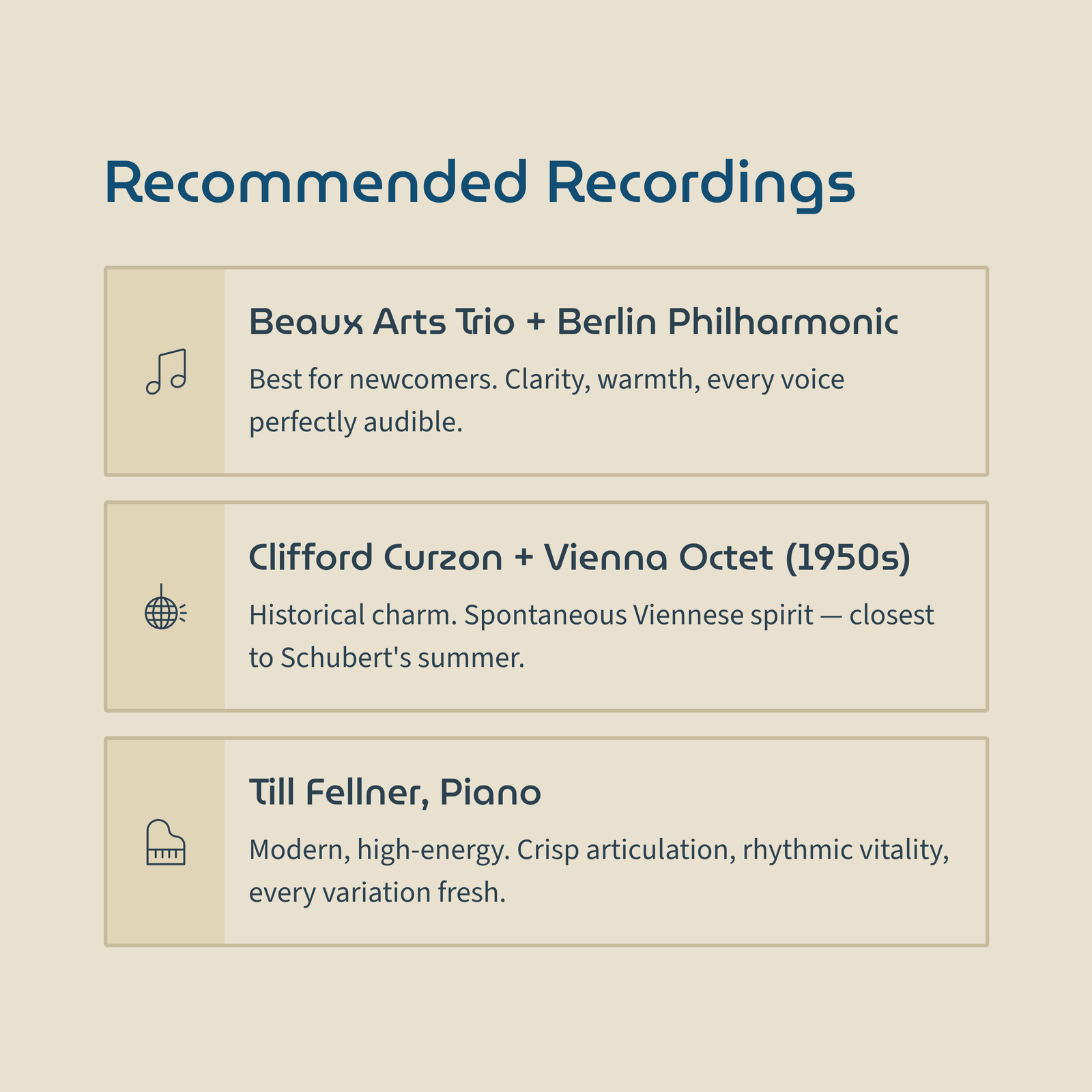
For newcomers, the recording by the Beaux Arts Trio with members of the Berlin Philharmonic is an ideal starting point. Their interpretation balances clarity with warmth, and every voice in the ensemble is perfectly audible.
If you want something with historical character, seek out the Clifford Curzon recording with members of the Vienna Octet from the 1950s. It has a spontaneity and Viennese charm that feels closest to the spirit of Schubert’s original summer gathering.
For a modern, high-energy reading, the recording featuring pianist Till Fellner offers crisp articulation and a rhythmic vitality that makes every variation feel fresh.
Why This Music Still Matters
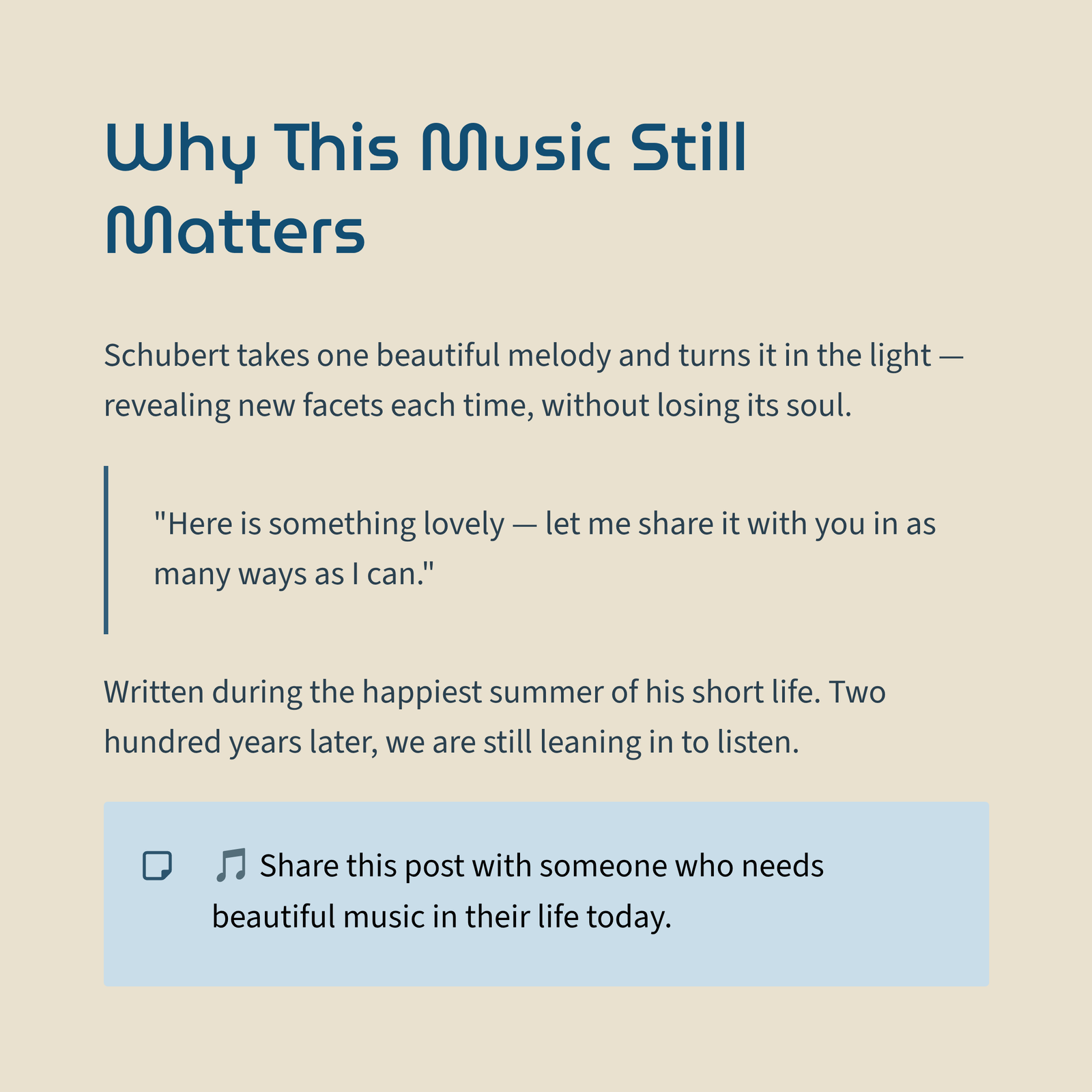
There is something profoundly comforting about the Trout Quintet’s fourth movement. It takes a simple, beautiful thing — a folk-like melody — and shows you all the ways it can be reimagined without ever losing its essential character. It darkens, it intensifies, it softens, and then it returns home.
Schubert wrote this piece during one of the happiest periods of his short life, surrounded by friends, good food, and the Austrian countryside. You can hear that contentment in every measure. This is not music wrestling with existential questions or pushing the boundaries of form. It is music that says: here is something lovely, let me share it with you in as many ways as I can.
In a world that constantly demands novelty, there is real wisdom in Schubert’s approach — taking what is already beautiful and simply turning it in the light, revealing new facets each time. The trout still swims. The melody still sings. And two hundred years later, we are still leaning in to listen.