Table of Contents
Fauré’s Barcarolle No. 1 in A minor, Op. 26
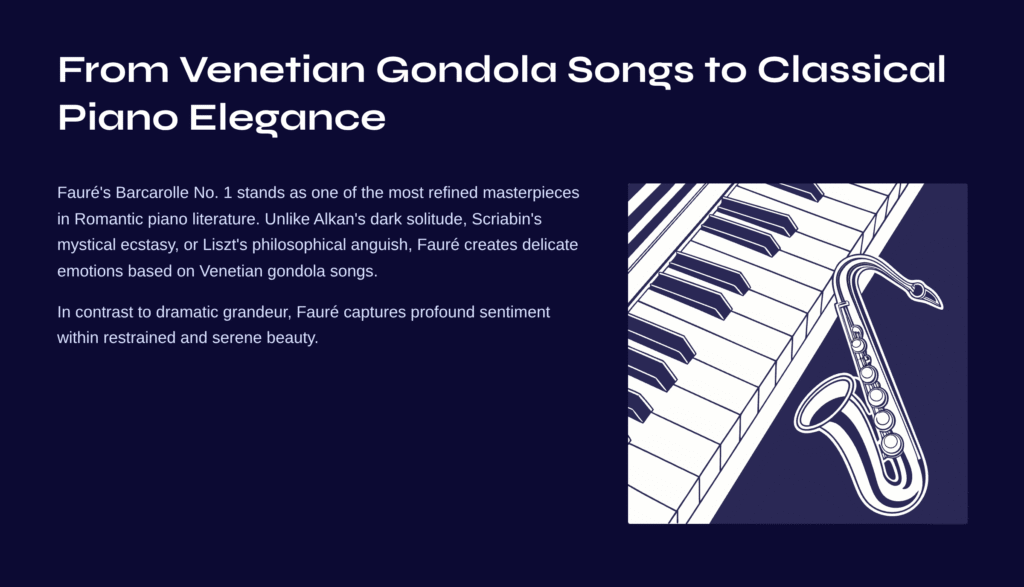
From Venetian Gondola Songs to Classical Piano Elegance
Fauré’s Barcarolle No. 1 stands as one of the most refined and elegant masterpieces in Romantic piano literature. Unlike Alkan’s dark solitude, Scriabin’s mystical spiritual ecstasy, or Liszt’s philosophical anguish, Fauré creates a symphony of delicate emotions and graceful rhythms based on Venetian gondola songs. In contrast to the dramatic grandeur of the previous three works, Fauré captures profound sentiment within restrained and serene beauty.

1. The Composer and the Barcarolle Tradition
1.1 Fauré’s Life and Music
Gabriel Fauré (1845-1924) embodies the quintessence of French Romanticism. After serving as a church organist, he later became Director of the Paris Conservatoire, yet he maintained distance from the provocative grandiosity of Liszt or Brahms, pursuing instead restrained elegance and classical restraint throughout his compositions.
Fauré’s most famous declaration:
“I prefer to express emotions through pure music itself, without elaborate explanations or grandiose titles.”
1.2 What is a Barcarolle?
The Barcarolle derives from the Italian word “barcarola,” meaning “boat song” (from “barca,” meaning boat, and “gondoliere,” meaning gondolier).
The original barcarolle:
- Folk songs sung by Venetian gondoliers
- Rhythms expressing the motion of rowing and the undulation of water
- 6/8 or 12/8 time signature with a gently swaying tempo
- Atmosphere: mild, romantic, nostalgic, tinged with melancholy
This form was also extremely popular in 19th-century classical music:
- Chopin’s Barcarolle in F# major
- Mendelssohn’s three “Venetian Gondola Songs” from Songs Without Words
- Offenbach’s “Belle nuit” from The Tales of Hoffmann
Fauré composed 13 barcarolles, making this genre distinctly his own.
1.3 Composition and Premiere of Op. 26
Fauré composed Barcarolle No. 1 around 1881, publishing it through J. Hamelle in Paris the same year.
Premiere: December 9, 1882, performed by Camille Saint-Saëns (Fauré’s close colleague).
Dedication: Mme Montigny-Rémaury
2. Structure and Form
2.1 Basic Construction
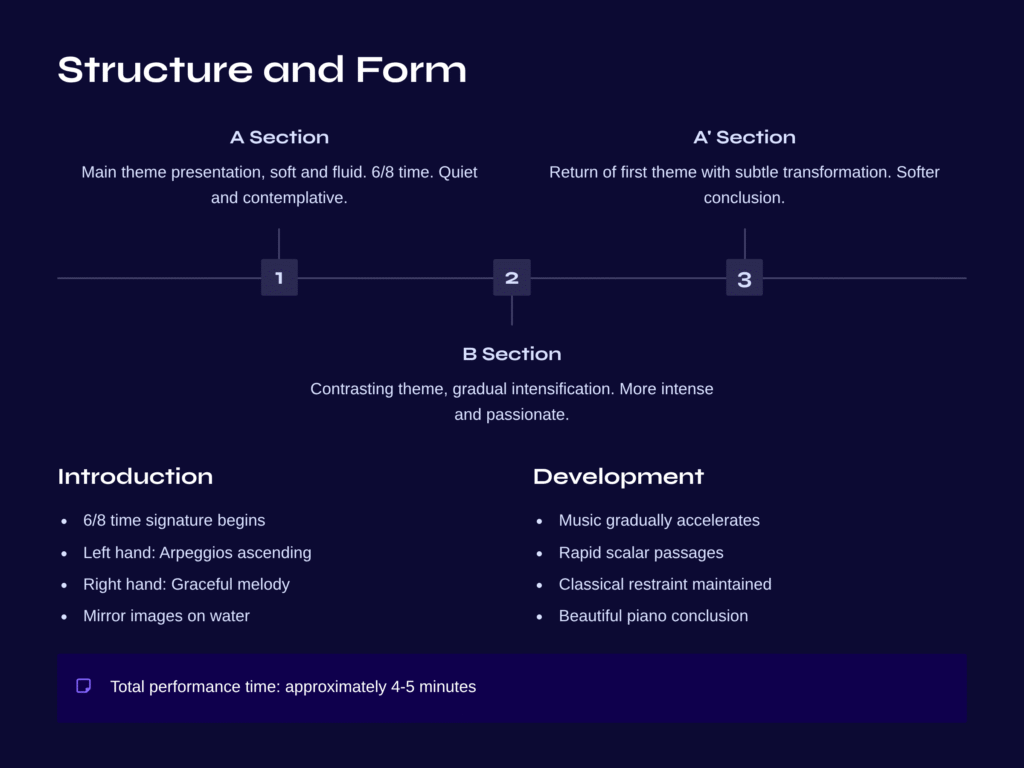
Fauré’s Barcarolle No. 1 follows a ternary form (A-B-A’).
| Section | Description | Time | Character |
|---|---|---|---|
| A (Introduction~Development) | Main theme presentation, soft and fluid | 6/8 (Main) | Quiet and contemplative (mezzo-forte) |
| B (Middle Section) | Contrasting theme, gradual intensification | Freely changing | More intense and passionate (forte) |
| A’ (Recapitulation) | Return of first theme, subtle transformation | Return to 6/8 | Softer conclusion than opening |
Total performance time: approximately 4-5 minutes (the shortest among Fauré’s barcarolles, yet condensed in form)
2.2 Detailed Musical Development
Introduction (Opening of A section):
- Begins in 6/8 time
- Left hand: Arpeggios gently ascending through chord progressions (rhythmic motion of rowing a gondola)
- Right hand: Graceful, flowing melody (melancholic song of the passenger)
- The middle register positioning creates symmetrical reflection between hands, evoking mirror images on water
B Section (Middle Part):
- Music gradually accelerates and intensifies
- Rapid scalar passages across the keyboard
- Left and right hands emphasize rhythm at equal intervals
- Not Liszt’s dramatic “explosion,” but heightening within classical restraint
A’ Section (Recapitulation):
- First theme returns, but softer and more refined
- Music gradually diminishes toward stability
- Concludes beautifully with piano (very soft) indication and repeated arpeggios
3. Musical Characteristics and Listening Points
3.1 How Are Barcarolle Features Expressed?
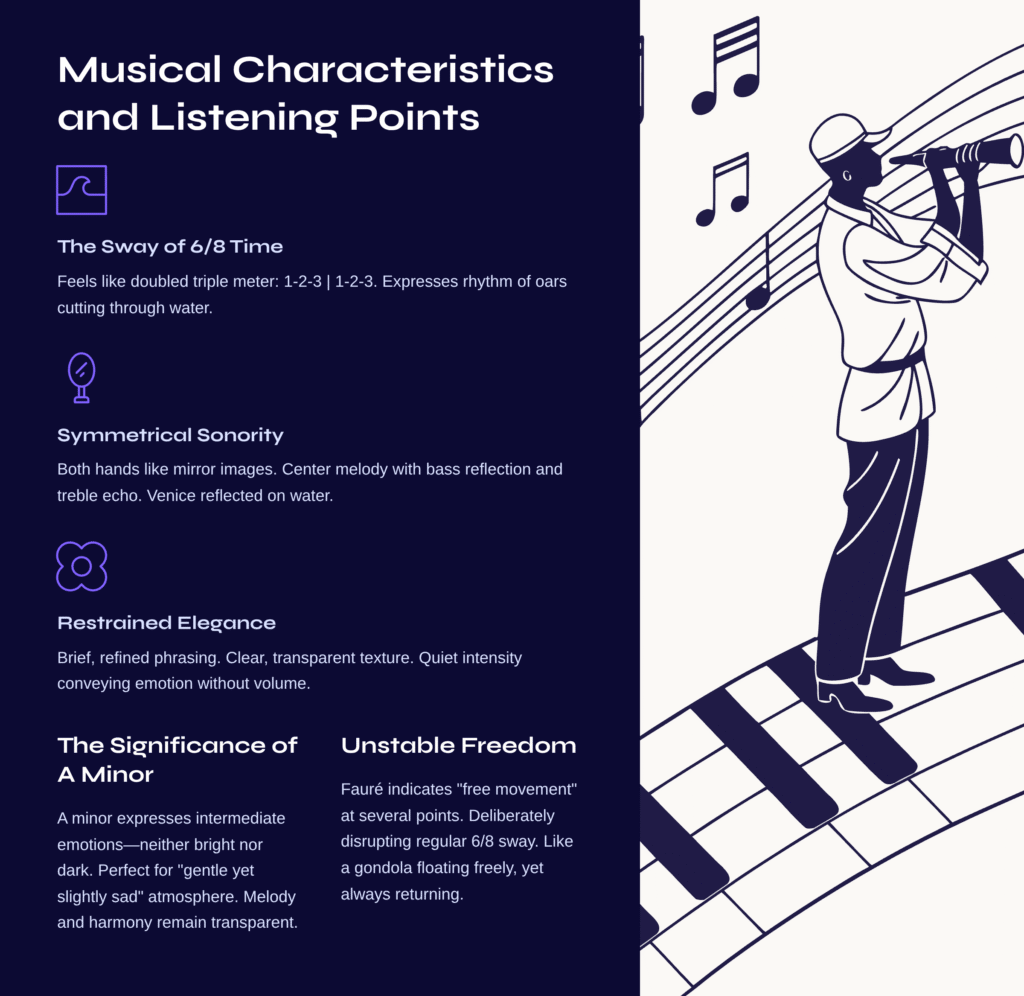
The Sway of 6/8 Time
The 6/8 time signature feels like doubled triple meter:
1-2-3 | 1-2-3 (rapid repetition)
  │     │
 wave  wave
This expresses the rhythm of oars cutting through water.
Symmetrical Sonority
Fauré uses both hands like mirror images:
- Center: Main melody (upper right hand)
- Lower: Left hand reflection (bass repetition)
- Upper: Right hand treble section (echo of middle melody)
This musically represents Venice as reflection on water.
3.2 The Aesthetic of Restrained Elegance
Fauré’s barcarolle rejects Chopin’s brilliance and Liszt’s grandeur.
Instead, it offers:
- Brief, refined phrasing (sentence-like musical structures)
- Clear, transparent texture (harmonies not overly complex)
- Attitude of concealing while revealing emotion (French classical tradition)
- Quiet intensity (conveying emotion without volume)
This is why Fauré is praised as “the perfect fusion of classical restraint and Romantic sentiment.”
3.3 The Significance of A Minor
Fauré’s choice of A minor was no accident:
- A minor expresses intermediate emotions—neither bright nor dark
- Perfect for the barcarolle’s “gentle yet slightly sad” atmosphere
- Melody and harmony remain clear and transparent
3.4 “Unstable Freedom”
Fauré indicates “free movement” at several points in the score.
This means:
- Deliberately disrupting the regular 6/8 sway
- Music “going where it wants to go”
- Like a gondola floating freely on the canal
- Yet always returning—this is Fauré’s delicacy

4. Listening Guide for Beginners
4.1 First Listen: Detecting the “Swaying Rhythm”
Feel the sway of 6/8 time:
- First 30 seconds: Do you hear the gentle repetition of “1-2-3, 1-2-3”? That’s the rhythm of rowing a gondola.
- Notice how this rhythm never changes. It doesn’t “explode” like Liszt or Scriabin.
- Yet feel how emotions gradually rise and descend.
4.2 Second Listen: Finding “Symmetry of Melody and Accompaniment”
Listen to how the graceful melody of the right hand and the repeated rhythm of the left hand function like “mirror images.”
This represents “mirror images on water.”
4.3 Third Listen: Experiencing “Emotion Within Restraint”
Fauré does not display emotion through loud volume.
Instead:
- Read emotion from small musical changes
- Feel how refined and classical the middle section’s heightening is
- Experience how soft and poignant the final arpeggios are
This is Fauré’s “French Elegance.”

5. Comparing Fauré with the Other Three Composers
| Feature | Alkan “Song of the Madwoman” | Scriabin “Sonata No. 4, 2nd Mvt” | Liszt “Vallée d’Obermann” | Fauré Barcarolle No. 1 |
|---|---|---|---|---|
| Atmosphere | Cold and dreamlike | Mystical and ecstatic | Philosophical and tragic | Gentle and elegant |
| Dramatic Intensity | Medium | High | Very High | Low |
| Musical Technique | Repetitive rhythm | Mystical sonorities | Theme transformation | Classical form |
| Background | Image-centered | Mysticism | Literary work | Folk song basis |
| Emotional Expression | Suggestive | Intense | Philosophical | Restrained |
| Duration | ~5 min | ~2 min | ~9 min | ~4 min |
| Beginner Difficulty | ⭐⭐⭐ | ⭐⭐ | ⭐⭐⭐⭐ | ⭐ |
Fauré is the most “approachable and comfortable to enjoy” among these.
6. The Evolution of Fauré’s 13 Barcarolles
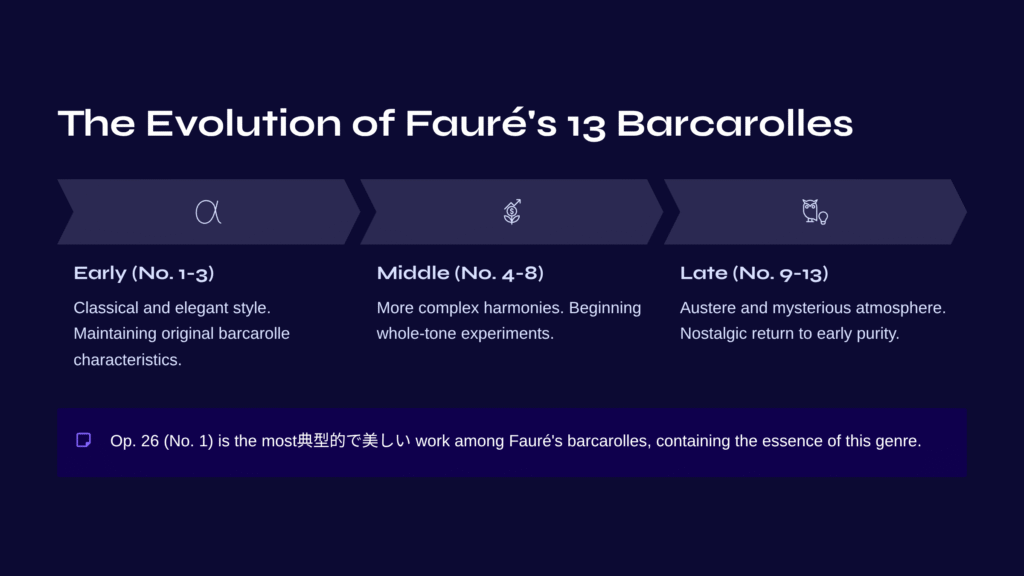
Fauré composed 13 barcarolles throughout his life, showcasing the composer’s musical evolution:
- Early (No. 1-3): Classical and elegant style, maintaining original barcarolle characteristics
- Middle (No. 4-8): More complex harmonies, beginning whole-tone experiments
- Late (No. 9-13): Austere and mysterious atmosphere, nostalgic return to early purity
Op. 26 (No. 1) is the most “典型的で美しい” work among Fauré’s barcarolles, containing the essence of this genre.
7. Recommended Performers
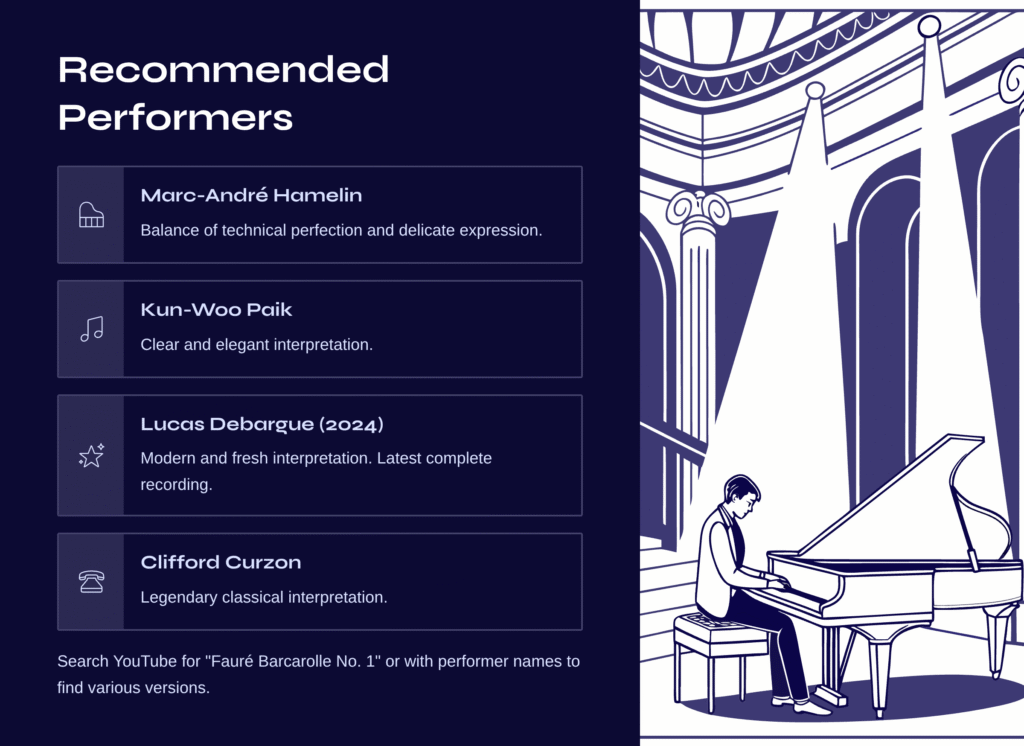
Comparing various interpretations enriches the listening experience:
- Marc-André Hamelin: Balance of technical perfection and delicate expression
- Kun-Woo Paik: Clear and elegant interpretation
- Lucas Debargue (2024): Modern and fresh interpretation, latest complete recording
- Clifford Curzon: Legendary classical interpretation
Search YouTube for “Fauré Barcarolle No. 1” or with performer names to find various versions.

8. One-Line Listening Guide
“On Venice’s canals, a gondola gently sways while someone’s quiet, wistful song floats reflected on the water in a romantic evening. Fauré touches the heart without grand drama, through pure elegance alone.”

9. The Musical Journey Through Four Works
The four pieces you’ve experienced represent diverse pinnacles of Romantic piano music:
- Alkan “Song of the Madwoman” → Individual solitude and reverie
- Scriabin “Sonata No. 4, 2nd Movement” → Soul’s mystical flight and transcendence
- Liszt “Vallée d’Obermann” → Philosophical anguish and fundamental human questions
- Fauré “Barcarolle No. 1” → Deep emotion within restrained elegance
These are all masters who revealed “new possibilities of piano solo works.”
Listen to each piece repeatedly, exploring which music touches your heart most and why each feels different. The depth and diversity of classical music lie precisely here.
10. Next Musical Journey: Elgar’s Cello Concerto
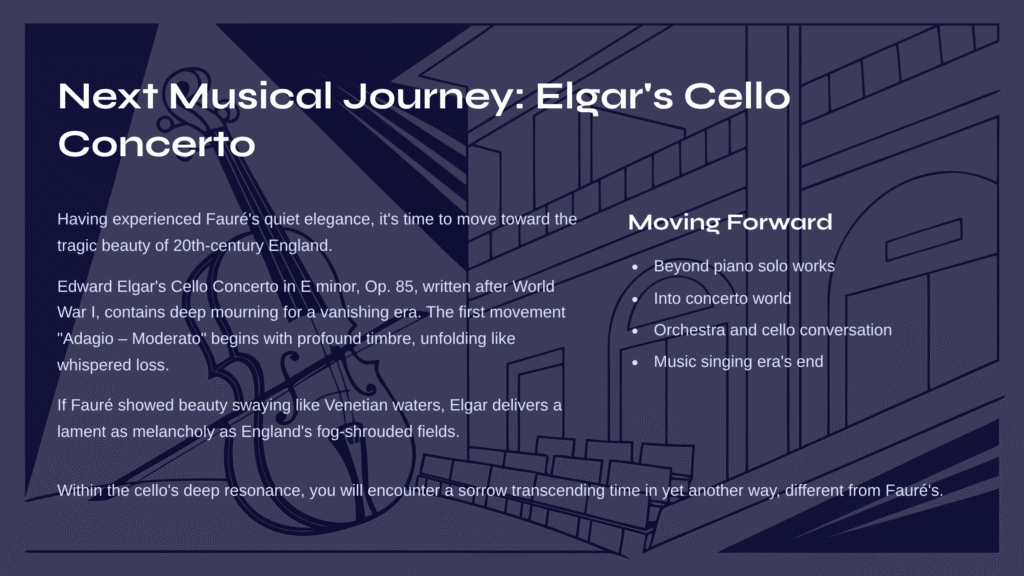
Having experienced Fauré’s quiet elegance, it’s time to move toward the tragic beauty of 20th-century England.
Edward Elgar’s Cello Concerto in E minor, Op. 85, written after World War I, contains deep mourning and regret for a vanishing era. Particularly the first movement “Adagio – Moderato” begins with the cello’s low, profound timbre, unfolding like the language of loss whispered in the darkness.
If Fauré showed beauty swaying softly like Venetian waters, Elgar delivers a lament as melancholy and majestic as England’s fog-shrouded fields. Moving beyond piano solo works into the world of concerto where orchestra and cello converse, and advancing from individual emotion to music singing the end of an entire era.
Within the cello’s deep resonance, you will encounter a sorrow transcending time in yet another way, different from Fauré’s.