📑 Table of Contents
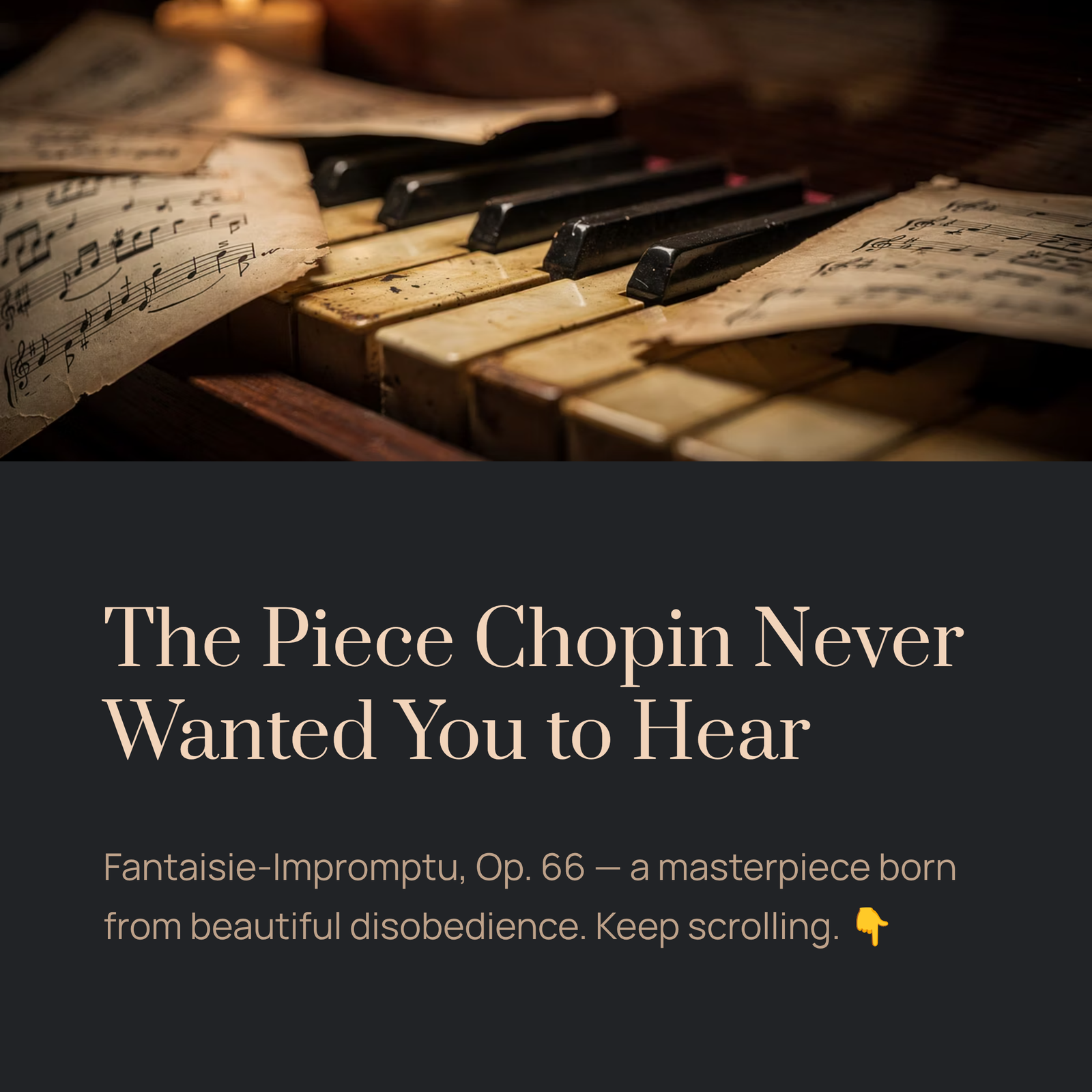
Imagine writing something so personal, so raw, that you beg your closest friend to burn it after you die. Now imagine that friend reading it, holding a lit match — and choosing not to strike it. That is the story of Chopin’s Fantaisie-Impromptu.
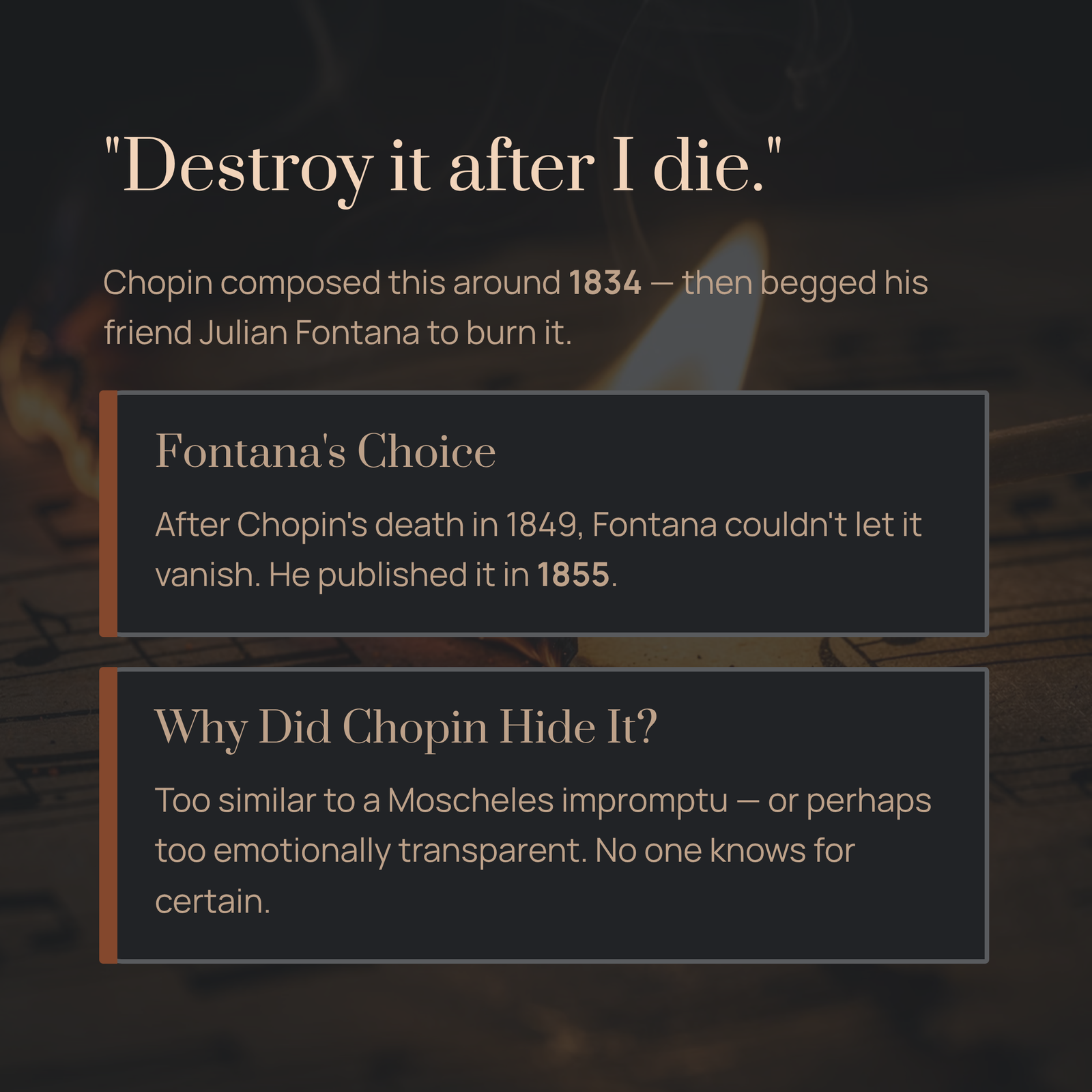
Frédéric Chopin composed this piece around 1834, during his mid-twenties, when his fingers were restless and his imagination ran faster than any metronome could track. Yet he never published it in his lifetime. He tucked it away, instructed his friend Julian Fontana to destroy the manuscript, and moved on to other works. But Fontana, upon hearing it again after Chopin’s death in 1849, simply could not let it disappear. He published it in 1855, assigning it the posthumous opus number 66. The world has been grateful for that act of beautiful disobedience ever since.
Why did Chopin want it gone? No one knows for certain. Some scholars suspect he felt it bore too close a resemblance to a Moscheles impromptu he admired. Others believe it was too emotionally transparent — too much of himself laid bare on the page. Whatever his reasons, history overruled him. And thank goodness it did.
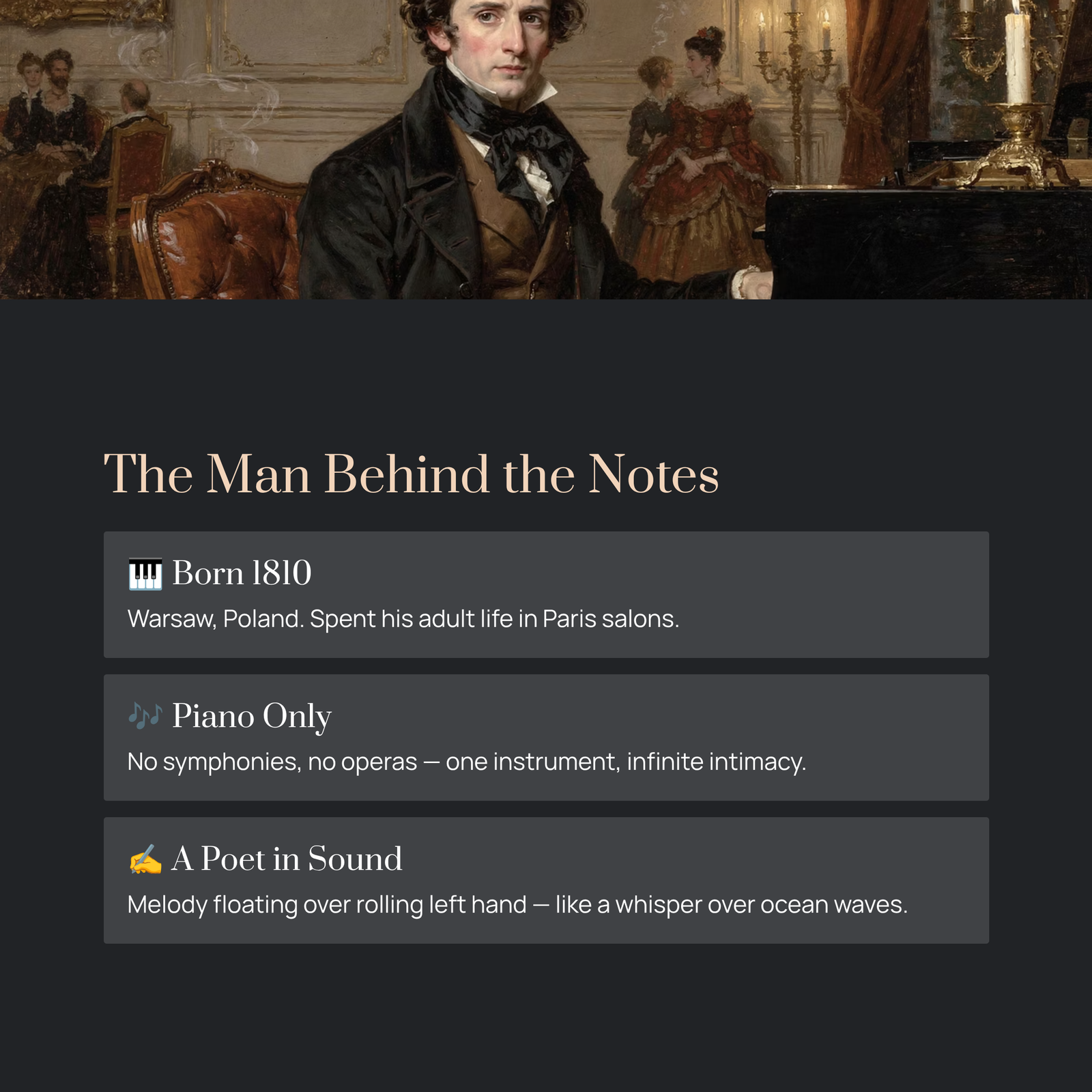
The Man Behind the Notes
If you are new to classical music, Chopin is one of the most welcoming doors you can walk through. Born in 1810 in a small village near Warsaw, he spent most of his adult life in Paris, becoming the darling of aristocratic salons. He wrote almost exclusively for the piano — no symphonies, no operas, just a single instrument explored with an intimacy that no one before him had quite achieved.
Chopin was not the thundering, fist-pounding type of Romantic composer. His genius lay in subtlety: the way a melody could float above a rolling left hand like a voice whispering over ocean waves, the way silence between notes carried as much weight as the notes themselves. He was, in many ways, a poet who happened to think in sound rather than words.
By 1834, Chopin had already established himself in Paris. He was composing études, nocturnes, and waltzes at an astonishing pace. The Fantaisie-Impromptu belongs to this fertile period — a time when he was still young enough to be reckless and skilled enough to make that recklessness sound effortless.
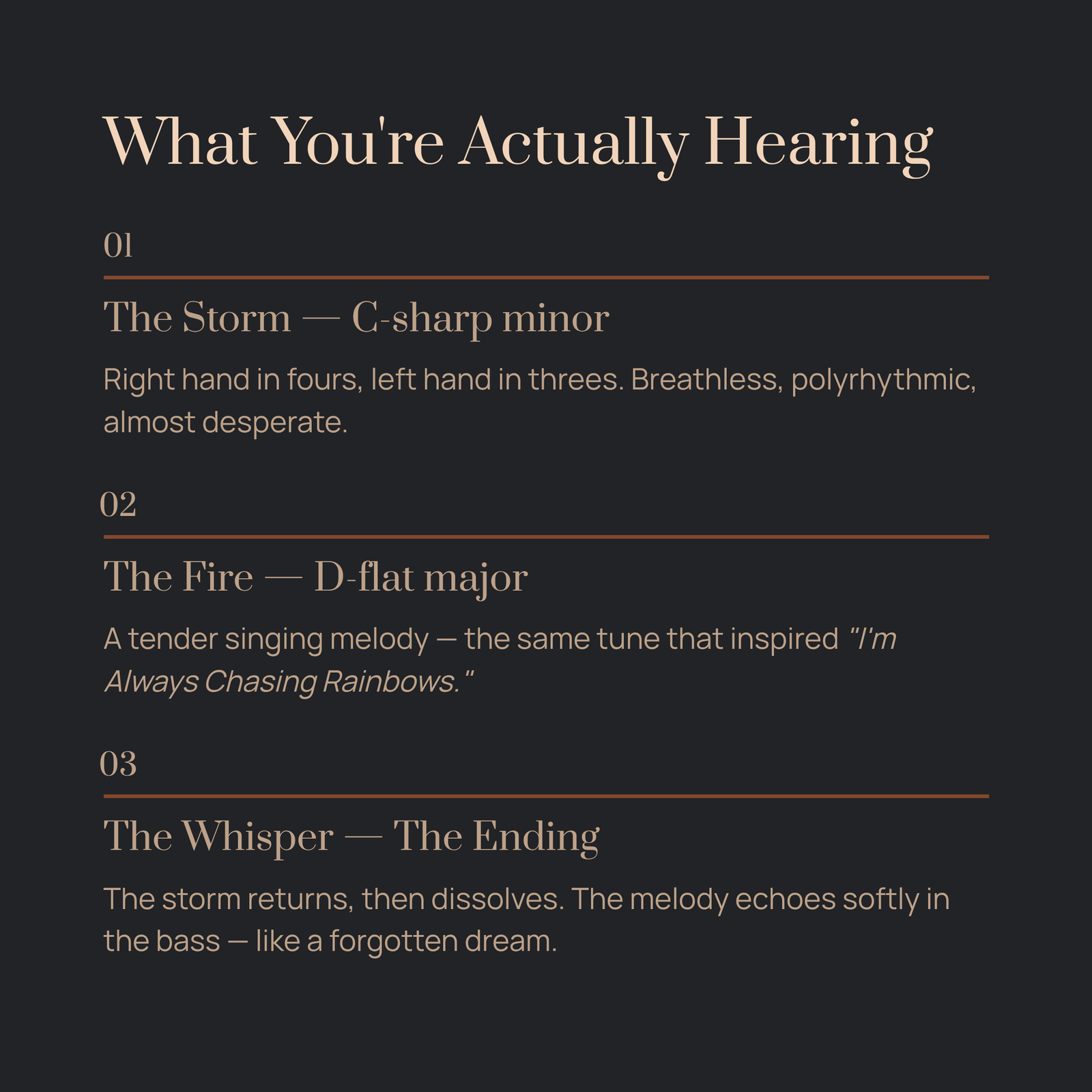
What You Are Actually Hearing
The Fantaisie-Impromptu is structured in three broad sections, but do not worry about memorizing a roadmap. Just think of it as a conversation between two very different moods.
The piece opens with a cascade of notes in C-sharp minor — the right hand racing in groups of four while the left hand insists on groups of three. This polyrhythmic tension is what gives the opening its breathless, almost desperate energy. It sounds like someone running through a rainstorm, not to escape it, but because the rain itself is exhilarating. If you listen closely, you will notice the two hands never quite align rhythmically. They chase each other, overlap, pull apart. It creates a sense of restlessness that is almost physical.
Then, without warning, the storm clears. The middle section arrives in D-flat major — the same key, technically, just seen from a warmer angle — and suddenly everything slows down. A singing melody emerges, tender and unhurried, like stepping indoors after that rainstorm and finding a fire already lit. This is the passage that later inspired the popular song “I’m Always Chasing Rainbows,” which borrowed its melody almost note for note. If you have ever heard that tune hummed in an old film, you have already met the heart of this piece without knowing it.
After this brief respite, the opening tempest returns, builds to a towering climax, and then dissolves. The final moments quote the middle section’s melody one last time in the bass — quiet, distant, as if remembering a dream you are already forgetting.

Why This Piece Still Gets Under My Skin
I have listened to the Fantaisie-Impromptu more times than I can count, and every time, it catches me in a slightly different place. Some nights, the opening section feels like ambition — that frantic energy of wanting something you cannot name. Other nights, it feels like anxiety, the kind that keeps your thoughts spinning at three in the morning.
But it is always the middle section that stops me. There is a particular kind of beauty that only exists in contrast. A sunset means nothing without the darkness that follows. The singing melody of this middle section would be lovely on its own, but arriving after that furious opening, it becomes something more — it becomes relief. And relief, I have come to believe, is one of the most underrated emotions in music.
What strikes me most is the courage it takes to be this vulnerable. Chopin, the perfectionist who agonized over every phrase, who revised obsessively and published sparingly, wrote something here that feels unguarded. Maybe that is exactly why he wanted it destroyed. Not because it was flawed, but because it was too honest.
How to Listen: A Practical Guide
If this is your first time, I would suggest a simple approach. Listen to it three times, each with a different focus.
On your first listen, just let it wash over you. Do not analyze, do not count, do not think about structure. Pay attention to how your body responds. Does the opening make your pulse quicken? Does the middle section make your shoulders drop? Trust those physical reactions — they are more reliable guides than any textbook.
On your second listen, try to follow the conversation between the two hands. The right hand is telling one story at one speed; the left hand is telling another at a slightly different pace. Notice how they weave together without ever perfectly synchronizing. This is the technical miracle of the piece, but you do not need to understand the math to feel it.
On your third listen, pay attention to the ending. After all that fire and tenderness, Chopin closes with the melody from the middle section played softly in the left hand while gentle arpeggios shimmer above. It is one of the most poignant endings in the piano repertoire — a whisper after a shout.
For recordings, I would point you toward a few distinct interpretations. Arthur Rubinstein’s version carries a noble restraint that lets the music breathe without melodrama. Evgeny Kissin, recorded live, brings a youthful fire that makes the opening section feel almost dangerous. And if you want something more introspective, try Krystian Zimerman — his attention to the inner voices of each passage reveals details you might miss elsewhere. Each pianist finds a different truth in the same notes, which is part of what makes classical music endlessly rewarding.
The Beautiful Disobedience of Listening
There is something poetic about the fact that every time someone presses play on the Fantaisie-Impromptu, they are participating in an act of gentle rebellion. Chopin said no. Fontana said yes. And now, over a century and a half later, millions of people have heard a piece of music that was meant to vanish.
I think about this sometimes when the music feels particularly alive — in the breathless rush of the opening, in the aching sweetness of the middle, in that final whispered memory at the close. We are hearing something we were never supposed to hear. And perhaps that is what makes it feel so intimate, so close. Not just a composition performed in a concert hall, but a private thought that somehow found its way to us across centuries, against the composer’s own wishes.
Some secrets, it turns out, are too beautiful to keep.