📑 Table of Contents
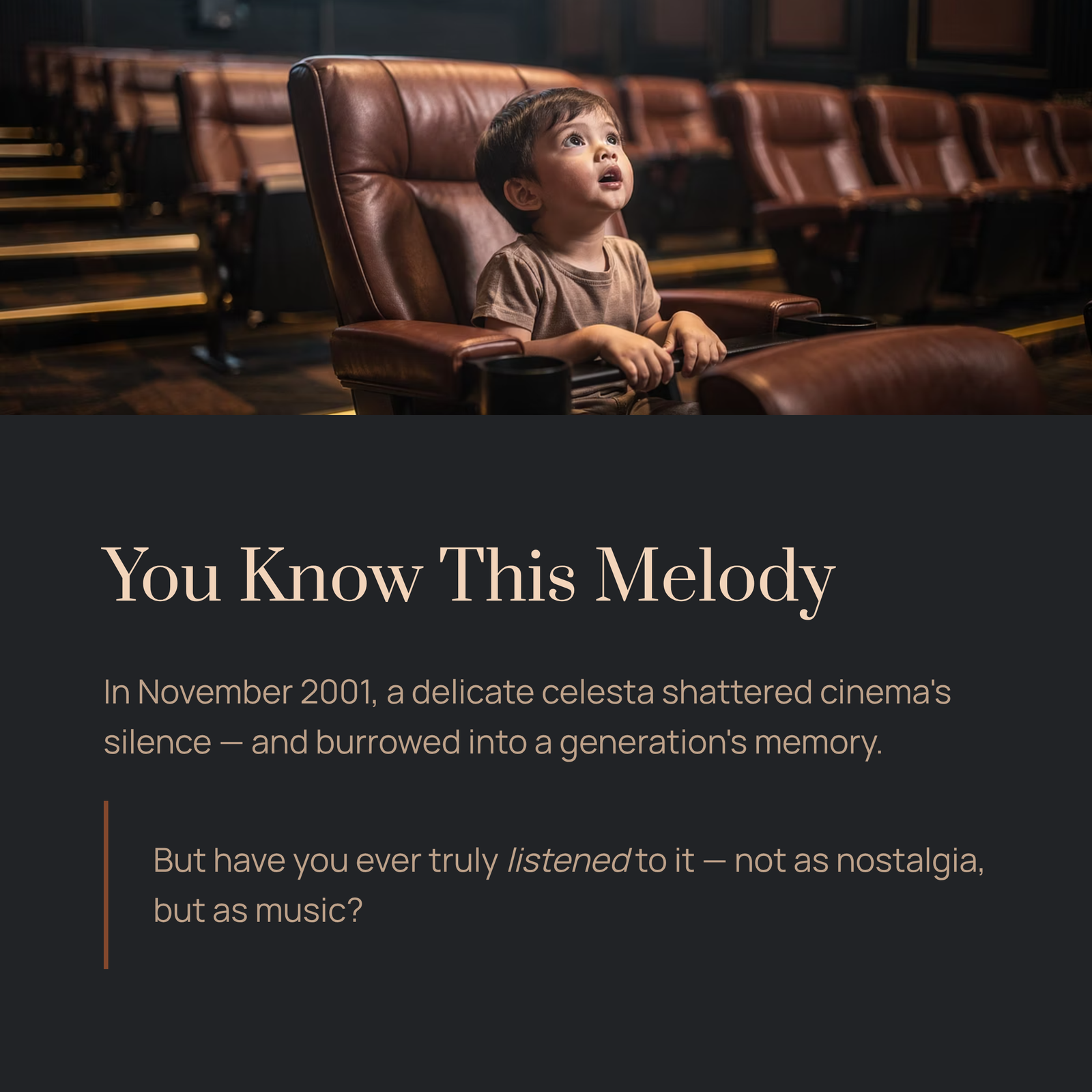
There is a particular kind of silence that exists in the half-second before a film score begins — a held breath between the darkness of a theater and the first flicker of story. In November 2001, when audiences around the world sat down to watch Harry Potter and the Philosopher’s Stone, that silence was shattered not by a trumpet fanfare or a sweeping string melody, but by something far more delicate: the tinkling, glass-like voice of a celesta, playing a melody that would burrow into the collective memory of an entire generation.
You know the melody. You have hummed it without thinking. You have heard it in shopping malls, in ringtones, in the whispered conversations of children pretending to cast spells. But have you ever truly listened to it — not as background nostalgia, but as a piece of music?
Because when you do, something remarkable happens. This deceptively simple tune reveals itself to be one of the most carefully constructed themes in modern orchestral writing.
The Man Who Gave Sound to Our Imagination
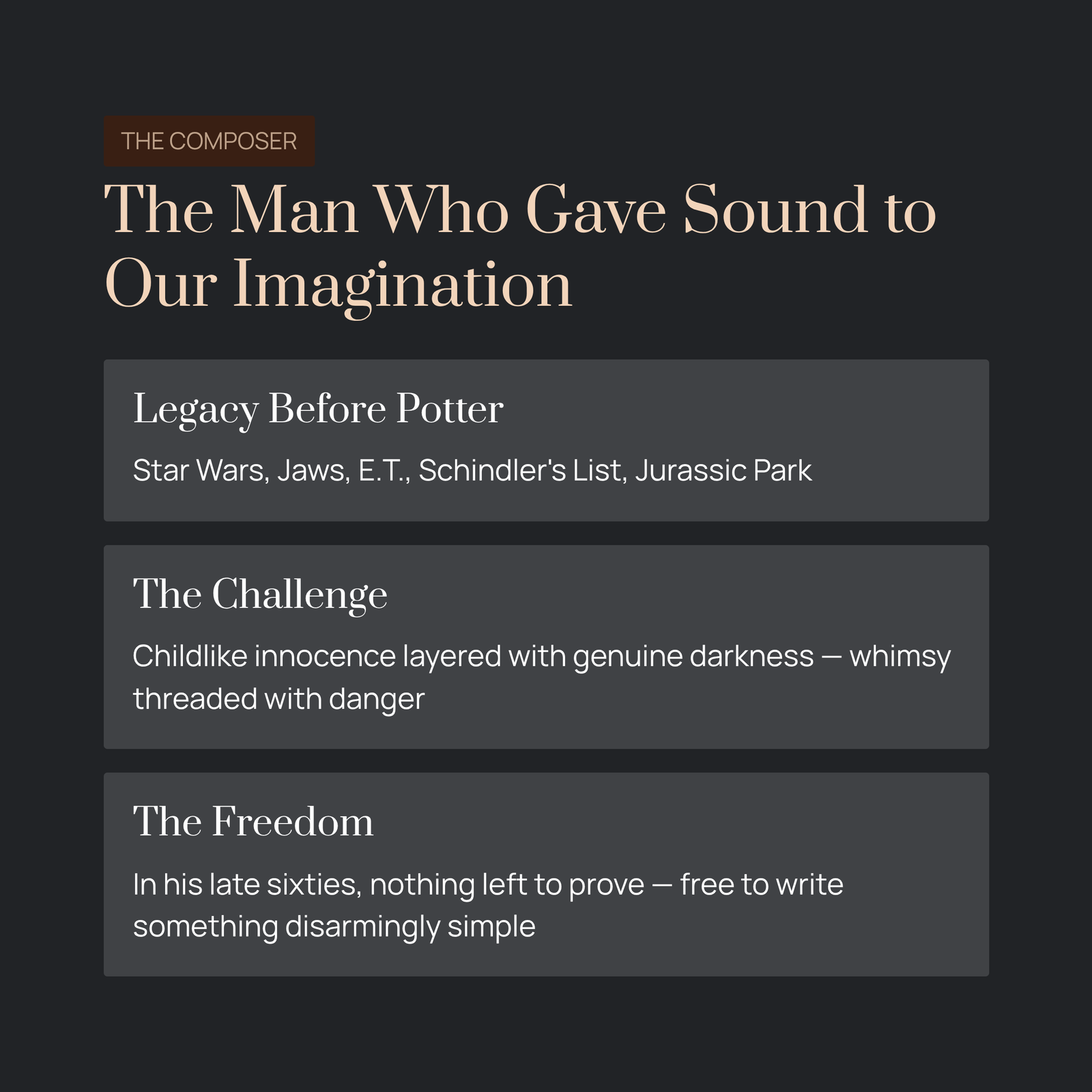
John Williams, born in 1932 in Floral Park, New York, had already reshaped the landscape of cinema long before a boy wizard entered his life. By the time director Chris Columbus approached him for the Harry Potter project, Williams had composed the musical DNA of Star Wars, Jaws, E.T., Schindler’s List, and Jurassic Park. Each of these scores didn’t merely accompany a film — they became the film, inseparable from the images they supported.
But here was a different challenge. The world of Harry Potter demanded something Williams had never quite been asked to deliver in this specific combination: childlike innocence layered with genuine darkness, whimsy threaded through with real emotional danger. The wizarding world needed to feel both inviting and unsettling, like a fairy tale told by someone who remembers that the original fairy tales were never entirely safe.
Williams was in his late sixties when he accepted the commission. He had nothing left to prove. And perhaps that freedom is exactly what allowed him to write something so disarmingly simple — a melody that a child could sing after one hearing, yet one that carries an almost unsettling harmonic ambiguity beneath its surface.
Why a Celesta? The Genius of the First Three Notes
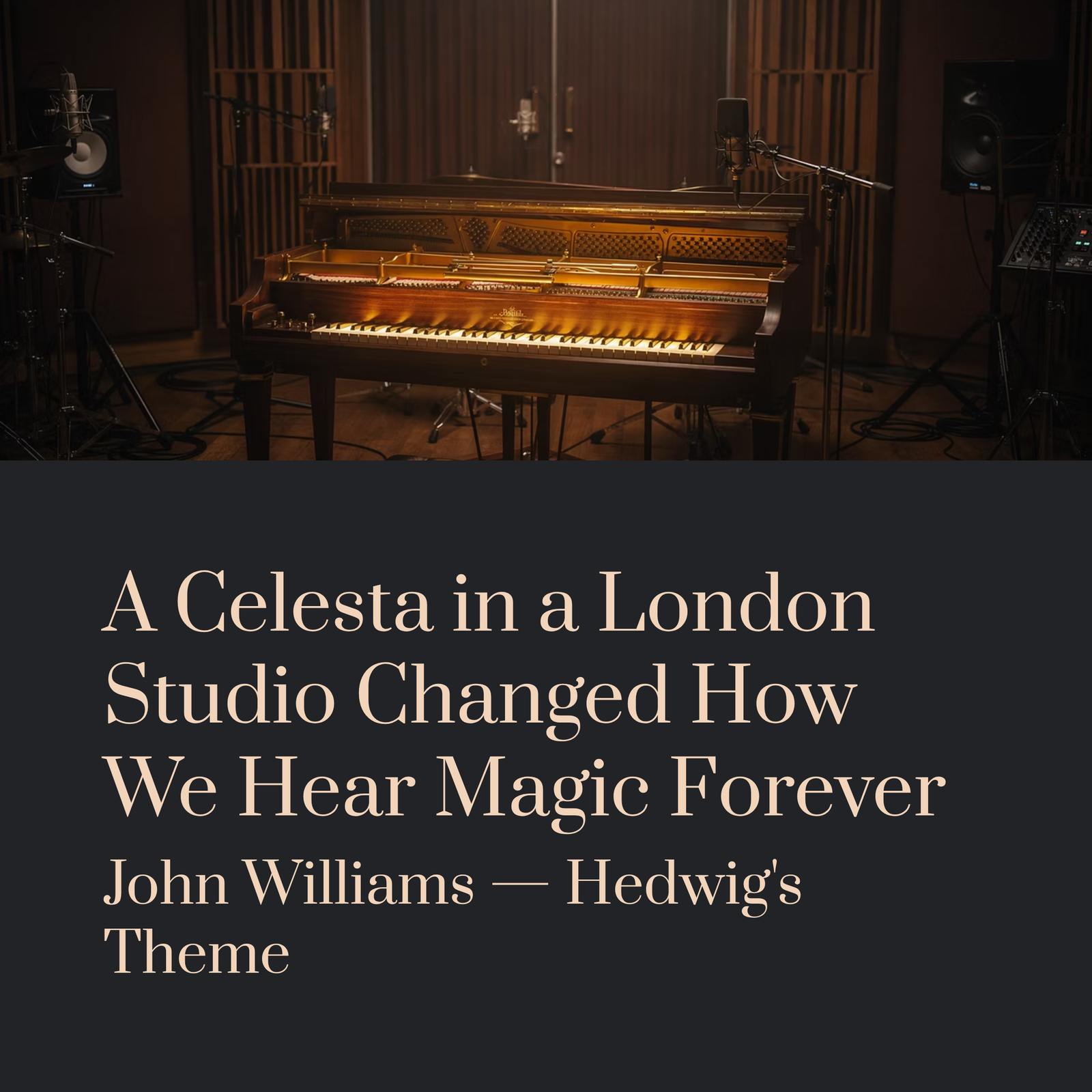
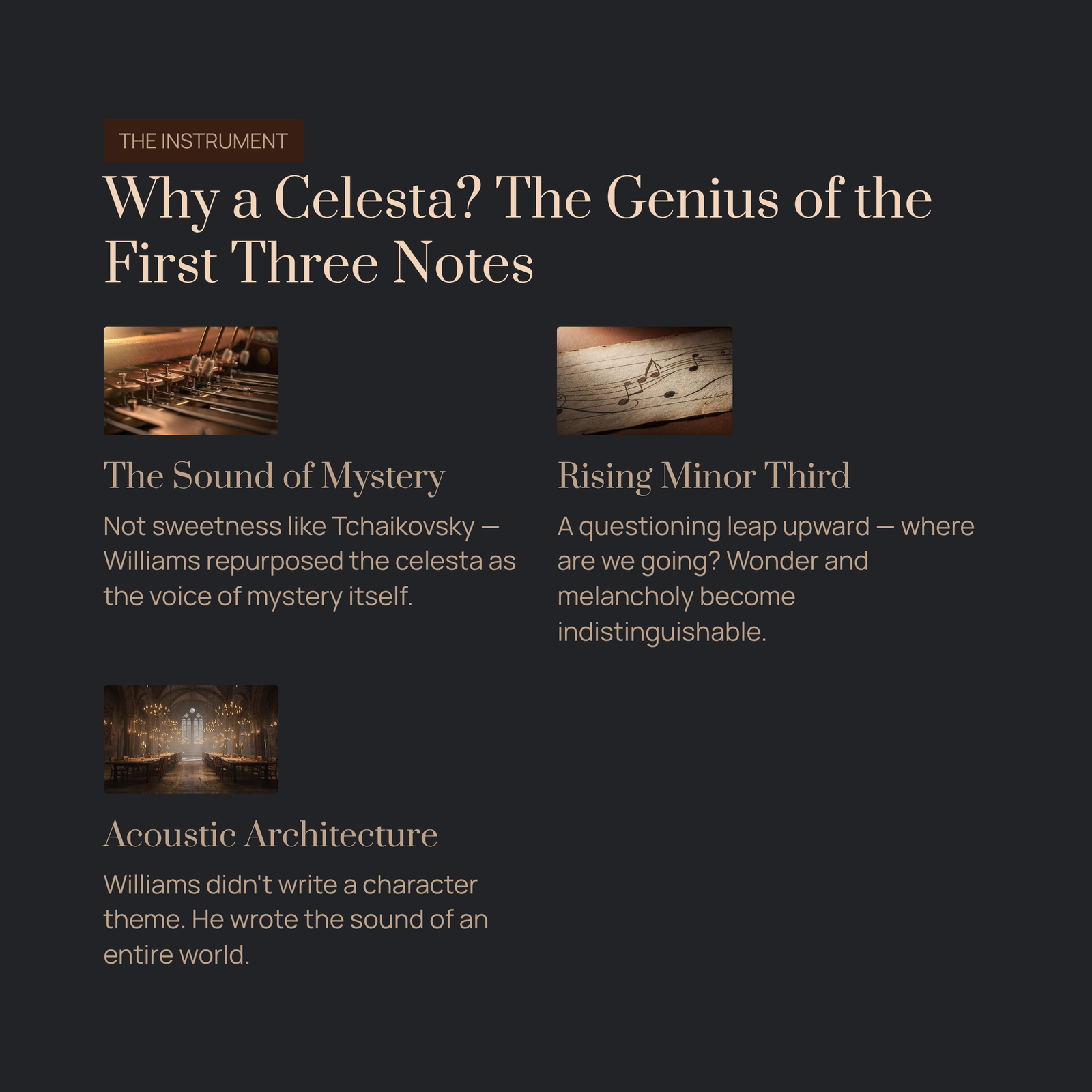
The celesta — that keyboard instrument that looks like a small upright piano but produces sound by striking metal plates — was not an obvious choice. It had been used memorably before, most famously in Tchaikovsky’s “Dance of the Sugar Plum Fairy.” But where Tchaikovsky used it for sweetness and delicacy, Williams repurposed its voice for something more complex: the sound of mystery itself.
Listen to the opening interval. The theme begins with a rising minor third — a small leap upward that immediately creates a sense of questioning. Where are we going? What lies ahead? Then the melody climbs further, reaching and stretching before tumbling back down in a pattern that feels like a music box slowly winding through a sequence it has played a thousand times, yet never quite the same way twice.
The harmonic language is deceptively sophisticated. Williams writes in a minor mode that constantly flirts with the major, creating that peculiar emotional state where wonder and melancholy become indistinguishable. This is not a “happy” theme, nor a “sad” one. It is the sound of standing on a threshold — of being eleven years old and realizing that the world is enormously larger and stranger than you ever imagined.
Pay attention to the orchestration as the theme develops beyond the celesta’s solo statement. Strings enter with a warmth that feels like a protective hand on a shoulder. Woodwinds add color — a flute here, an oboe there — each one a different shade of enchantment. The full orchestra eventually joins, and what began as a fragile, crystalline whisper becomes something grand and sweeping, like walking from a narrow corridor into a vast, candlelit hall.
This is Hogwarts in sound. Williams didn’t just write a theme for a character; he wrote the acoustic architecture of an entire world.
The Emotional Map Hidden in the Melody
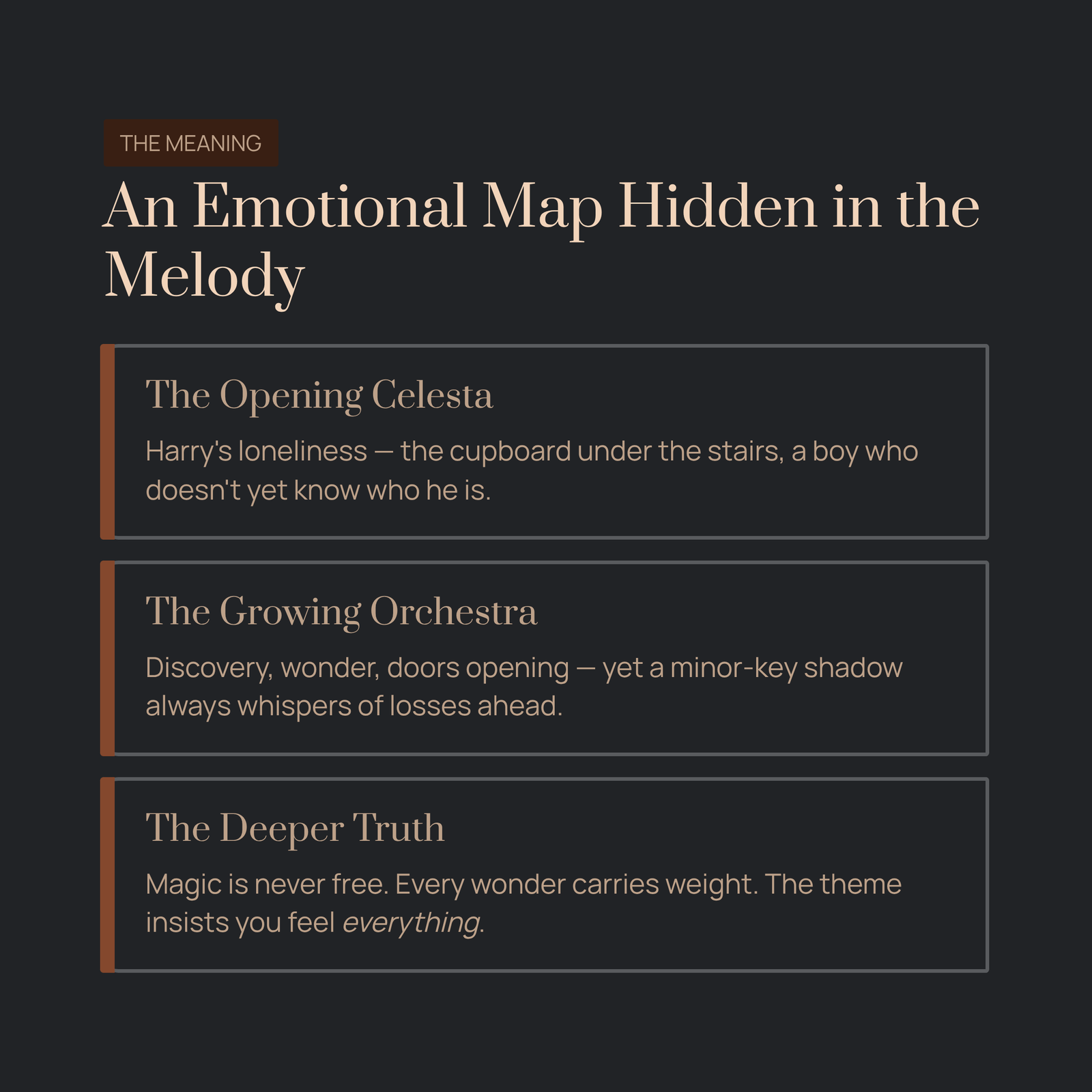
Here is what makes Hedwig’s Theme more than a clever piece of film scoring: it functions as an emotional map of the entire Harry Potter narrative, compressed into roughly ninety seconds.
The opening celesta passage is Harry’s loneliness — the cupboard under the stairs, the quiet solitude of a boy who doesn’t yet know who he is. As the melody expands and the orchestra grows, we hear the discovery, the wonder, the doors opening one after another. But notice how the theme never fully resolves into uncomplicated joy. There is always a slight shadow in the harmony, a minor-key turn that whispers of the dangers ahead, of the losses that will come.
Williams understood something profound about the story he was scoring: magic, in the world of Harry Potter, is never free. Every spell has a cost. Every wonder carries weight. And so his theme refuses to let you simply feel delighted. It insists that you feel everything — the thrill and the ache, the adventure and the grief, all woven together in a single melodic line.
This is why the theme has endured far beyond the films themselves. It speaks to something universal: the bittersweet nature of growing up, of discovering that the world is full of extraordinary things and that knowing this changes you in ways you cannot undo.
How to Listen: Three Passes Through the Magic
If you want to experience Hedwig’s Theme with fresh ears, try this approach.
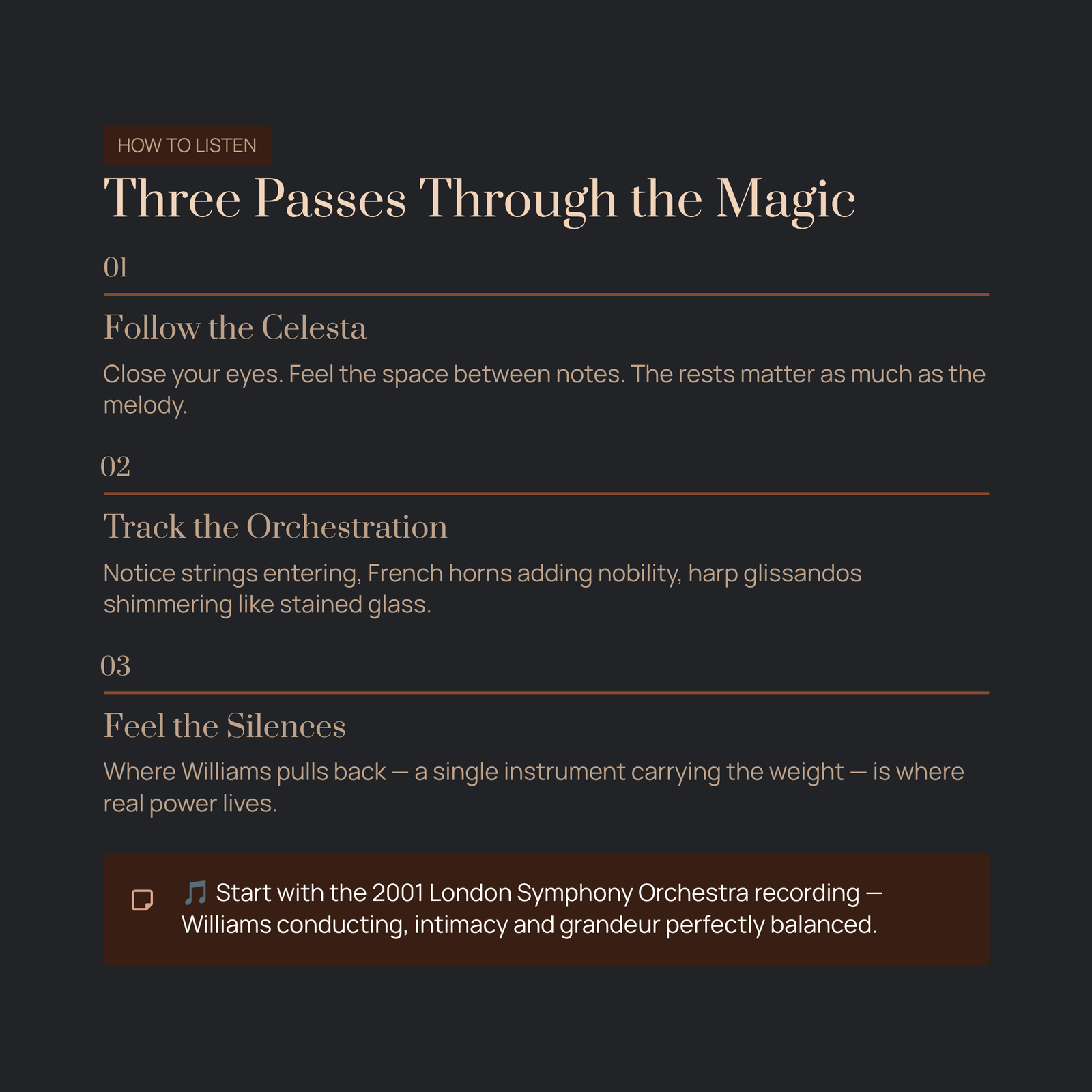
First listen — close your eyes and follow the celesta. Isolate that solo opening. Notice how each note hangs in the air before the next one arrives. Feel the space between the notes. Williams is a master of silence, and the rests in this theme are as important as the notes themselves. The original soundtrack recording from the 2001 film is the definitive starting point — it captures the London Symphony Orchestra under Williams’ own baton, and the balance between intimacy and grandeur is impeccable.
Second listen — track the orchestration. This time, pay attention to who is playing when. Notice the moment the strings first enter. Feel how the texture thickens. Listen for the French horns that add a sense of nobility, and the harp glissandos that shimmer like light through stained glass. If you can find the concert suite version that Williams arranged for live performances, it extends and develops the theme in ways the film version only hints at. The recording from the John Williams in Vienna album with the Vienna Philharmonic is a particularly luminous performance — the Viennese warmth in the string tone adds an entirely different emotional dimension.
Third listen — feel the silences. Great film composers understand that music’s power often lives in what is not played. Notice where Williams pulls the orchestra back, where he lets a single instrument carry the weight alone. These moments of restraint are where the real emotional power lives.
The Spell That Never Breaks
There is something almost paradoxical about Hedwig’s Theme. It was written for a commercial film franchise — one of the most commercially successful in history, in fact. It has been reproduced, remixed, parodied, and plastered across theme parks and merchandise. By every measure, it should have been stripped of its power through sheer overexposure.
And yet.
Play those first celesta notes in a quiet room, and something shifts. The air changes. For a moment, the distance between the ordinary world and something luminous and strange collapses entirely. Adults who first heard it as children feel a catch in their throat they cannot fully explain. Children hearing it for the first time go still with a kind of alert wonder.
This is the mark of music that has transcended its original context. Like the best classical works — like a Bach chorale or a Schubert song — Hedwig’s Theme has become a vessel for something larger than itself. It no longer belongs to a film. It belongs to the private emotional landscape of millions of people, each of whom hears something slightly different in its crystalline notes.
John Williams, now in his nineties, has said in interviews that he writes music to serve the story. But with Hedwig’s Theme, he did something rarer and more lasting. He wrote a melody that became the story — not just of a boy wizard, but of everyone who has ever stood at the edge of something unknown and felt, despite everything, the impossible pull of wonder.
That celesta is still playing. And if you listen carefully enough, you might just hear it.
![Read more about the article Air Cooled CPU vs Water Cooled CPU: Choose the right cooling system for PCs out of 2 [Part.1]](https://rvmden.com/wp-content/uploads/2024/01/Air-Cooled-CPU-vs-300x169.png)