📑 Table of Contents
There is a particular kind of silence that settles over you at the end of a good cry. Not the heavy silence of sadness, but the lighter kind — the kind that comes after you have finally let something go. Nick Laird-Clowes’s main theme for About Time lives in that silence. It arrives without announcement, a few piano notes stepping carefully into the room like someone who does not want to wake the house, and yet, within seconds, it has found the one soft place in your chest you thought you had sealed shut.
I first encountered this piece the way most people do — through Richard Curtis’s 2013 film of the same name. And like most people, I assumed the theme was simply a functional piece of scoring, a pleasant accompaniment to montage and dialogue. I was wrong. Separated from the film, standing entirely on its own, the About Time theme reveals itself as something far more deliberate: a meditation on the texture of days that have already passed through our fingers.
The Unlikely Film Composer Who Once Stood on Stadium Stages
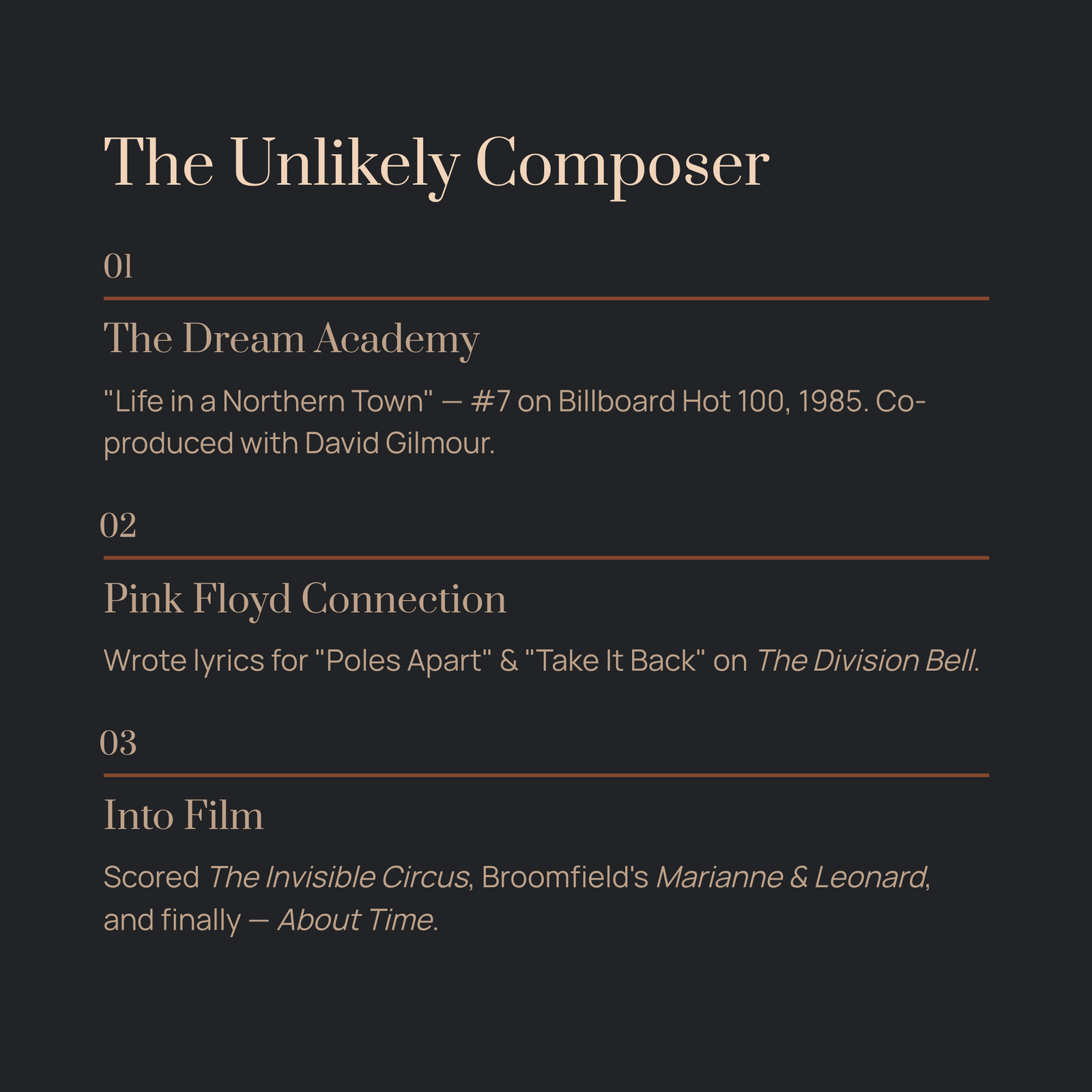
To understand why this theme sounds the way it does, you need to know who wrote it — and the answer is not what you might expect from a film score credit. Nick Laird-Clowes is a London-born musician who first came to international attention as the lead singer and principal songwriter of The Dream Academy, the art-pop trio whose 1985 single “Life in a Northern Town” climbed to number seven on the Billboard Hot 100. That song, co-produced with Pink Floyd’s David Gilmour, was dedicated to the late folk singer Nick Drake — an early signal that Laird-Clowes was drawn to beauty inseparable from melancholy.
His friendship with Gilmour went deeper than one production credit. Laird-Clowes contributed lyrics to two tracks on Pink Floyd’s The Division Bell — “Poles Apart” and “Take It Back” — and the Dream Academy’s music featured prominently in John Hughes films like Ferris Bueller’s Day Off and Planes, Trains and Automobiles. After the Dream Academy disbanded in 1991, Laird-Clowes moved steadily into film composition, scoring features like The Invisible Circus and documentaries for director Nick Broomfield, including the Leonard Cohen portrait Marianne & Leonard: Words of Love.
So when Richard Curtis — himself a resident of the same Notting Hill streets where Laird-Clowes grew up — needed someone to translate the emotional architecture of About Time into sound, the choice was almost autobiographical. Curtis did not need a conventional film composer. He needed a songwriter who understood that the most devastating melodies are the ones that sound simple.
A Film Disguised as a Romantic Comedy
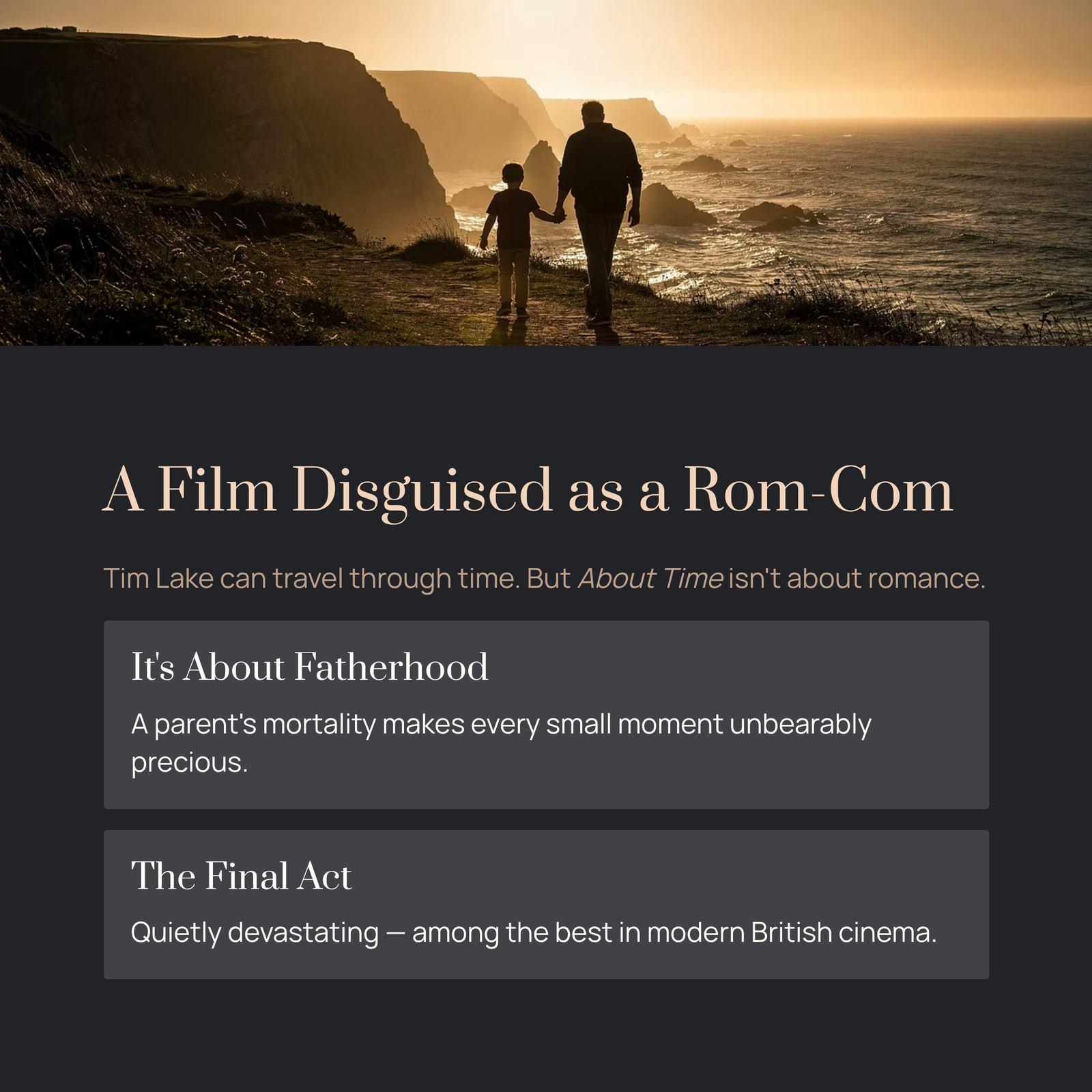
Before we listen closely to the music, a word about the film it serves. About Time opens with a premise that sounds almost frivolous: Tim Lake, a young Englishman played by Domhnall Gleeson, discovers from his father (Bill Nighy) that the men in his family can travel through time. He uses this gift to pursue a relationship with Mary (Rachel McAdams), correcting awkward first dates and smoothing the rough edges of courtship.
But the film is not really about romance. It is about fatherhood. It is about the way a parent’s mortality transforms every small shared moment — a game of table tennis on a winter afternoon, a walk along the Cornish coast — into something unbearably precious. The final act, in which Tim must accept that visiting his dying father in the past means never doing so again once his next child is born, is among the most quietly devastating sequences in modern British cinema.
This is the emotional ground the main theme must hold. And it holds it not through grandeur, but through restraint.

Listening to the Architecture of a Sigh
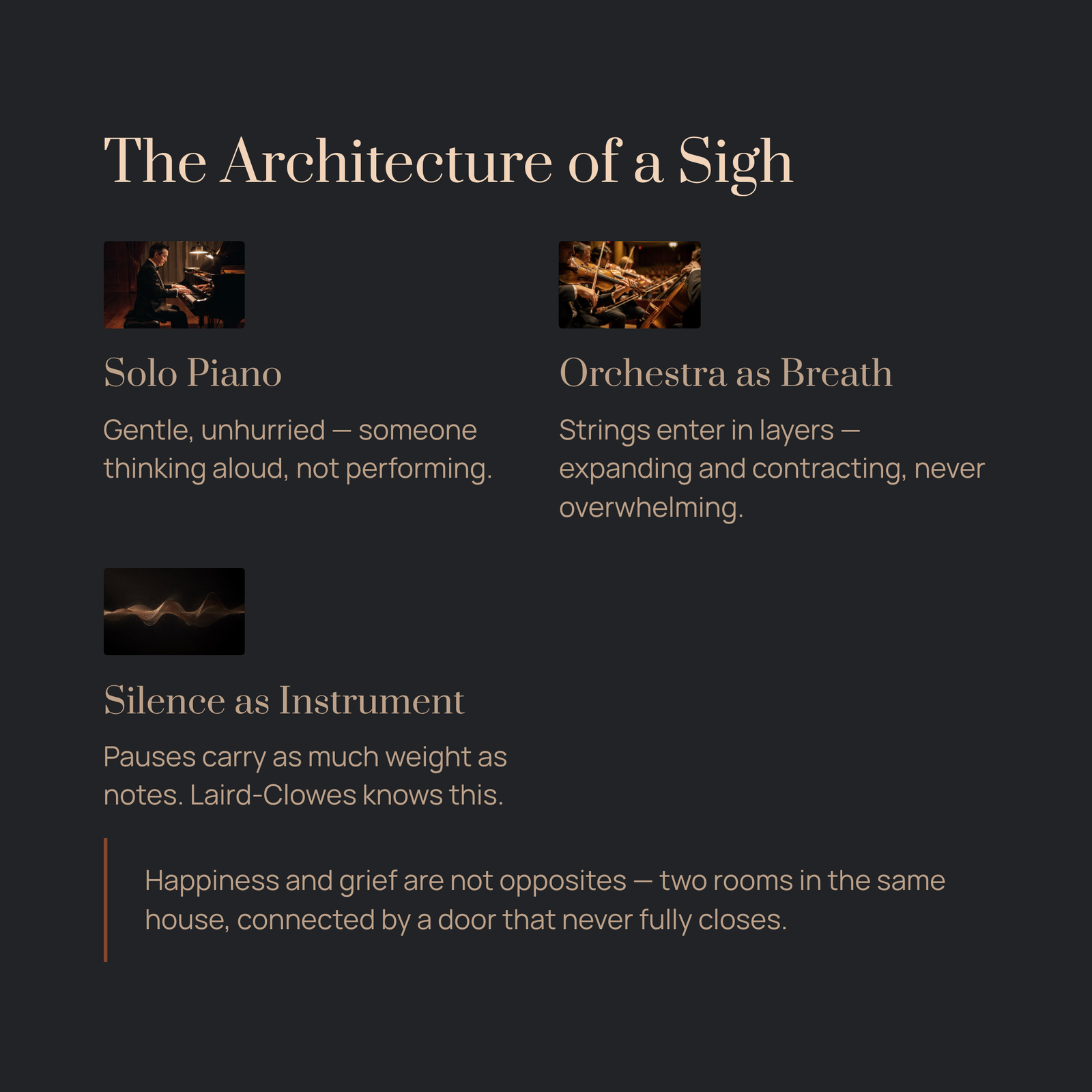
The About Time theme opens with solo piano — gentle, unhurried, almost conversational. Sally Heath’s performance has the quality of someone thinking aloud at a keyboard late at night, not performing for an audience but simply letting a thought complete itself. The melody moves in small intervals, never leaping dramatically, as though it knows that the deepest feelings do not announce themselves with fanfare.
Then the London Metropolitan Orchestra enters. Not all at once, but in careful layers — strings first, low and warm, providing a bed of sustained harmony beneath the piano’s continuing meditation. The orchestration, conducted by Andy Brown, is a masterclass in knowing what to leave out. There are no triumphant brass passages, no percussion building toward a climax. Instead, the orchestra functions almost like breath — expanding and contracting around the piano’s solitary voice, giving it room to speak and then gently amplifying what it says.
If you listen with headphones, pay attention to the space between notes. Laird-Clowes understands something that many film composers overlook: silence is not the absence of music. It is music’s most expressive instrument. The pauses in this theme carry as much emotional weight as the notes themselves, creating the sensation of someone gathering courage before saying something important.
The harmonic language is deceptively simple — mostly diatonic, with none of the chromatic restlessness that signals “serious” classical composition. But simplicity here is not the same as naivety. It is the simplicity of someone who has learned, through decades of songwriting, exactly which chord progression will unlock a particular shade of longing. The piece hovers in a space between major and minor that mirrors the film’s emotional thesis: that happiness and grief are not opposites but rather two rooms in the same house, connected by a door that never fully closes.

Three Ways to Let This Theme Find You
This is not a piece that rewards analytical listening on the first encounter. It rewards presence. Here are three approaches I would suggest:
First, listen to the theme completely separated from the film. Find it on a streaming platform, close your eyes, and give it your full attention for its three-minute duration. Without visual cues telling you what to feel, you may be surprised by where the music takes you. Many listeners report that the theme brings to mind not a specific memory but a category of memory — the feeling of an ordinary afternoon you did not know, at the time, was extraordinary.
Second, if you have seen the film, revisit the scene where Tim and his father take their final walk along the beach. Notice how the theme does not try to compete with the emotional weight of the moment. It simply walks alongside it, the way a close friend might walk beside you without speaking when words would be too much.
Third, try listening to this theme alongside another piece from the About Time soundtrack — “Golborne Road,” also composed by Laird-Clowes. Where the main theme is reflective and bittersweet, “Golborne Road” carries a gentler, more domestic warmth. Together, the two pieces form a kind of emotional portrait: one looking backward at what has been lost, the other looking around at what remains.
The Ordinary Extraordinary
I keep returning to this theme the way I keep returning to certain photographs — not because they capture anything dramatic, but because they capture something true. Nick Laird-Clowes, a man who once filled arenas with The Dream Academy and wrote words for one of rock’s most legendary bands, chose to pour decades of musical wisdom into a piece so humble it could almost be mistaken for simplicity.
But that is exactly the point. Richard Curtis built an entire film around the idea that the extraordinary hides inside the ordinary — that the most valuable moments are the ones we are most likely to overlook. Laird-Clowes’s theme is the sonic embodiment of that philosophy. It does not try to convince you of anything. It does not perform emotion for you. It simply opens a small, quiet window and waits for you to look through it.
Some compositions demand your attention with complexity and scale. This one earns it with patience. And in the end, that patience is what makes it linger — not in your ears, but somewhere deeper, in the place where you keep the things you are most afraid to forget.