📑 Table of Contents
There are mornings when the air changes before anything else does. The sky is still pale, the streets are still quiet, but something in the breeze tells you — winter is leaving. If that feeling had a sound, it would be the opening measures of Mendelssohn’s Spring Song. A gentle ripple of notes in the right hand, bright and unhurried, floating over a soft accompaniment like sunlight skipping across a pond. No grand announcement, no dramatic entrance. Just the quiet, unmistakable arrival of warmth.
This is a piece that doesn’t try to impress you. It simply invites you to sit beside an open window and breathe. And somehow, that’s exactly what makes it unforgettable.
The Composer Who Painted with Sound
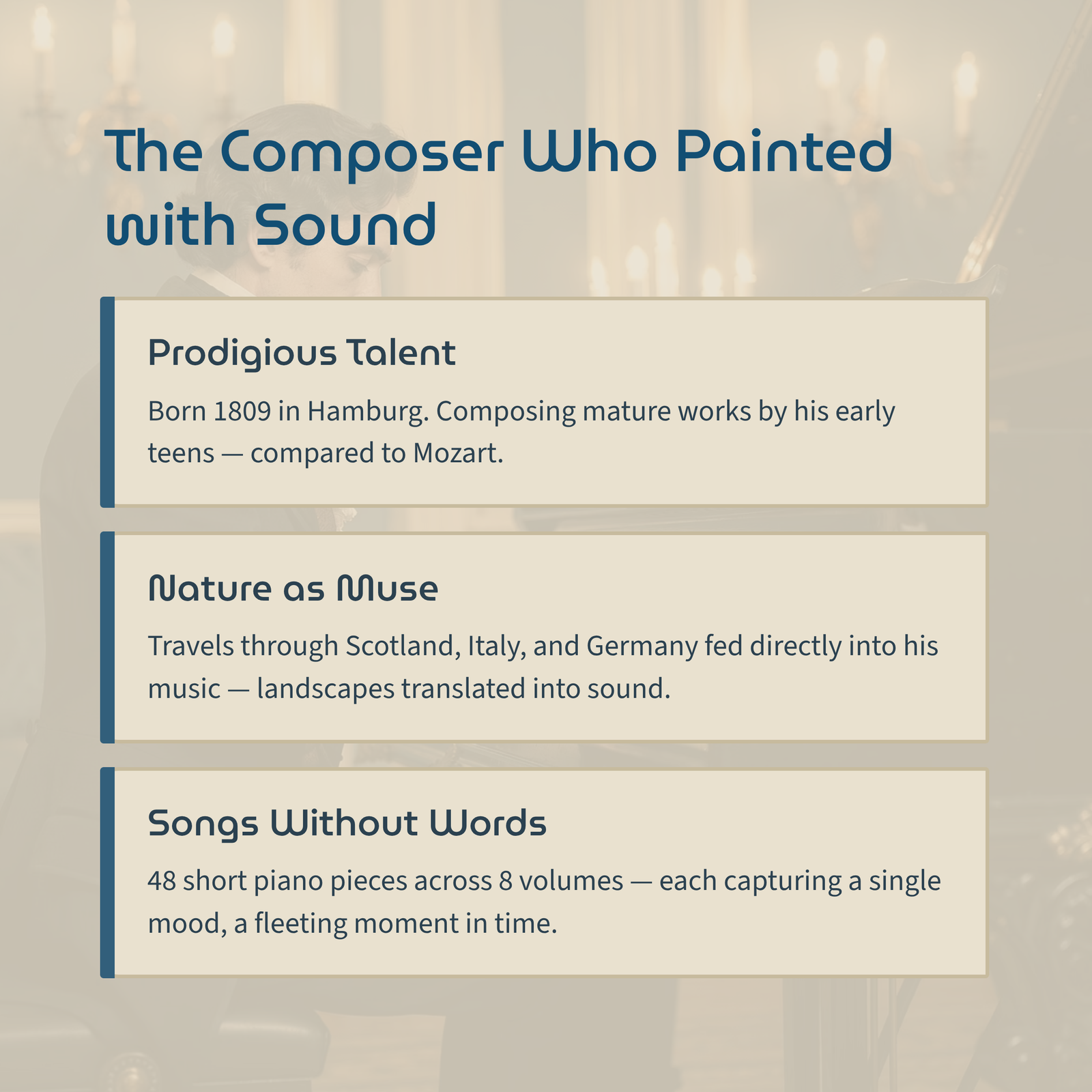
Felix Mendelssohn was born in 1809 into one of the most cultured families in Hamburg, Germany. A prodigious talent from childhood, he was composing mature works by his early teens — an achievement sometimes compared to Mozart’s. But where Mozart’s genius often carried a sense of restless fire, Mendelssohn’s gift leaned toward elegance, clarity, and an almost painterly sensitivity to color and atmosphere.
He was also a man deeply connected to the natural world. His travels across Europe — through the Scottish Highlands, the Italian countryside, the forests of Germany — fed directly into his music. You can hear the crash of ocean waves in his Hebrides Overture, the warmth of Mediterranean light in his Italian Symphony. Mendelssohn didn’t just compose; he translated landscapes into sound.
The Songs Without Words (Lieder ohne Worte) were his most personal laboratory for this kind of translation. Written across his adult life and published in eight volumes, these short piano pieces were exactly what their title promised: songs that needed no lyrics. Each one captured a single mood, a fleeting emotion, a moment in time. And among all forty-eight of them, none has endured quite like the Spring Song.
A Small Piece with a Long Story
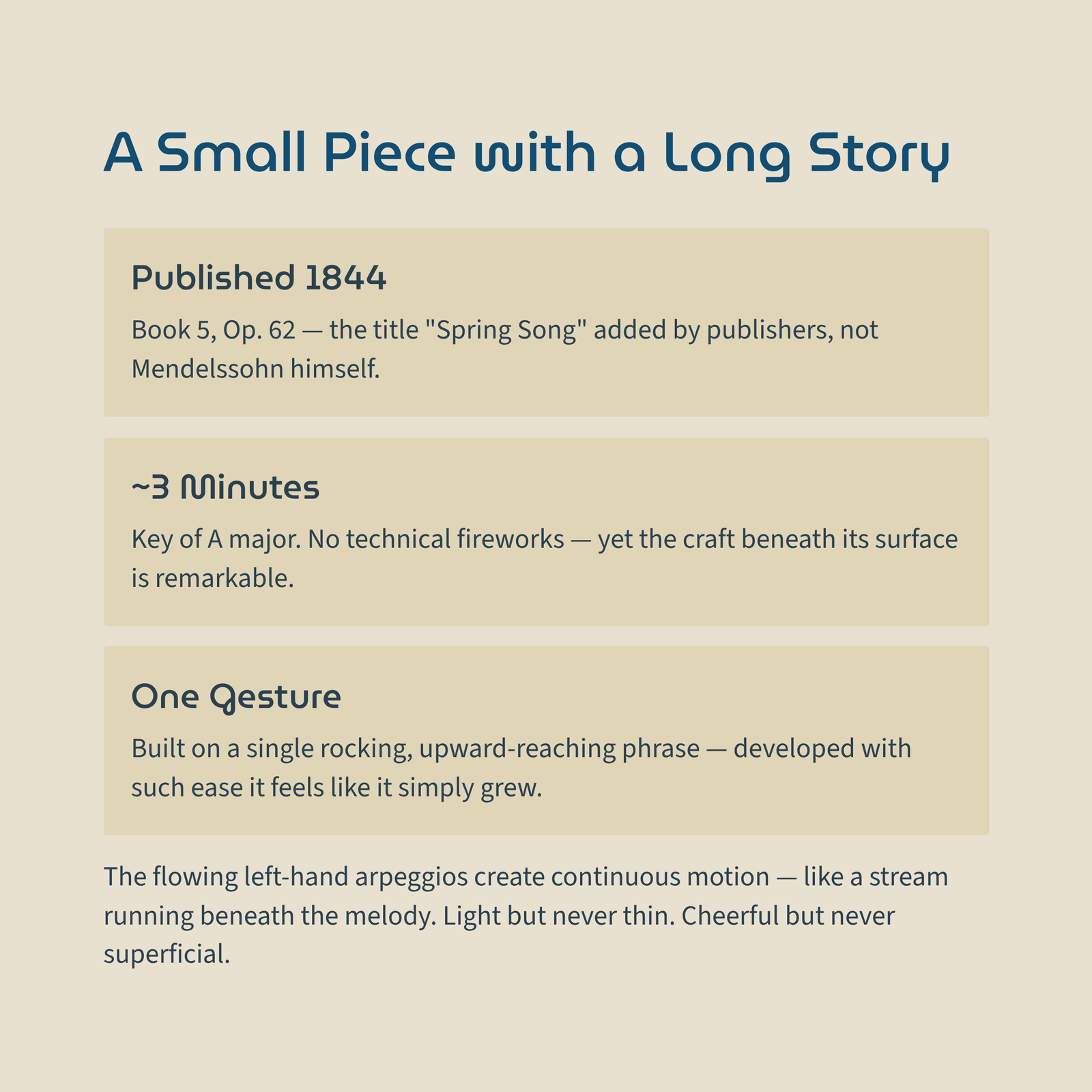
The Spring Song appears as the sixth and final piece in Book 5, Op. 62, published in 1844. Mendelssohn himself never gave it the title “Spring Song” — that name was added later by publishers who recognized what every listener instinctively feels: this music is spring.
Written in the key of A major, the piece is deceptively simple. It runs barely three minutes in most performances. There are no technical fireworks, no complex harmonic detours. And yet, the craft beneath its surface is remarkable. Mendelssohn constructs the entire piece around a single melodic gesture — that gently rocking, upward-reaching phrase in the right hand — and develops it with such natural ease that the music feels less like a composition and more like something that simply grew, the way a flower opens without effort.
The accompaniment deserves attention too. Listen to the left hand: it moves in a flowing, arpeggiated pattern that creates a sense of continuous motion, like a stream running beneath the melody. Together, the two hands create a texture that is light but never thin, cheerful but never superficial. It’s the musical equivalent of dappled sunlight through new leaves.
How to Listen: Three Invitations
If you’re approaching this piece for the first time — or returning to it after many years — here are three ways to let it in.
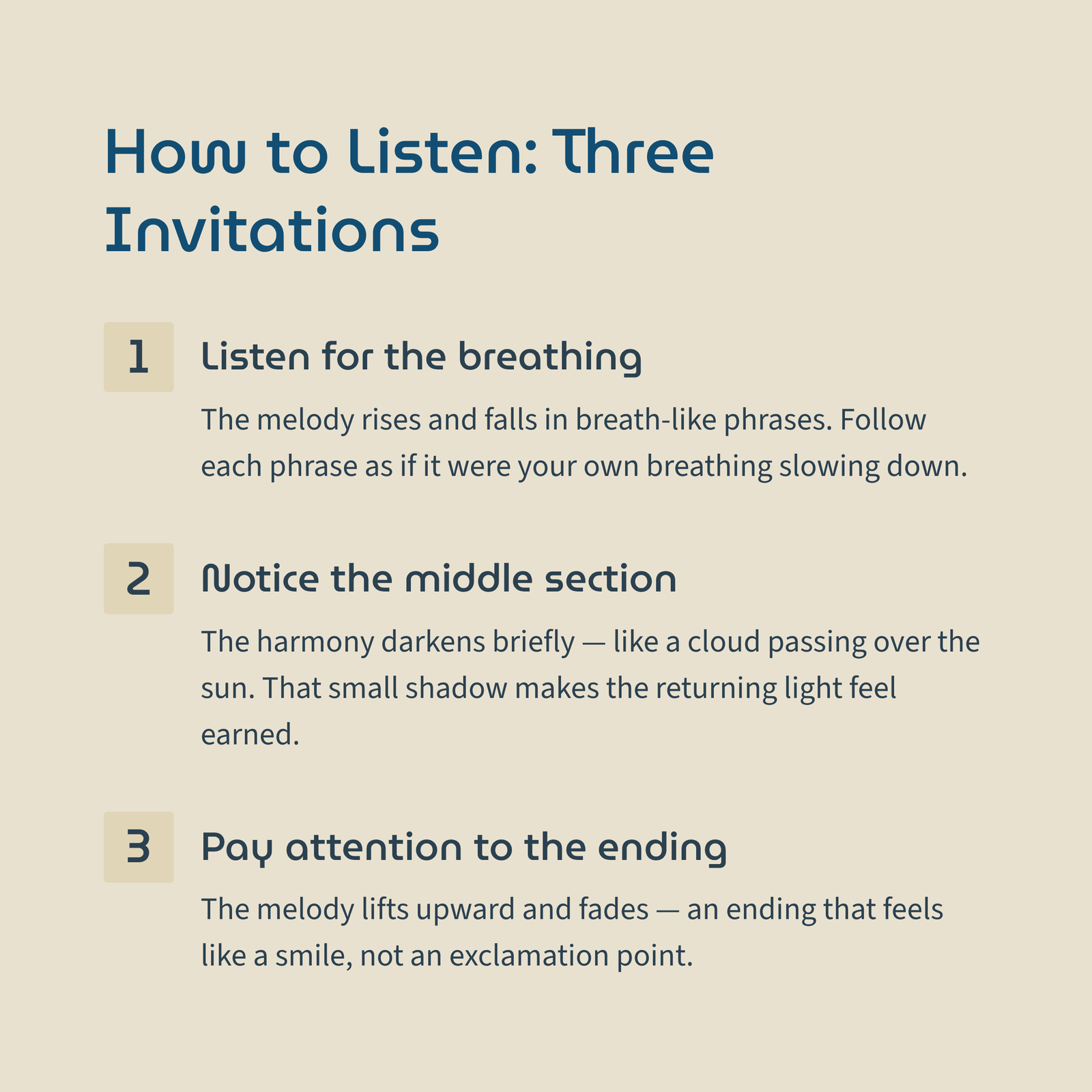
First, listen for the breathing. The melody in Spring Song rises and falls in natural, breath-like phrases. It doesn’t rush toward a climax. Instead, it exhales gently, pauses, and begins again. Try closing your eyes and simply following each phrase as if it were your own breathing slowing down.
Second, notice the middle section. Around the halfway point, the harmony shifts slightly — the colors darken just a touch, like a cloud passing briefly over the sun. It’s subtle, almost easy to miss, but it gives the return of the main theme a warmth it wouldn’t otherwise have. That small shadow makes the light feel earned.
Third, pay attention to how it ends. Mendelssohn doesn’t build toward a grand finale. The piece simply dissolves, the melody lifting upward one last time before fading into silence. It’s an ending that feels like a smile rather than an exclamation point — as if spring itself doesn’t need to announce its departure because it knows it will return.
Recordings Worth Your Time
The beauty of Spring Song lies in how differently great pianists interpret its apparent simplicity.
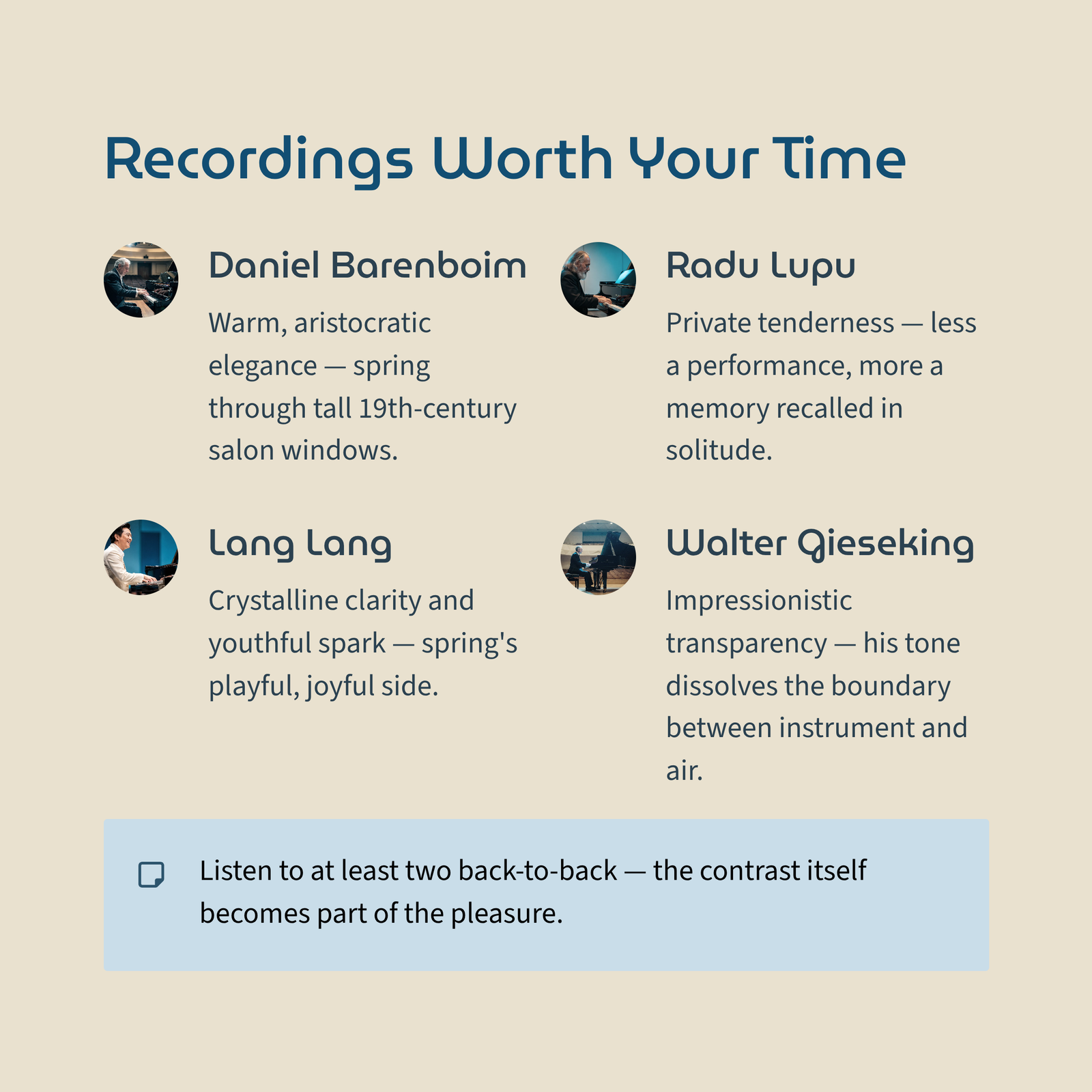
Daniel Barenboim brings a warm, unhurried elegance to the piece, letting each phrase breathe with aristocratic poise. His recording feels like watching spring arrive through the tall windows of a 19th-century salon — stately, refined, and deeply satisfying.
Radu Lupu, in his characteristically introspective style, finds an almost private tenderness in the melody. Under his fingers, the piece feels less like a performance and more like a memory — something recalled in solitude with a quiet, knowing smile.
For a lighter, more sparkling interpretation, Lang Lang‘s version offers youthful energy and crystalline clarity. His touch brings out the playful side of the music, reminding us that spring is not only gentle — it’s also joyful.
And if you’re curious about historical approaches, seek out Walter Gieseking‘s mid-20th-century recording, where the piece glows with an almost impressionistic transparency. His piano tone seems to dissolve the boundary between the instrument and the air around it.
Each of these recordings reveals a different facet of the same jewel. I’d encourage you to listen to at least two back-to-back — the contrast itself becomes part of the pleasure.
Why Three Minutes Can Change Your Morning
We live in a world saturated with sound. Playlists run for hours. Albums demand our full attention. Podcasts fill every commute. Against all of that noise, a three-minute piano piece from 1844 might seem like too small a thing to matter.
But that’s precisely its power. Spring Song doesn’t ask for your whole afternoon. It asks for one unhurried moment. One breath. One pause between the rush of yesterday and the demands of today. And in that pause, it offers something almost radical in its simplicity: the reminder that beauty doesn’t need to be complicated to be real.
Mendelssohn understood this instinctively. He knew that the deepest emotions often arrive not in thunderclaps but in the quiet turn of a phrase, the way morning light moves slowly across a wall. Spring Song is his proof that a whisper can outlast a shout.
So the next time the season shifts — or the next time you simply need to feel that it has — open a window, press play, and give yourself three minutes. Spring will do the rest.