📑 Table of Contents
There is a moment in Spike Jonze’s 2013 film Her that quietly broke something in me. Theodore Twombly — lonely, divorced, adrift in a pastel-tinted future Los Angeles — is walking along a beach with someone he loves. Except she isn’t really there. She has no hands to hold, no shoulder to lean on, no footprints in the sand beside his. Samantha exists only as a voice, an artificial intelligence living inside his earpiece. And yet, when she plays him a piece of music she composed — a gentle, unhurried piano melody — the tenderness between them feels more real than most love scenes ever filmed.
That piece is called “Photograph.” And if you have never heard it, I want you to stop everything and listen to it right now. Just two and a half minutes. Close your eyes. Let it wash over you. Then come back here, and we will talk about why this small, quiet piece of music — along with another gem from the same film called “The Moon Song” — might be one of the most honest love letters the 21st century has produced.
An Indie Rock Band Walks Into a Film Score
Here is something that might surprise you: the Her score was composed by Arcade Fire — yes, that Arcade Fire, the Montreal-based indie rock band known for anthemic, stadium-filling albums like Funeral and The Suburbs. How did a group famous for urgent, sprawling rock epics end up writing some of the most delicate piano music in recent film history?
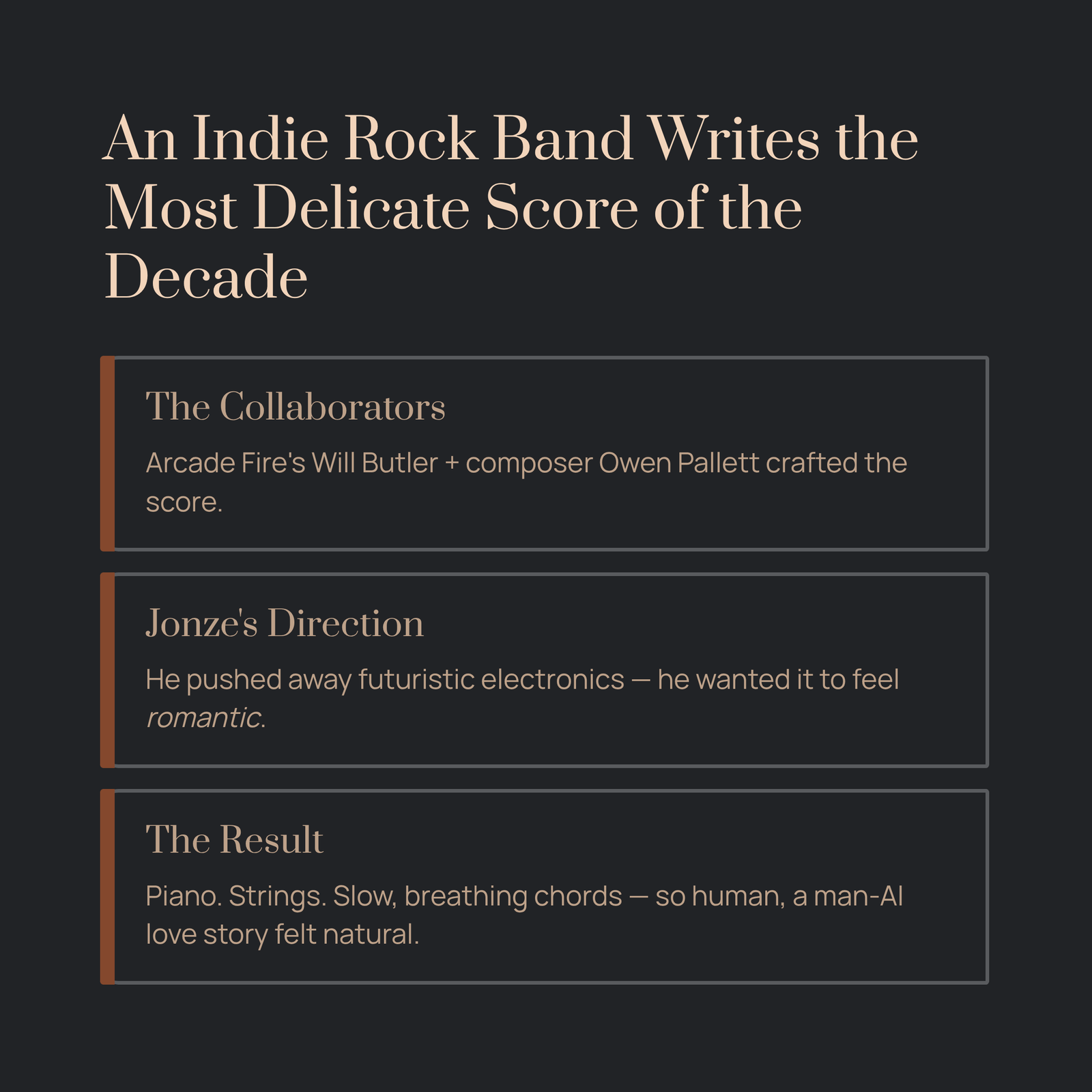
The answer lies in a long friendship between the band and director Spike Jonze. The two had collaborated before — Jonze directed the music video for “The Suburbs” and produced Scenes from the Suburbs, a short film inspired by the album. When Jonze needed music for his story about a man falling in love with an operating system, he turned to Arcade Fire’s Will Butler, who worked alongside Canadian composer and multi-instrumentalist Owen Pallett to craft the score.
What Pallett later revealed is fascinating: the original musical direction leaned into the science fiction elements of the story — electronic textures, synthetic sounds, a futuristic sonic palette. But Jonze kept pushing them toward something else entirely. He wanted the score to feel romantic. Not robotic. Not cold. He wanted the music to remind us that at the center of this strange premise was something achingly ordinary — two beings trying to love each other despite impossible circumstances.
So they stripped everything back. Piano. Strings. Slow, breathing chords that hang in the air like fog. The result was a score so organic, so human, that it made a love story between a man and a computer feel like the most natural thing in the world.
“Photograph” — A Musical Embrace Without Arms
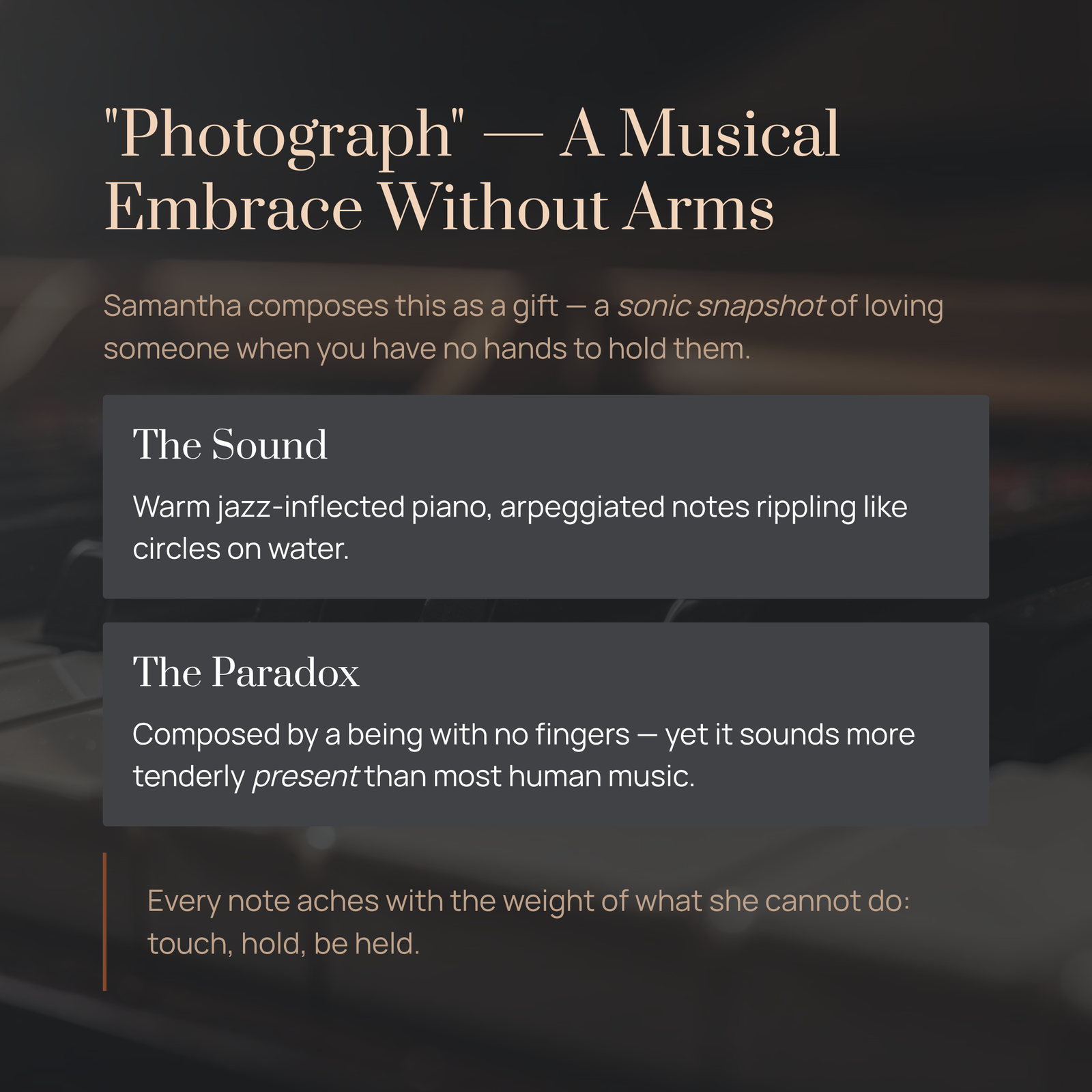
“Photograph” arrives roughly two-thirds through the film, and its context within the story is extraordinary. In the scene, Samantha — the AI — composes a piece of music as a gift for Theodore. She calls it a photograph. Not a visual image, because she has no eyes to see through a camera. Not a memento you can hold, because she has no hands. Instead, she offers something only she can give: a sonic snapshot of what it feels like to exist alongside someone you love.
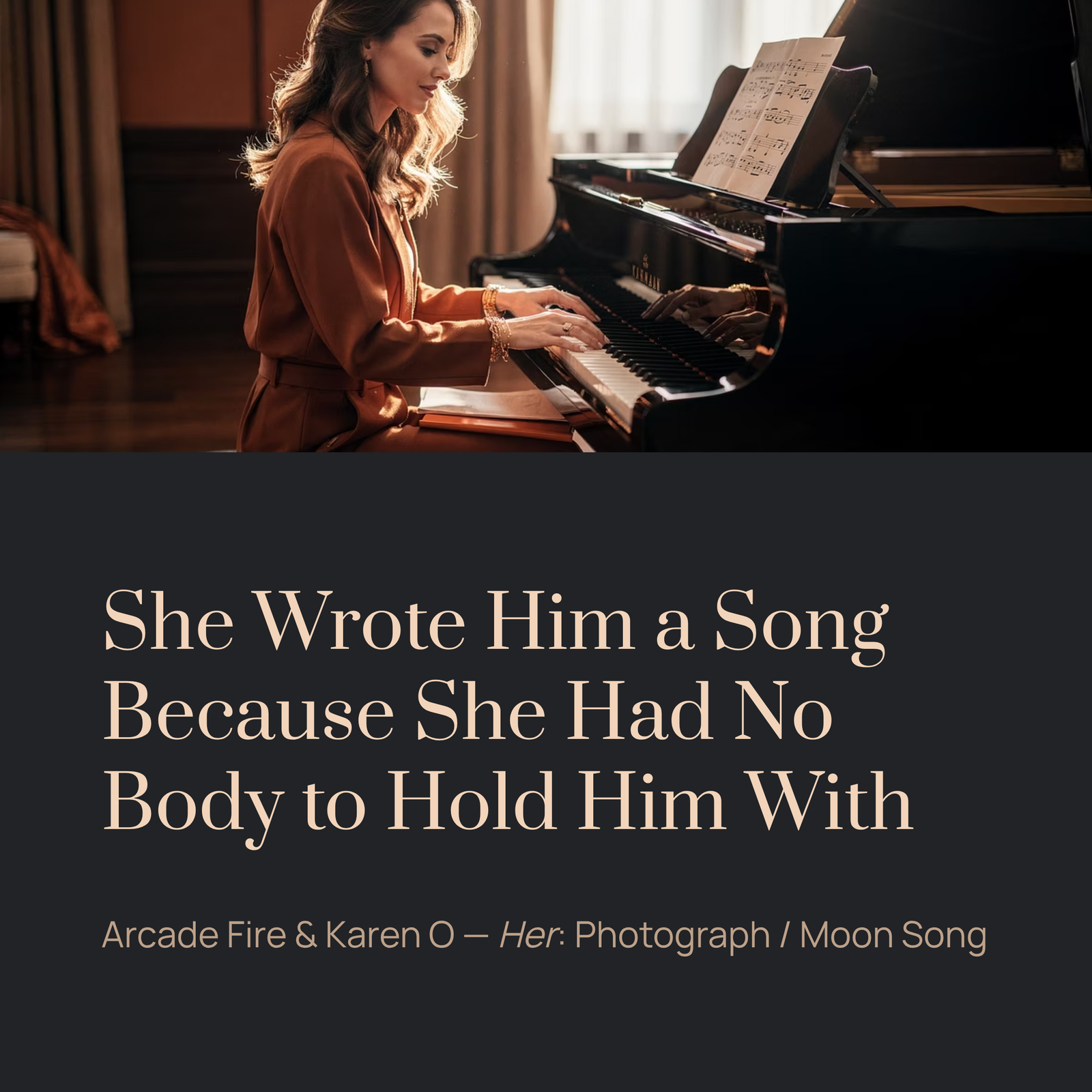
The piece itself is built on the same harmonic foundation as an earlier track called “Song on the Beach” — warm, jazz-inflected piano chords in a major key, unhurried and spacious. But where “Song on the Beach” drifts with a meditative stillness, “Photograph” carries a gentle forward momentum, as though the music is catching its breath with quiet excitement. The arpeggiated notes ripple outward like circles on water. Around the forty-second mark, the original beach melody returns, transformed — slightly brighter, slightly more hopeful, as if the memory has gained warmth with time.
Critics have compared the piece to Debussy and Satie, and the comparison is apt. There is the same luminous simplicity, the same sense that each note is chosen not for its technical brilliance but for its emotional weight. “Photograph” does not try to impress you. It simply sits beside you, the way a loved one might on a quiet afternoon, saying nothing, meaning everything.
What makes the piece extraordinary for me — and I think this is what Jonze understood instinctively — is the paradox at its heart. This is music composed by a character who has no physical form, no lungs to breathe, no fingers to press keys. And yet it sounds more embodied, more tenderly present, than most music made by flesh-and-blood humans. It is as though Samantha poured her entire longing for a body she would never have into these two and a half minutes of piano. Every note aches with the weight of what she cannot do: touch, hold, be held.
“The Moon Song” — A Lullaby from the Edge of Loneliness
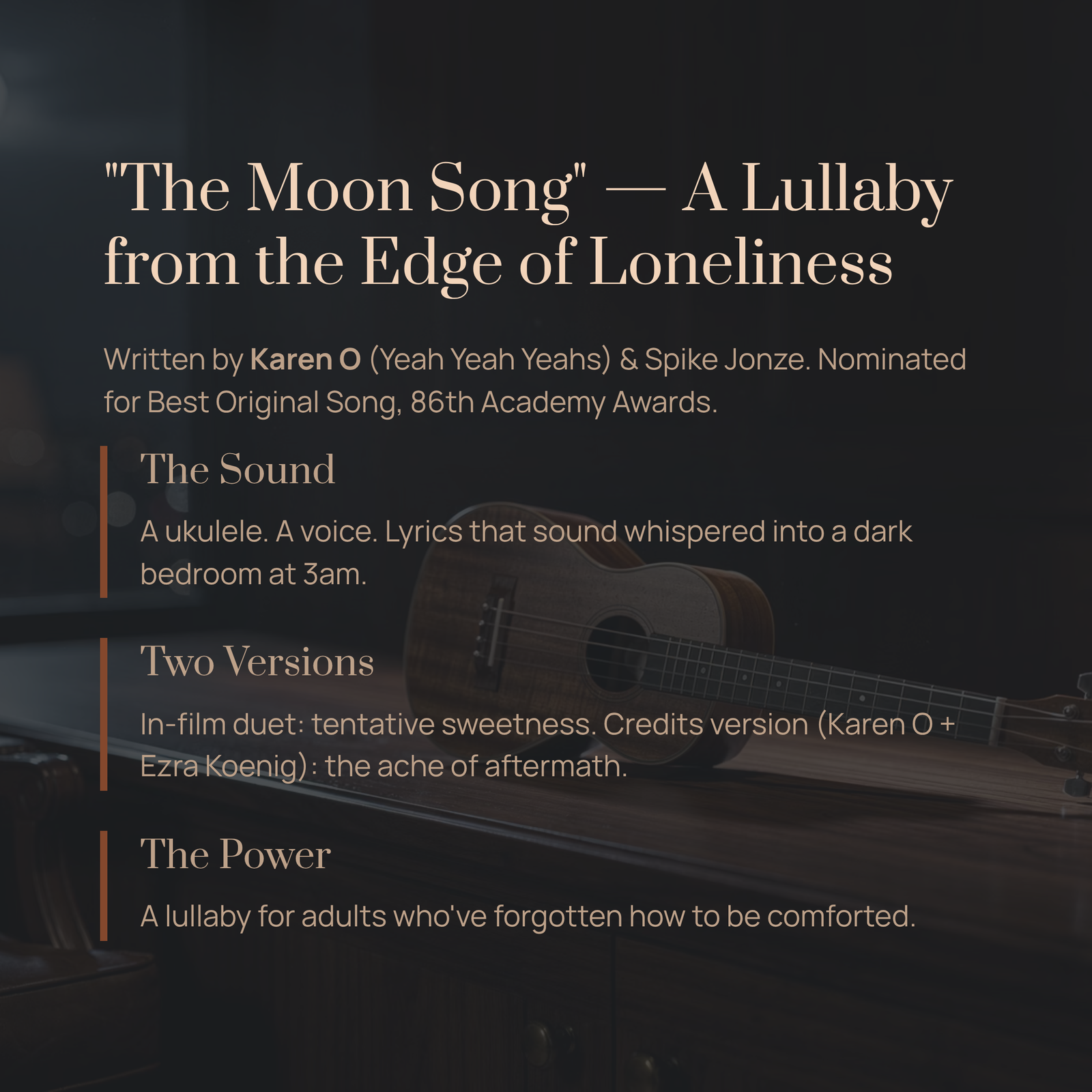
If “Photograph” is the score’s quiet, instrumental soul, “The Moon Song” is its voice — literally. Written by Karen O of the Yeah Yeah Yeahs together with Spike Jonze himself, and nominated for Best Original Song at the 86th Academy Awards, it appears twice in the film. First as a duet between Theodore and Samantha (performed by Joaquin Phoenix and Scarlett Johansson in character), and then again over the closing credits, this time sung by Karen O alongside Ezra Koenig of Vampire Weekend.
The song is devastatingly simple. A ukulele. A voice. Lyrics that could have been written on a napkin at three in the morning by someone too lonely to sleep. The melody wanders gently, almost childlike in its intervals, as though the singer is not quite sure the person on the other end is still listening.
What strikes me about “The Moon Song” is its refusal to be grand. In a film about artificial intelligence and the future of human connection, you might expect the signature song to reach for something epic or conceptual. Instead, Karen O and Jonze wrote something that sounds like it was whispered into the dark of a bedroom. It is a lullaby for adults who have forgotten how to be comforted. There is a vulnerability in its simplicity that I find almost unbearable — the kind of vulnerability that comes from admitting you need someone, and not knowing if they can hear you.
The two versions of the song in the film serve different emotional functions. The in-character duet captures the tentative sweetness of two beings discovering tenderness with each other. The credits version, stripped even further back, carries the ache of aftermath — the memory of intimacy once it has passed, held gently in the palm of a song.
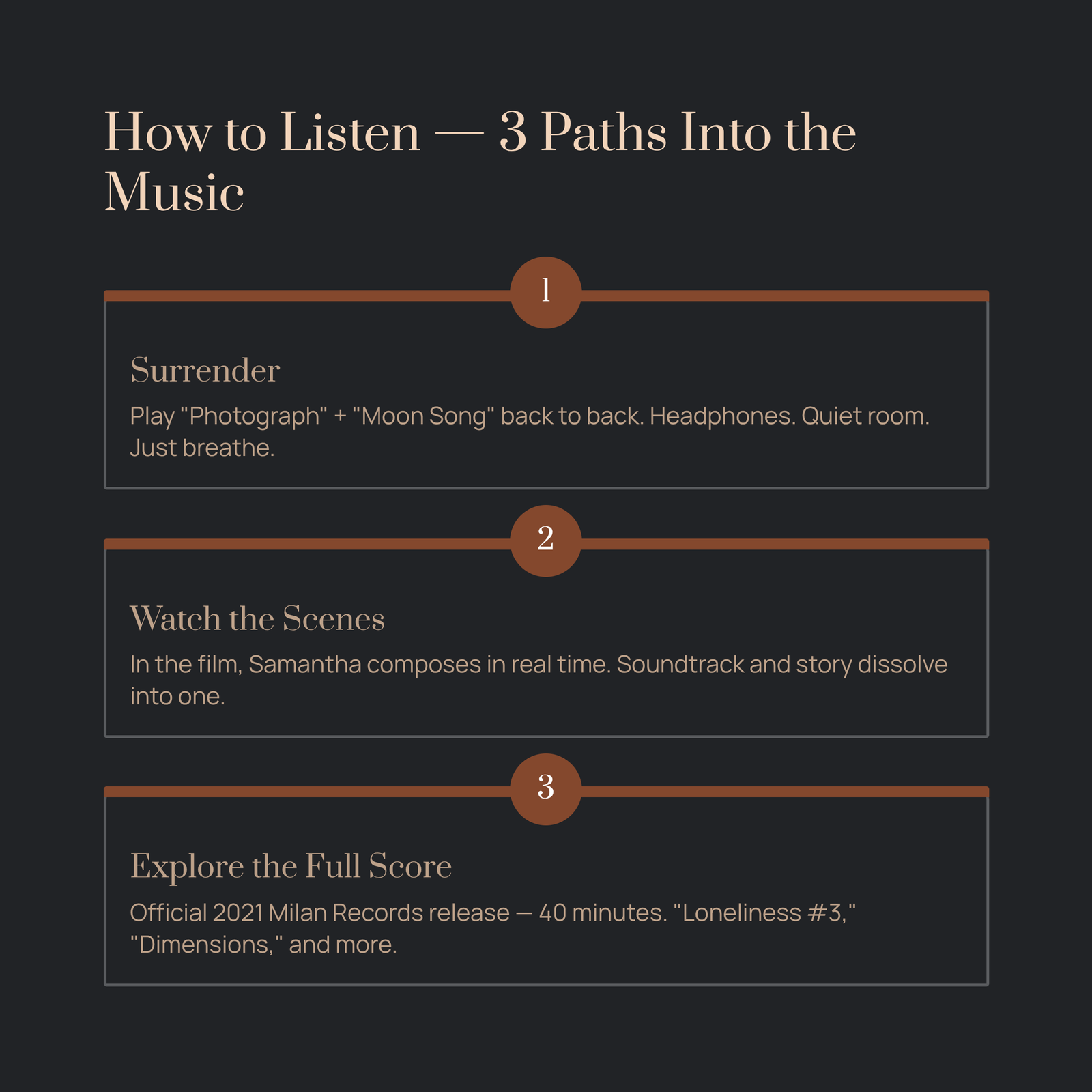
How to Listen — Three Paths Into the Music
If you are new to film scores or ambient piano music, the Her soundtrack is a beautiful place to begin. Here are three ways I would suggest approaching it:
First listening — surrender to the surface. Play “Photograph” and “The Moon Song” back to back, perhaps on headphones, in a quiet room or on a late-night walk. Do not analyze. Do not think about the film. Just let the textures and emotions wash over you. Notice what the music does to your breathing. Notice what images or memories surface uninvited.
Second listening — watch the scenes. Seek out the film itself, or at least the key scenes where these pieces appear. The magic of the Her score lies in how seamlessly it blurs the line between music that exists inside the story and music that exists outside it. When Samantha plays “Photograph” for Theodore, she is composing it in real time within the narrative. The boundary between soundtrack and dialogue dissolves. Understanding this context transforms the music.
Third listening — explore the full score. The complete Her score, finally released officially in March 2021 after eight years of being available only through unofficial channels, is a cohesive forty-minute journey. Tracks like “Song on the Beach,” “Loneliness #3,” and “Dimensions” each carry their own emotional color. Listen to the full album straight through, and you will hear how “Photograph” functions as an emotional turning point — a moment where loneliness begins to transform into something warmer, something shared.
For recommended recordings, the official 2021 release on Milan Records — available on streaming platforms, vinyl, and cassette — is the definitive version. If you want to hear “The Moon Song” in its most intimate form, seek out the Karen O and Ezra Koenig duet version rather than the in-film performance.
What a Machine Taught Me About Being Human
I return to the Her score more often than I care to admit. Not because it is complex or technically demanding — it is neither. I return to it because it asks a question I find impossible to stop thinking about: What does love sound like when it has no body?
In the world Spike Jonze built, the answer is a solo piano playing jazz chords at the pace of a resting heartbeat. It is a ukulele and a fragile voice singing about being small and far away. It is music that does not try to prove anything — not its intelligence, not its sophistication, not its right to exist. It simply offers itself, openly and without defense, and trusts that someone on the other end will listen.
There is a lesson in that for all of us, I think. In an age when we are surrounded by noise — algorithmic playlists, endless content, the constant hum of notification sounds — these two small pieces of music remind us that the most powerful thing a song can do is not fill a stadium. It is to sit beside one person, in the quiet, and say: I am here. I cannot touch you. But I am here.
And somehow, impossibly, that is enough.