📑 Table of Contents
There are pieces of music that don’t simply begin — they arrive, the way spring does. Not with thunder or announcement, but with a single breath of warm air that makes you realize the long winter is already behind you.
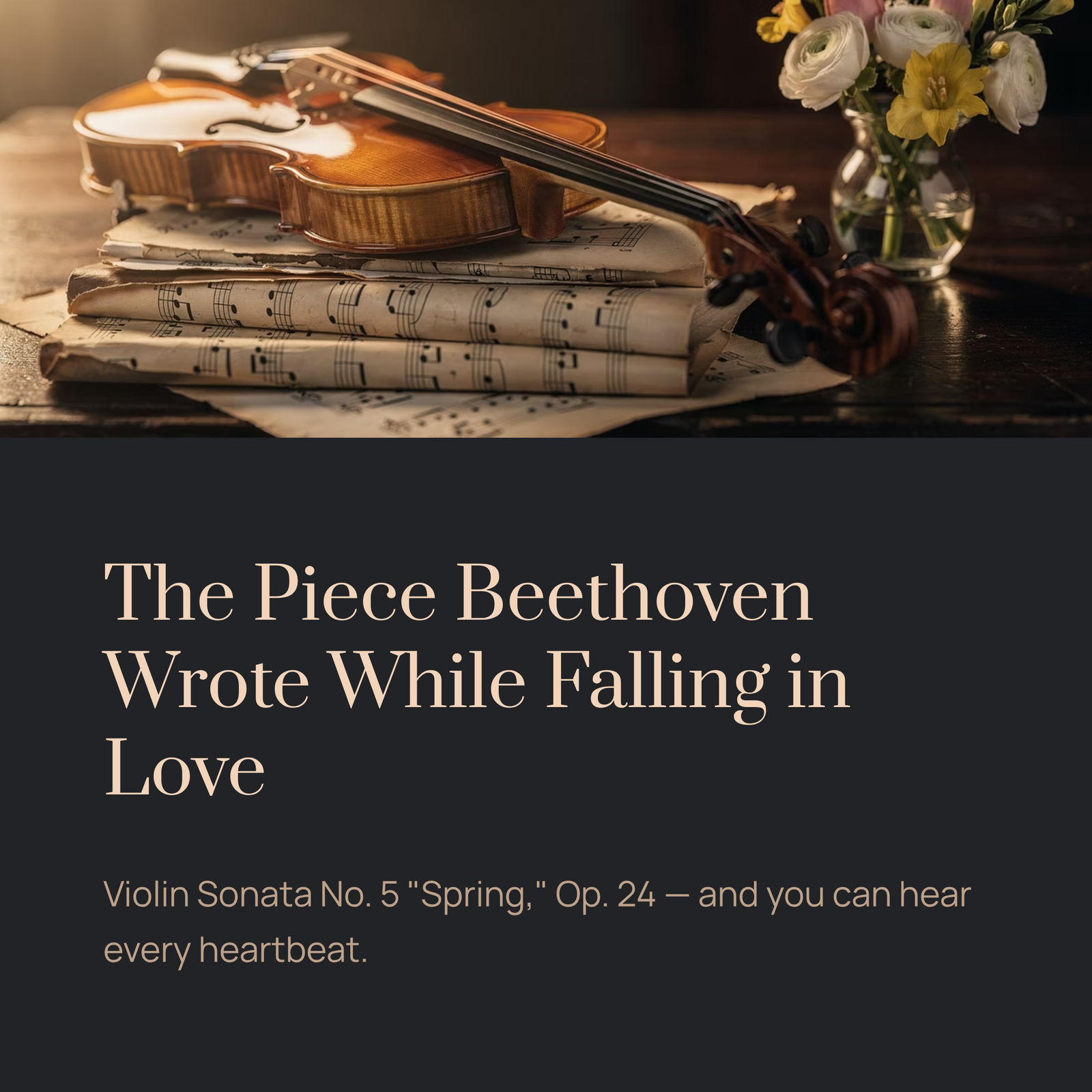
The opening of Beethoven’s Violin Sonata No. 5 in F major, Op. 24 — universally known as the “Spring” Sonata — is exactly that breath. The violin enters alone, climbing gently upward in a melody so pure, so unguarded, that it feels less like a performance and more like someone opening a window for the first time in months. The piano answers softly beneath, and in that quiet exchange, something luminous takes shape.
I remember the first time I heard this opening. I wasn’t sitting in a concert hall or deliberately seeking out Beethoven. It drifted toward me from a café speaker on an unremarkable Tuesday afternoon, and I stopped mid-step. There was no drama in it, no grand gesture — just a melody that felt like it had always existed somewhere inside me, waiting to be recognized.
That is the strange power of this sonata. It doesn’t demand your attention. It simply deserves it.
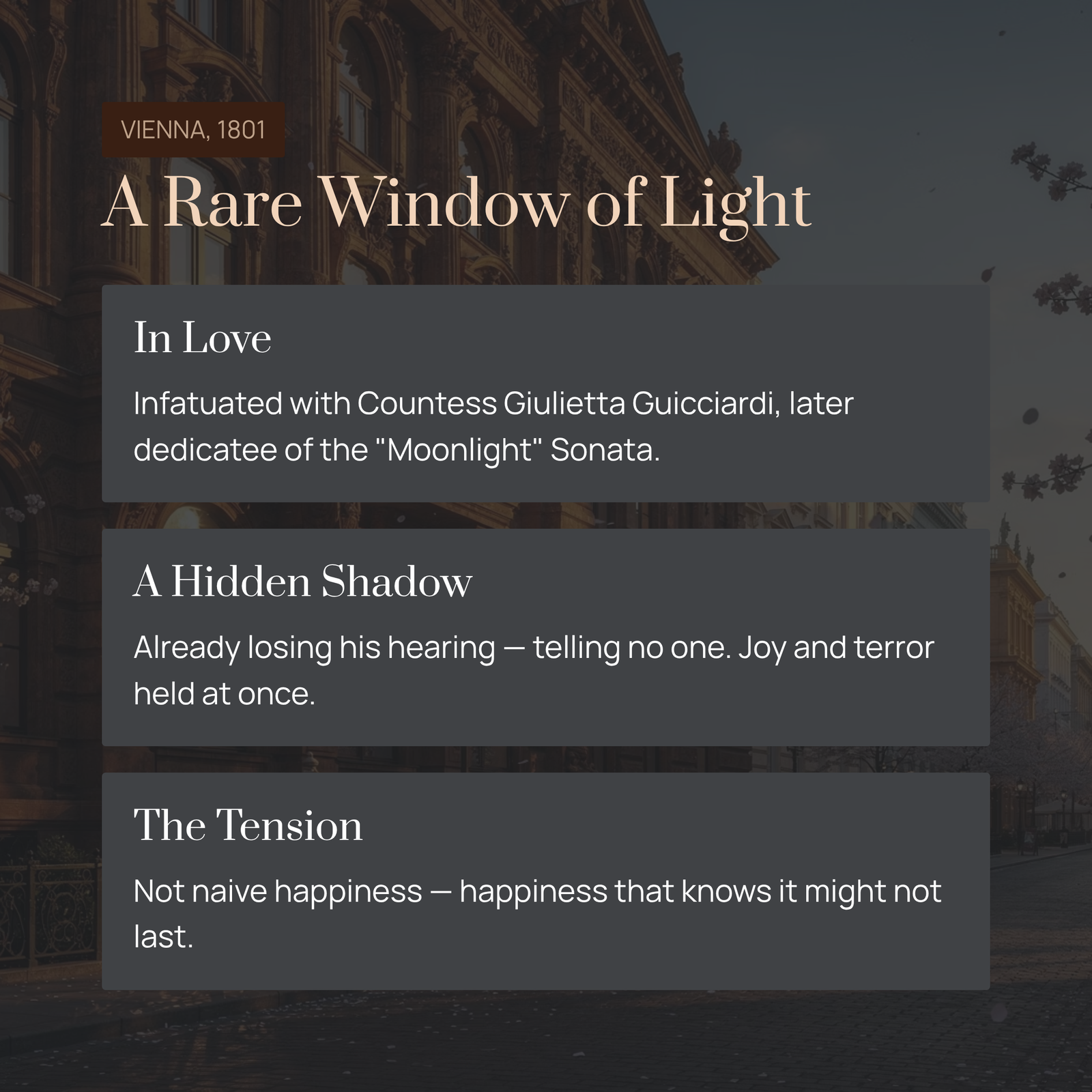
Vienna, 1801: A Rare Window of Light
To understand why this music sounds the way it does, you need to know what was happening in Beethoven’s life when he wrote it. The year was 1801, and for a brief, almost miraculous moment, Ludwig van Beethoven was genuinely happy.
He was thirty years old, increasingly celebrated across Vienna, and deeply infatuated with Countess Giulietta Guicciardi — the young woman to whom he would later dedicate the “Moonlight” Sonata. His letters from this period reveal a man intoxicated with possibility. He wrote to a friend: he spoke of his art, his ambitions, his belief that life was opening before him like a vast, promising landscape.
But there was a shadow. By 1801, Beethoven had already begun to notice the hearing loss that would eventually consume him. He hadn’t yet told anyone. He was holding two truths at once — the joy of love and creative power, and the quiet terror of a musician losing the one sense he could not live without.
The “Spring” Sonata lives in that exact tension. It is not naive happiness. It is happiness that knows, somewhere beneath the surface, that it might not last. And that knowledge is precisely what makes every bright phrase feel so precious, so achingly alive.
This sonata was published in 1801 alongside the darker Violin Sonata No. 4 in A minor, Op. 23. The contrast is striking: where Op. 23 is turbulent and restless, Op. 24 glows with warmth. Beethoven himself didn’t give it the nickname “Spring” — that came later, from listeners who couldn’t help hearing the season in its melodies. Some names aren’t chosen; they’re inevitable.
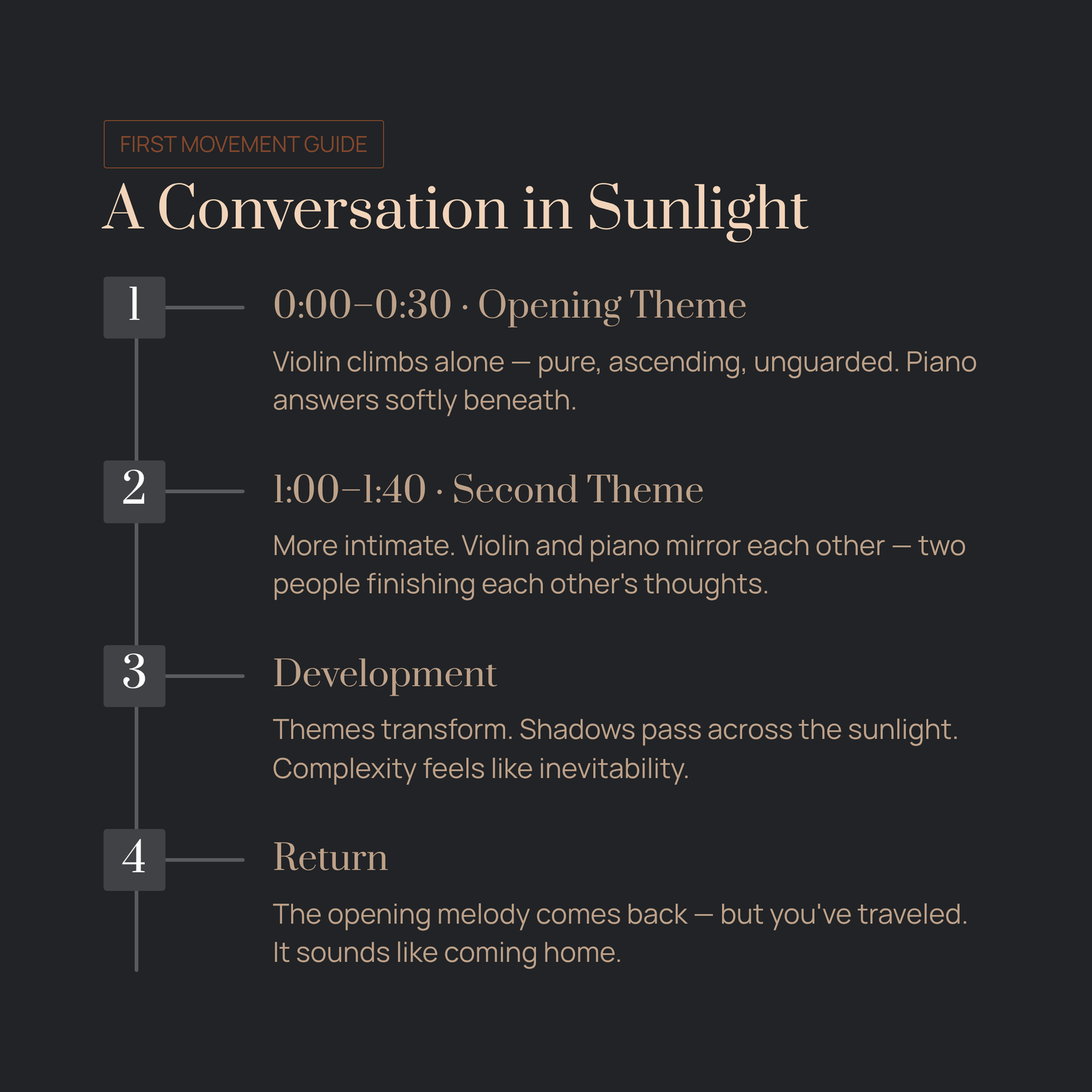
Hearing the First Movement: A Conversation in Sunlight
The first movement, marked Allegro, is written in sonata form — but please don’t let that term intimidate you. Think of it simply as a story told in three acts: introduction, complication, and resolution. Beethoven uses this structure not as a cage but as a canvas, and what he paints on it is extraordinarily vivid.
The Opening Theme (0:00–0:30)
The violin begins alone with the famous rising melody in F major. Listen to the shape of it — it climbs upward in stepwise motion, like someone walking up a hillside into open air. There’s no hesitation, no ornament. Just pure, ascending song. The piano joins beneath with gentle, rocking accompaniment, and together they establish a mood of effortless grace.
Here’s what I want you to notice: the melody breathes. Beethoven builds in natural pauses, small moments of silence between phrases, the way a person pauses between sentences when they’re saying something that matters. This isn’t music in a hurry. It trusts you to stay.
The Second Theme (around 1:00–1:40)
After the opening melody has been explored and developed between the two instruments, a second theme appears — slightly more intimate, more inward. If the first theme is walking through an open meadow, the second is sitting down beside a stream. The key shifts, the texture softens, and the violin and piano begin to mirror each other more closely, exchanging fragments of melody like two people finishing each other’s thoughts.
This is one of the great pleasures of chamber music: the conversation. Unlike a concerto, where a soloist stands against an orchestra, a sonata for violin and piano is a partnership. Neither instrument dominates. They listen to each other, respond, sometimes agree, sometimes gently disagree. In the “Spring” Sonata, this dialogue feels especially warm — less like a debate and more like two old friends walking together in comfortable rhythm.
The Development (middle section)
In the central portion of the movement, Beethoven takes the themes you’ve already heard and begins to transform them. Fragments of the opening melody appear in unexpected keys. The mood shifts — not into darkness exactly, but into something more searching, more complex. Shadows pass across the sunlight. The piano becomes more assertive; the violin reaches higher.
Don’t worry about following every harmonic turn. Instead, listen for the feeling of motion — the sense that you’re being carried somewhere new, that the story is unfolding in ways you didn’t predict. This is Beethoven at his most skillful: making complexity feel like inevitability.
The Return (recapitulation and coda)
And then — the opening melody comes back. In F major, in full sunlight, as if it never left. But here’s the beautiful thing: it sounds different now. Not because the notes have changed, but because you have. You’ve traveled through the development, heard the themes stretched and questioned, and now their return feels like coming home after a journey. The movement closes with quiet confidence, the violin and piano settling into a final, luminous phrase that seems to hover in the air even after the last note fades.

Why This Piece Feels Like It Was Written for You
I’ve introduced this sonata to many people over the years — friends who don’t listen to classical music, colleagues who assumed Beethoven was all fury and fate. And almost without exception, the “Spring” Sonata changes something in them. Not dramatically. Quietly. The way a good conversation with a kind person can shift the color of an entire afternoon.
I think it’s because this music does something rare: it is joyful without being superficial. So much of what we encounter daily — in pop songs, in advertising, in the relentless optimism of social media — presents happiness as a simple, uncomplicated state. But anyone who has lived through a difficult season knows that real joy is more complex than that. It carries within it an awareness of what was endured to reach it, and a tenderness toward the fragile, temporary nature of good things.
Beethoven understood this at thirty, standing on the edge of deafness, writing music that sings with a hope he must have known was precarious. The “Spring” Sonata doesn’t pretend that life is easy. It insists that life, even in its uncertainty, is worth celebrating — and it does so with a gentleness that can catch you completely off guard.
There’s a particular passage near the end of the first movement where the violin plays the main theme one final time, very simply, almost as a whisper. Every time I hear it, I feel the same thing: gratitude. Not for anything specific. Just gratitude that something this beautiful exists, and that I happened to be listening.
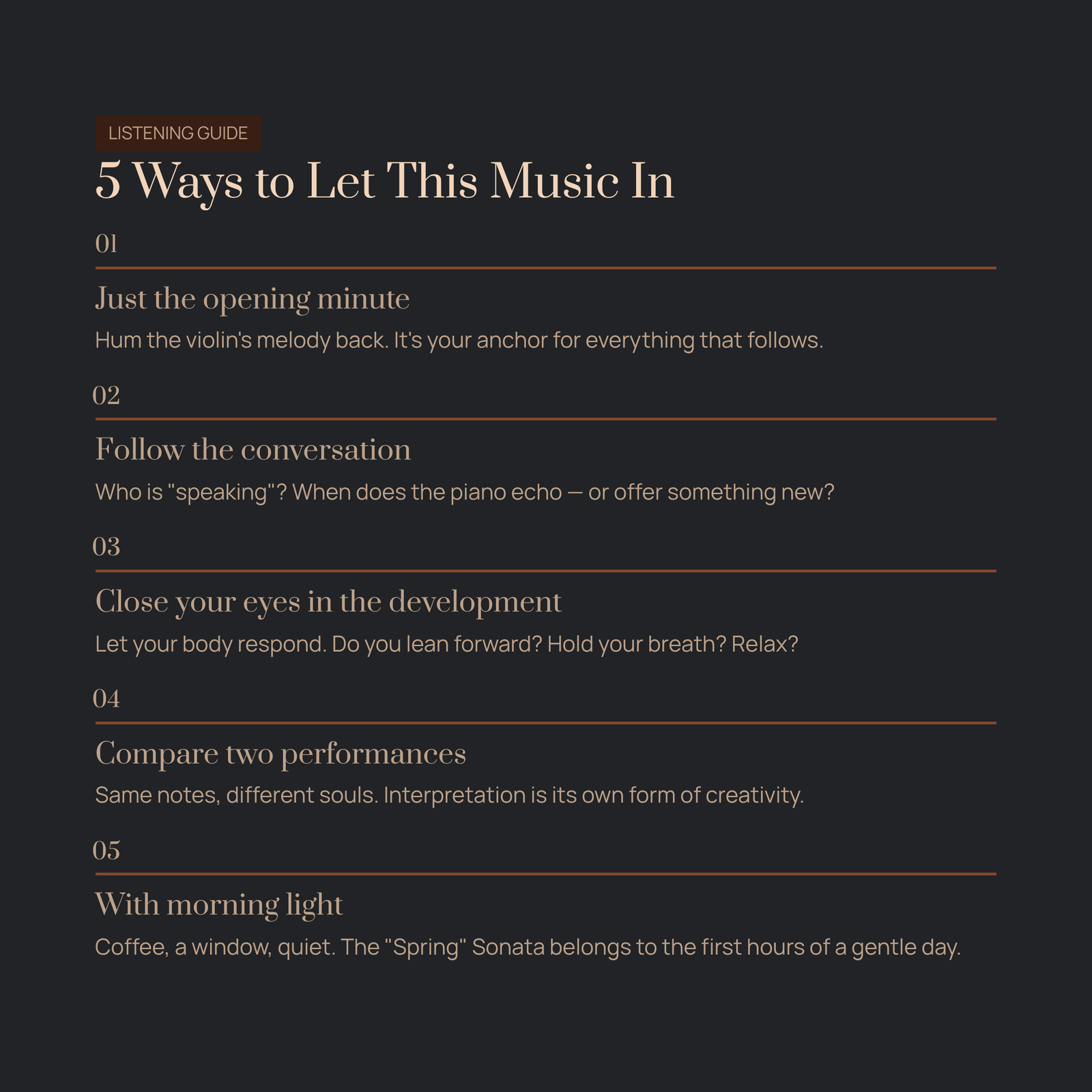
Five Ways to Let This Music In
If you’re new to this piece — or new to classical music altogether — here are some suggestions for making the most of your first few listens.
First listen: just the opening minute. Don’t commit to the entire movement yet. Play the first sixty seconds, and pay attention only to the violin’s opening melody. Can you hum it back? That melody is your anchor for everything that follows.
Second listen: follow the conversation. This time, listen for the back-and-forth between violin and piano. Notice who is “speaking” at any given moment. When does the piano echo the violin? When does it offer something entirely new? Think of it as eavesdropping on a beautiful, wordless dialogue.
Third listen: close your eyes in the development section. The middle of the movement is where Beethoven gets adventurous. Close your eyes and let the music carry you without trying to analyze it. Notice how your body responds — do you lean forward? Hold your breath? Relax? Your physical response is a more honest guide than any textbook.
Fourth listen: compare two performances. The same notes can sound remarkably different depending on who plays them. Try listening to one recording that emphasizes brightness and energy, then another that lingers on tenderness and space. You’ll discover that interpretation is its own form of creativity.
Fifth listen: with morning light. This is personal advice, not musical instruction. Play this sonata on a quiet morning, with coffee or tea, near a window. Some music belongs to certain moments, and the “Spring” Sonata belongs to the first hours of a gentle day.
Recordings That Bring This Music to Life
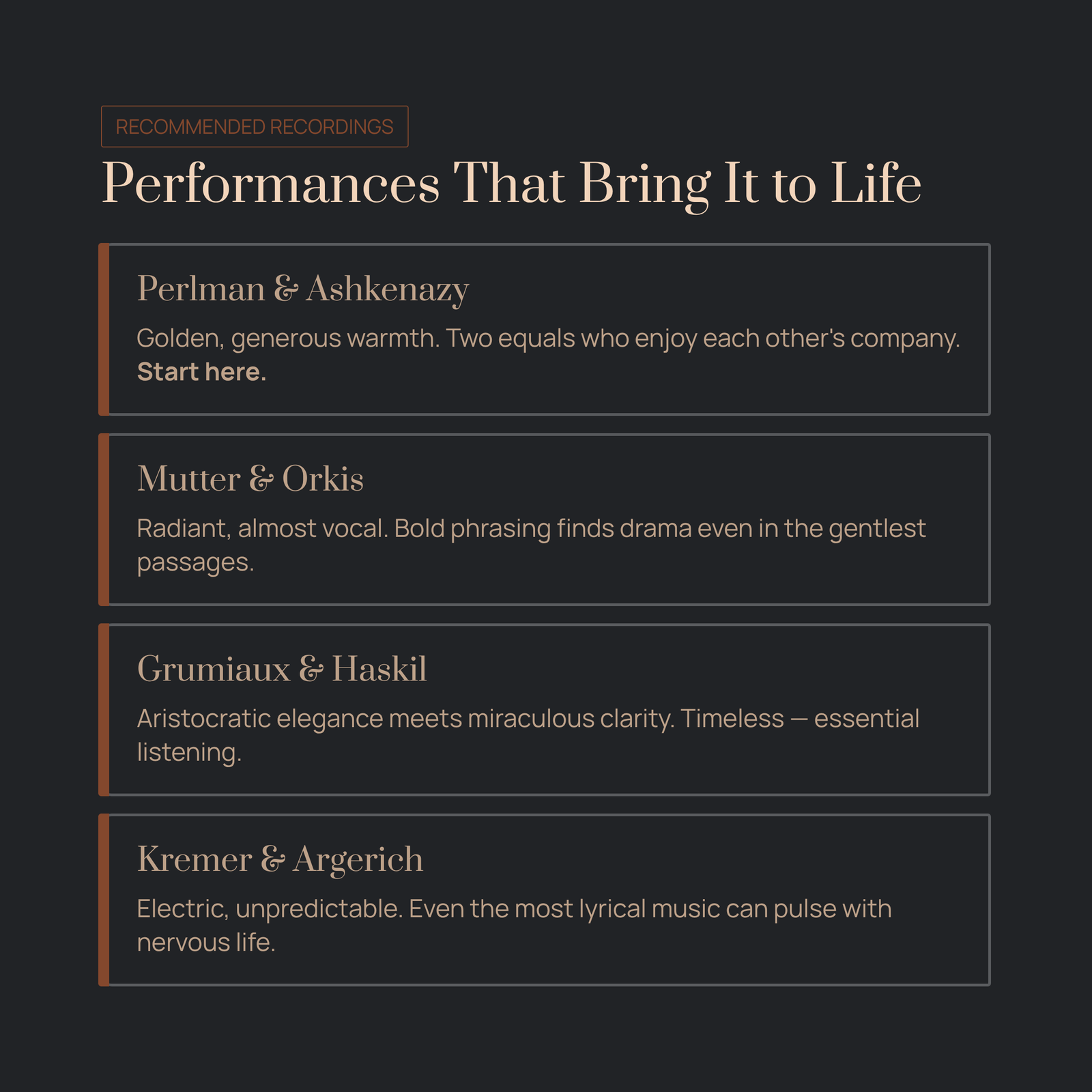
The history of “Spring” Sonata recordings is rich with remarkable partnerships. Here are several that illuminate different dimensions of the work.
Itzhak Perlman & Vladimir Ashkenazy — This is the recording I return to most often. Perlman’s tone is golden and generous, with a warmth that never tips into sentimentality. Ashkenazy matches him with playing that is both supportive and illuminating. Their reading feels like a conversation between equals who genuinely enjoy each other’s company. If you listen to only one version, make it this one.
Anne-Sophie Mutter & Lambert Orkis — Mutter brings a radiant, almost vocal quality to the violin line, with a slightly more modern sensibility. Her phrasing is bold and expressive, finding drama even in the gentlest passages. The sound is crystalline and immediate.
Arthur Grumiaux & Clara Haskil — A legendary partnership from the mid-twentieth century. Grumiaux plays with aristocratic elegance, and Haskil’s piano work is a miracle of clarity and sensitivity. This recording has a timeless quality — it sounds as fresh today as it did decades ago. If you love the idea of hearing two master musicians in perfect, understated sympathy, this is essential listening.
Gidon Kremer & Martha Argerich — For something more electric, try this pairing. Both musicians are known for their intensity and unpredictability, and their “Spring” crackles with energy and spontaneity. It’s a reminder that even the most lyrical music can pulse with nervous life.
Each of these recordings reveals something the others don’t. The “Spring” Sonata is generous that way — it has room for many truths.
The Music That Stays
I want to end with something simple.
There are compositions that impress you, compositions that move you, and — very rarely — compositions that accompany you. They become part of the texture of your inner life, surfacing unbidden on a spring morning or during a quiet walk, reminding you of something you can’t quite name but recognize immediately.
Beethoven’s “Spring” Sonata has been that companion for me. Not because it’s the most complex music he ever wrote — it isn’t. Not because it represents some towering achievement of human intellect — there are grander candidates for that. But because it captures, with impossible precision, the feeling of being alive on a day when being alive feels like enough.
Beethoven composed this in a year when he still had hope — hope for love, for hearing, for the vast unwritten music inside him. Some of those hopes would be fulfilled. Others would be shattered. But the music doesn’t know that yet. It lives in the eternal present tense of that bright, uncertain spring, and every time you press play, you step into that present tense with him.
Let the violin climb its gentle, rising scale. Let the piano answer softly beneath. And for a few minutes, let the world be exactly as luminous as Beethoven heard it — before the silence began to close in, and while the door to spring still stood wide open.