📑 Table of Contents

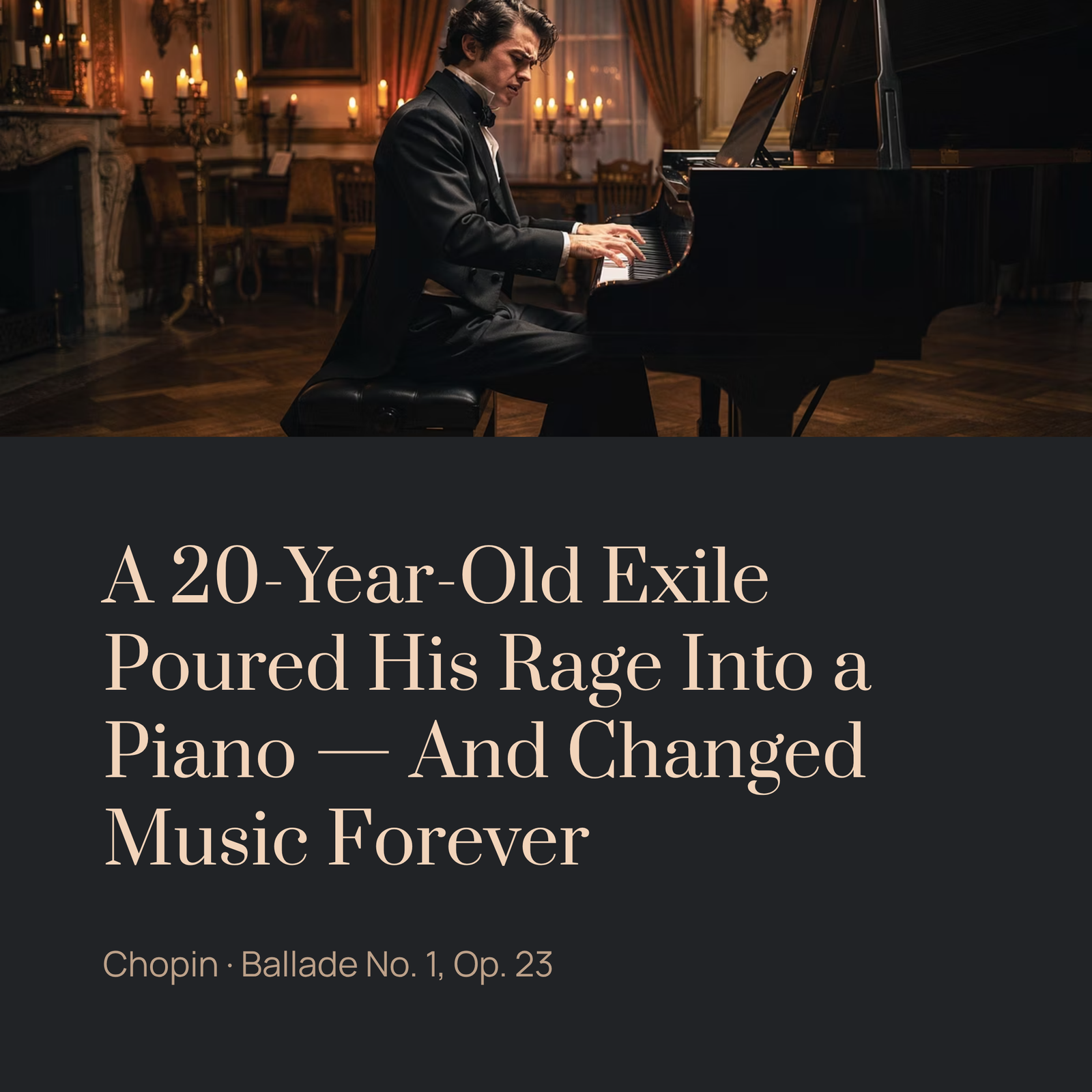
There is a moment — roughly six minutes into Chopin’s Ballade No. 1 in G minor — where the music stops pretending to be polite. The melody that had been sighing so gently suddenly clenches its fist. The harmonies darken. The tempo lurches forward as though someone has grabbed you by the collar.
The first time I heard that passage, I was sitting in a coffee shop with cheap earbuds, and I physically flinched. I didn’t know anything about Chopin. I didn’t know what a “ballade” was. But I understood, in some wordless, full-body way, that someone was furious — and that fury was beautiful.
That is the strange power of this piece. It does not require expertise. It only requires that you have, at some point in your life, felt something you could not say out loud.
A Young Man With No Country
To understand this music, you need to know one fact about the man who wrote it: Frédéric Chopin left Warsaw in November 1830, at the age of twenty. A few weeks later, the Polish people rose up against Russian imperial rule. The uprising was crushed. Chopin’s friends were killed, imprisoned, or scattered across Europe. He would never return to Poland.
He settled in Paris, where he became the darling of aristocratic salons — elegant, witty, chronically ill. But beneath that polished surface, something was burning. His letters from this period are raw with grief and guilt. He felt he had abandoned his people. He called himself a coward for leaving.
The Ballade No. 1, composed between 1831 and 1835, is widely believed to have been inspired by the poetry of Adam Mickiewicz, Poland’s greatest Romantic poet, whose epic verses told stories of Lithuanian heroes, doomed lovers, and a lost homeland. Chopin never confirmed this connection directly. He didn’t need to. The music speaks in the same language as Mickiewicz’s poetry — the language of exile.
What Exactly Is a “Ballade”?
Before Chopin, the word “ballade” belonged to literature, not music. It referred to a narrative poem — a story told in verse, usually involving heroism, tragedy, or both.
Chopin essentially invented the piano ballade as a genre. He took the idea of a story and translated it into pure sound. There are no words, no program notes explaining “and here the hero draws his sword.” Instead, you get something more honest than a literal story: you get the emotional shape of one.
Think of it this way. A novel tells you what happened. A ballade tells you what it felt like.
Chopin wrote four ballades in total over the course of his career. The first remains the most performed, the most recorded, and — for many listeners — the most devastating.
A Map of the Music (No Theory Degree Required)
You don’t need to read sheet music to follow this piece. You just need your ears and a few landmarks.
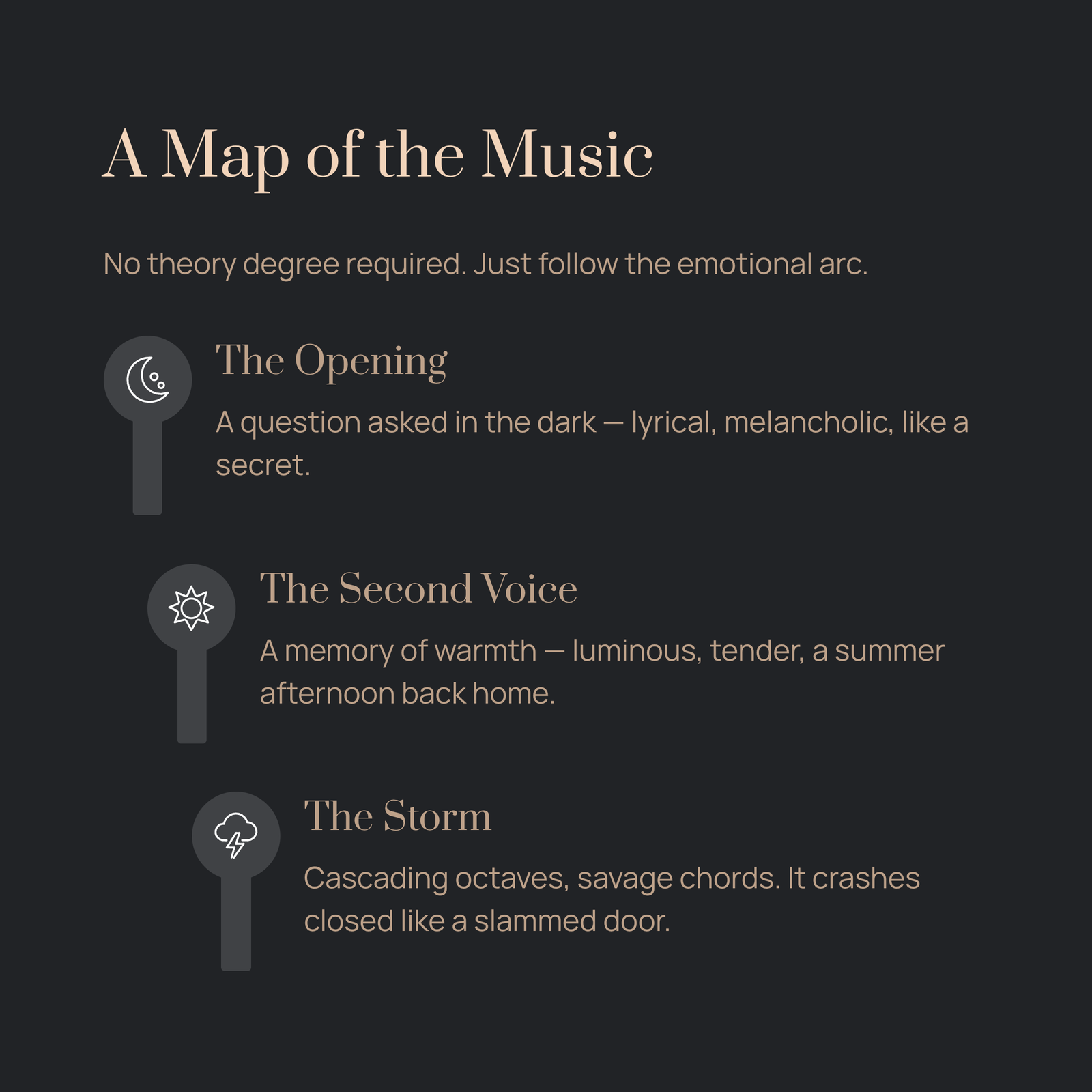
The opening — a question asked in the dark. The piece begins with a slow, unaccompanied introduction. A few bass notes, deliberate and heavy, like footsteps in an empty hall. Then comes the first theme: a melody in G minor that feels like someone speaking quietly, almost to themselves. It is one of the most recognizable melodies in all of piano literature — lyrical, melancholic, and strangely conversational, as though the piano is telling you a secret.
The second voice — a memory of warmth. After the first theme has been explored, a second theme arrives in E-flat major. The mood shifts entirely. Where the first theme was shadowed and introspective, this one is luminous, almost tender. If the first theme is the exile looking out at a grey Parisian street, the second is the memory of a summer afternoon back home.
The storm — when memory isn’t enough. As the piece progresses, these two themes return, but each time they are transformed — more urgent, more ornamented, more desperate. The tension builds through a series of increasingly dramatic passages until the piece reaches its infamous coda. This final section is one of the most technically ferocious passages Chopin ever wrote. Cascading octaves, savage chords, a tempo that borders on reckless. It does not resolve peacefully. It crashes to a close like a door slammed in the middle of an argument.
The first time you listen, just follow the emotional arc: intimacy, warmth, tension, fury. That arc is the story.

Three Recordings, Three Ways to Feel It
One of the joys of classical music is that the same piece can sound completely different depending on who plays it. Here are three recordings that illuminate different dimensions of this Ballade.
Krystian Zimerman delivers what many consider the definitive recording. His interpretation is architectural — every phrase balanced, every dynamic shift precisely calibrated. Yet it never feels cold. Zimerman is Polish, and there is a quiet patriotic fire in his playing that gives the coda an almost unbearable intensity. If you listen to only one recording, make it this one.
Evgeny Kissin, in his famous live performances, plays this Ballade with youthful volatility. His rubato is more extreme, his fortissimos more explosive. Where Zimerman builds a cathedral, Kissin lights a bonfire. It is thrilling and a little dangerous, which is exactly how a twenty-something exile might have played it.
Ivo Pogorelich offers the most unconventional reading. His tempos are slower, his pauses longer, his tone darker. Some listeners find it mannered. Others find it revelatory — as though Pogorelich heard something in the score that everyone else rushed past. His recording rewards patience and repeated listening.
How to Listen (A Practical Guide for First-Timers)
If this is your first time with the Ballade No. 1, here is what I would suggest.
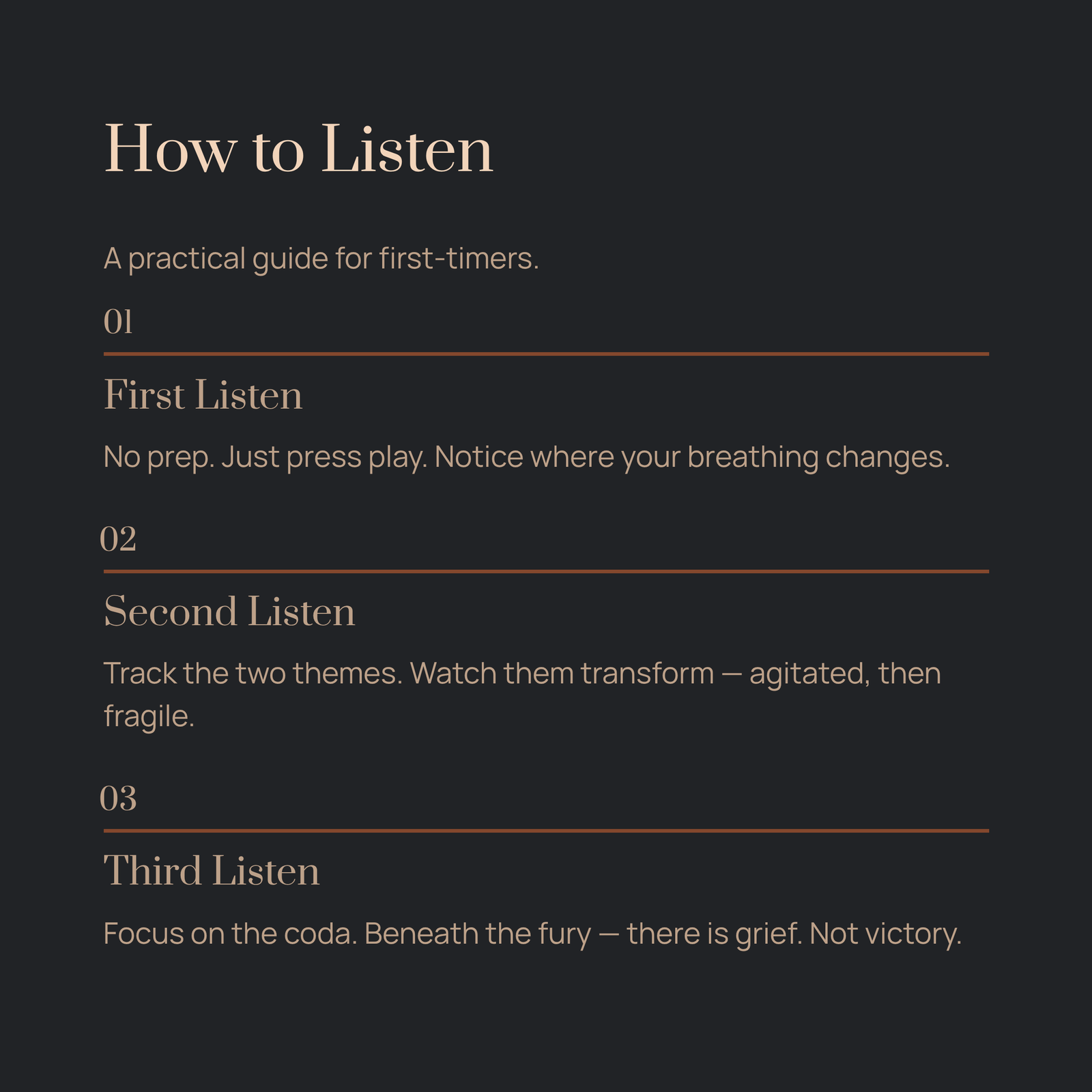
First, listen once without any preparation. Just press play. Don’t read liner notes, don’t follow along with analysis. Let the music hit you however it hits you. Notice where your attention sharpens, where your breathing changes, where you feel a pull in your chest. Those moments are your entry points.
Then listen again — and this time, pay attention to the two main themes. Try to notice when each one appears and how it has changed since the last time you heard it. The first theme becomes increasingly agitated. The second theme becomes increasingly fragile. Following these transformations is like watching two characters develop over the course of a novel.
On your third listen, focus on the ending. The coda is often described as violent, but listen more carefully. Beneath the fury, there is grief. The final chords do not sound like victory. They sound like someone who has exhausted every other option.
What Stays After the Last Note
I have listened to this piece hundreds of times over the years, and it has never once sounded the same. That is not an exaggeration. When I am restless, I hear restlessness in it. When I am mourning something I have lost, the second theme makes me close my eyes. When I am angry at the world for being what it is, the coda feels like permission.
Chopin was twenty-four when this piece was published. He was sick, far from home, and surrounded by people who admired him but could not truly know him. He poured all of that into ten minutes of music — and somehow, nearly two centuries later, that music still has the power to make a stranger in a coffee shop flinch.
That is not technique. That is not genius, exactly. That is something closer to honesty — the kind of honesty that only becomes possible when you have lost everything that once made you feel safe, and the only thing left is a piano and a silence that demands to be filled.