📑 Table of Contents
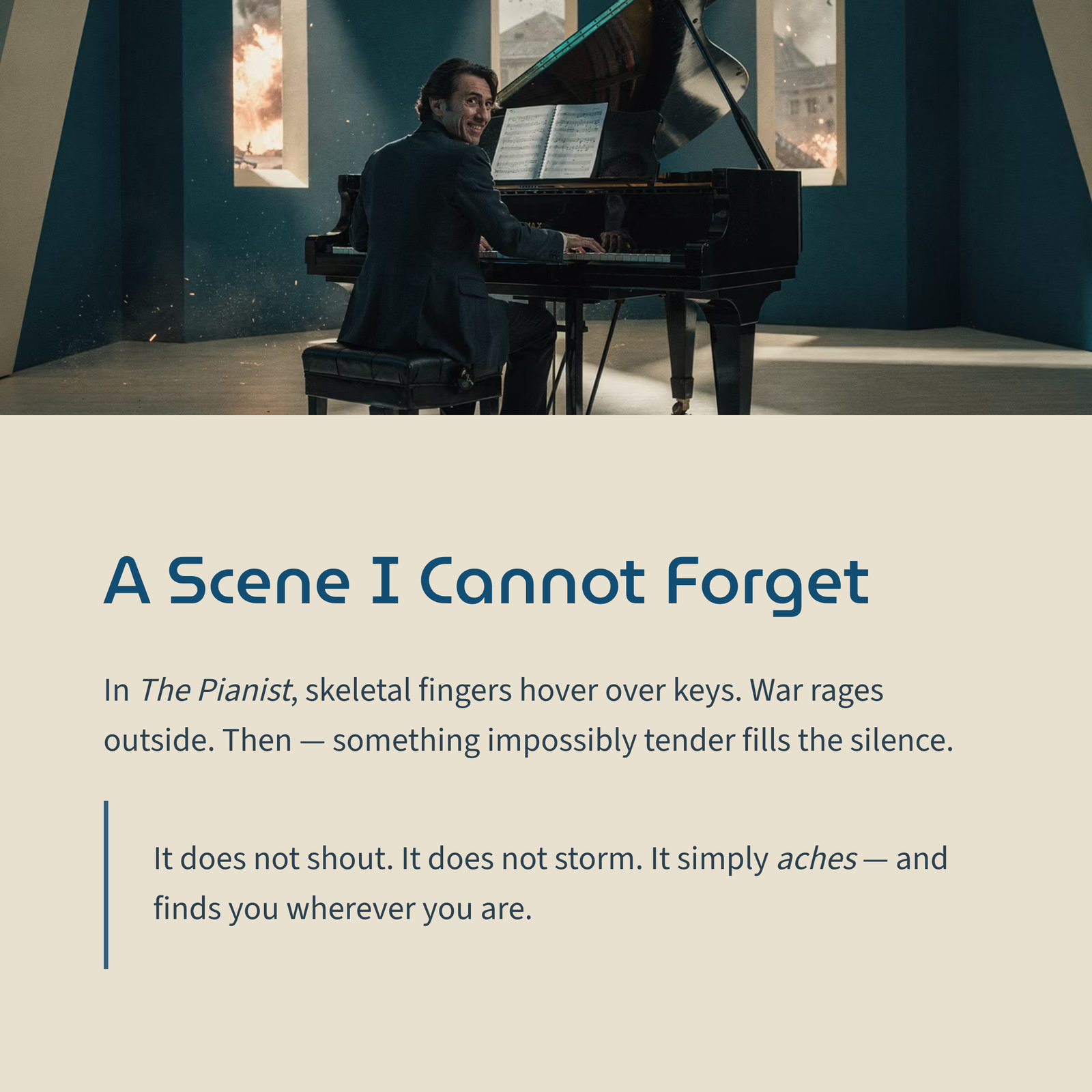
There is a scene in The Pianist that I cannot forget. Adrien Brody sits before a piano in a bombed-out apartment in Warsaw. His fingers, skeletal and trembling, hover over the keys. And then he plays — Chopin’s Nocturne No. 20 in C-sharp minor. The room is cold. The war is still raging outside. But for a few minutes, something impossibly tender fills the silence.
I first heard this piece through that film, and I suspect many of you did too. What struck me was not just the beauty of the melody — it was the way it seemed to carry an entire life’s worth of sorrow in a single breath. That is the strange, almost unsettling power of this nocturne. It does not shout. It does not storm. It simply aches, and in that aching, it finds you wherever you are.
The Story Behind the Notes
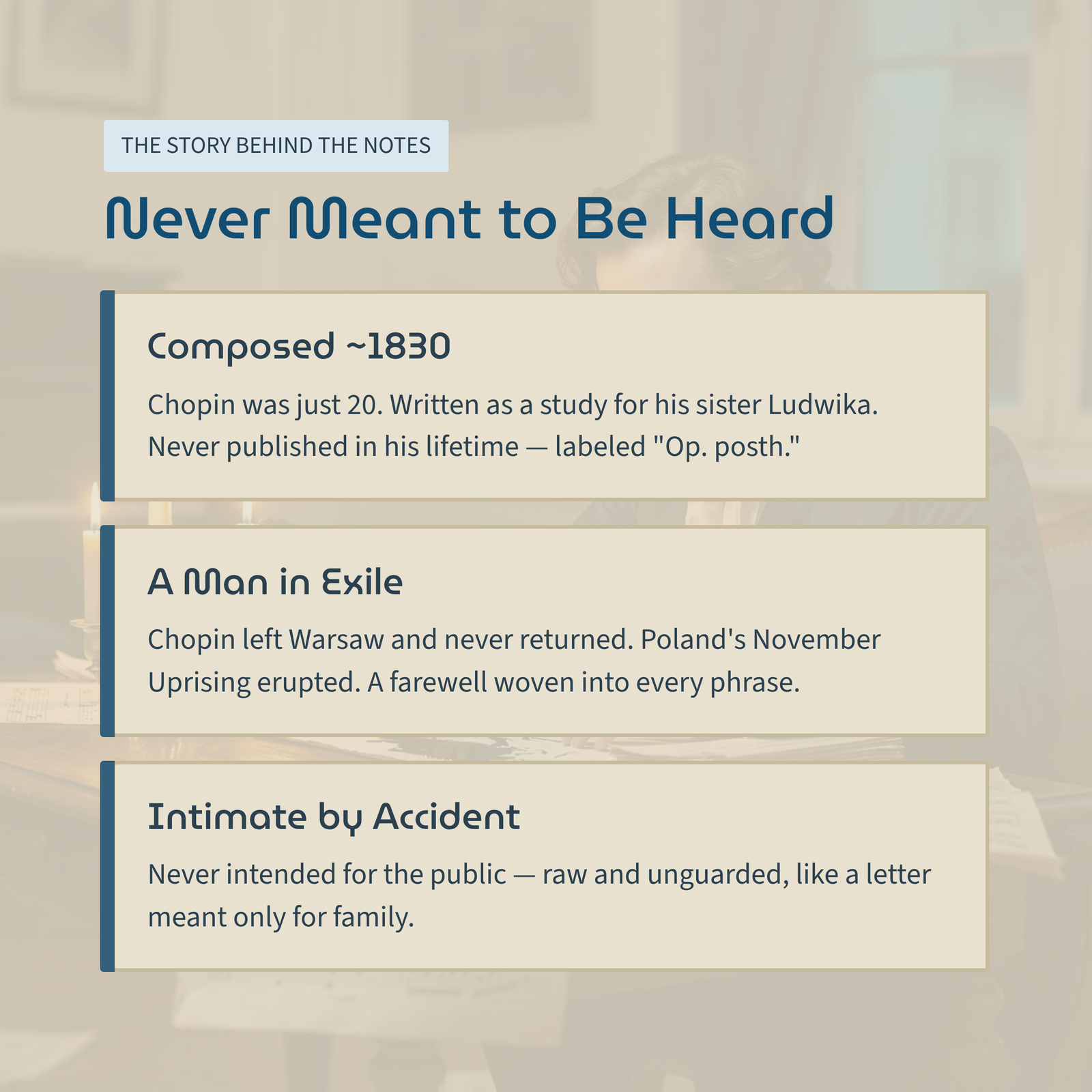
Frédéric Chopin composed this nocturne around 1830, when he was only about twenty years old. He never published it during his lifetime. It was written as a study piece — an étude dedicated to his older sister, Ludwika — and it sat quietly among his manuscripts until it was published posthumously, decades after his death. That is why it carries the label “Op. posth.” rather than a standard opus number.
Consider the timing. In 1830, Chopin had just left Warsaw for Vienna, and he would never return to Poland. The November Uprising — Poland’s desperate revolt against Russian rule — erupted shortly after his departure, and the news devastated him. He was a young man in exile, watching his homeland burn from a distance. Whether or not this nocturne was composed directly in response to those events, there is an undeniable sense of farewell woven into every phrase.
It is also worth noting that Chopin never intended for this piece to reach the public. There is something deeply intimate about that — as if we are reading a letter that was meant only for family. Perhaps that is why it feels so raw, so unguarded, compared to his more polished published works.
Listening to the Architecture of Grief
If you are new to classical music, do not worry about following the technical structure. Just listen for these three things, and you will hear everything that matters.
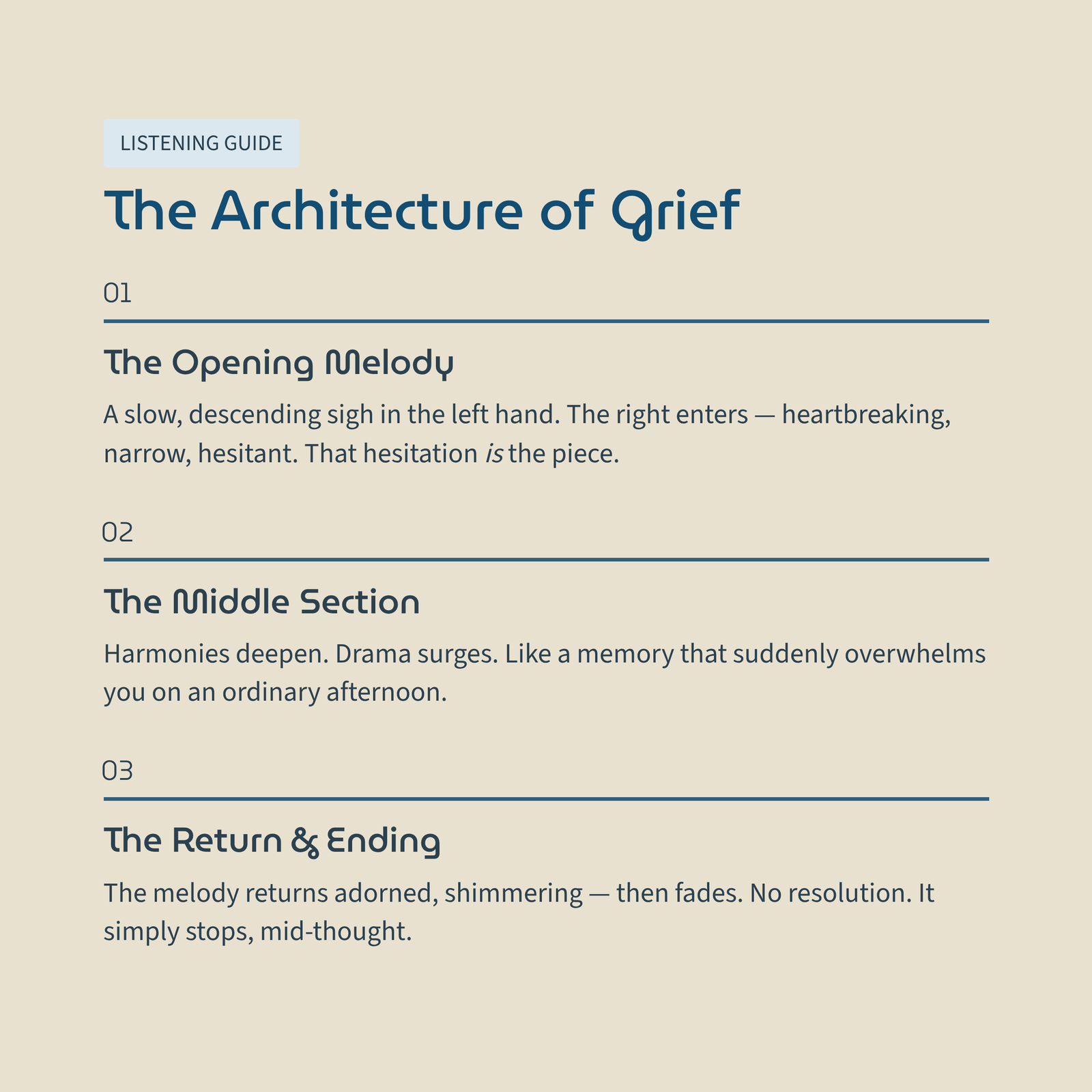
The opening melody. It arrives in the left hand first — a slow, descending figure that feels like a sigh. Then the right hand enters with the main theme, and it is one of the most heartbreaking melodies Chopin ever wrote. It moves in a narrow range, almost as if the music is afraid to raise its voice. Pay attention to how it lingers on certain notes, as though reluctant to move forward. That hesitation is the emotional core of the piece.
The middle section. After the gentle opening, the music gathers intensity. The harmonies become richer, the rhythm more agitated. There are moments of almost orchestral fullness here — Chopin packs a remarkable amount of drama into just two hands on a keyboard. It feels like a memory that suddenly becomes vivid and overwhelming, the kind that catches you off guard on an ordinary afternoon.
The return and the ending. The opening melody comes back, but it is not quite the same. It is adorned with ornamental runs — cascading notes that shimmer around the original theme like light through water. And then the piece fades, dissolving into a quiet chord that hangs in the air. It does not resolve with finality. It simply stops, as if the person playing has turned to look out the window and lost the thread of thought.
Why The Pianist Changed Everything
Roman Polanski’s 2002 film did something remarkable for this nocturne. The piece had always been beloved among pianists and Chopin devotees, but the film placed it at the emotional center of one of cinema’s most devastating stories.
Wladyslaw Szpilman, the real Polish-Jewish pianist whose memoir the film is based on, survived the Warsaw Ghetto and the destruction of nearly everything he loved. When Brody’s Szpilman plays this nocturne for a German officer in the ruins of Warsaw, the music becomes more than a beautiful melody. It becomes proof that something human still exists in a world that has tried to destroy humanity itself.
What makes the pairing so powerful is that Chopin himself was a Polish exile mourning his homeland. The nocturne, written nearly two centuries earlier, suddenly spoke to a tragedy its composer could never have imagined. That is what the greatest music does — it waits patiently through the centuries until history gives it new meaning.
Recordings Worth Your Time
If you are just beginning your journey with this piece, here are a few interpretations that reveal different facets of the music.
Maurizio Pollini delivers a reading of crystalline clarity. His touch is precise and unsentimental, which paradoxically makes the emotional impact even greater. He trusts the music to speak for itself and never forces a tear. For listeners who prefer restraint over drama, this is the version to start with.
Maria João Pires brings a warmth and tenderness that feels like a private confession. Her phrasing breathes naturally, and the ornamental passages in the return section shimmer with an almost vocal quality. If you want to feel the nocturne rather than analyze it, Pires is your guide.
Janusz Olejniczak, who actually performed the piano parts for The Pianist film, offers an interpretation steeped in Polish musical tradition. There is a particular gravity in his playing — a sense that this music belongs to a specific place and a specific history. Listening to his recording after watching the film is an experience that blurs the line between art and life.
Valentina Lisitsa provides a performance on YouTube that has reached millions of listeners. Her playing is intensely expressive, with bold dynamic contrasts and a dramatic sense of pacing. It is an excellent entry point for those coming to classical music for the first time.
Where the Music Takes You
I have a theory about why this nocturne resonates so deeply with people who otherwise never listen to classical music. It is not because it is technically dazzling or structurally innovative. It is because it sounds exactly like what longing feels like.
We all carry some version of that ache — for a place we have left, a person we have lost, a version of ourselves that no longer exists. Chopin, at twenty, somehow captured the universal shape of that feeling and gave it a melody that fits in the palm of your hand.
You do not need to know anything about sonata form or harmonic modulation to understand this piece. You just need to have lost something. The nocturne will do the rest.
Put on a good pair of headphones. Turn the lights down. And give yourself four minutes with Chopin’s quiet, unfinished goodbye. You will understand why a piece that was never meant to be heard has become one of the most listened-to works in the history of music.