📑 Table of Contents
There are pieces of music that seem to exist outside of time—melodies so pure they feel less composed than discovered, as if they had always been waiting somewhere in the silence for someone to finally write them down. Jules Massenet’s Meditation from Thaïs is one such piece.
You may have heard it at a wedding, drifting from a string quartet. Perhaps it found you in a film, underscoring a moment of impossible tenderness. Or maybe you stumbled upon it late at night, a solo violin singing through your speakers, and you stopped whatever you were doing just to listen. However it reached you, you likely felt what millions have felt since 1894: that this music touches something we rarely speak of aloud.
But what is this piece, really? And why does a five-minute instrumental interlude from an opera most people have never seen continue to move us so deeply?
To understand the Meditation, you must first meet Thaïs—not the music, but the woman.
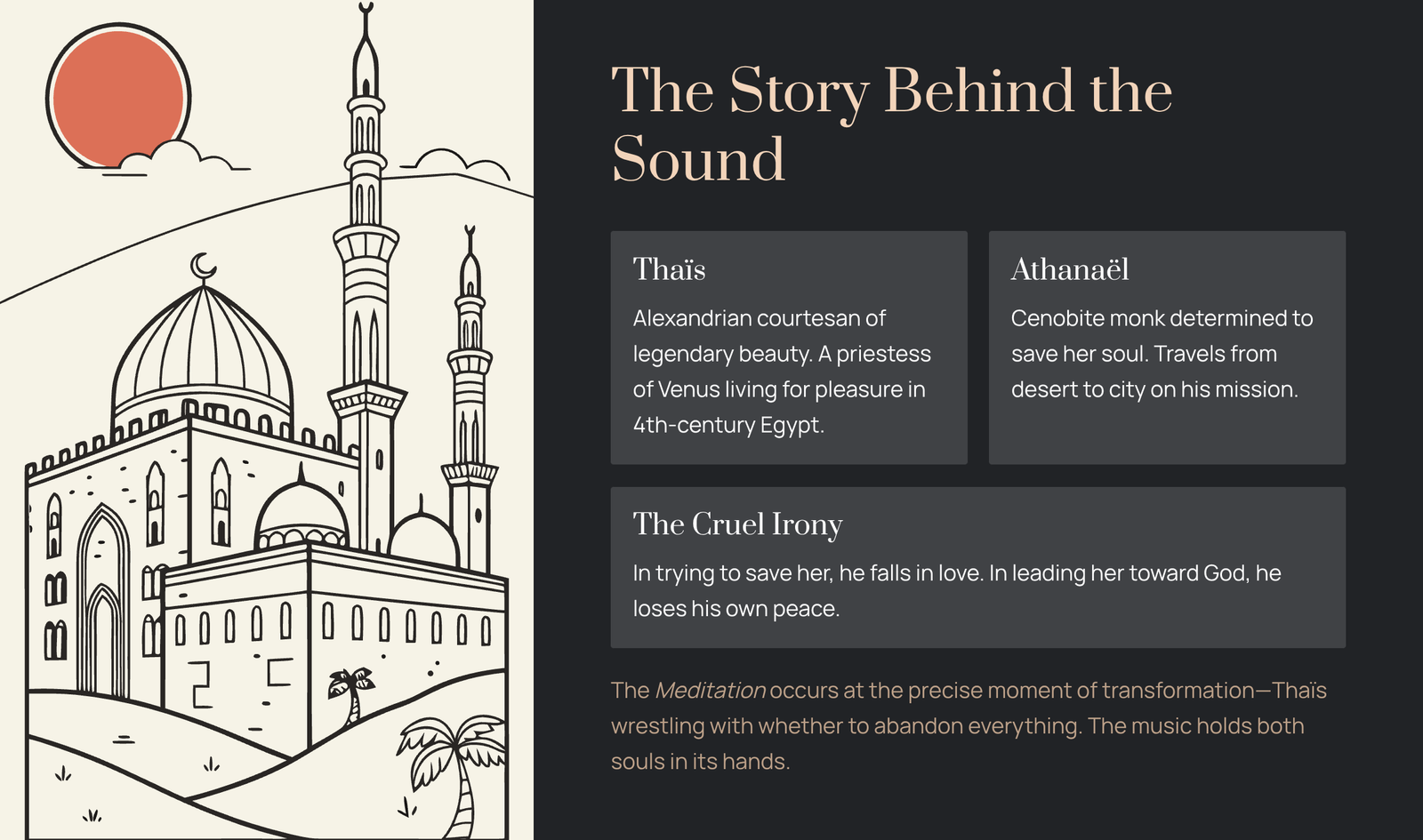
In Massenet’s opera, Thaïs is an Alexandrian courtesan of legendary beauty, a priestess of Venus who lives for pleasure in fourth-century Egypt. She is everything sensual and worldly. Enter Athanaël, a Cenobite monk who has known Thaïs since childhood and has made it his mission to save her soul. He travels from the desert to the decadent city, determined to convert her to Christianity.
Here is the opera’s cruel irony: in trying to save her, he falls in love with her. In leading her toward God, he loses his own peace.
The Meditation occurs at the precise moment of transformation. Thaïs, exhausted from her confrontation with the monk’s fervent preaching, retreats to consider her life. The stage directions tell us she is “meditating” on what Athanaël has said, wrestling with whether to abandon everything she has known.
But Massenet was too sophisticated to give us just her thoughts. The violin solo that emerges is equally Athanaël’s—his suppressed desire, his spiritual anguish, his dawning realization that his “pure” mission has become something far more human and far more dangerous.
The music does not take sides. It simply holds both souls in its hands.
A Melody Born in the Golden Age of Paris
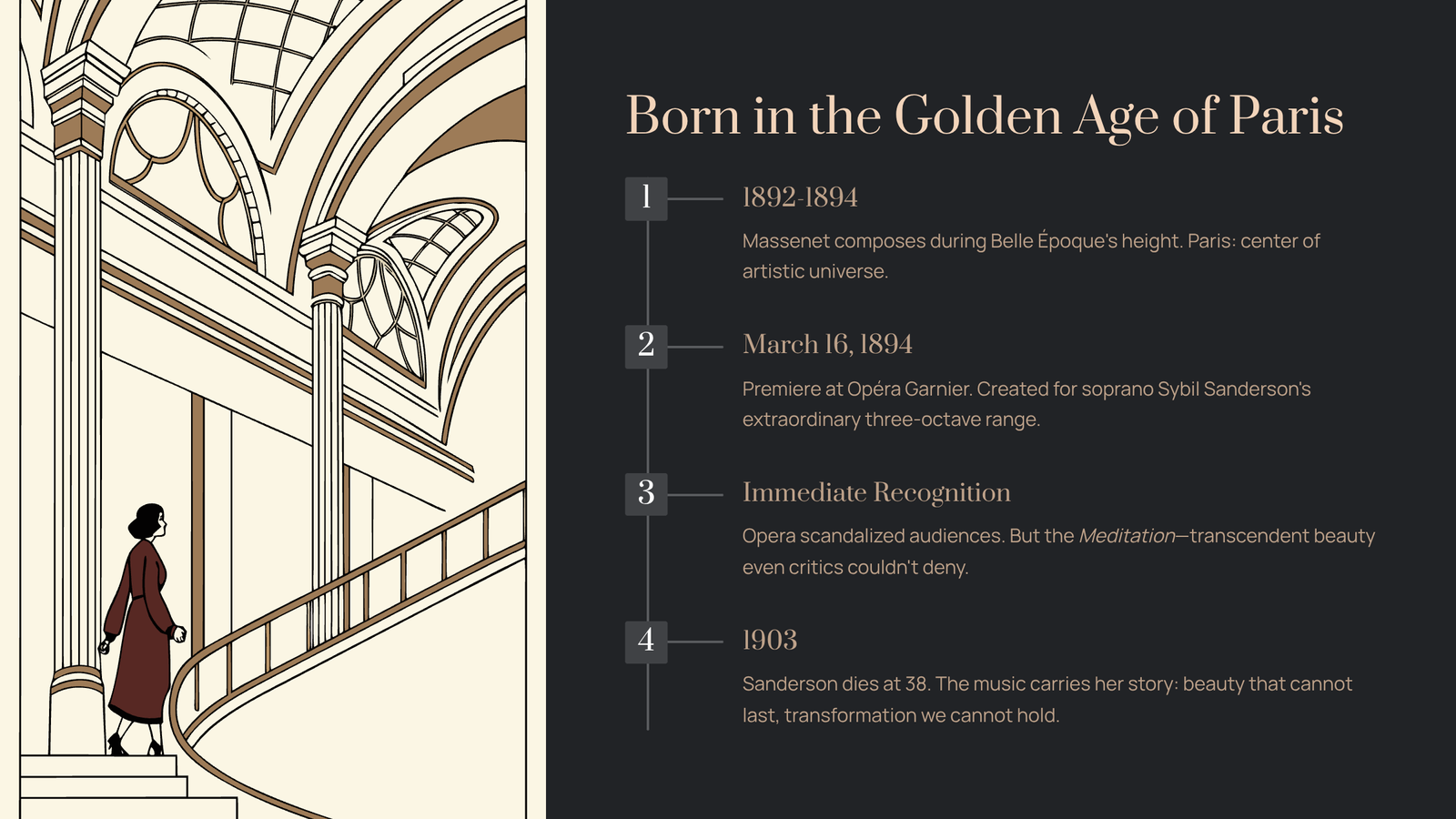
Massenet composed Thaïs between 1892 and 1894, during the glittering height of the Belle Époque. Paris was the center of the artistic universe, and Massenet—at fifty-two years old—was one of its reigning masters. He had already triumphed with Manon and Werther, operas that made audiences weep in theaters across Europe.
He created the role of Thaïs for a specific voice: Sybil Sanderson, a young American soprano from California who had captivated Parisian society with her extraordinary three-octave range and dramatic presence. Massenet was devoted to her, crafting impossible vocal lines that only she could sing. Their professional relationship was the subject of considerable speculation in the gossip columns of the day.
The opera premiered on March 16, 1894, at the Opéra Garnier. It was, by some accounts, a scandal. The collision of sacred and profane—a monk burning with desire, a courtesan achieving sainthood—proved too provocative for some tastes. But the Meditation itself was immediately recognized as something special, a moment of transcendent beauty that even the opera’s critics could not deny.
Tragically, Sanderson’s own life would echo something of Thaïs’s arc. After the opera’s premiere, her fortunes declined—a difficult marriage, financial ruin, and failing health. She died in 1903 at just thirty-eight, her extraordinary voice silenced far too soon. The opera that made her famous outlived her, but the Meditation seems to carry something of her story in its notes: the flicker of beauty that cannot last, the transformation we seek but cannot always hold.
What You Are Actually Hearing
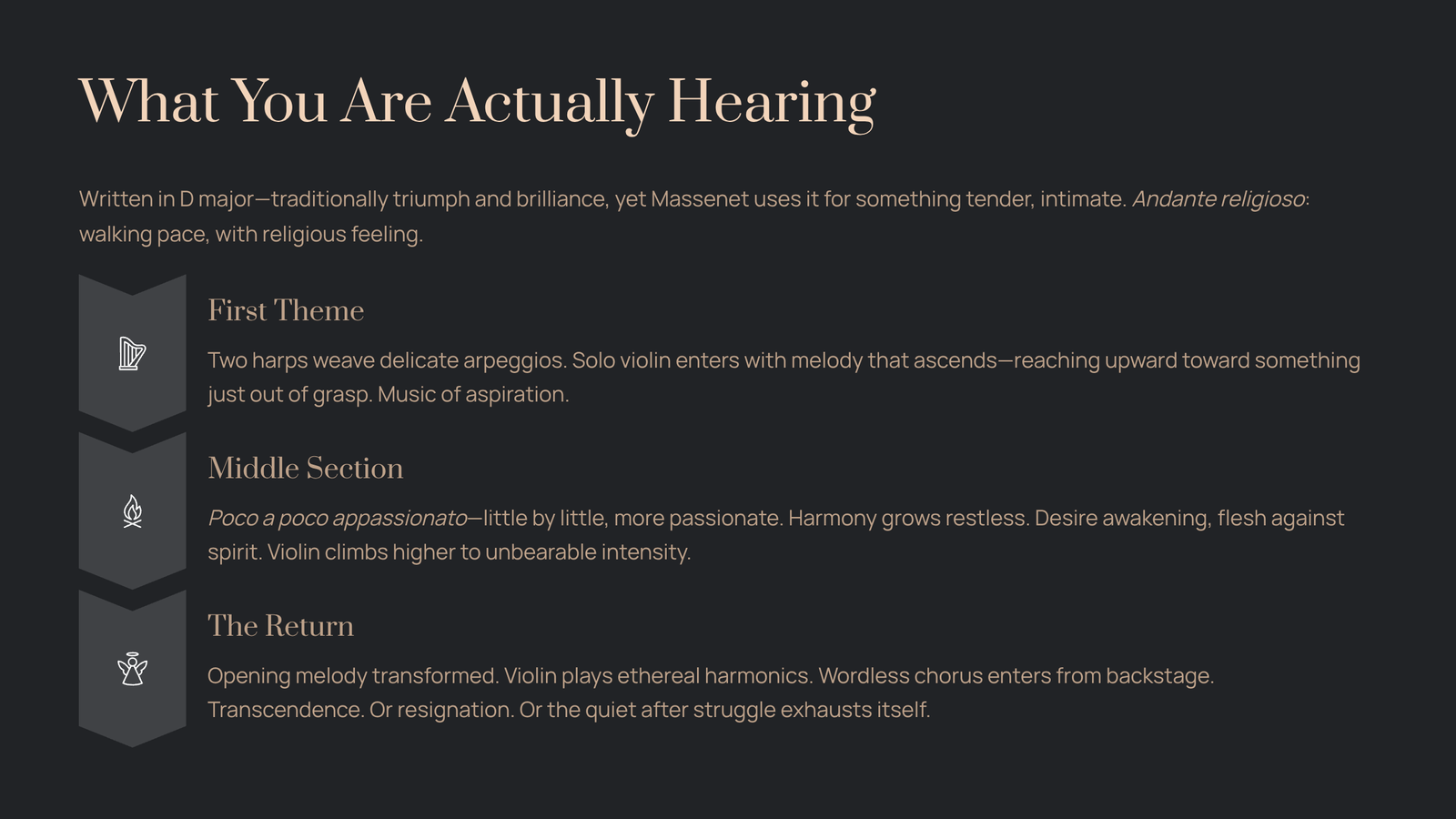
The Meditation is written in D major—a key traditionally associated with triumph and brilliance, yet Massenet uses it here for something more tender, more intimate. The tempo marking, “Andante religioso,” tells us much: this should be played at a walking pace, with religious feeling. Not church-rigid, but reverent.
The piece unfolds in a simple three-part structure that mirrors the emotional journey of its characters.
The First Theme opens with two harps weaving a delicate tapestry of arpeggios—an unusual choice for the era, lending the music an almost otherworldly shimmer. Then the solo violin enters with one of the most recognizable melodies in classical music. It rises gently, long notes decorated with graceful ornaments, like a prayer that does not yet know what it is praying for.
Listen for how the melody seems to ascend—the intervals reaching upward as if toward something just out of grasp. This is the music of aspiration, of souls turning toward light they cannot name.
The Middle Section brings transformation. The tempo quickens subtly, marked “poco a poco appassionato”—little by little, more passionate. The harmony grows more restless, introducing chromatic shifts that create gentle dissonance and release. This is desire awakening, the flesh asserting itself against the spirit. The violin climbs higher, the orchestra swells, and we reach a climax that feels almost unbearable in its intensity.
Then comes a brief cadenza—a moment of virtuosic freedom where the soloist seems to break from the orchestra entirely, spinning rapid figurations that could be ecstasy or anguish or both.
The Return brings us back to the opening melody, but everything has changed. The violin now plays in its highest register, using harmonics—those ethereal, bell-like tones produced by barely touching the string. A wordless chorus enters from backstage, voices without text, humming a sound that seems to come from nowhere and everywhere at once.
This is transcendence. Or perhaps resignation. Or perhaps just the quiet that follows when the struggle has exhausted itself. Massenet leaves it to us to decide.
How to Listen: Three Approaches
The Emotional Journey
Close your eyes. Do not think about form or structure. Simply follow the feeling.
Notice how the opening seems to create a space—a room of sound you can enter. Let the violin’s melody be a voice speaking directly to you. When the music intensifies in the middle section, do not resist it; let the waves of sound wash over you. When the harmonics appear at the end, feel how the texture thins, how the music seems to float upward and disappear.
This is meditation not as thought but as pure experience.
The Instrumental Dialogue
On a second listen, try tracking the conversation between violin and orchestra.
The harps establish a kind of sonic halo that never quite disappears—always shimmering underneath. The strings provide warmth and support, breathing with the soloist. In the passionate middle section, notice how the woodwinds emerge, adding color and intensity. And at the very end, listen for that ghostly chorus: where does it come from? It seems to exist between the instruments, as if the music itself has become a voice.
The Dramatic Context
Finally, listen while holding the story in your mind.
This is not abstract beauty. This is two people at a crossroads. Thaïs is deciding whether to surrender her entire identity. Athanaël is discovering that his certainty is an illusion. The violin is singing what neither can say aloud—the truth that terrifies them both.
When the harmonics appear at the end, ask yourself: who has been transformed? Is this Thaïs ascending toward grace? Is it Athanaël realizing what he has lost? Or is it something beyond both of them, the music itself becoming the prayer they could not speak?

The Interpreters: Finding Your Version
Because the Meditation is one of classical music’s beloved encore pieces, almost every great violinist has recorded it. The differences between interpretations can be remarkable, and finding “your” version is part of the pleasure.
For Purity and Restraint, seek out Jascha Heifetz. His 1940s recording approaches the piece with aristocratic control—no wallowing in sentiment, just clean lines and perfect intonation. This is the Meditation as architecture, showing that depth does not require display.
For Vocal Warmth, Nathan Milstein is incomparable. He plays as if the violin were actually singing words, with breath and phrasing borrowed from the human voice. His interpretation moves from peaceful contemplation to urgent passion and back again without ever losing its center.
For Dramatic Arc, Michael Rabin’s legendary recording shows what happens when every rubato, every vibrato speed, every accent is perfectly calibrated to serve a single emotional trajectory. Many modern interpretations trace their lineage to his approach.
For Romantic Opulence, Anne-Sophie Mutter with the Vienna Philharmonic delivers the piece with gorgeous tone and unabashed sensuality. Some find it too rich; others find it definitive.
For Modern Clarity, Joshua Bell offers technique so pristine you can hear every nuance of Massenet’s writing. This is a good version for first-time listeners who want to understand the piece’s structure before diving into more idiosyncratic interpretations.
If you want something unexpected, seek out the cello transcription performed by Yo-Yo Ma and Kathryn Stott. The deeper register gives the melody a different character—more mature, perhaps more resigned, as if looking back on passion rather than living through it.

Why This Music Still Matters
The Meditation from Thaïs has outlived its opera. Most people who love it have never seen a staging of the full work and likely never will. The piece exists now in a space beyond its original context—played at weddings and funerals, in concert halls and living rooms, as background music in films and as foreground music in moments of private contemplation.
Why does it endure?
Perhaps because it captures something essential about being human: the ache of wanting two things that cannot coexist. We want transcendence and we want connection. We want to rise above and we want to be held. We want spirit and we want flesh. The Meditation does not resolve this tension; it simply makes it beautiful.
Or perhaps it endures because it proves that music can say what words cannot. The opera’s libretto has not aged well; its religious debates feel dated, its characters sometimes two-dimensional. But the Meditation bypasses all of that. It is a piece of music about the moment before language, the place where feeling has not yet hardened into thought.
Listen to it when you need to think clearly. Listen to it when you need to stop thinking entirely. Listen to it when the world is too loud and you need something that reminds you of silence.
Five minutes. A solo violin. Two harps shimmering in the background.
Sometimes that is enough to change everything.
Recommended Recording for First Listen:
Itzhak Perlman, “A La Carte” (EMI Classics) – A warmly lyrical interpretation that balances technical mastery with emotional generosity, perfect for encountering this music for the first time.