📑 Table of Contents
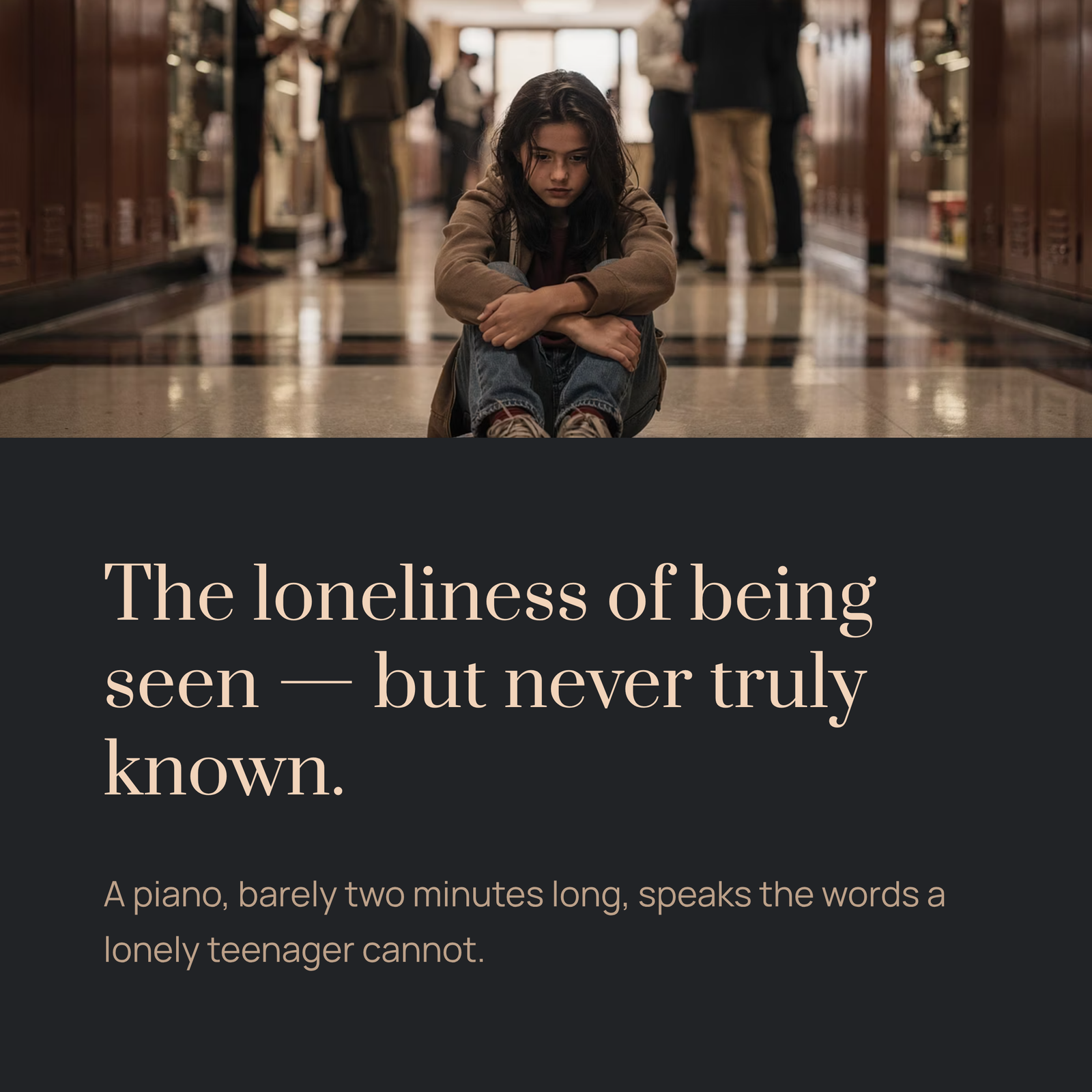
There is a particular kind of loneliness that belongs only to the young — the kind where you are surrounded by people, yet convinced that no one truly sees you. You laugh too loudly, you chase too eagerly, you put on a face that isn’t quite yours, all because you believe the real you isn’t enough to be loved. If you have ever felt that quiet desperation, there is a piece of music that already understands. It has been waiting for you, patient as a cat curled in a patch of afternoon sunlight.
The main theme from A Whisker Away is that piece. Composed by Mina Kubota for the 2020 Studio Colorido anime film, it is barely two minutes long. Yet within those two minutes, something remarkable happens: the piano speaks the exact words a lonely teenager cannot say out loud.
A Composer Who Learned to Listen to Silence
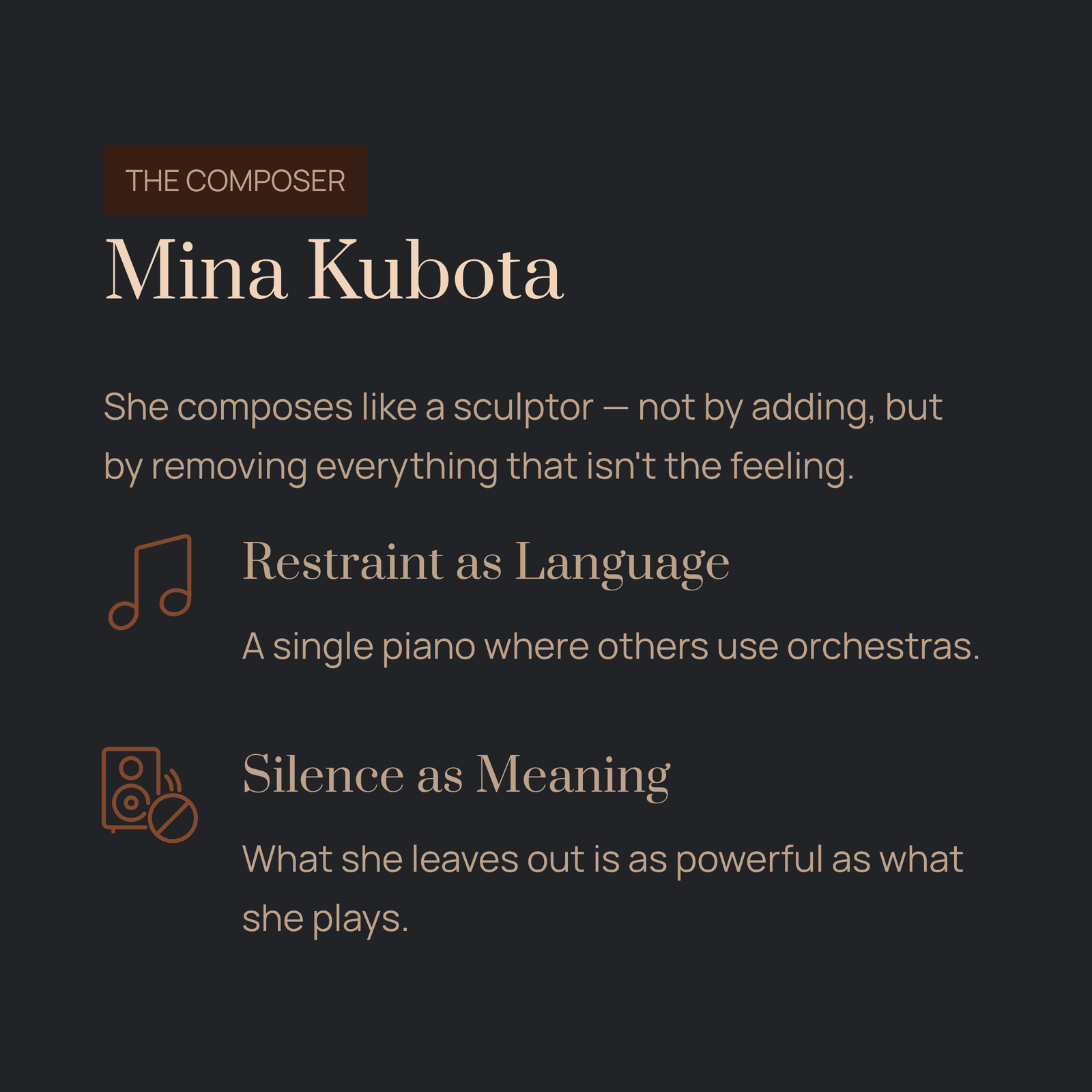
Mina Kubota is not a household name, even among dedicated anime fans. Born in Fukuoka, Japan in 1972, she has spent over two decades quietly building one of the most emotionally intelligent bodies of work in Japanese animation. If you have ever watched ARIA the Animation and felt an inexplicable peace wash over you as a gondola drifted through Neo-Venezia’s canals, that was Kubota’s music breathing beneath the surface. If you were moved to unexpected tears during A Letter to Momo, her piano was the invisible hand guiding your emotions.
What sets Kubota apart from many of her contemporaries is her philosophy of restraint. Where other film composers might reach for a full orchestra to convey sadness, Kubota often chooses a single piano. Where others pile on layers of instrumentation, she strips things away until only the essential emotional truth remains. She composes the way a sculptor works — not by adding, but by removing everything that isn’t the feeling she wants you to have.
This approach makes her a perfect match for a story about a girl hiding behind a mask.
The Girl Who Wanted to Cry, So She Pretended to Be a Cat
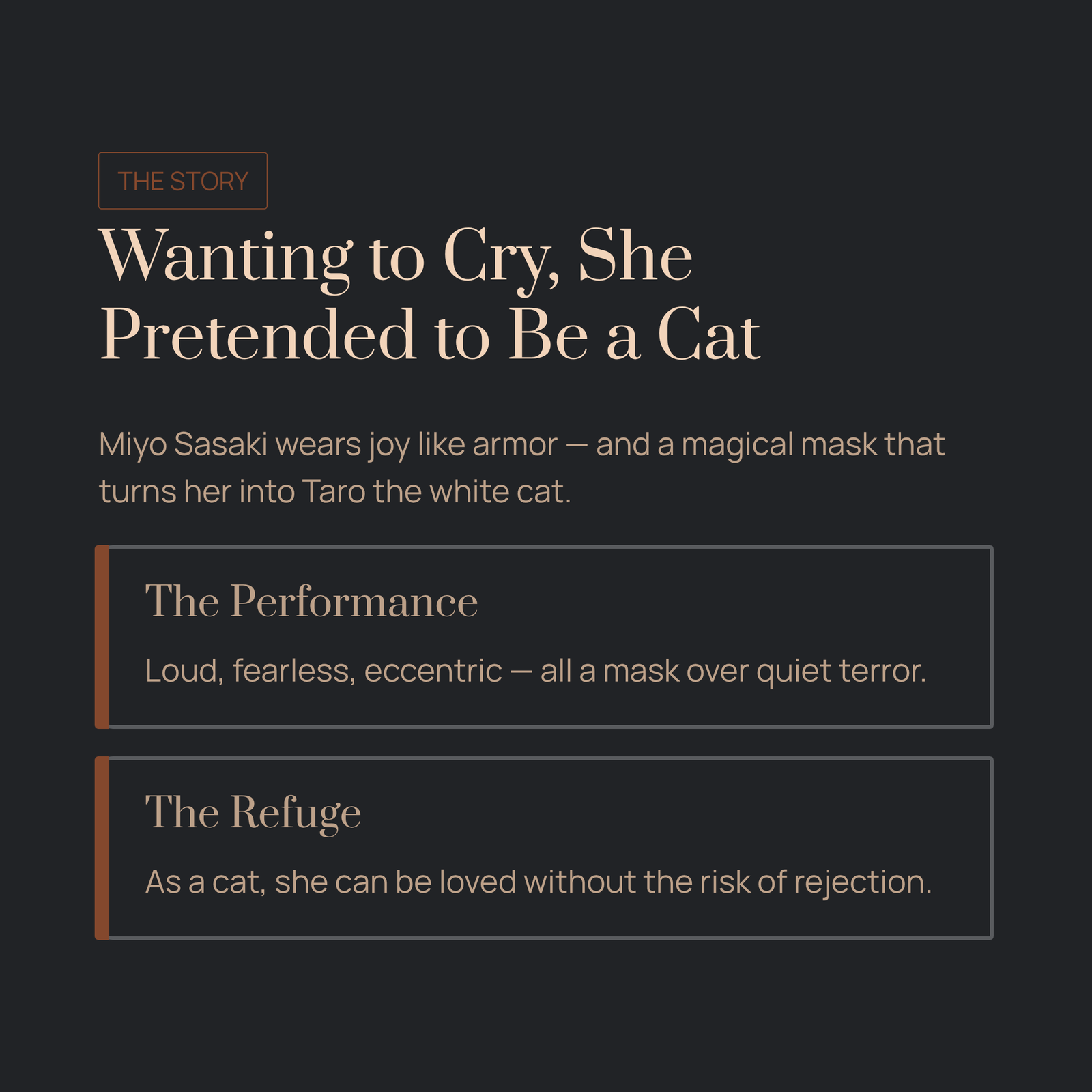
To understand why this main theme resonates so deeply, you need to know the story it was born from. A Whisker Away — whose Japanese title, Nakitai Watashi wa Neko wo Kaburu, translates to “Wanting to Cry, I Pretend to Be a Cat” — follows Miyo Sasaki, a middle school girl living in the ceramic town of Tokoname, Aichi Prefecture.
Miyo’s home life is fractured. Her biological mother left the family. Her father is well-meaning but emotionally distant. Her stepmother, Kaoru, tries her best, but Miyo keeps her at arm’s length. At school, Miyo earns the nickname “Muge” — short for “Mugendai Nazo Ningen,” meaning “infinitely mysterious human” — because of her erratic, over-the-top behavior. She chases after her classmate Kento Hinode with relentless, almost embarrassing enthusiasm, and everyone around her sees a girl who is fearless, eccentric, unbreakable.
But it is all a mask. Beneath the performance, Miyo is terrified of being rejected for who she really is. So when a mysterious cat dealer offers her a magical Noh mask that transforms her into a white cat named Taro, she seizes it. As Taro, she can sit quietly beside Hinode, listen to his troubles, feel his gentle hand on her fur — all without the risk of being turned away. The cat mask becomes her refuge. The problem, of course, is that the longer she wears it, the harder it becomes to take off.
The screenplay by Mari Okada — one of Japan’s most celebrated anime writers, known for works like Anohana and Maquia — treats this transformation not as a simple fantasy device, but as a metaphor for the masks we all wear when we are afraid of being vulnerable. The direction by veteran Junichi Sato and newcomer Tomotaka Shibayama wraps this emotional complexity in the sun-drenched, ceramic-tiled beauty of Tokoname’s streets.
And underneath it all, Mina Kubota’s music breathes.
What the Piano Says When Words Fail
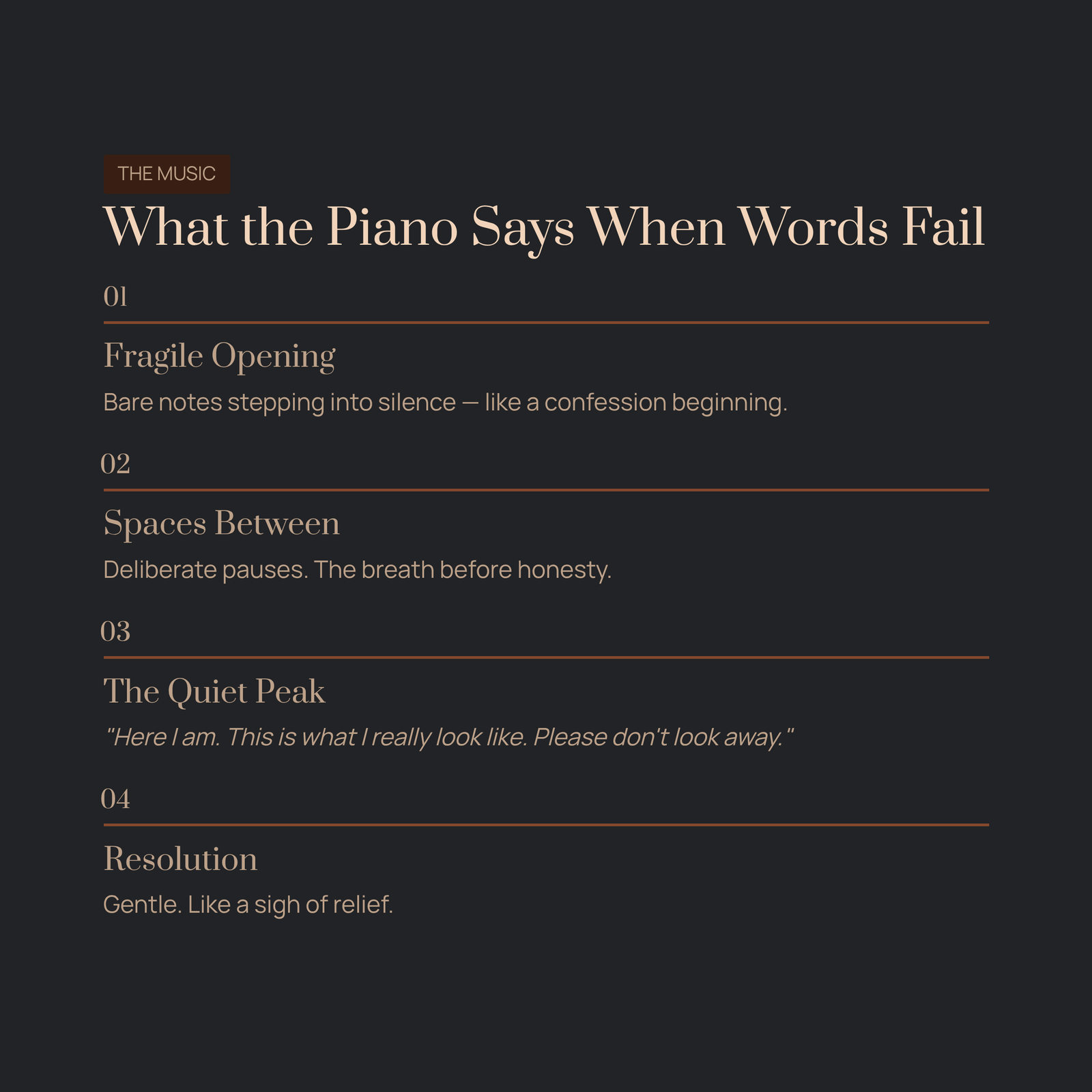
The main theme opens with a simplicity that borders on fragility. A few piano notes, unhurried, stepping carefully into the silence like bare feet on a cold floor. There is no grand introduction, no sweeping statement of intent. The melody simply begins — tentatively, the way you might start a confession you have been rehearsing for weeks.
Listen to the intervals between the notes. Kubota leaves deliberate spaces, small pockets of silence where the music seems to hold its breath. These gaps are not emptiness. They are the pauses of a person gathering courage — the hesitation before saying something honest, the heartbeat between deciding to be vulnerable and actually doing it.
As the melody develops, a gentle warmth enters. The harmonic language remains simple, almost childlike in its clarity, but there is a quiet sophistication in how Kubota moves between chords. She favors resolutions that feel slightly unexpected — not dissonant, but tilted, as if the music is looking at the world from a slightly different angle. It mirrors Miyo’s perspective perfectly: a girl who sees the world through a sideways lens, who expresses love in ways no one around her quite understands.
The emotional peak of the theme does not arrive through crescendo or dramatic gesture. Instead, it comes through a subtle shift in the melody’s register — a climbing phrase that reaches upward with the quiet determination of someone finally deciding to remove their mask. It is not triumphant. It is not even fully confident. It simply says: Here I am. This is what I really look like. Please don’t look away.
And then the theme resolves, gently, like a sigh of relief.

How to Let This Music Find You
There is no single correct way to experience this piece, but I want to share a few approaches that have opened the music up for me in different ways.
First listening — without the film. Find the original soundtrack on Spotify or Apple Music (listed under Mina Kubota’s Film ‘A Whisker Away’ Original Soundtrack, released July 2020). Listen to the main theme on its own, without visuals, without context. Let the piano speak to you directly. Notice what images or feelings arise in your mind. Many listeners report a sense of gentle melancholy mixed with hope — a feeling the Japanese call setsunai (切ない), that bittersweet ache that is neither fully sad nor fully happy.
Second listening — with the film. Watch A Whisker Away on Netflix. Pay attention to when and how the main theme appears. Kubota deploys it not only in the obvious emotional climaxes, but in small, almost throwaway moments — a shot of Miyo walking home alone, the camera lingering on an empty classroom. These quiet placements are where the music does its most powerful work, coloring ordinary moments with the ache of unexpressed feeling.
Third listening — at the piano, if you play. The main theme’s sheet music is accessible enough for intermediate pianists. What you discover when you play it yourself is how much of its emotional power lives in the dynamics — the difference between pressing a key softly and pressing it just a fraction more firmly. Kubota’s writing rewards the pianist who understands that music lives not in the notes themselves, but in the space and breath between them.
For those who connect with Kubota’s approach, I recommend exploring her soundtrack for A Letter to Momo (2012), where she uses a similar piano-centered language to paint the emotional landscape of a girl processing grief, and the ARIA series soundtracks, where her compositions achieve a state of gentle transcendence that is almost meditative.
The Courage to Take Off the Mask
I return to this main theme more often than I expected when I first heard it. Not because it is technically complex or harmonically adventurous — by conventional measures, it is neither. I return to it because it captures something that more ambitious music often misses: the specific, private courage required to stop performing and simply be yourself.
We live in an age of masks. We curate our lives on social media, we perform confidence we do not feel, we laugh when we want to cry. Miyo Sasaki’s cat mask is a fantasy device, but the impulse behind it is devastatingly real. And Mina Kubota’s piano, with its tender hesitations and quiet resolve, speaks directly to that impulse — not with judgment, but with the gentle assurance that the person beneath the mask is worth knowing.
The Japanese title of the film contains the word kaburu (かぶる), which means both “to wear” and “to put on” — specifically, to put something over your head, to cover yourself. But the film’s emotional arc, and the music that carries it, ultimately moves toward the opposite gesture: the act of uncovering, of revealing, of letting yourself be seen even when it terrifies you.
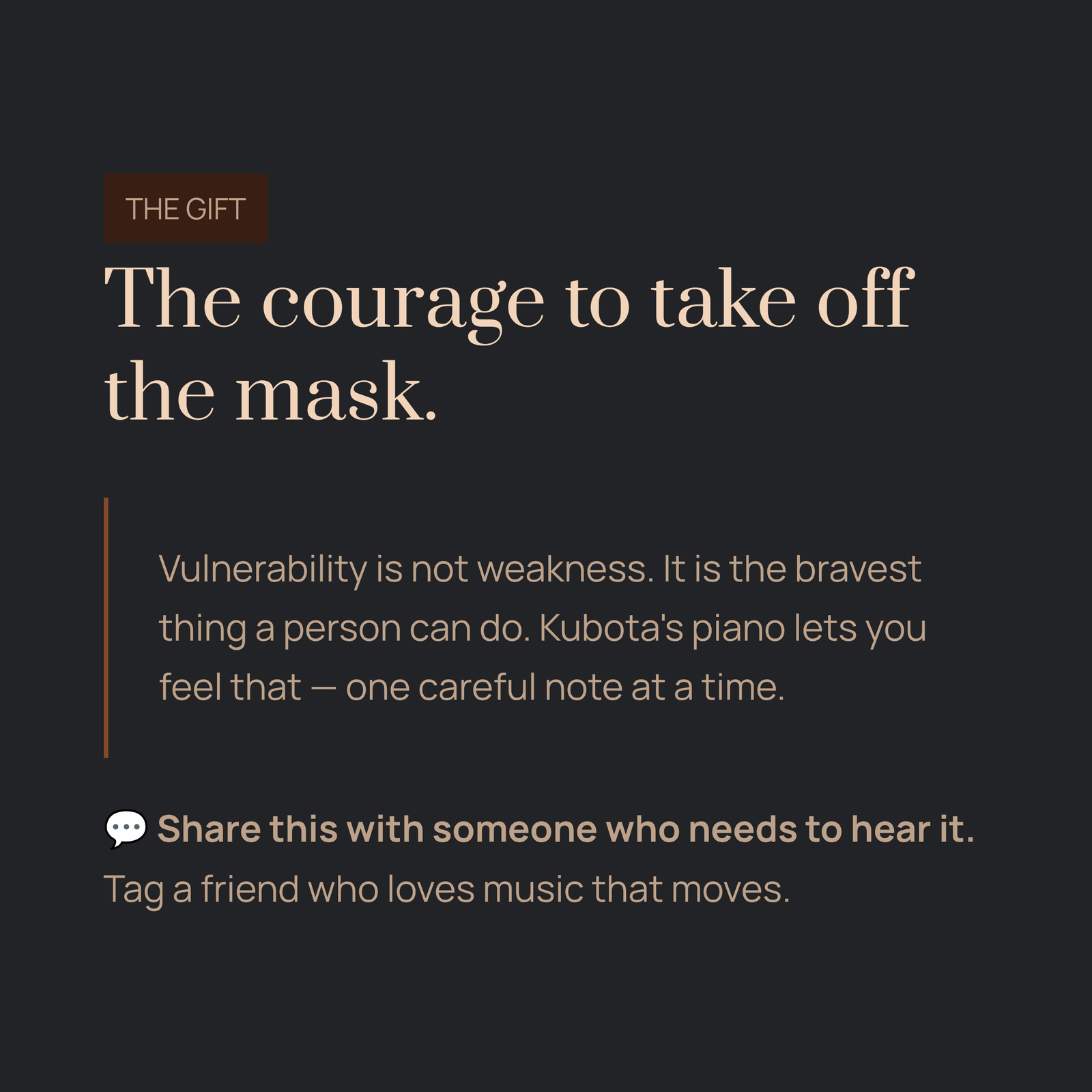
There is a moment, near the end of the film, when the main theme returns one final time. By now, you have heard it several times, in different contexts, at different emotional temperatures. But in this final appearance, something has shifted. The melody is the same. The piano is the same. Yet it sounds different — lighter, somehow, as if a weight has been lifted from the notes themselves. Nothing in the composition has changed. What has changed is Miyo. What has changed is you, the listener, who has traveled the entire length of this story and arrived at the understanding that vulnerability is not weakness. It is the bravest thing a person can do.
That is the gift of Mina Kubota’s music. It does not tell you this. It lets you feel it, one careful note at a time — like a cat stepping softly into the room, sitting beside you in the silence, and waiting patiently until you are ready to take the mask off yourself.