📑 Table of Contents
There are moments in life when you stand at the edge of something vast and unknown — a new career, a foreign city, the end of a long relationship — and words fail you. You know you need to move forward, but your feet won’t budge. The mind races with reasons to stay put: comfort, familiarity, the fear of regret. And then, sometimes, a piece of music arrives and does what logic cannot. It lifts you. It says, without a single syllable, that the open road is not something to fear — it is something to embrace.
Hans Zimmer’s “The Way: Come Sail Away” is exactly that kind of music. It does not argue. It does not explain. It simply opens a door and lets the wind rush in. From the very first notes, you feel something shift inside your chest — a quiet stirring, as if your heart suddenly remembered a promise it made to itself long ago. A promise about the life you actually wanted to live.
I first heard this piece on a late-night drive, alone, windows down, heading nowhere in particular. By the time the final swell of strings faded, I had pulled over to the shoulder of the road. Not because something was wrong. Because something, for the first time in months, felt unmistakably right.
Hans Zimmer — The Architect of Emotion
Hans Florian Zimmer, born in Frankfurt, Germany in 1957, is not merely a film composer. He is, in the truest sense, an architect of human feeling. Over a career spanning more than four decades and over 150 film scores, Zimmer has redefined what music can do inside a story — and, more importantly, what it can do inside a listener.
His journey began far from Hollywood. As a teenager in London, Zimmer taught himself synthesizers and keyboards, drawn to the space where electronic textures meet orchestral grandeur. His early work with the band The Buggles and producer Stanley Myers gave him an unconventional foundation — one foot in pop experimentalism, the other in classical tradition. This duality would become his signature.
The breakthrough came with Barry Levinson’s Rain Man in 1988, earning Zimmer his first Academy Award nomination. But it was The Lion King in 1994 that truly announced his arrival, winning him the Oscar for Best Original Score. From there, the trajectory was relentless: Gladiator, The Dark Knight Trilogy, Inception, Interstellar, Dune — each score not just accompanying the film but elevating it into something mythic.
What makes Zimmer singular is his refusal to treat film music as mere background. He builds sonic worlds. He layers synthesizers beneath full orchestras, weaves ethnic instruments into modern arrangements, and treats silence as a compositional tool. His music does not simply underscore a scene — it becomes the emotional spine of the entire narrative.
The Story Behind “The Way: Come Sail Away”
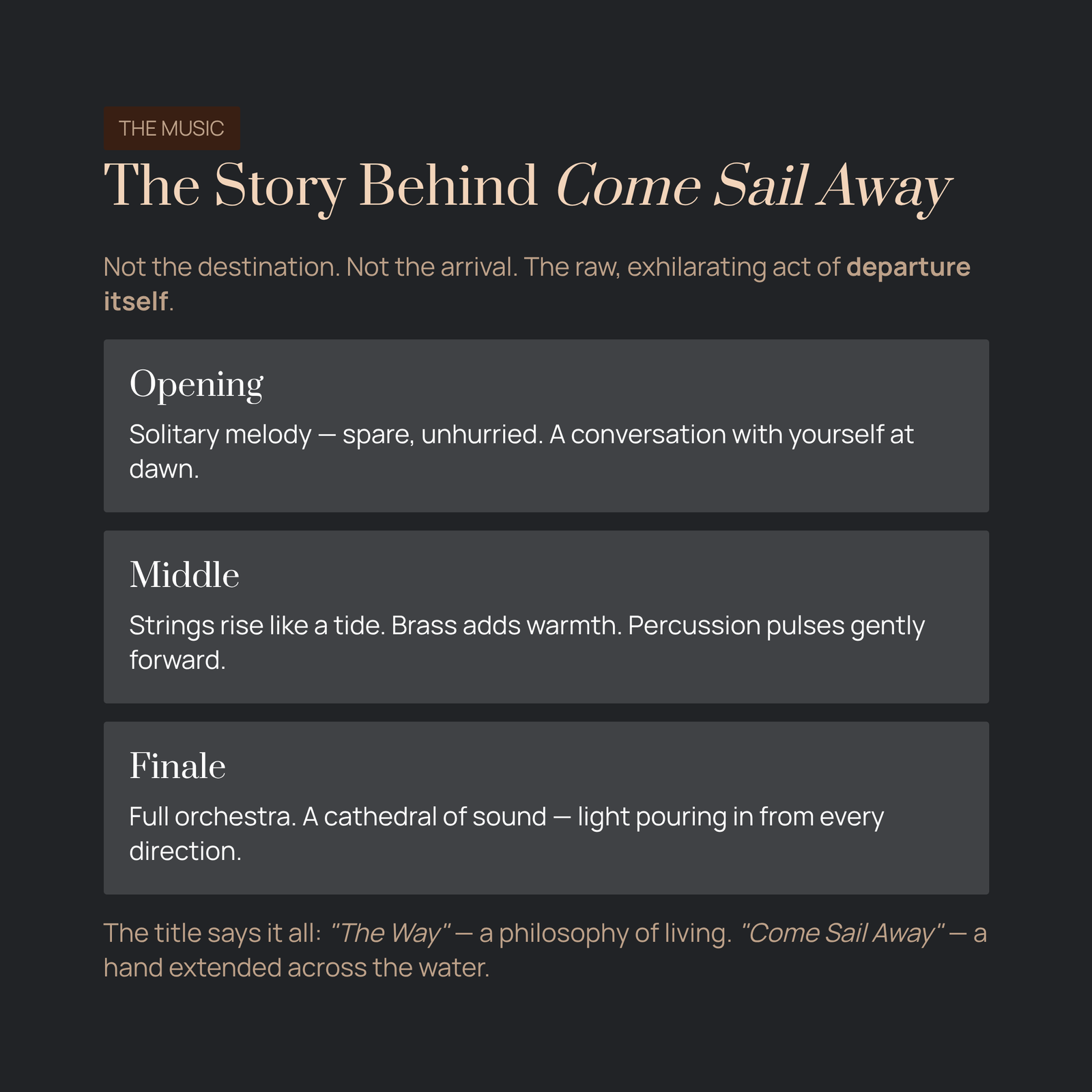
“The Way: Come Sail Away” represents one of Zimmer’s most evocative explorations of a theme he returns to again and again throughout his career: the journey. Not the destination, not the arrival, but the raw, uncertain, exhilarating act of departure itself.
The piece belongs to a lineage of Zimmer compositions that deal with the moment a character — or a listener — decides to step beyond the known world. Think of “Time” from Inception, with its slow, aching build toward something both inevitable and heartbreaking. Think of “Cornfield Chase” from Interstellar, where the simple act of driving through a field becomes a prelude to crossing the stars. “The Way: Come Sail Away” operates in this same emotional territory, but with a crucial difference: where those pieces carry the weight of loss and sacrifice, this one is lit from within by something closer to joy. A fearful joy, perhaps — the kind you feel standing at the bow of a ship as it leaves harbor, watching the shoreline shrink, knowing there is no turning back.
The title itself is revealing. “The Way” suggests a path, a philosophy, a method of living. And “Come Sail Away” is both an invitation and a declaration — a hand extended across the water, calling you toward something you cannot yet see but somehow already trust.
Structurally, the piece moves through three distinct emotional phases. The opening is intimate: a solitary melodic line, spare and unhurried, like a conversation you have with yourself in the early hours of morning. Then the middle section introduces layers — strings rising like a tide, brass adding warmth and weight, percussion providing a gentle but insistent pulse. By the final movement, the full orchestra is engaged, and the effect is nothing short of breathtaking. It feels less like listening to music and more like standing inside a cathedral of sound, with light pouring in from every direction.
What I Hear When I Close My Eyes
I want to be honest about something. When I listen to “The Way: Come Sail Away,” I do not think about films. I do not picture any specific scene or character. What I see instead is entirely personal — and I suspect that is exactly what Zimmer intends.
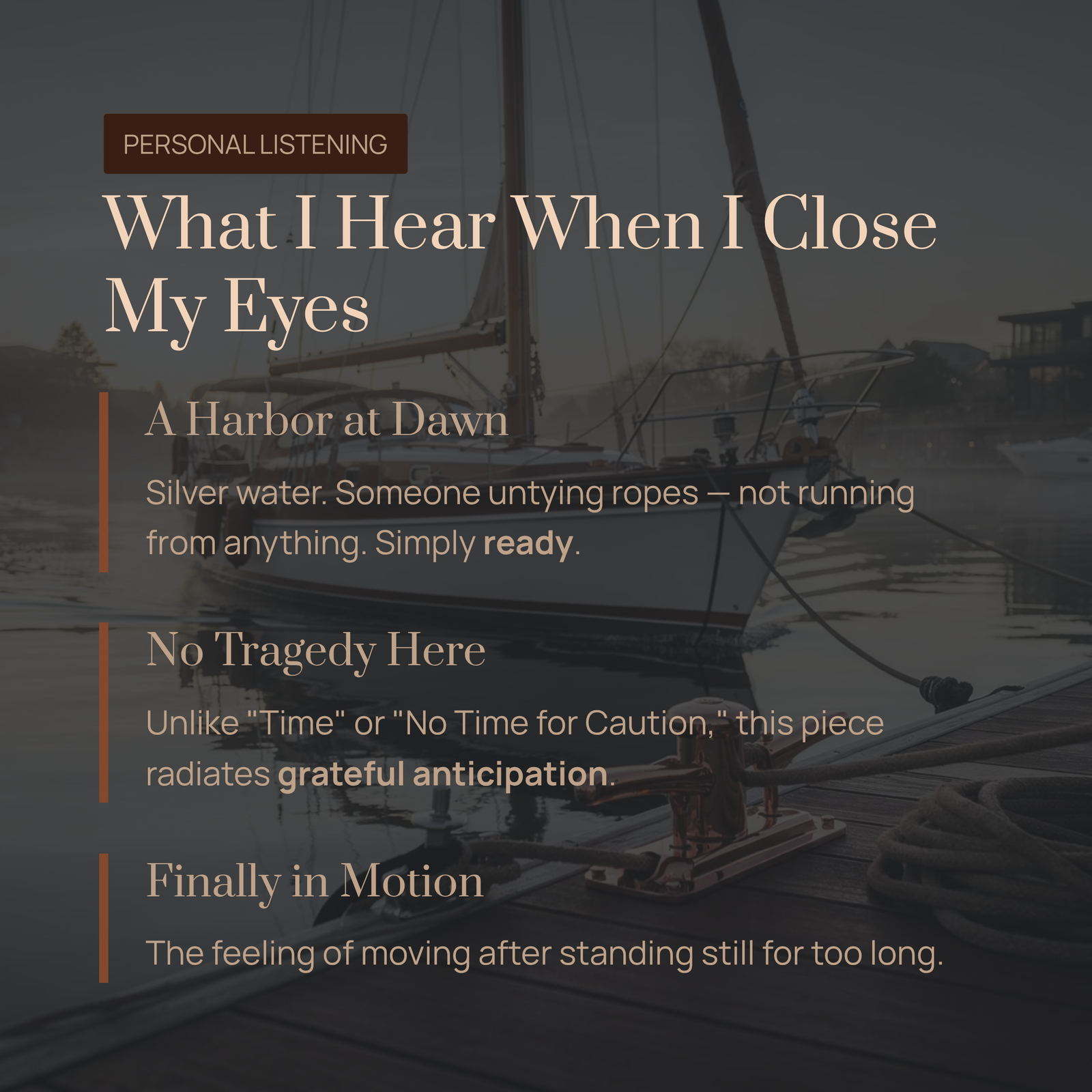
I see a harbor at dawn. The water is not blue but silver, catching the first light. There is a small boat, and someone is untying the ropes with slow, deliberate hands. There is no rush. The person is not running from anything. They are simply ready. Ready for the weight of routine to fall away. Ready for the horizon to stop being a line in the distance and start being a place they can actually reach.
The opening melody, with its gentle ascending phrases, feels like the act of breathing deeply before a leap. There is tenderness in it, and also resolve. When the strings enter, they do not crash in — they bloom, the way morning light fills a room gradually, until suddenly everything is illuminated. And that transition, from solitude to fullness, from quiet courage to open-hearted adventure, is the emotional heart of the entire piece.
What strikes me most is the absence of tragedy. So much of Zimmer’s most celebrated work carries an undertone of sorrow — the ache of “Time,” the desperation of “No Time for Caution.” But here, the dominant emotion is something I can only describe as grateful anticipation. It is the feeling of finally being in motion after standing still for too long.
How to Listen — A Practical Guide
If you are coming to this piece for the first time, I have a few suggestions that might deepen the experience.
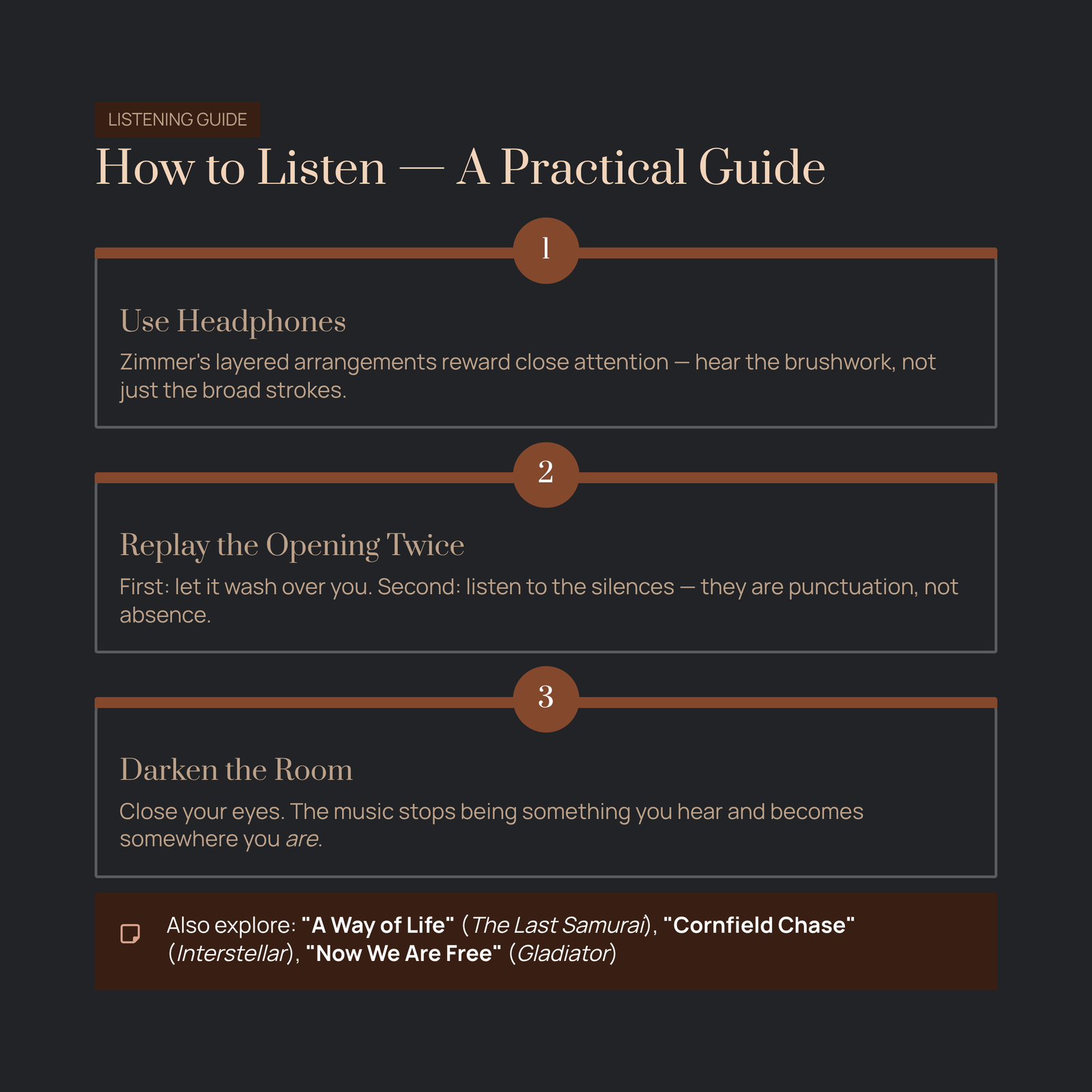
First, give it headphones. This is not background music for a coffee shop or a commute. Zimmer’s arrangements are layered with a precision that rewards close attention — the way a cello line will quietly shadow the main melody, the way a single sustained note in the brass section will shift the emotional color of an entire passage. On speakers, you hear the broad strokes. On headphones, you hear the brushwork.
Second, listen to the opening section at least twice before moving on. The first time, let it wash over you. The second time, pay attention to the spaces between the notes. Zimmer is a master of negative space — the silences in this piece are not absences but punctuation marks, giving you room to feel.
Third, if you can, listen in a darkened room. I know that sounds dramatic, but visual stimulation competes with the emotional bandwidth that this music demands. When you close your eyes and let “The Way: Come Sail Away” fill the space around you, something remarkable happens. The music stops being something you are hearing and starts being somewhere you are.
For those who want to explore further, I recommend placing this piece alongside some of Zimmer’s other journey-themed compositions: “A Way of Life” from The Last Samurai, “Cornfield Chase” from Interstellar, and “Now We Are Free” from Gladiator. Together, they form an unofficial suite about the courage it takes to leave one life and begin another.
For a different interpretive lens, try listening to Zimmer’s live concert recordings, where his ensemble often extends and reimagines studio pieces with improvisational energy. The live versions carry a rawness and spontaneity that the studio recordings, polished as they are, sometimes smooth away.
The Courage to Set Sail
There is a reason the metaphor of sailing has endured for centuries in music, literature, and myth. To sail is to surrender control. It is to trust the wind, the current, the unseen architecture of the world beneath the surface. It is, in the deepest sense, an act of faith — not in a deity, but in the journey itself.
Hans Zimmer understands this. His music has always been less about answering questions than about making you brave enough to live inside the questions. “The Way: Come Sail Away” does not tell you where to go. It does not promise safe passage or a happy ending. What it offers is something rarer and more valuable: the feeling that departure itself is enough. That the act of choosing to move, to change, to leave the harbor — that is the victory.
I think about the people who listen to this piece at pivotal moments in their lives. The student packing boxes for a city they have never visited. The parent dropping their child off at college, driving home in a car that suddenly feels too quiet. The person sitting in a parked car outside a job interview, needing one last push of courage before opening the door. Music like this does not change the circumstances. But it changes the person inside the circumstances. And sometimes, that is all you need.
If you have been standing at your own harbor, watching the boats come and go, waiting for the right moment — I want you to know something. The right moment is not a date on a calendar. It is a feeling. And it sounds exactly like this.