
📑 Table of Contents
Here is something that might surprise you. The piece of music most people associate with one of the greatest war films ever made was never written for that film at all.
Stanley Myers composed Cavatina in 1970 for a largely forgotten British thriller called The Walking Stick. The film came and went without much fanfare, and so did the melody — quietly tucked away, waiting. Eight years later, director Michael Cimino chose it as the theme for The Deer Hunter, and the world finally heard what had been hiding in plain sight all along. That gentle, aching guitar melody became the emotional spine of a film about young men shattered by the Vietnam War, about the unbridgeable distance between innocence and experience.
Sometimes the most powerful music needs time to find the story it was always meant to tell.
Stanley Myers: The Man Behind Sixty Scores and One Immortal Melody
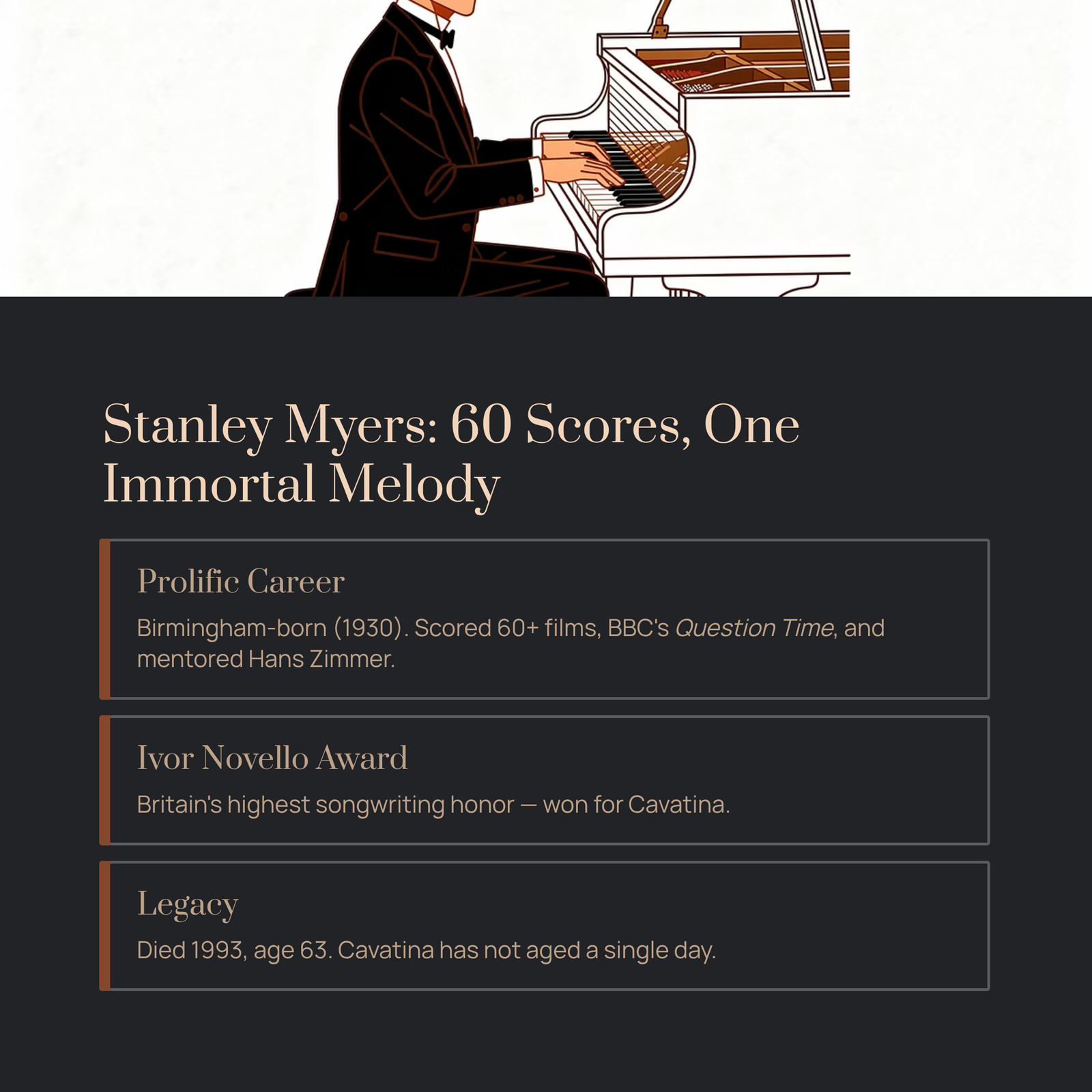
Stanley Myers was born in Birmingham, England, in 1930 and went on to become one of British cinema’s most prolific composers, scoring over sixty films and television series throughout his career. He wrote the theme music for the BBC’s Question Time, composed scores for cult horror films, and even contributed brass arrangements for Pink Floyd. Later in his career, he collaborated closely with a young Hans Zimmer — yes, that Hans Zimmer — serving as something of a mentor before Zimmer went on to reshape the sound of Hollywood.
Yet for all that output, Myers’ name is remembered primarily for a single piece. It is both the blessing and the quiet tragedy of his legacy: Cavatina eclipsed everything else he ever wrote. He won the Ivor Novello Award for it, one of Britain’s highest honors in songwriting, and the melody went on to live a life far larger than the man who created it. Myers passed away in 1993 at the age of sixty-three, but Cavatina has not aged a single day.
From Piano Keys to Nylon Strings: How the Piece Was Reborn
The origin story of Cavatina contains a small miracle of collaboration. Myers originally conceived the piece for piano. It was a pleasant enough composition, but it had not yet found its true voice. That changed when classical guitarist John Williams — not the Star Wars composer, but the Australian-born virtuoso widely regarded as one of the finest classical guitarists alive — heard the music and invited Myers to rewrite it for solo guitar.
Myers accepted, and in the process of rearranging and expanding the work, something alchemical happened. The piano version had been pretty. The guitar version became profound. There is something about the nylon-stringed classical guitar — its warmth, its intimacy, the way each note seems to breathe and then fade like a whispered confession — that transformed Cavatina into something far more emotionally resonant than its original form. Williams recorded it at Olympic Sound Studios in London, and the result appeared on his 1971 album Changes.
Keen-eared listeners may also notice something familiar in the opening bars. The accompaniment pattern at the beginning closely mirrors Mozart’s Laudate Dominum from the Solemn Vespers (K. 339), transposed from F major to E major. Whether this was a conscious homage or a happy coincidence, it lends the piece an almost sacred quality from its very first notes — as though the melody is arriving from somewhere ancient and consecrated.
Inside the Music: Why Cavatina Breaks Your Heart So Gently
The Italian word cavatina traditionally refers to a short, simple, and melodious song. And on the surface, that is exactly what this piece is. There are no pyrotechnics here, no dramatic crescendos or virtuosic fireworks. Cavatina moves slowly, deliberately, like someone choosing each word with great care because they know they may not get another chance to speak.
The piece unfolds in E major, and the melody floats above a gently arpeggiated accompaniment — think of sunlight filtering through still water. The guitar’s treble voice carries the tune with a singing quality that is remarkably close to the human voice, while the bass notes provide a steady, almost heartbeat-like pulse underneath. There is a middle section where the harmony shifts, introducing a subtle darkness, a shadow passing across an otherwise luminous landscape. And then the opening theme returns, but by now you hear it differently. You have traveled somewhere and come back, and the familiar suddenly carries the weight of everything you have felt along the way.
This is the secret architecture of Cavatina: it does not assault your emotions. It simply sits beside you, and by the time you realize what it has done, you are already moved beyond words. In the context of The Deer Hunter, this quality becomes devastating. The melody plays over scenes of small-town Pennsylvania life — hunting trips, weddings, laughter among friends — moments whose sweetness we can only fully appreciate because we know, as the audience, what is coming. The music knows it too. It is a lullaby sung to something that is about to be lost.
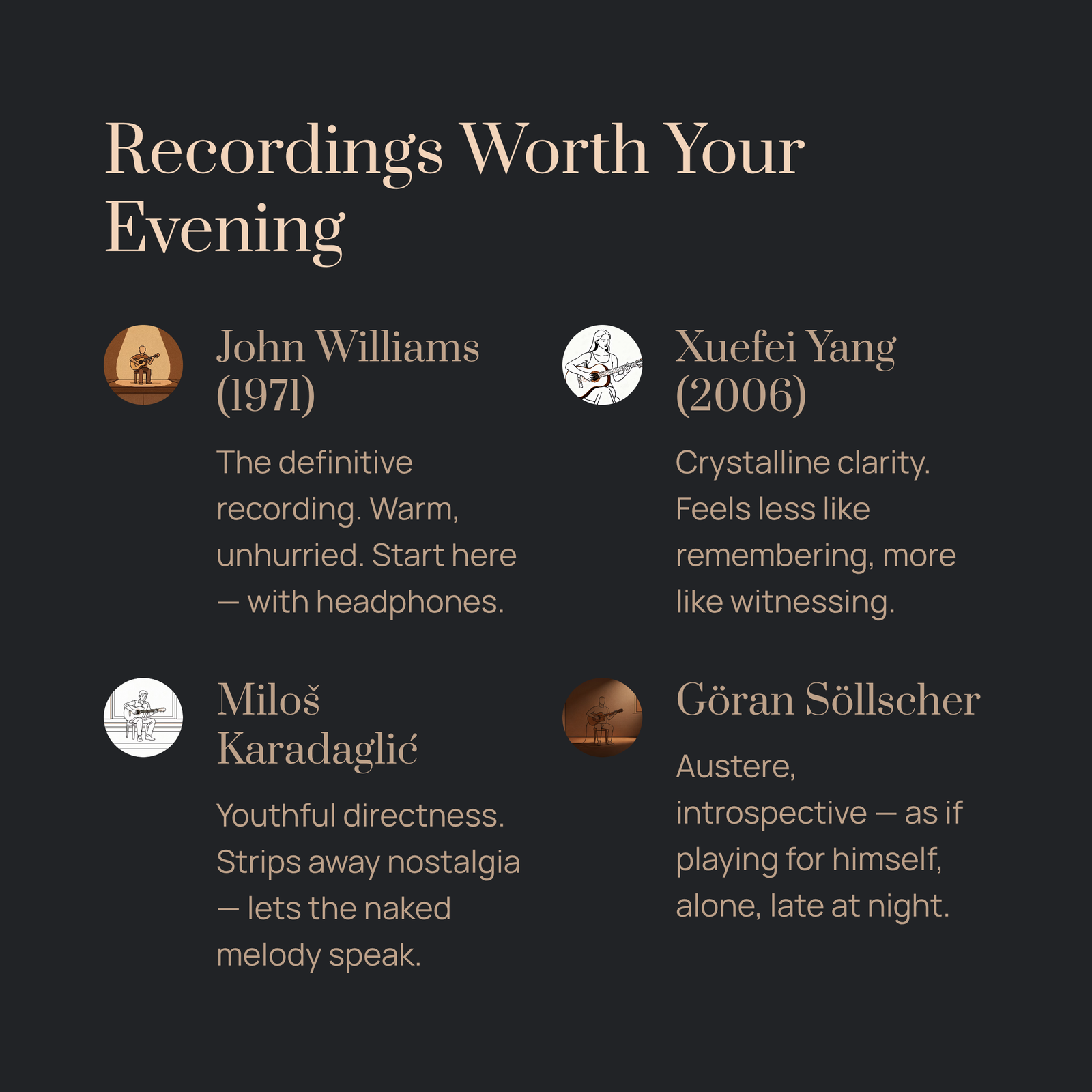
Recordings Worth Your Evening: Finding the Right Voice for the Melody
The definitive recording remains John Williams’ original. His tone is warm and unhurried, each phrase shaped with the patience of someone who understands that silence is as important as sound. If you are encountering Cavatina for the first time, start here. Listen with headphones if you can, and pay attention to how much space exists between the notes — that space is where the emotion lives.
For a different perspective, seek out Xuefei Yang’s 2006 recording on her album Romance de Amor. Yang brings a crystalline clarity to the piece, with a slightly brighter tonal palette that reveals harmonic details Williams’ warmer approach sometimes softens. Her interpretation feels less like remembering and more like witnessing.
Miloš Karadaglić, the Montenegrin guitarist who has done perhaps more than anyone in the twenty-first century to bring classical guitar to mainstream audiences, also recorded a memorable version. His playing has a youthful directness that strips away some of the piece’s accumulated nostalgia and lets the naked melody speak for itself.
And if you want something truly unexpected, look for Göran Söllscher’s recording on Deutsche Grammophon. Söllscher’s approach is more introspective, almost austere, as though he is playing the piece not for an audience but for himself, alone in a room, late at night.
Each of these guitarists finds something different in the same notes. That is the mark of a great composition — it is generous enough to accommodate many truths.

Sitting with the Silence After the Last Note
I think there is a reason Cavatina endures in a way that so much film music does not. Most movie themes want to make you feel something specific: triumph, terror, romance. Cavatina does not insist. It simply opens a door and lets you walk through it carrying whatever you happen to be holding at the time. If you are grieving, it grieves with you. If you are at peace, it deepens that peace. If you are simply tired at the end of a long day and need to hear something that acknowledges the weight of being alive without trying to fix it, Cavatina is there.
Stanley Myers may not have known, back in 1970, that he was writing one of the most emotionally precise pieces of music of the twentieth century. He certainly did not know it would find its home in a film about the psychic wounds of war, or that it would still be moving strangers to tears half a century later. But perhaps that is fitting. The best melodies, like the best truths, do not announce themselves. They arrive quietly, settle into your chest, and stay.
Put it on tonight. No distractions. Just the guitar, the silence, and whatever it is you need to feel.