📑 Table of Contents
- Who Is Joe Hisaishi, and Why Does His Music Feel Like a Memory?
- The Film, the Story, and the Problem of Being 14
- What to Listen For: A Beginner’s Listening Guide
- The “Country Roads” Thread: A Detail That Changes Everything
- How to Listen: Three Recommended Entry Points
- Why This Piece Matters Beyond the Film
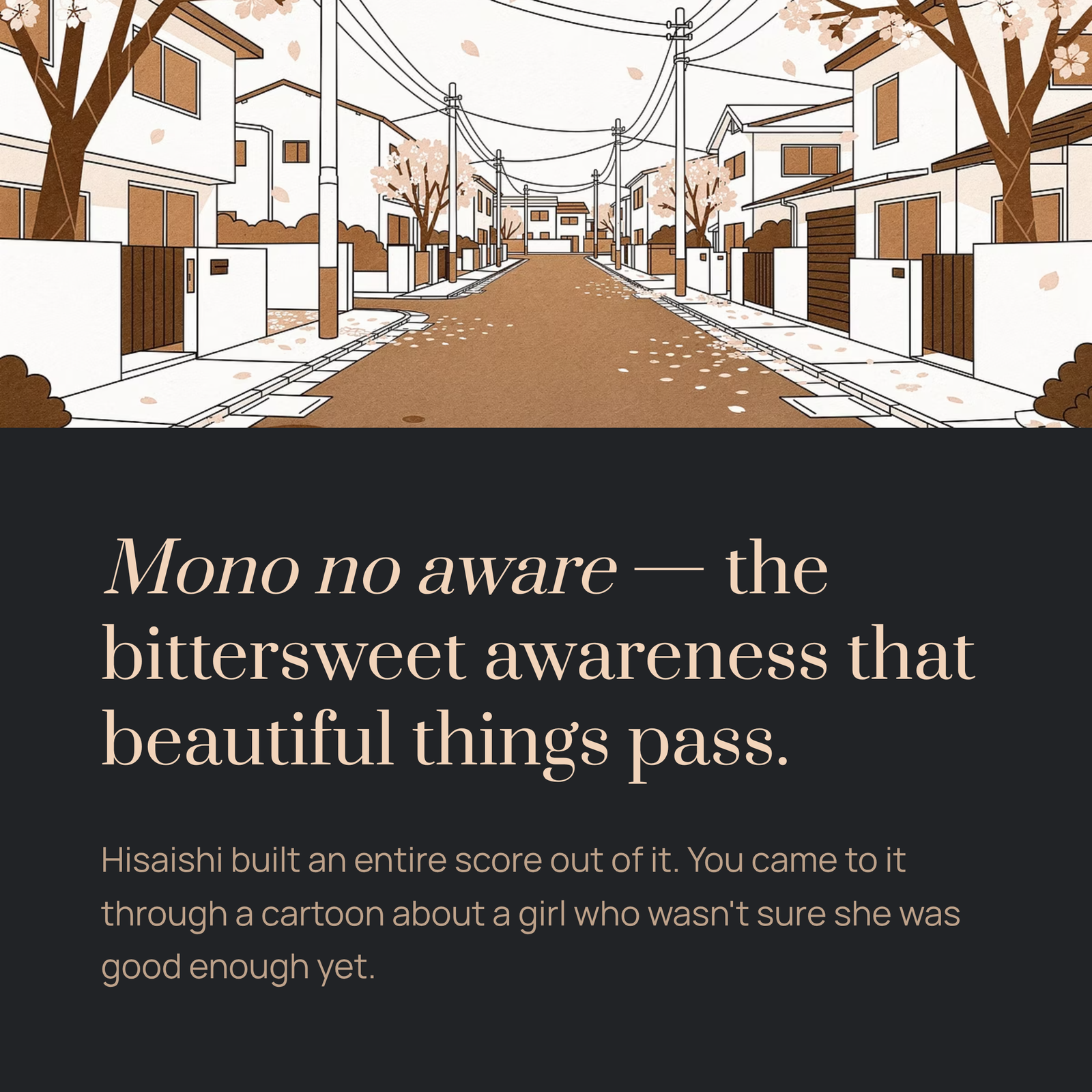
There’s a specific kind of longing that doesn’t have a name in English. The Japanese call one version of it mono no aware — the bittersweet awareness that beautiful things pass. Joe Hisaishi built an entire film score out of it in 1995, and somewhere between the first piano note and the swelling strings of Whisper of the Heart, that feeling climbs into your chest and doesn’t leave.
You probably didn’t come to this piece through a concert hall. You came through a cartoon about a girl who wanted to be a writer — and wasn’t sure she was good enough yet. That’s the point. That’s always been the point.
Who Is Joe Hisaishi, and Why Does His Music Feel Like a Memory?
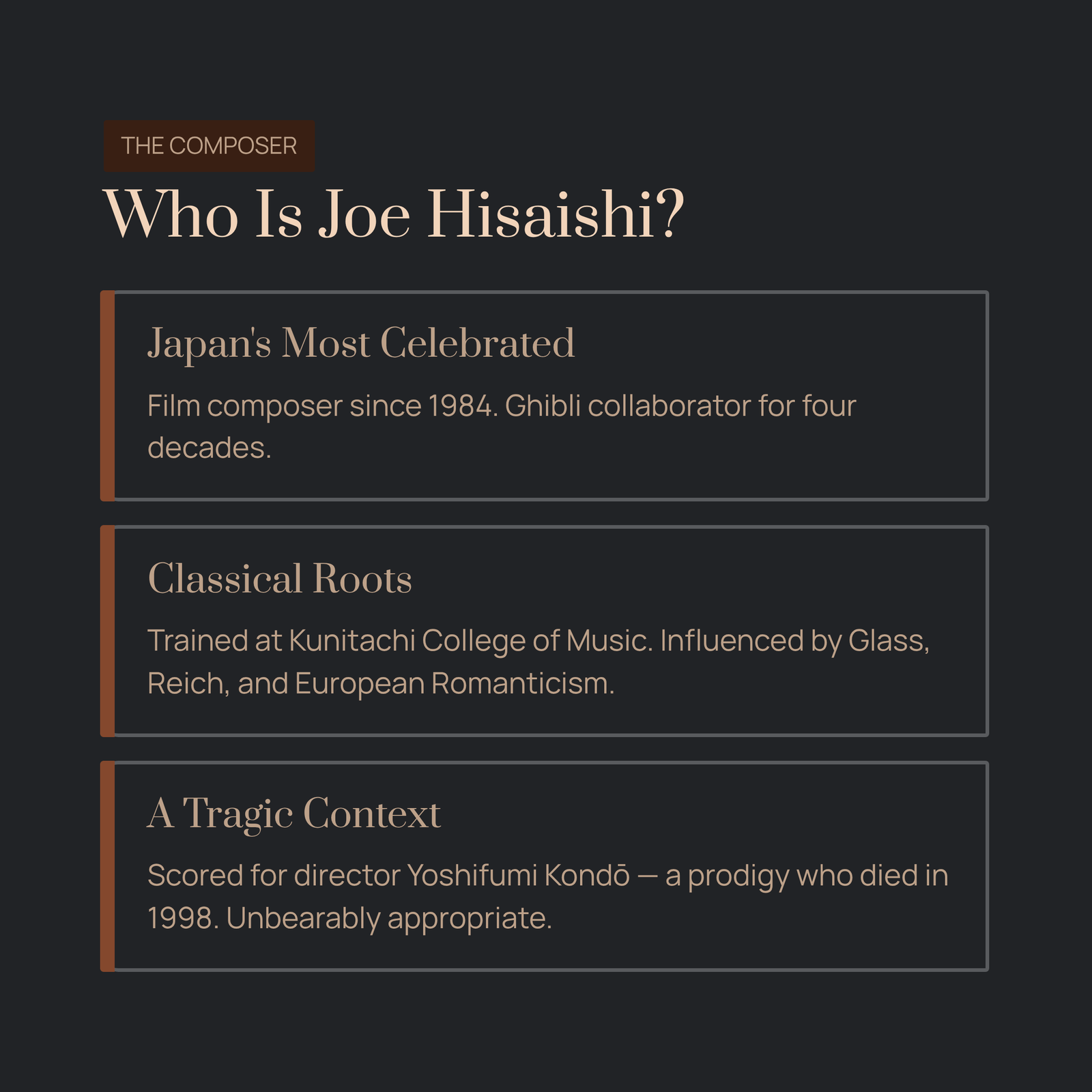
Joe Hisaishi (born Mamoru Fujisawa in 1950) is Japan’s most celebrated film composer — a title that understates just how permanently his work has lodged itself in global popular consciousness. His collaboration with Studio Ghibli’s Hayao Miyazaki began in 1984 with Nausicaä of the Valley of the Wind, and over four decades, the two have created a body of work that routinely tops polls of the most beloved film music ever written.
But Hisaishi isn’t Miyazaki’s shadow. He’s a trained classical composer who studied at the Kunitachi College of Music in Tokyo and absorbed equal parts minimalism (Philip Glass and Steve Reich are audible in his DNA) and European Romanticism. He writes music that sounds simultaneously ancient and invented five minutes ago. His harmonies are simple on the surface and quietly devastating underneath.
Whisper of the Heart was, notably, not a Miyazaki film. It was directed by Yoshifumi Kondō — a prodigy widely expected to become Ghibli’s next visionary, whose early death in 1998 remains one of animation’s great losses. Hisaishi scored a film about artistic ambition for a director who barely had time to show his own. There is something unbearably appropriate about that.

The Film, the Story, and the Problem of Being 14
Whisper of the Heart (Mimi wo Sumaseba, 1995) follows Shizuku Tsukishima, a bookish middle-schooler in suburban Tokyo who keeps noticing the same name — Seiji Amasawa — on the library cards of every book she checks out. She tracks him down. He’s infuriating and talented and going to Italy to apprentice as a violin maker. She decides, in the irrational way only teenagers can, to write a fantasy novel before he returns.
The film is not about magic. It’s about the terror and necessity of attempting something you’re not yet qualified to do.
Hisaishi’s score is built around that terror. The main theme — sometimes called “Whisper of the Heart” or “Theme from Mimi wo Sumaseba” — is a piano piece that later blooms into full orchestration. It doesn’t announce itself. It begins tentatively, like someone choosing their first words carefully, and then gradually finds its confidence. By the time the strings arrive, something in you has already surrendered.
What to Listen For: A Beginner’s Listening Guide
You don’t need to know music theory to hear what Hisaishi is doing — but knowing a few things will deepen the experience.
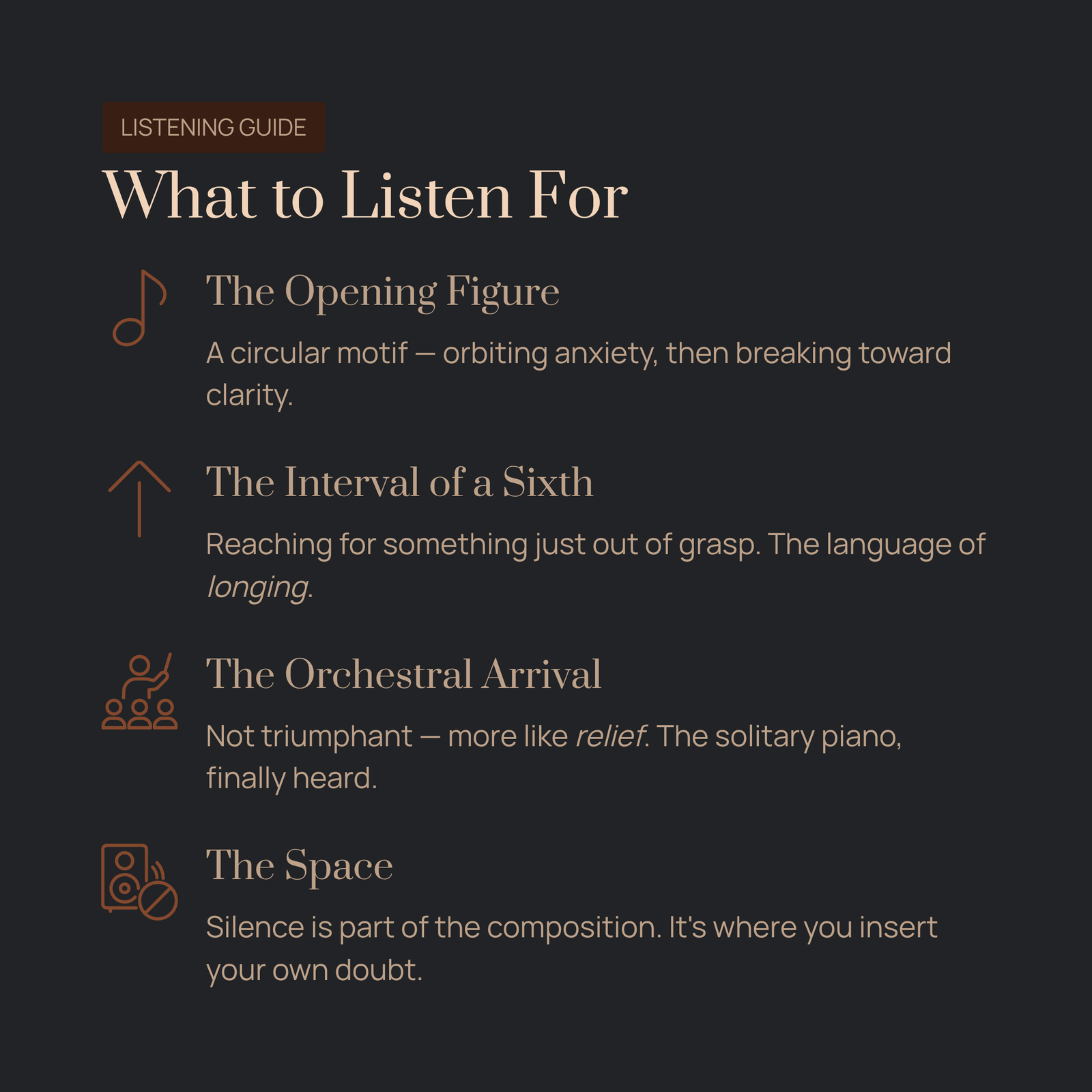
The opening piano figure. Notice how the main melody begins with a small, circular motif — it spirals around itself before finding a direction. Hisaishi is mimicking the way a young person’s thoughts move: orbiting the same anxiety, then suddenly breaking toward clarity.
The interval of a sixth. Much of the theme is built on leaps of a sixth — that particular emotional interval that sounds like reaching for something just out of grasp. It’s the same interval Schumann used obsessively in his music for Clara. It means longing in the language of Western tonal music, and Hisaishi knows exactly what he’s doing.
The orchestral expansion. When the strings enter — typically around the piece’s midpoint in its full arrangement — the effect isn’t triumphant. It’s something more like relief. As if the solitary piano has finally been joined, has been heard. For a film about a girl working alone in her room, convinced her writing is mediocre, this orchestral arrival carries enormous narrative weight even when you’re listening without the images.
The use of space. Hisaishi is a devoted minimalist in the Philip Glass tradition. He leaves room between phrases. He lets notes decay. The silence is part of the composition — it’s where you insert your own version of Shizuku’s doubt.
The “Country Roads” Thread: A Detail That Changes Everything
One of the most quietly clever things about the Whisper of the Heart score is what Hisaishi does with John Denver’s Take Me Home, Country Roads.
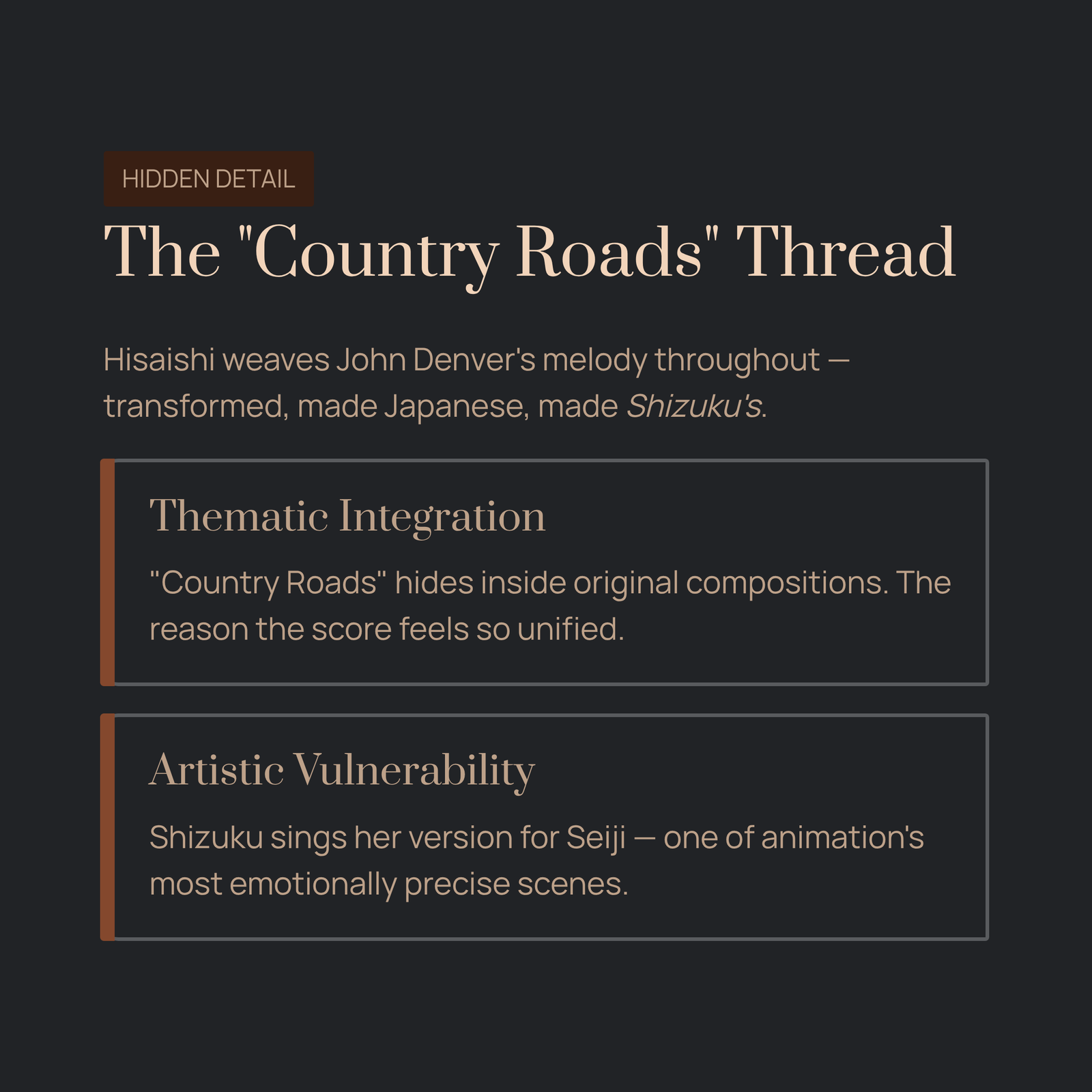
The film opens with a scene of suburban Tokyo, and over this image plays a Japanese pop arrangement of Denver’s song — localized, slightly awkward, and completely charming. Throughout the movie, Shizuku attempts her own version of the song, writing new Japanese lyrics. By the film’s final act, she sings her version for Seiji in a scene that is, without exaggeration, one of the most emotionally precise depictions of artistic vulnerability in all of animated film.
Hisaishi weaves fragments of that melody into the orchestral score throughout. If you know to listen for it, you’ll hear “Country Roads” hiding inside the texture of his original compositions — transformed, made Japanese, made Shizuku’s. It’s a masterclass in thematic integration, and it’s the reason the film’s score feels so unified even when you can’t consciously identify why.

How to Listen: Three Recommended Entry Points
Start with the original soundtrack. The album Whisper of the Heart: Image Album (1995) is the cleanest introduction. Hisaishi’s piano arrangements are more intimate here than the orchestral film score — closer to what you might hear in a recital hall.
Watch the antique shop scene. If you haven’t seen the film, search for the sequence where Shizuku first hears “Country Roads” played in the antique shop — a spontaneous performance that brings together strangers of different generations. It is the emotional center of the film, and the music Hisaishi writes around it is where his compositional intelligence is most visible.
Listen to a live orchestral performance. Hisaishi regularly conducts his own Ghibli scores with major orchestras worldwide. His One Summer’s Day and Merry-Go-Round of Life (from Howl’s Moving Castle) frequently appear alongside Whisper of the Heart themes in these concerts. The BBC Proms 2023 featured his work, and recordings circulate widely. The live context transforms what already felt large into something almost unbearable in the best way.
Why This Piece Matters Beyond the Film
It would be easy — and wrong — to file Hisaishi’s Whisper of the Heart under “anime music” and move on. That category, while accurate, doesn’t capture what the piece is doing musically or emotionally.
What Hisaishi wrote is a score about creative adolescence — about the specific anguish of knowing what you want to become before you have the skill to become it. That anguish has no age limit. It belongs to the 14-year-old writing her first novel and to the 45-year-old who has been revising the same paragraph for three years.
The main theme works because it doesn’t resolve too quickly. It sits in its uncertainty. It doesn’t promise the writing will be good, or that Seiji will come home, or that anything will work out the way it’s supposed to. It just keeps moving forward, one phrase at a time, which turns out to be the only advice worth giving.
There’s a line late in the film when Shizuku’s father tells her something close to this: Don’t compare yourself to others. Just ask yourself whether you’re living honestly.
Joe Hisaishi put that entire sentence into a single musical theme. And somehow, when you hear it, you already know he’s right.