📑 Table of Contents
There’s a cruel irony at the heart of Coco‘s most celebrated piece of music.
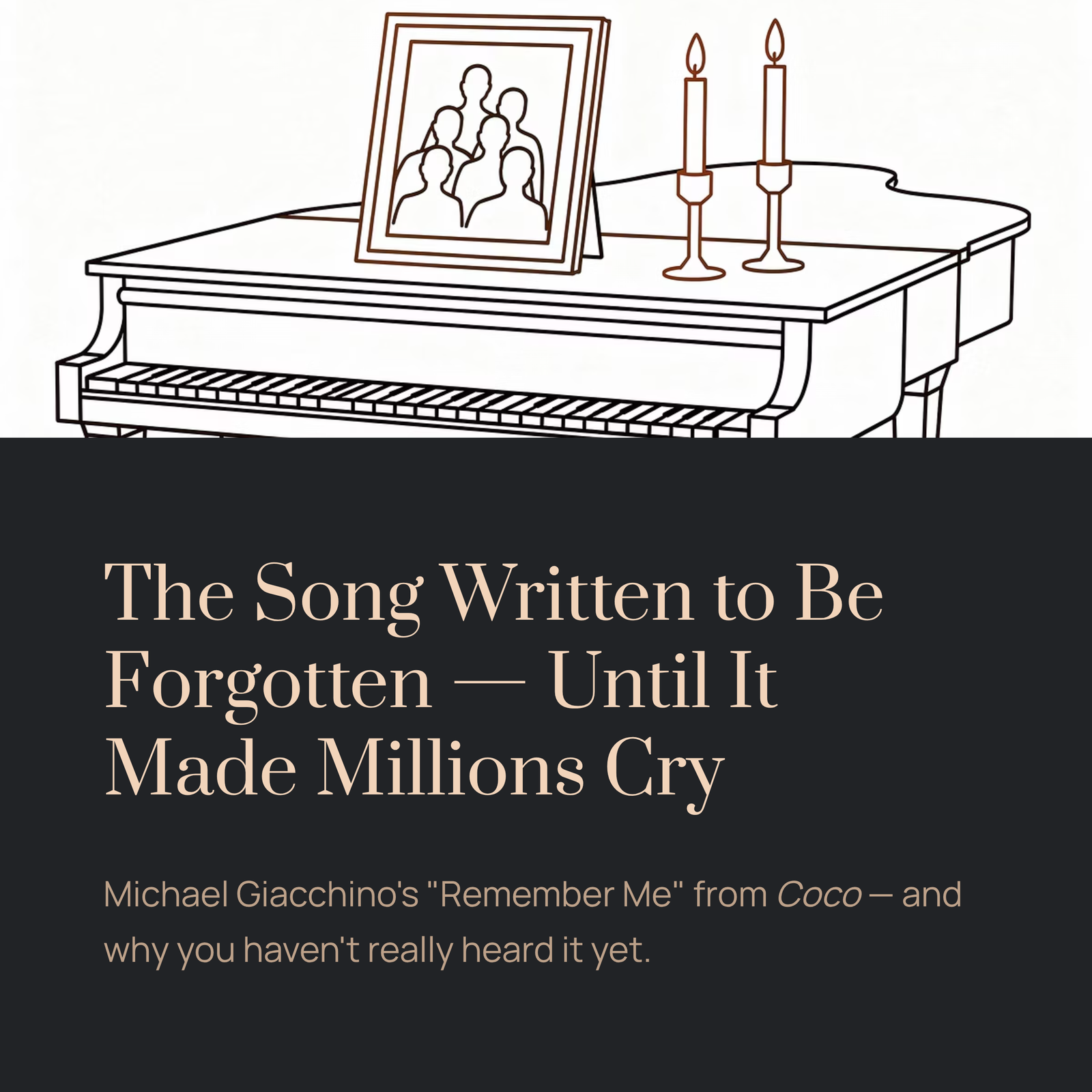
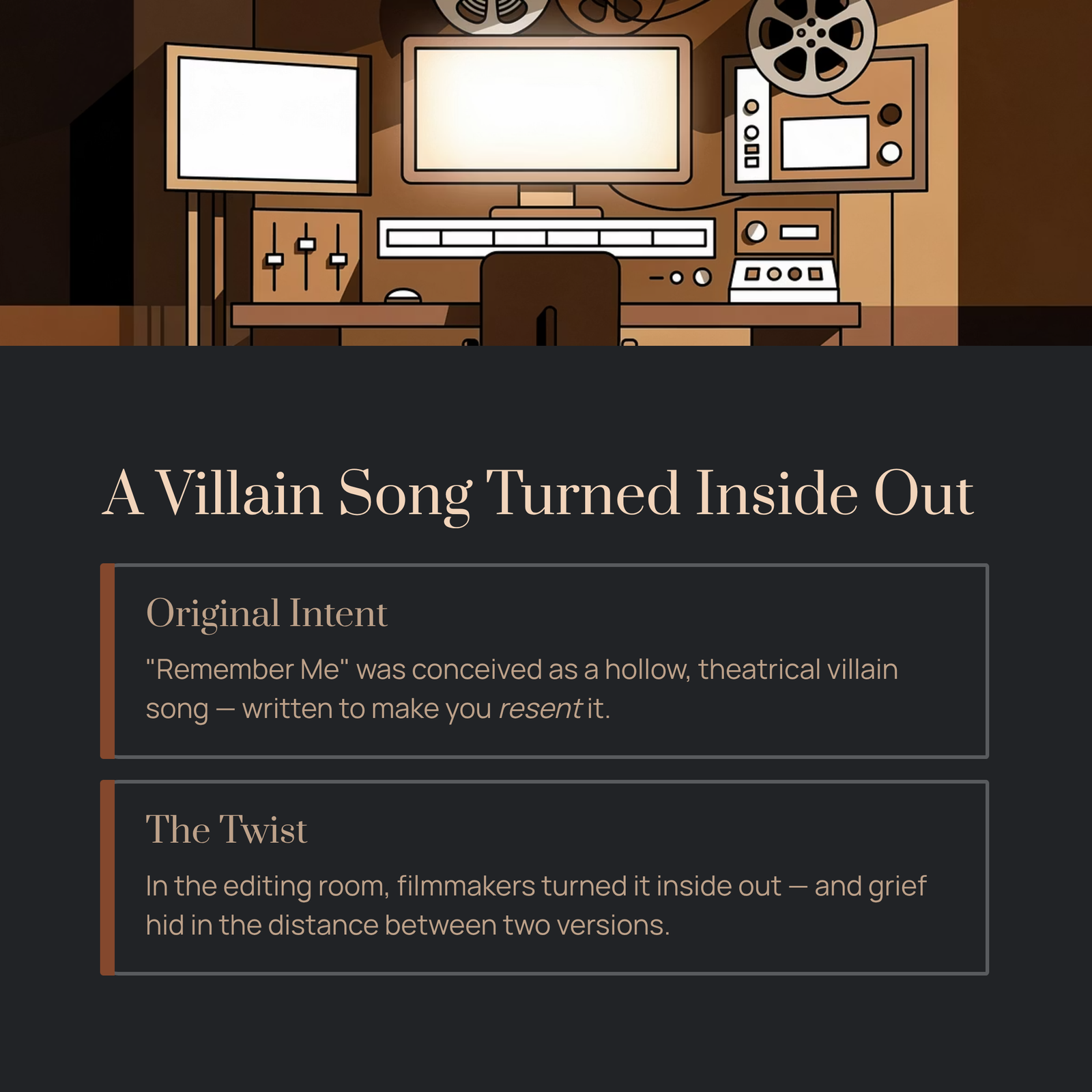
“Remember Me” — the piano ballad that leaves grown adults reaching for tissues in darkened theaters — was originally conceived as a villain song. A hollow, glittering number for a fame-hungry performer to belt out with theatrical narcissism. It was meant to represent everything shallow about chasing celebrity over family. It was written to make you resent it.
And then something happened in the editing room. The filmmakers turned it inside out.
What you hear in the final film isn’t just a melody. It’s a composition that lives two completely separate lives — and the distance between those two lives is where the grief hides. If you’ve only ever heard “Remember Me” as background music, you haven’t really heard it yet.
Who Is Michael Giacchino?
Before we go further, it’s worth pausing on the man behind the music — because Michael Giacchino’s story is itself a lesson in what this song is about.
Giacchino grew up obsessed with film scores. As a kid in New Jersey, he would record movie soundtracks off the television onto cassette tapes and listen to them on repeat. He wanted to be John Williams. He studied at the Juilliard School and eventually broke into the industry through video games — composing for Medal of Honor at a time when nobody took game music seriously.
His first major film break came with Pixar, scoring The Incredibles in 2004. From there, his career expanded into some of the defining soundtracks of the 2000s and 2010s: Up, Ratatouille, Star Trek, Mission: Impossible – Ghost Protocol, Doctor Strange, Jurassic World. He won the Academy Award for Best Original Score for Up in 2010.
What distinguishes Giacchino from other Hollywood composers isn’t technical complexity — it’s emotional directness. His melodies tend to be deceptively simple, almost nursery-rhyme in their accessibility. But he layers emotional context around them with extraordinary precision. He understands that the most devastating musical moments in cinema aren’t complicated. They’re familiar. They’re songs you feel like you’ve always known.
“Remember Me” is his masterwork in that tradition.
The Architecture of a Lullaby
Let’s talk about the music itself — and don’t worry, you don’t need to read sheet music to follow this.
“Remember Me” is built on one of the oldest compositional principles in Western music: theme and variation. You introduce a simple idea, then you transform it across the piece, letting the emotional meaning of the transformations do the work.
The theme itself is almost childishly simple. In its piano form, it’s gentle, unhurried, and shaped around a rocking, lullaby-like rhythm. The intervals — the distances between notes — are small and close together, which creates a feeling of intimacy and enclosure. This is music that exists at low volume, at close range. It’s music for a quiet room.
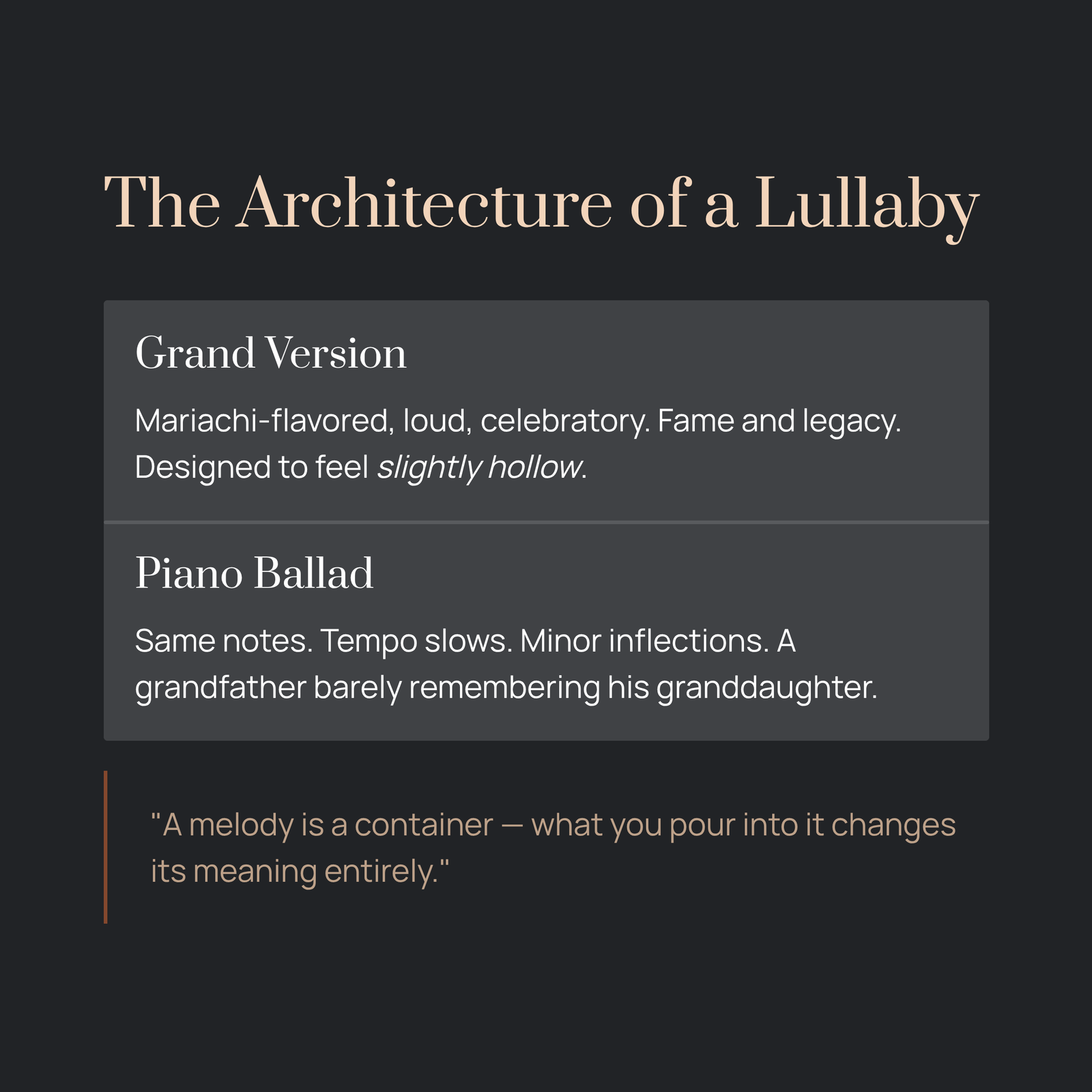
But here is what Giacchino and the filmmakers understood: a melody is a container, and what you pour into it changes its meaning entirely.
In its first incarnation in the film, “Remember Me” appears as a grand, mariachi-flavored production number. It’s loud, celebratory, performed for a crowd. The lyrics speak of fame and legacy — a performer telling his audience he’ll live on through his music. It sounds like triumph. It’s designed to feel slightly hollow.
In its piano ballad form — the version that has circulated millions of times on YouTube and streaming platforms — the same notes become something utterly different. The tempo slows to a near-stop. The harmonic underpinning shifts toward minor inflections. And when the melody is finally sung softly by a grandfather to the granddaughter he can barely remember, the words “Remember me / though I have to say goodbye / remember me / don’t let it make you cry” arrive with the full weight of everything the film has built toward.
Same notes. Different world.
Why the Piano Version Specifically Hits Different
There’s a reason the piano arrangement has become the definitive way most people know this piece, even though it wasn’t composed for solo piano first.
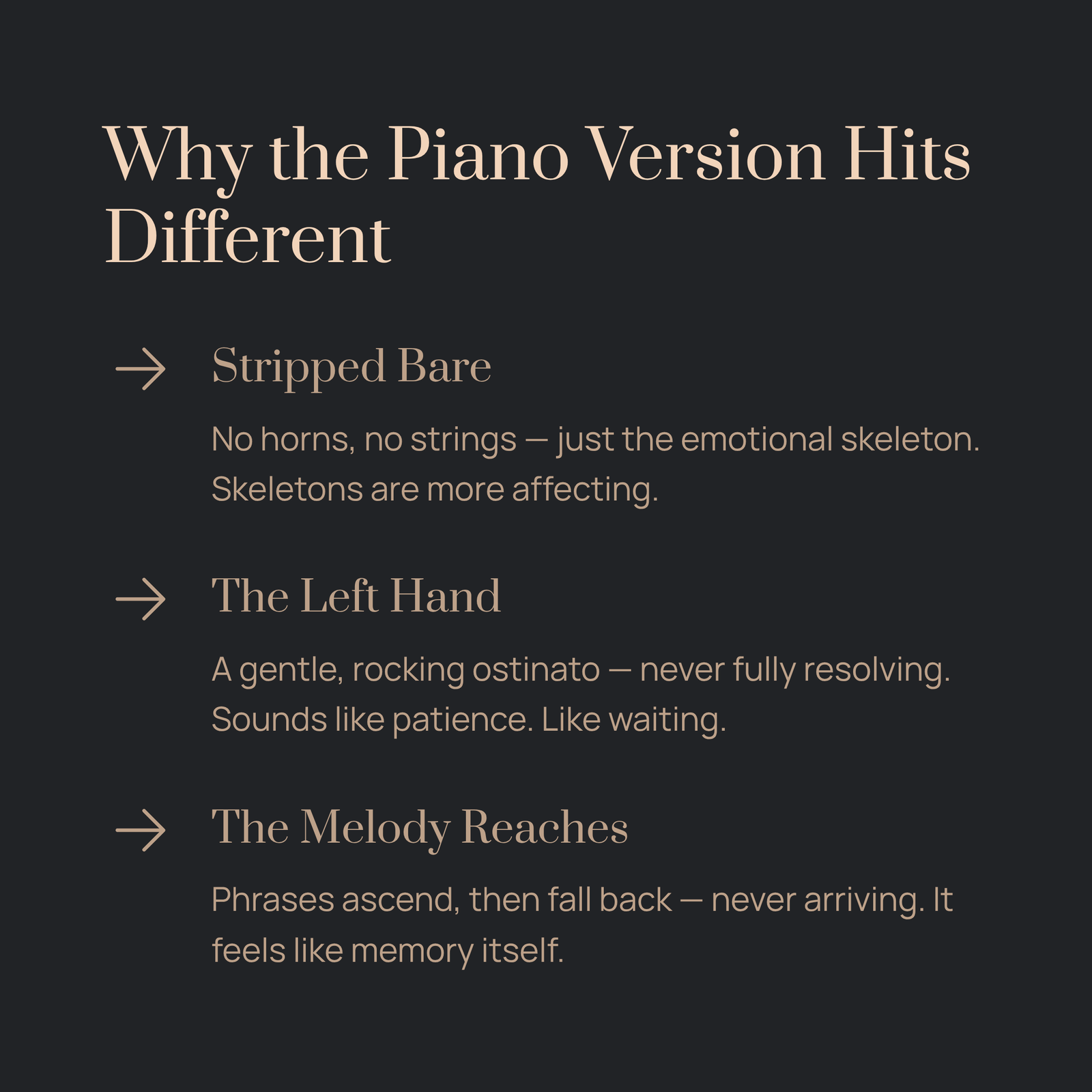
The piano strips away everything except the melody and its harmonic support. No mariachi horns. No strings swelling underneath. No production gloss. What you’re left with is the essential emotional skeleton of the piece — and skeletons, it turns out, are more affecting than the fully clothed versions.
When you listen to the piano rendition, pay attention to the left hand. It’s doing something subtle but crucial: it maintains a gentle, rocking ostinato — a repeating pattern — that never quite resolves into full stability. It keeps moving, gently restless, like someone sitting beside a hospital bed or rocking a child to sleep. It sounds like patience. It sounds like waiting.
The right hand carries the melody above it, and Giacchino gives it this beautiful quality of reaching — phrases that ascend toward higher notes and then gently fall back, never quite arriving at where they seem to want to go. In music theory, we’d call this “melodic tension and release,” but experientially, it feels like longing. It feels like memory itself — the way a recollection of someone comes close and then recedes.
How to Listen: A Practical Guide
If you’re new to listening to film music as a serious artistic form, here’s how to approach “Remember Me” as a piece of music rather than just a movie moment:
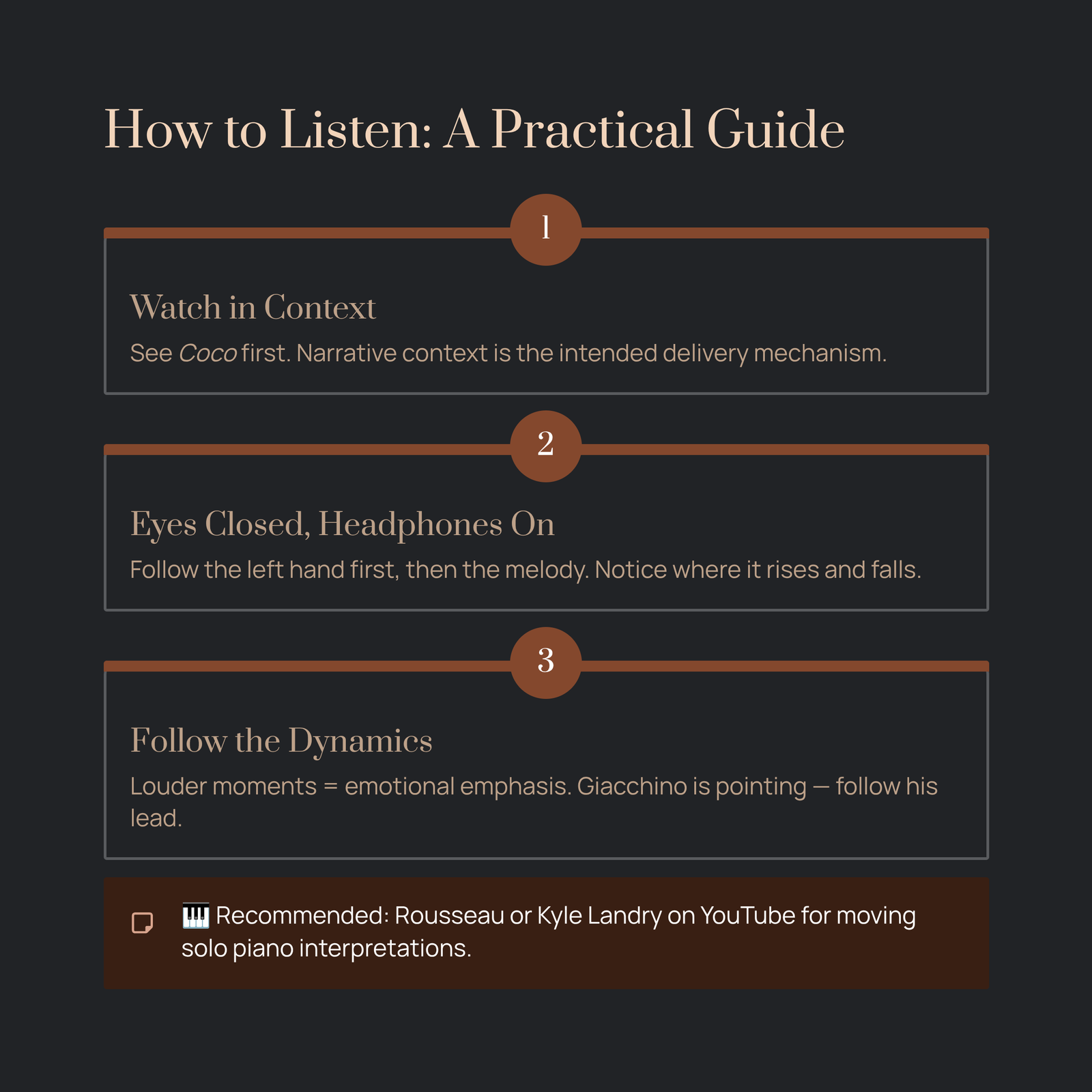
First listen: Watch it in context. If you haven’t seen Coco (2017), watch the film first. The piano version appears near the end — you’ll know the scene when you reach it. Experiencing it in narrative context isn’t cheating; it’s the intended delivery mechanism.
Second listen: Eyes closed, headphones on. Listen to the piano-only arrangement in isolation. Focus on the left hand first — just follow the rhythm of the accompaniment for the first minute. Then switch your attention to the melody. Notice where it rises, where it falls, where it pauses.
Third listen: Follow the dynamics. Notice where the music gets slightly louder and where it retreats. These are the moments of emotional emphasis — Giacchino and his orchestrators are pointing at things, and following their pointing reveals the emotional architecture beneath the notes.
A recommended recording: The official piano arrangement from the Coco soundtrack (available on most streaming platforms) is the cleanest place to start. For a particularly moving solo piano interpretation, search for performances by pianists like Rousseau or Kyle Landry on YouTube — both have created arrangements that honor the spare quality of the original.
What This Song Is Actually About
The deepest layer of “Remember Me” isn’t about death, even though it appears in a film about the Land of the Dead.
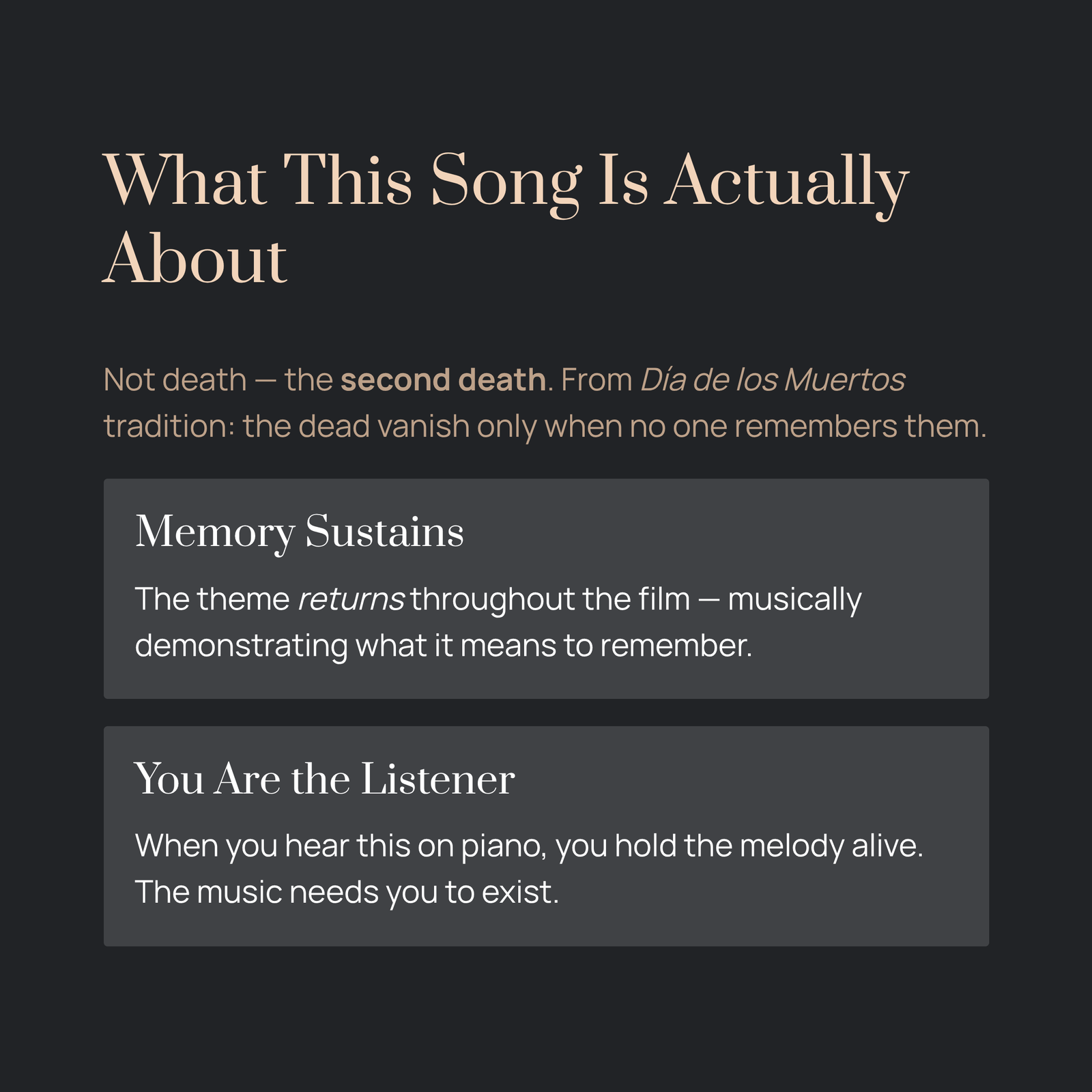
It’s about the second death — a concept Coco takes from Mexican Día de los Muertos tradition. In the film’s mythology, the dead only truly disappear when there is no one left alive who remembers them. Memory is the sustaining force. Forgetting is the final erasure.
Giacchino’s melody embeds this idea into its structure. The theme keeps returning — it’s recalled throughout the film in fragments, in different keys, in different orchestrations. It demonstrates, musically, what it means to remember. To remember is to bring something back. To play a melody again is to give it another moment of life.
When you hear “Remember Me” on the piano, you are participating in that act. You are the living person holding a melody in mind. The music needs you to exist.
That’s not a small thing to ask of a piece of film music. But Giacchino asks it, and most listeners, without quite knowing why, answer yes.
A Note on Film Music as Classical Music
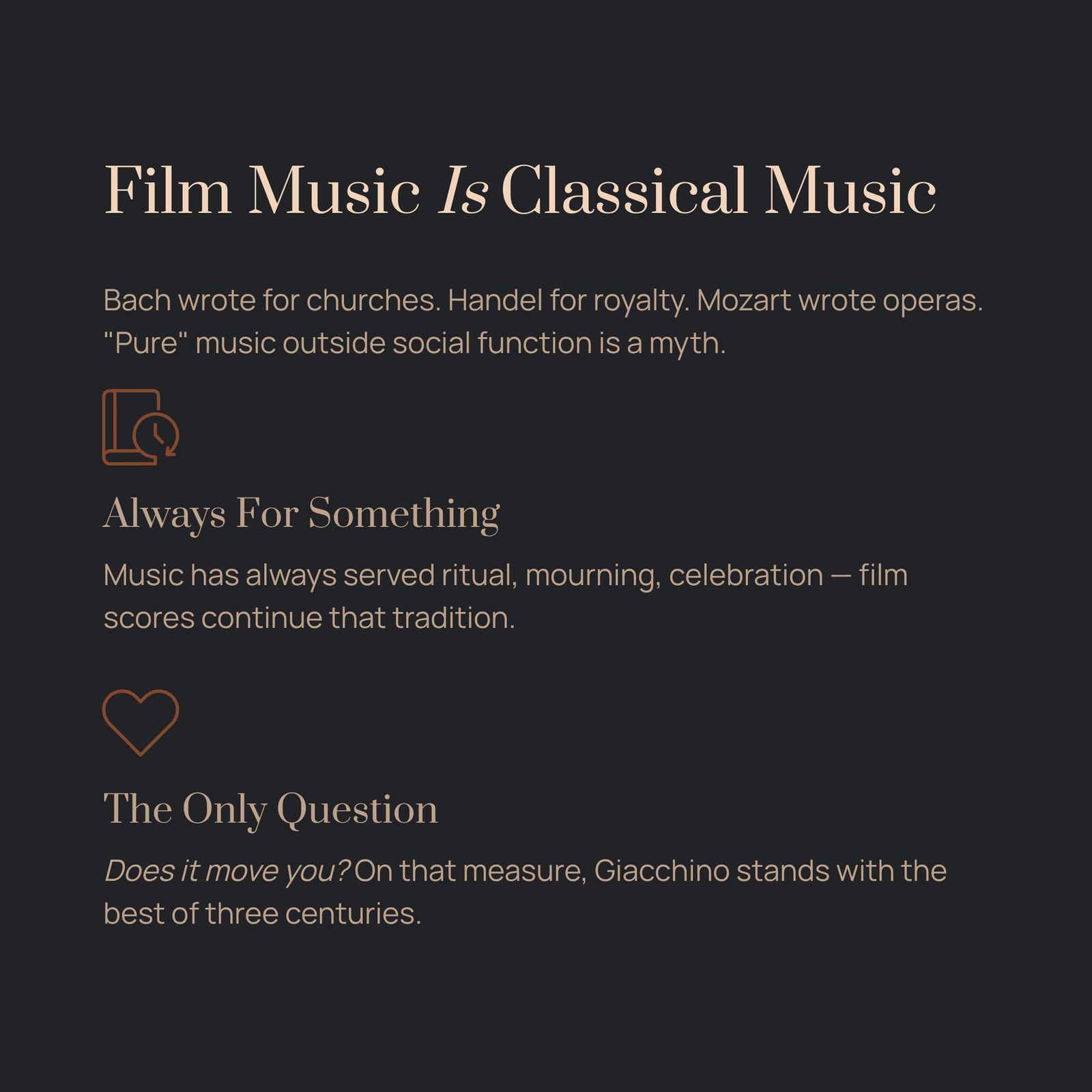
Some listeners feel uneasy treating film scores with the same seriousness as Beethoven or Chopin. There’s a historical snobbery here — the idea that music composed for narrative function is somehow less “pure” than absolute music.
This is worth examining and discarding.
Bach wrote for churches. Handel wrote for royal patronage. Vivaldi composed to teach students. Mozart wrote operas. The idea of “pure” music existing outside of social function is a relatively recent invention — and it’s never been entirely true. Music has always been for something: for ritual, for dancing, for mourning, for celebration.
Film music is, in its finest examples, exactly in this tradition. “Remember Me” was composed for a specific emotional and narrative purpose, and Giacchino fulfilled that purpose with the same craft, intelligence, and feeling that the best classical composers brought to their commissions.
The question to ask of any piece of music isn’t what was it written for, but does it move you. And on that measure, Michael Giacchino’s piano ballad from a Pixar film about a boy and his great-great-grandfather stands up to anything written in the past three centuries.
Further Listening
If “Remember Me” has opened a door for you, here are natural next steps in Giacchino’s catalog:
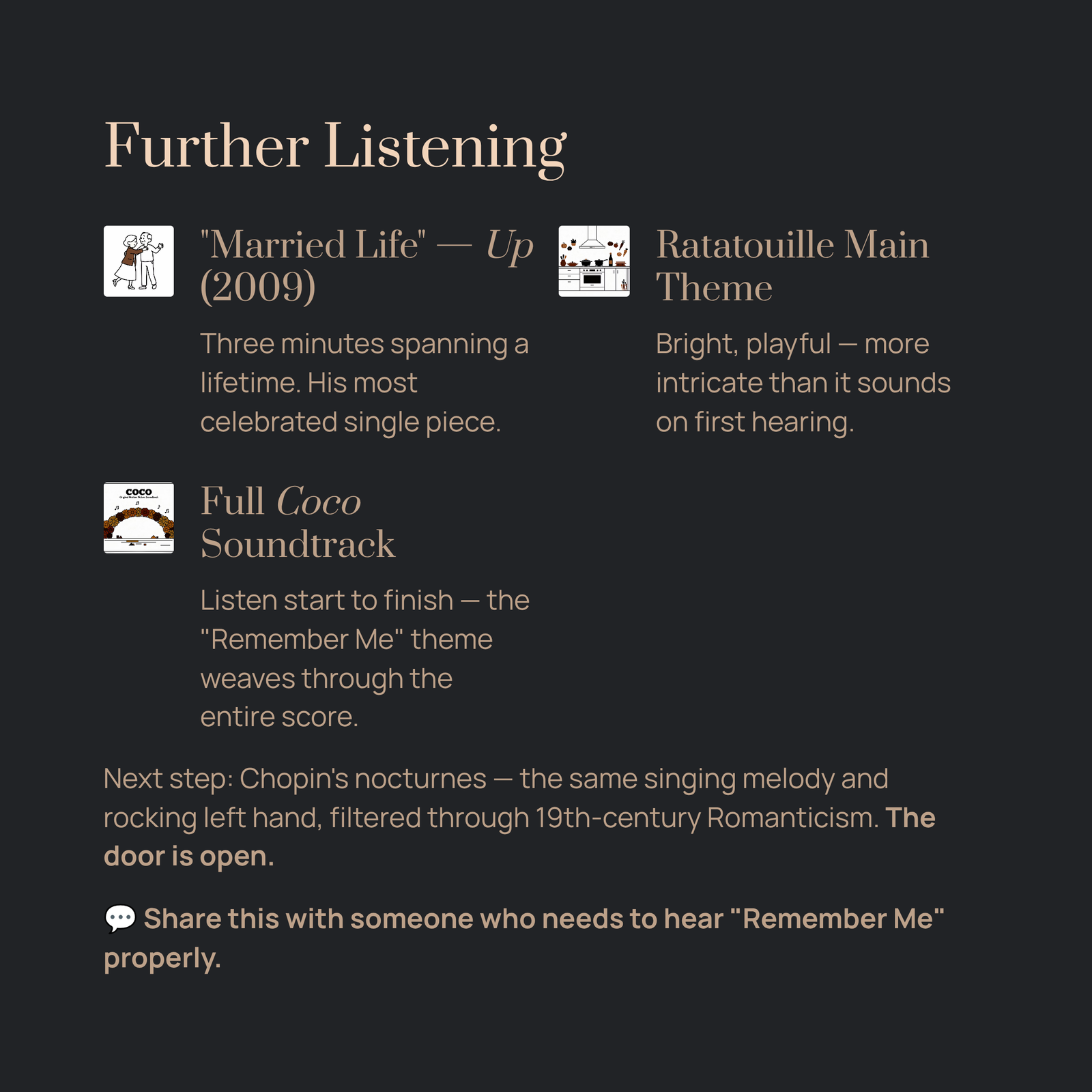
- “Married Life” from Up (2009) — arguably his most celebrated single piece, a three-minute musical montage that spans a lifetime.
- “Ratatouille Main Theme” — bright, playful, and technically more intricate than it sounds on first hearing.
- The full Coco soundtrack — listen from start to finish; Giacchino weaves the “Remember Me” theme through the entire score in ways that only become visible on a complete listen.
And if film music has sparked curiosity about the broader tradition of melodic piano music, the transition toward Chopin’s nocturnes is a natural one — the same emphasis on singing melody, rocking left-hand accompaniment, and emotional directness that makes “Remember Me” work is present in the nocturnes, just filtered through nineteenth-century Romanticism rather than twenty-first-century animation.
The door is open. Walk through it.