📑 Table of Contents
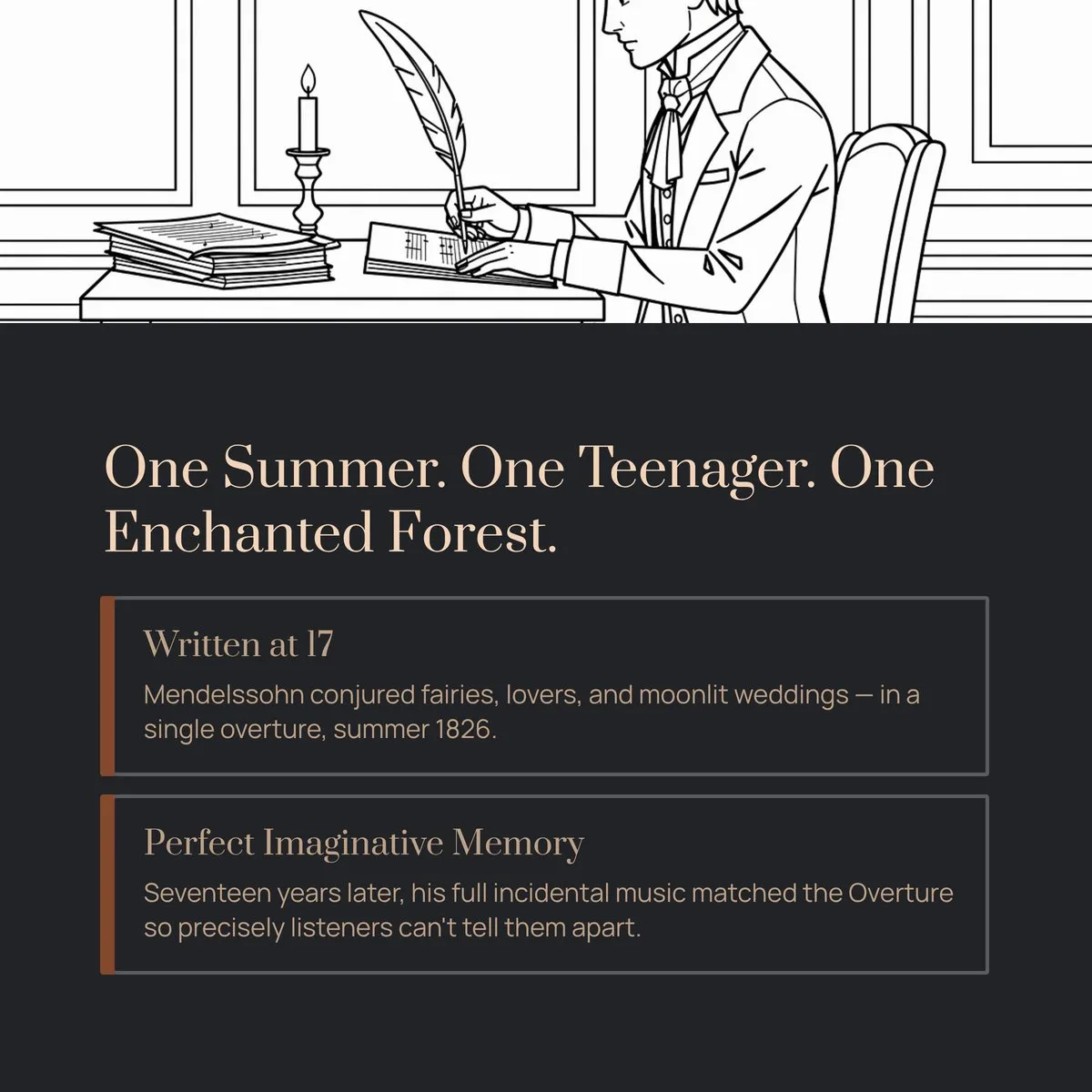
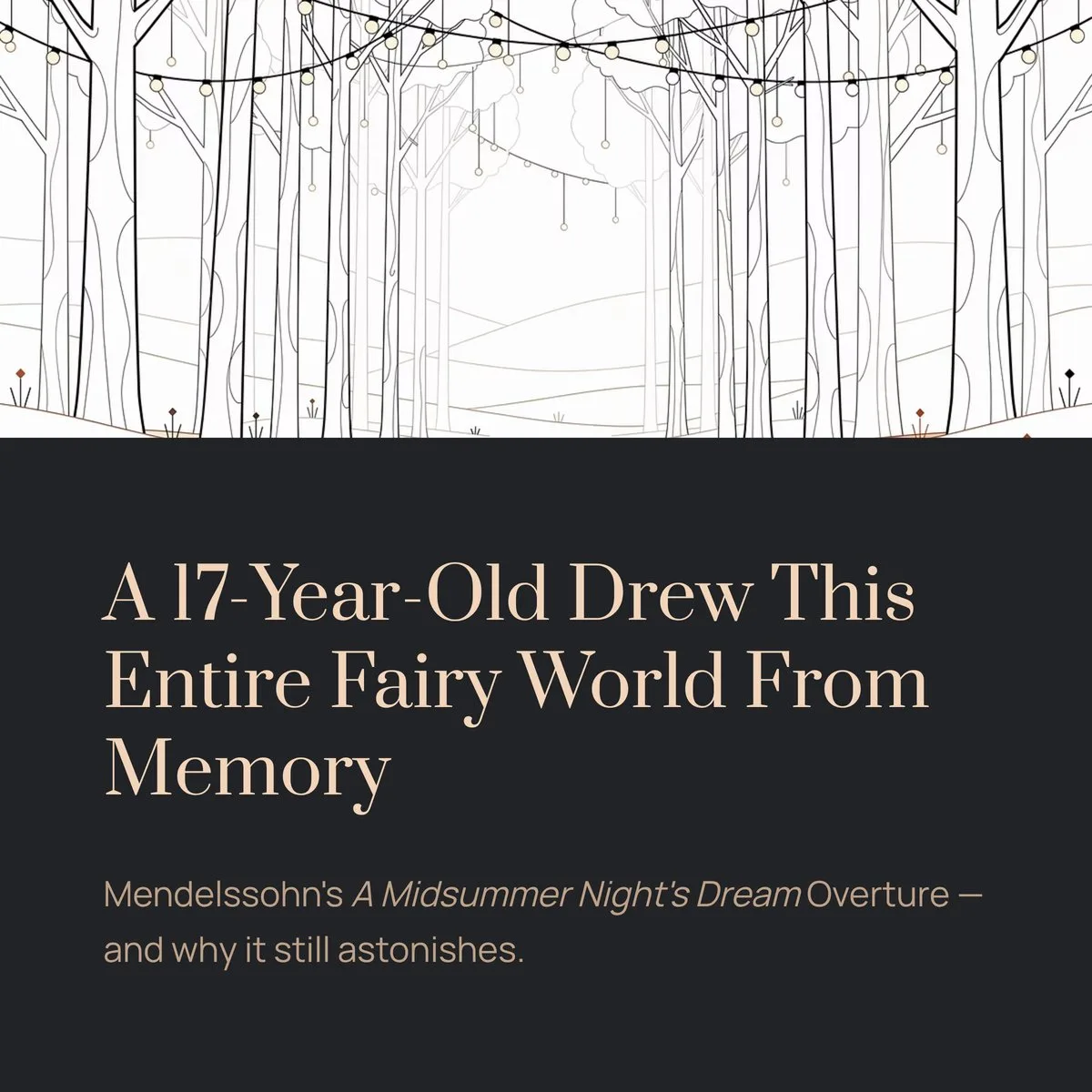
Most of us at seventeen were struggling to write a coherent essay. Felix Mendelssohn, at the same age, sat down and conjured an entire enchanted forest — complete with dancing fairies, quarreling lovers, a donkey-headed weaver, and a moonlit wedding procession — in a single orchestral overture.
He wrote A Midsummer Night’s Dream Overture in the summer of 1826, inspired by a German translation of Shakespeare’s play that he and his sister Fanny had been reading together. He had never seen the play staged. He had never visited England. He simply heard it, and wrote it down.
That fact alone should stop you in your tracks. But what’s even more astonishing is this: when he returned to the same material seventeen years later to write the full incidental music — including the famous Wedding March you’ve heard at countless ceremonies — he matched the Overture’s sound world so precisely that listeners can’t tell where the seventeen-year-old ends and the thirty-four-year-old begins. He didn’t just have talent. He had perfect imaginative memory.
Who Was Mendelssohn?
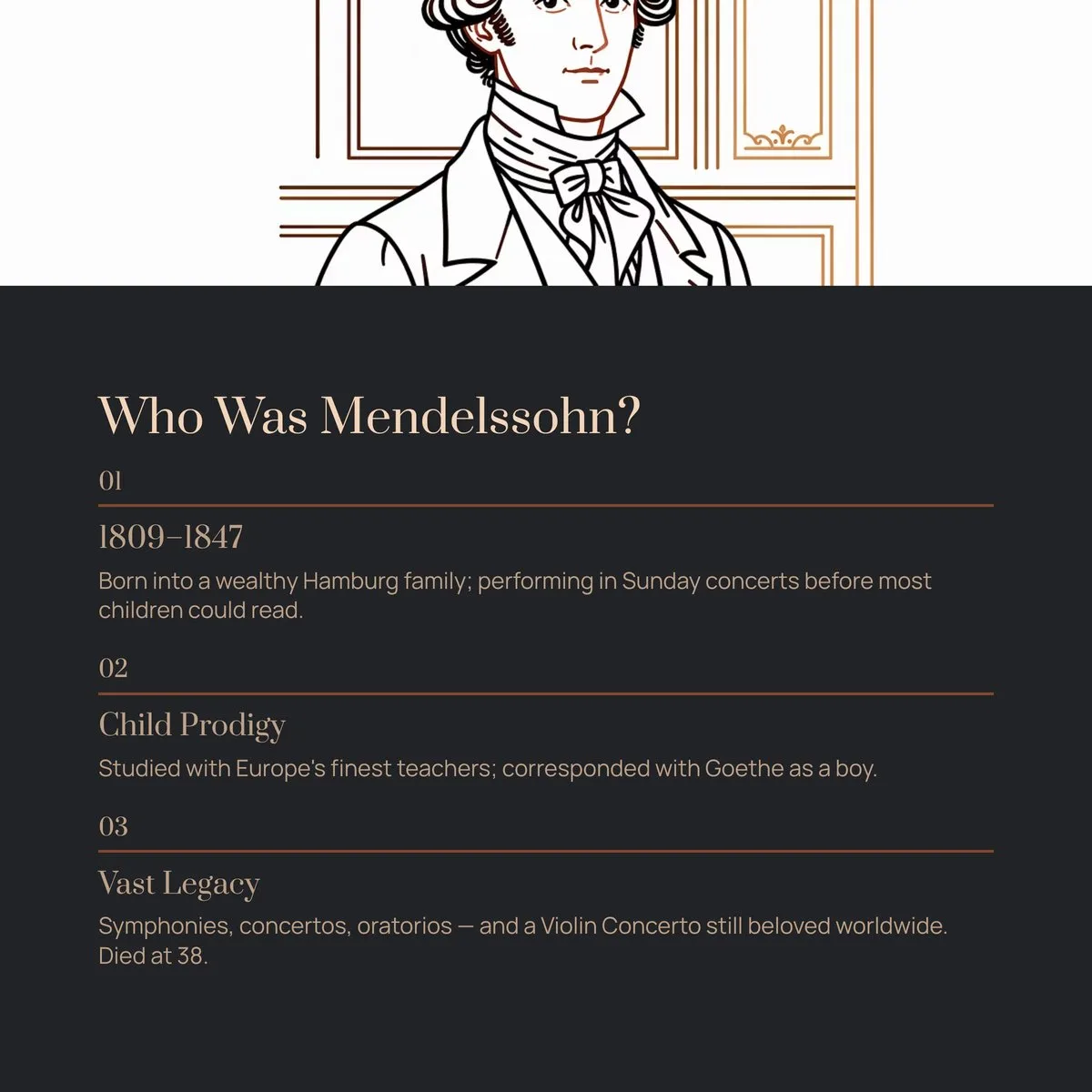
Felix Mendelssohn (1809–1847) was one of those rare figures in music history who seemed to arrive fully formed. Born into a wealthy, cultured Jewish family in Hamburg, he grew up in a household where Sunday afternoon concerts were a regular event — and he was performing in them before most children learn to read.
He was, by any measure, a child prodigy in the mold of Mozart. But unlike Mozart, who spent much of his life financially precarious and institutionally dependent, Mendelssohn had stability, education, and the freedom to develop at his own pace. He studied with some of the finest teachers in Europe, corresponded with Goethe as a boy, and by his mid-twenties was one of the most celebrated musicians on the continent.
His output spans symphonies, concertos, oratorios, chamber music, and piano works — including the Songs Without Words, gentle character pieces that helped define the domestic musical culture of the Victorian era. His Violin Concerto in E minor remains one of the most beloved in the repertoire.
He died at thirty-eight, exhausted and grief-stricken after his sister Fanny’s sudden death earlier that year. But in those thirty-eight years, he left behind a body of work that balances Classical structural clarity with Romantic emotional warmth in a way few composers have matched.
What Is This Piece, Exactly?
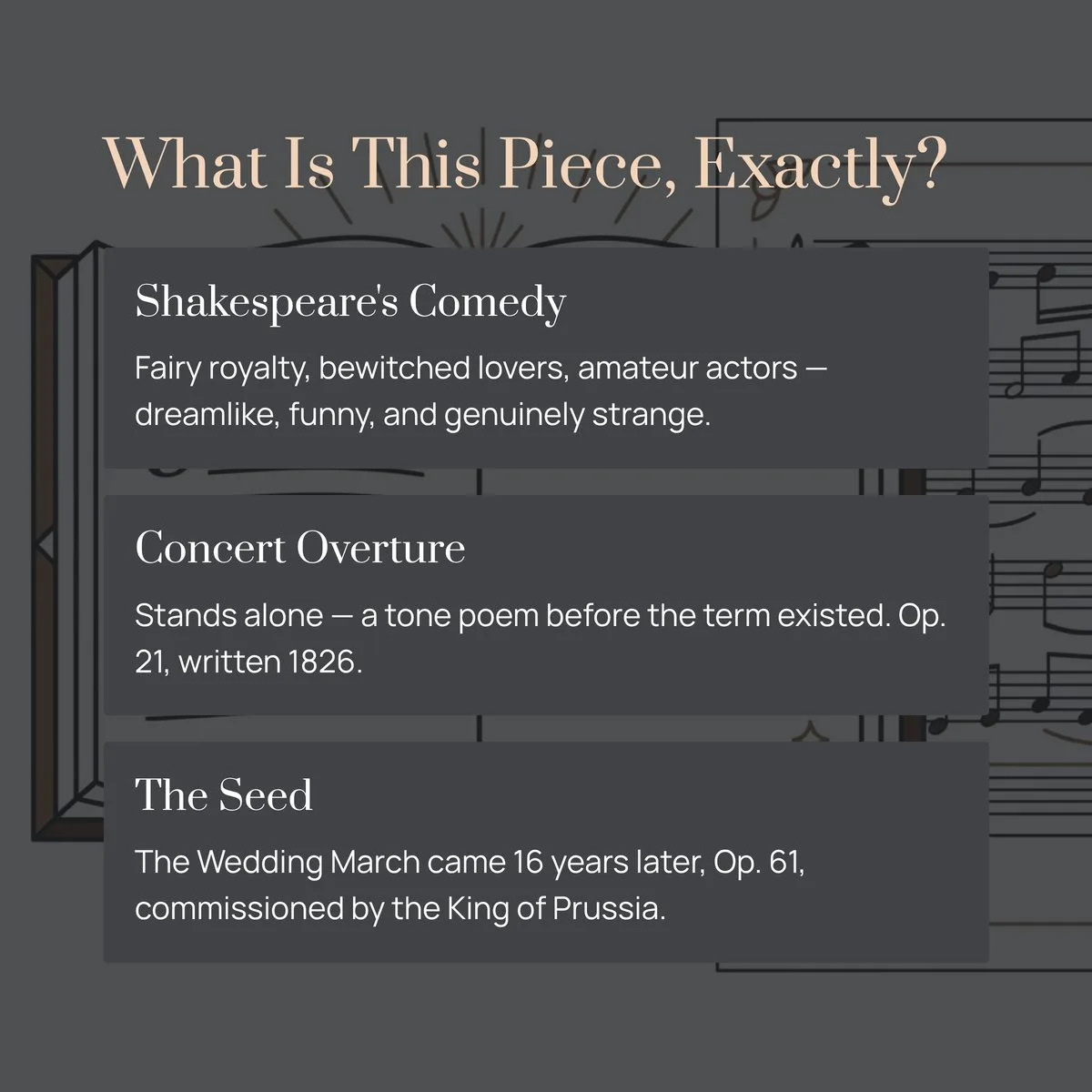
Shakespeare’s A Midsummer Night’s Dream is one of the great comedies of the English canon — a tangled story of fairy royalty, bewitched lovers, and amateur actors stumbling through an enchanted Athenian forest on a summer night. It’s chaotic, dreamlike, and funny, with a strong undercurrent of something genuinely strange and unsettling.
Mendelssohn’s Overture is a concert overture, meaning it isn’t an introduction to an opera or stage production — it stands alone as a piece of orchestral music that tells a story purely through sound. Think of it as a tone poem before the term existed.
The full incidental music, Op. 61, came later in 1842 when King Friedrich Wilhelm IV of Prussia commissioned Mendelssohn to provide music for a stage production. That’s where the Wedding March lives. But the Overture, Op. 21, predates all of that by sixteen years. It’s the seed from which everything else grew.
How to Listen: A First-Timer’s Guide
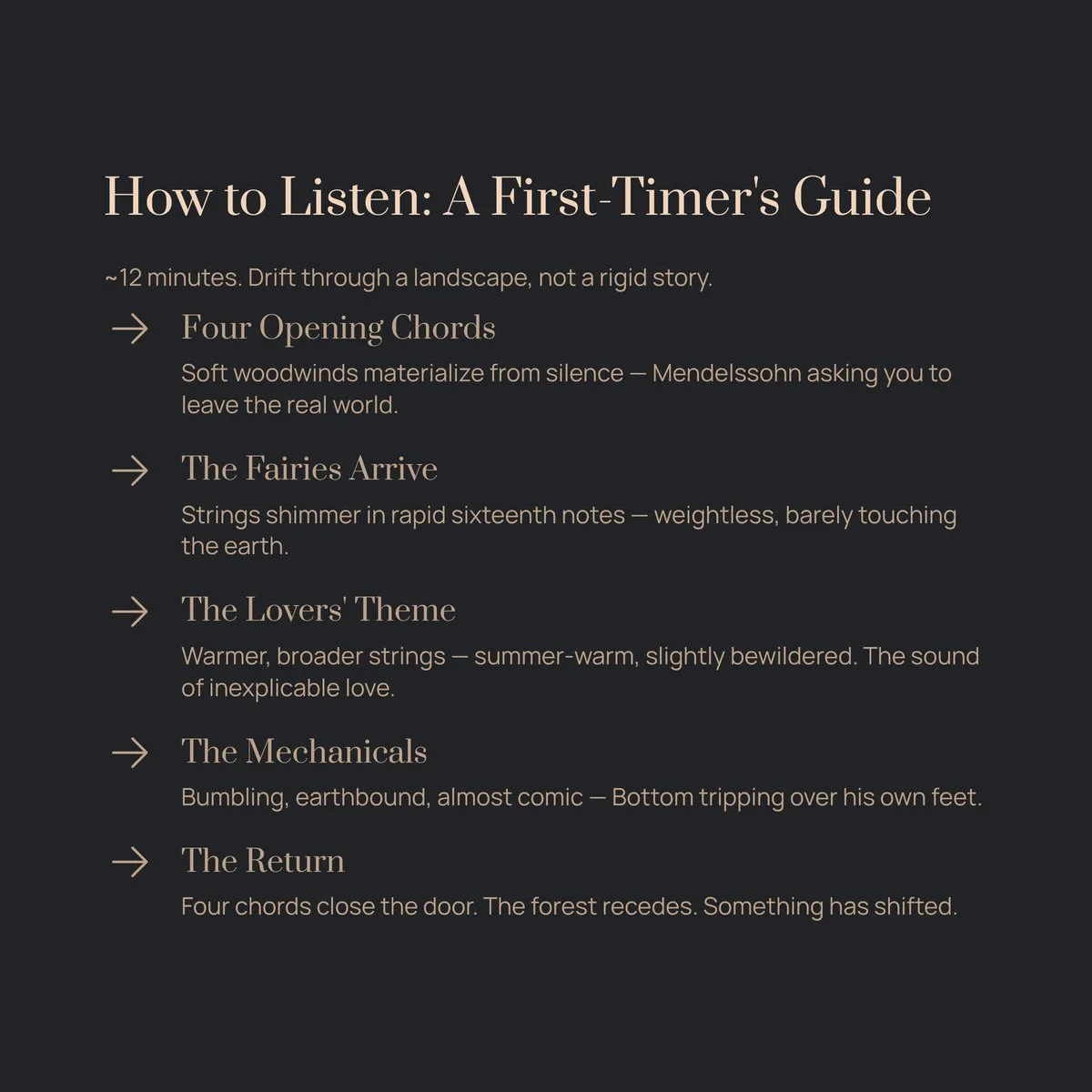
The Overture runs about twelve minutes, and it’s organized almost like a dream sequence — you’re not following a rigid story so much as drifting through a landscape.
The opening four chords are one of the most instantly recognizable openings in all of orchestral music. Four slow, soft woodwind chords that seem to materialize out of thin air, like a mist forming over still water. They don’t resolve right away. They just hang there. Mendelssohn is asking you to step out of the real world. Take the invitation.
Then the fairies arrive. The strings begin a rapid, barely-there shimmer — sixteenth notes moving so fast they seem to hover rather than move. This is technically demanding to play, and Mendelssohn knew it. He wanted the effect of something weightless, barely touching the earth. Listen for how quiet it stays, how the melody seems to float just above a surface rather than landing on it. This is what “fairy music” sounds like when a genius writes it.
The lovers’ theme arrives as a broader, warmer melody in the strings — more human, more emotionally legible. If the fairy music is iridescent and cool, this theme is summer-warm and slightly bewildered. It’s the sound of being in love and not quite knowing why.
The mechanicals — the working-class amateur actors — get a bumbling, good-natured passage that’s almost comically earthbound compared to everything else. You can practically see Bottom tripping over his own feet.
The development section weaves all these threads together in ways that grow increasingly tangled and strange — like a dream where you’re not sure which version of events is real. And then, gradually, the mist clears.
The ending returns to those four opening chords, the same gesture that opened the door. The forest recedes. You’re back in daylight. But something has shifted — the way something always shifts when you wake from a vivid dream and can’t quite return to the person you were before you fell asleep.
A Note on the Wedding March
If you go on to listen to the full incidental music, you’ll arrive eventually at the famous Wedding March — the one that’s been played at the entrance of countless brides across two centuries. It appears in the incidental music as an interlude between acts, celebrating the wedding of Theseus and Hippolyta in the play.
Mendelssohn almost certainly had no idea this particular piece would follow him into eternity as background music for one of humanity’s most ceremonial moments. He wrote it as one movement among many. History made it into an institution.
It’s worth knowing that the tune so many people associate with beginnings was written by a man who was 33 years old and would be dead in five years. There’s something quietly moving in that.
Recommended Recordings
For a first listen, the Overture rewards a recording that emphasizes the transparency and lightness of the orchestration — you want to hear the fairies’ string shimmer clearly, not buried under a thick wash of sound.
Herbert von Karajan / Berlin Philharmonic (Deutsche Grammophon, various releases) remains a benchmark. Karajan understood how to make large orchestras sound gossamer-light, and his accounts of the Mendelssohn are consistently luminous without being precious.
Claudio Abbado / London Symphony Orchestra (various live recordings) brings a slightly warmer, more animated quality — less manicured than Karajan, more spontaneous in feel.
George Szell / Cleveland Orchestra (Sony) is sharper and more precise, with an almost Classical clarity that suits the structural elegance of the piece beautifully.
If you prefer a period-instrument performance — a smaller ensemble playing on instruments closer to what Mendelssohn would have heard — look for recordings by the Orchestra of the Age of Enlightenment or the Orchestre Révolutionnaire et Romantique under John Eliot Gardiner. The leaner, airier sound makes the fairy music feel genuinely weightless.
Why It Still Matters
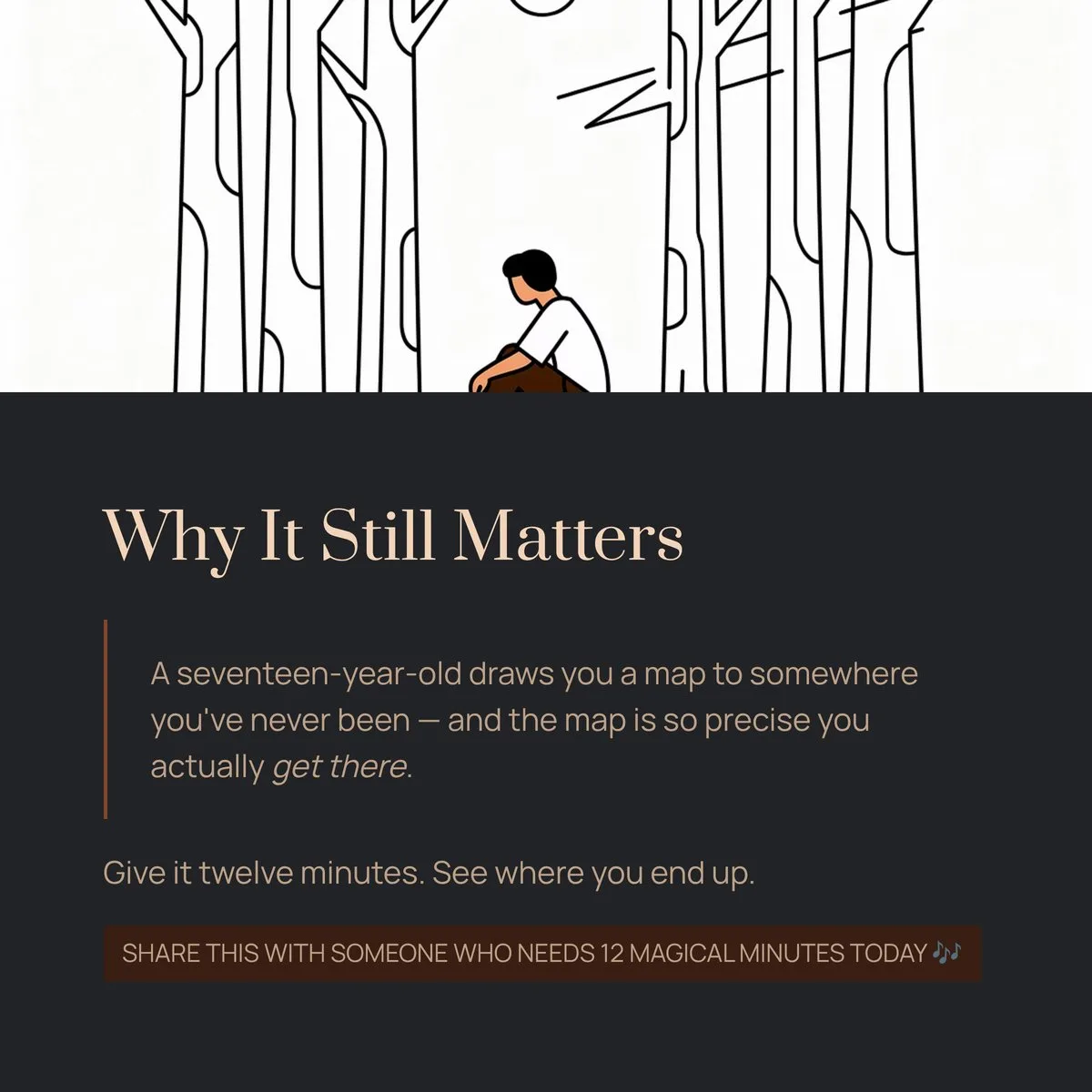
There’s a reason music students and scholars return to this piece again and again, and it’s not just historical reverence. The Overture is a near-perfect demonstration of what orchestral music can do that no other art form can quite replicate: it can make you feel a place that doesn’t exist.
Mendelssohn had never been in an enchanted forest. He invented one from imagination, Shakespeare’s words, and the sounds available to a mid-nineteenth-century orchestra. And generations of listeners have walked into that forest and felt the damp grass under their feet and the strange cool light of a moon that doesn’t quite belong to the ordinary world.
That’s the whole argument for listening to classical music, really — not that it’s educational or improving or culturally important, but that occasionally a seventeen-year-old sits down and draws you a map to somewhere you’ve never been, and the map is so precise that you actually get there.
Give it twelve minutes. See where you end up.