📑 Table of Contents
There’s a melody so gentle and so quietly familiar that you might swear you’ve heard it in a film, a commercial, or a half-remembered childhood afternoon. That’s the strange magic of Edvard Grieg’s Norwegian Dance, Op. 35 No. 2. It opens like someone humming to themselves, swaying a little, the kind of tune that seems to have always existed — as if Grieg didn’t compose it so much as overhear it drifting in from a Norwegian valley.
And in a way, that’s exactly what happened.

Who Was Edvard Grieg?
Edvard Grieg (1843–1907) is Norway’s most beloved composer, and he earned that title by doing something deceptively simple: he made his country sound like itself. Before Grieg, “classical music” mostly meant the grand traditions of Germany, Austria, and Italy. Grieg took the fiddle tunes, dances, and folk melodies of the Norwegian countryside and lifted them into the concert hall without scrubbing away their rough, earthy character.
You may already know his music even if his name is new to you. The shimmering “Morning Mood” and the stomping “In the Hall of the Mountain King,” both from his Peer Gynt music, are everywhere — in cartoons, movies, and ringtones. Grieg had a gift for melody so natural that his tunes slip into the culture and stay there.
Where This Music Comes From
Grieg published the Norwegian Dances, Op. 35 in 1880, originally writing them for piano four hands — that is, two pianists sharing a single keyboard. He didn’t invent these melodies from scratch. Instead, he drew them from an older collection of genuine Norwegian folk tunes compiled by a musician and folk-music researcher named Ludvig Mathias Lindeman. Grieg’s role was to dress these humble country melodies in rich, expressive harmonies, like a painter adding color and depth to a simple line drawing.
Three of the four dances are based on a folk dance called the halling — a vigorous, athletic dance traditionally performed by young men at weddings and celebrations to show off their strength and agility. Picture leaps, kicks, and the famous move where a dancer tries to kick a hat off a stick held high in the air. That energy is baked into the music.
But the second dance, our piece, plays a clever trick with all of that.
What to Listen For
Here’s the charm of Norwegian Dance No. 2: it sets up a contrast and then springs it on you.
The outer sections — the gentle sway. The piece opens with a tune that’s tender, a little shy, almost teasing. It’s slow and lilting, the musical equivalent of a knowing smile. If you’ve ever heard a melody that felt both playful and slightly melancholy at the same time, this is that feeling. Let yourself relax into its gentle rocking motion.
The middle — the storm rolls in. Then, without much warning, the mood flips. A fast, furious burst of energy interrupts — this is the halling showing its true wild face, all stamping rhythm and physical force. It’s brief, almost like a sudden gust of wind, but it completely changes the room.
The return — back to the smile. Just as quickly, the storm passes and the gentle opening tune returns, as if nothing happened. The contrast is the whole point. Grieg gives you tenderness, then a flash of raw folk energy, then tenderness again — a tiny three-part story told in just a few minutes.
A fun detail for the curious: most of these dances run fast–slow–fast, but No. 2 flips that order, opening and closing gently with the fiery part in the middle. That little reversal is part of why it feels so distinctive.
If you’re listening to relax, you’ll love the outer sections. And when that middle section erupts, don’t be startled — think of it as the music briefly remembering that it came from a dance meant to show off raw physical joy.
Recordings Worth Your Time
The piece exists in a few different forms, and each offers a different flavor:
-
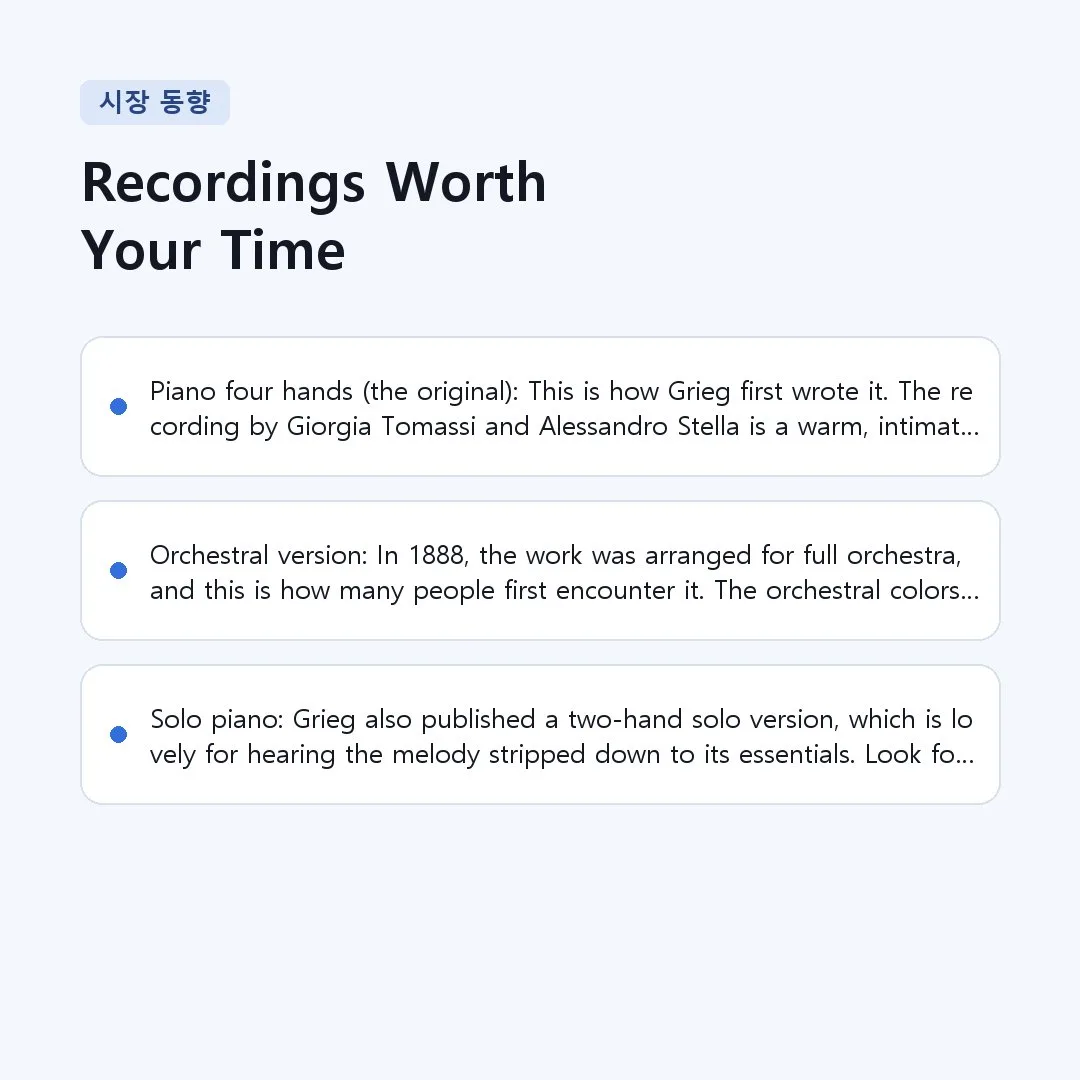
Piano four hands (the original): This is how Grieg first wrote it. The recording by Giorgia Tomassi and Alessandro Stella is a warm, intimate way to hear the piece as Grieg intended — two players, one piano, full of give-and-take. Great if you want to appreciate the human, conversational quality of the music.
-
Orchestral version: In 1888, the work was arranged for full orchestra, and this is how many people first encounter it. The orchestral colors make the gentle sections even more lush and the wild middle even more dramatic. Search for recordings by Scandinavian orchestras — they tend to have a special feel for this repertoire.
-
Solo piano: Grieg also published a two-hand solo version, which is lovely for hearing the melody stripped down to its essentials. Look for it on collections of Grieg’s piano music.
If you’re new to all this, I’d suggest starting with the orchestral version to enjoy the full sweep of the contrast, then circling back to the four-hands original to hear the intimacy that started it all.
A Closing Thought
What I love about this little dance is how much it understands about feeling. In just a few minutes, it tells you that gentleness and wildness aren’t opposites — they live side by side, in the same tune, in the same evening, maybe in the same person. Grieg took a simple folk melody handed down from anonymous country fiddlers and found that whole truth hiding inside it.
So next time you need something that’s soothing but not boring, put this on. Let the gentle part hold you, and let the wild part wake you up. That’s the dance.