
📑 Table of Contents
There’s a particular kind of sadness that doesn’t announce itself. It doesn’t crash through the door. It sits down quietly beside you, says almost nothing, and somehow by the end of the evening it has rearranged your entire heart.
That is how Chopin’s Ballade No. 4 begins.
The opening is so soft and hesitant that you might almost miss it—a few repeated notes, like someone clearing their throat before telling you something difficult. Then a melody unfolds, turning back on itself, never quite resolving, as if the music is searching for words it can’t find. If you’ve ever lain awake at 2 a.m. circling the same thought, you already understand the emotional language of this piece before a single technical term enters the room.
Many pianists consider this the hardest of Chopin’s four Ballades to play—and many critics consider it the greatest single piece he ever wrote. Both of those things are true for the same reason, and we’ll get there.

Who Was Chopin, Really?
Frédéric Chopin (1810–1849) was a Polish composer and pianist who spent most of his adult life in Paris, far from the homeland he never saw again. He was famous in his lifetime, adored in fashionable salons, and chronically ill for most of it—he died of tuberculosis at just 39.
What makes Chopin unusual among the great composers is his focus. While others wrote symphonies, operas, and concertos by the dozen, Chopin poured nearly his entire genius into a single instrument: the piano. He understood it the way a poet understands their native tongue. Under his hands the piano didn’t just play notes—it sighed, it wept, it sang in a way that sounded uncannily like the human voice.
By 1842, when he completed the Fourth Ballade, Chopin was at the height of his powers and the beginning of his decline. His health was failing. His long, complicated relationship with the writer George Sand was fraying. He was, in many ways, a man writing from inside a slow goodbye—and you can hear it.
What Is a “Ballade,” Anyway?
Here’s something that surprises a lot of newcomers: before Chopin, “ballade” wasn’t a type of piano music at all. It was a kind of storytelling poem—often dramatic, often tragic, the sort of tale told around a fire.
Chopin took that idea and did something nobody had done: he invented the instrumental ballade, a single-movement piece for solo piano that feels like it’s telling a story even though there are no words. There’s no fixed plot you’re meant to decode. Instead, the music has the shape of a narrative—a quiet beginning, rising tension, moments of tenderness and fury, and an ending that arrives like fate.
So when you listen to Ballade No. 4, don’t worry about “understanding” it correctly. Just follow it the way you’d follow a story being told aloud. Notice when the storyteller’s voice softens, when it suddenly raises, when it goes silent before the final blow.

How to Listen: A Guide Through the Storm
You don’t need to read music to follow this. Here’s a simple map for a first listen (timings are approximate and vary by performer):
The hesitant opening (0:00–1:30). Those gentle, circling notes. The main theme enters quietly—graceful, a little melancholy, asking a question it doesn’t answer. Let yourself settle into its uncertainty.
The theme transformed (around 1:30–4:00). Here’s Chopin’s genius at work: that opening melody keeps coming back, but never the same way twice. Each return is more decorated, more emotionally charged—like a memory you keep revisiting, finding new pain or beauty in it each time. Listen for how a simple tune grows richer and more aching with every appearance.
A moment of grace (around 4:30–6:00). The storm pauses. A chorale-like passage appears, hushed and almost prayerful—as if the music is holding its breath. It’s one of the most tender stretches Chopin ever wrote.
The gathering and the reckoning (around 6:00 to the end). The tension builds and builds. Then comes a brief, eerie silence—five quiet chords, like a held breath—before the music erupts into a final coda of overwhelming force. These last two minutes are devastating: technically brutal for the pianist, emotionally shattering for the listener. The piece doesn’t resolve gently. It blazes, and then it’s gone.
That moment of silence before the ending is the whole piece in miniature. Chopin makes you wait. He makes you feel the weight of what’s coming. And then he doesn’t spare you.
Recordings Worth Your Time
The Fourth Ballade has been recorded by nearly every great pianist, and the differences between them are striking—this is music where interpretation is everything.
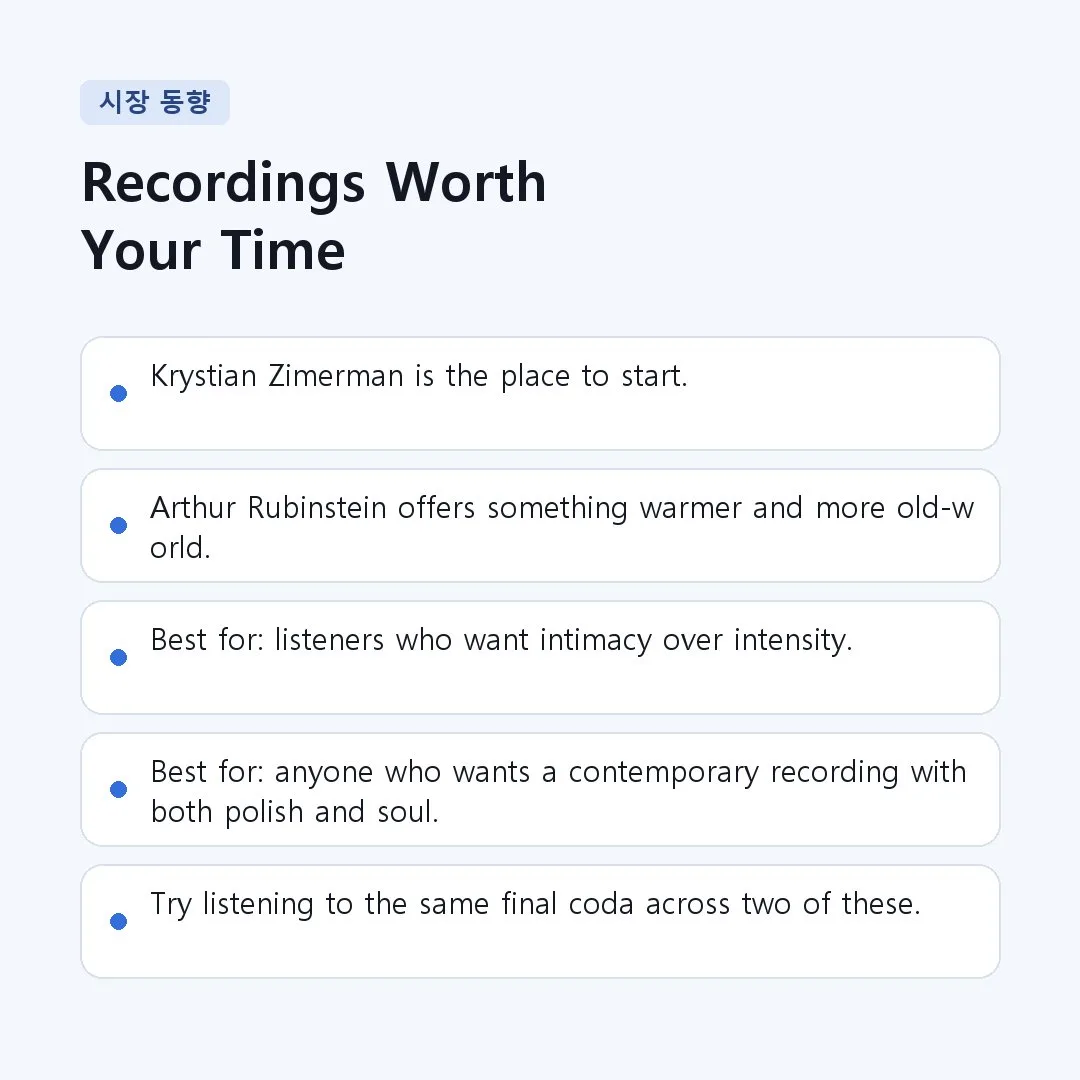
Krystian Zimerman is the place to start. His complete recording of the four Ballades (Deutsche Grammophon) is widely considered definitive—architecturally clear, emotionally controlled until it isn’t. He understands the structure so completely that the final coda lands with full force. Best for: anyone who wants to hear the piece done as close to “perfectly” as it gets.
Arthur Rubinstein offers something warmer and more old-world. A legendary Chopin interpreter, his playing has a singing, human quality—less stormy, more like a story told by someone who has lived a long time. Best for: listeners who want intimacy over intensity.
Seong-Jin Cho, the Korean pianist who won the 2015 Chopin Competition, brings a beautifully poised, modern sensibility—crystalline tone with deep feeling underneath. Best for: anyone who wants a contemporary recording with both polish and soul.
Try listening to the same final coda across two of these. Hearing how differently each pianist handles that last eruption will teach you more about music than any textbook.
Why This Piece Stays With You
Most sad music makes you sad and then lets you go. The Fourth Ballade does something rarer. It begins so gently that it earns your trust, then it builds an entire emotional architecture—memory, tenderness, longing, dread—and walks you all the way to an ending that feels both inevitable and unbearable.
It’s the sound of a man who knew, on some level, that his time was short, putting everything he understood about beauty and loss into eleven minutes of music. He never told us in words what it was about. He didn’t have to.
Put on a good recording. Turn off the lights. Let the hesitant opening pull you in, and don’t reach for your phone when the silence comes near the end.
Just wait for it. That’s the whole point.