📑 Table of Contents
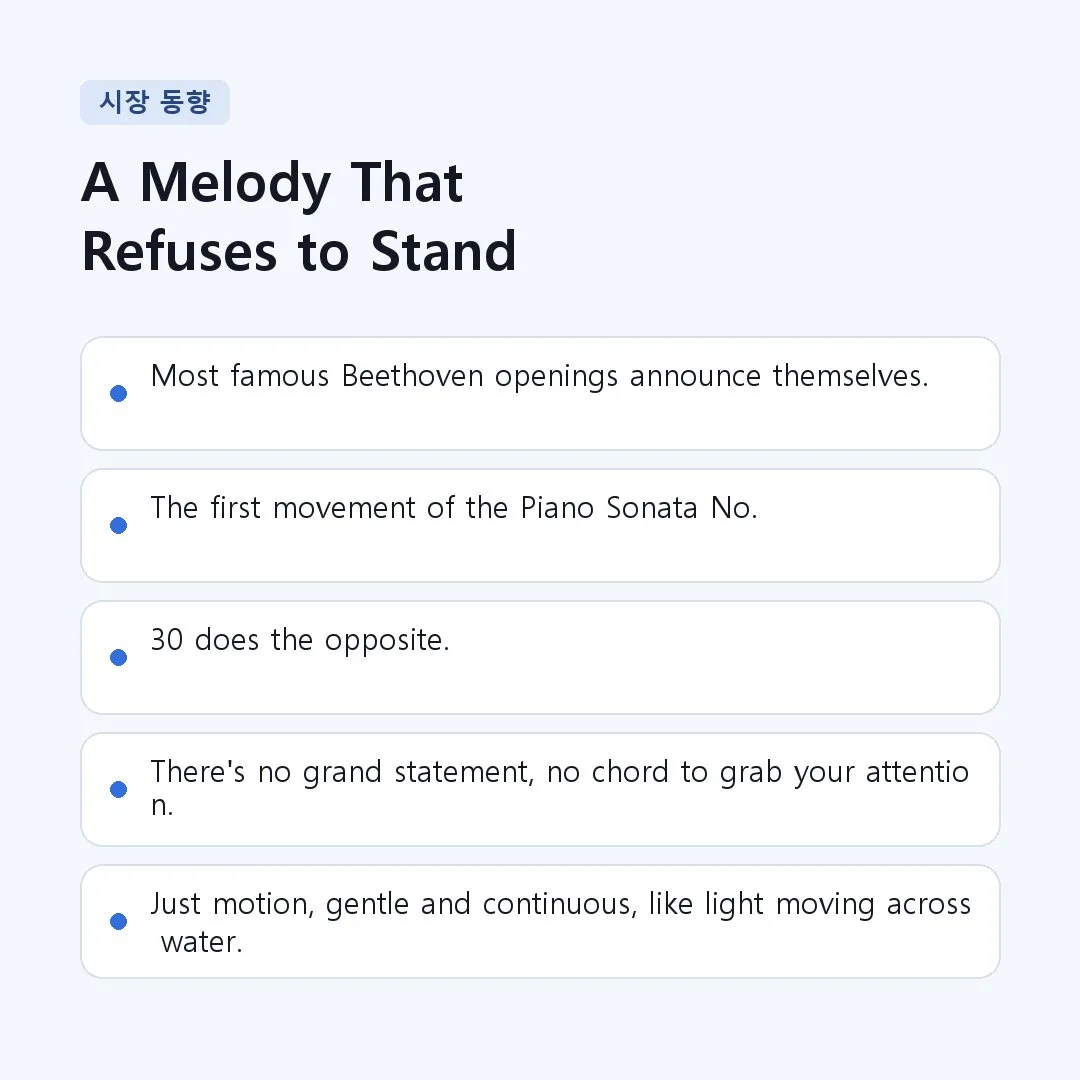
Most famous Beethoven openings announce themselves. Think of the four hammered notes of the Fifth Symphony, or the stormy left-hand churn that opens the “Pathétique.” You brace yourself; something important is about to happen.
The first movement of the Piano Sonata No. 30 does the opposite. It begins mid-thought, as if you walked into a room where someone was already humming to themselves. The right hand drifts downward in soft, rocking figures, marked Vivace, ma non troppo — lively, but not too much. There’s no grand statement, no chord to grab your attention. Just motion, gentle and continuous, like light moving across water.
And then, barely a minute in, the music stops. The flow freezes, the key shifts, and a slow, searching passage marked Adagio espressivo takes over — hesitant, almost questioning. It’s the musical equivalent of a sentence trailing off into “…but what if.” Then the original lively motion returns, as though nothing happened.
This back-and-forth — fast then slow, certainty then doubt — is the whole story of the movement. If it feels unusual, that’s because it is. Beethoven was sixty percent of his way into rewriting what a piano sonata could even be.
The Man Who Could No Longer Hear
By 1820, when Beethoven sketched this sonata, he was almost completely deaf. He carried “conversation books” so friends could write down what they wanted to say to him. He had stopped performing in public years earlier. The bustling, charismatic pianist who once dazzled Vienna’s salons was now an isolated, increasingly eccentric man who composed by feeling vibrations and imagining sound in his mind.
You might expect that isolation to produce bitter or heavy music. Often it did — the late period includes some of the most monumental, difficult works ever written. But it also freed him. With no audience to please in real time and no fingers to show off for, Beethoven wrote inward. The late sonatas, of which Op. 109 is the first, feel like private notebooks rather than public speeches.
He dedicated this sonata to Maximiliane Brentano, the young daughter of close friends. It was, in a sense, a personal gift — which suits a piece that sounds less like a performance and more like a confession spoken softly to someone trusted.
Why This Movement Sounds So Strange (In a Good Way)
Here is the thing worth knowing as a beginner: a classical first movement is usually the “argument” of the piece. It traditionally follows a tidy structure — present an idea, develop it through tension, resolve it. Composers treated it almost like a debate with a clear opening, middle, and conclusion.
Beethoven takes that expectation and quietly dissolves it. Instead of a strong main theme followed by a contrasting one, he gives you two opposed speeds and moods that keep interrupting each other. The flowing Vivace feels like thinking out loud; the Adagio espressivo feels like stopping to feel something too large for words.
A useful way to listen: imagine someone walking briskly through a familiar place, then suddenly pausing because a memory caught them off guard. They stand still for a moment, lost in it — and then keep walking. The movement does this twice. By the end, the two have almost merged, the fast and slow folding into a single quiet resolution.
It’s only about three to four minutes long, which is remarkably short for a movement of such ambition. Beethoven says what he needs to say and stops.

A Listening Map for Your First Time
You don’t need to track key changes or technical terms. Just notice the shifts:
The opening flow — soft, rolling, continuous. Let it wash over you without searching for a “tune.” The point is the gentle momentum.
The first interruption — within the first minute or so, the motion suddenly slows and deepens. The music turns inward and uncertain. Notice how the mood changes more than the volume.
The return — the lively motion comes back, but it feels different now, colored by what just happened.
The closing — the movement doesn’t end with a flourish. It settles, quietly, almost mid-breath, leading directly toward the rest of the sonata. (Op. 109’s three movements flow as a single emotional journey, though we’re focusing on the first here.)
Try listening twice. The first time, just let it happen. The second time, listen for the seams — the exact moments where Beethoven changes his mind.

Recordings Worth Your Ears
Maurizio Pollini brings clarity and architectural control. If you want to hear the structure clearly — the contrast between flow and stillness laid out with precision — his account is illuminating, never cold.
Mitsuko Uchida is the choice for emotional intimacy. She treats the slow interruptions as genuine moments of vulnerability, and her sense of timing makes the music breathe. A wonderful entry point for newcomers who want to feel the piece first.
Wilhelm Kempff offers a warmer, more songful, old-school approach. His playing has a gentle, conversational quality that suits the diary-like nature of late Beethoven beautifully.
Any of the three will serve you well. If you only have time for one, start with Uchida and let the movement introduce itself on its own terms.
The Sound of a Mind at Peace With Uncertainty
What makes this short movement quietly radical is that it stops trying to convince you of anything. There’s no triumph to earn, no struggle to overcome — just a person, alone with his thoughts, allowing them to wander and pause and wander again.
For a composer once defined by his fight against fate, that acceptance feels like its own kind of victory. The music doesn’t resolve its tensions so much as make peace with them. And maybe that’s why it lands so gently on a quiet evening: it asks nothing of you except that you sit still long enough to listen.