📑 Table of Contents
If you know one piece by Antonio Vivaldi, it’s almost certainly The Four Seasons — those bright, restless violins chasing storms and songbirds across the calendar. That Vivaldi is all energy and sunlight, the soundtrack of a thousand commercials and waiting rooms.
So the first time you hear “Cujus animam gementem,” you might wonder if you’ve made a mistake. There are no fireworks here. A single voice descends slowly over a string accompaniment that seems to ache with every step. The music doesn’t dazzle. It mourns. And strangely, somewhere in that mourning, a lot of listeners report feeling something closer to peace than to sadness.
That contradiction is the whole reason this short movement deserves your attention.
The Composer Behind the Red Hair
Vivaldi was born in Venice in 1678 and ordained as a priest — earning the nickname “il Prete Rosso,” the Red Priest, for his shock of red hair. But he was a violinist long before he was anything else, trained by his father, a professional player in the city’s churches and theaters. For most of his early career, his genius poured into instruments: concertos by the hundreds, written for the orchestra of girls at Venice’s Ospedale della Pietà, where he taught.
What’s surprising is how late vocal church music entered the picture. By the time he wrote the Stabat Mater, Vivaldi was in his mid-thirties and had been dismissed from his post at the Pietà a few years earlier. He was, in a sense, between chapters — traveling, playing freelance violin gigs, looking for the next thing. The Stabat Mater is his earliest sacred work that can be reliably dated, and you can hear in it a man more accustomed to writing for strings reaching, carefully, for the human voice.
A Commission in Brescia, a Mother at the Cross
In 1711 Vivaldi was in Brescia — the northern Italian city where his father had been born — performing at the church of Santa Maria della Pace. The clergy there commissioned him to set the Stabat Mater, a thirteenth-century Latin poem, for their celebration of the Feast of the Seven Sorrows of the Virgin Mary. The new work was first performed in that church in March of 1712.
The text itself is one of the most sorrowful in all of Christianity. Its title comes from its opening line, Stabat mater dolorosa — “the grieving mother stood.” It imagines Mary at the foot of the cross, watching her son die. The second stanza, the one Vivaldi sets in “Cujus animam,” puts it in a single unforgettable image: through her weeping soul, a sword has passed.
You don’t need to share the faith to feel the weight of that. It’s the most universal grief there is — a parent watching a child suffer, helpless to stop it.
What to Listen For
Here is where the genius hides in plain sight. Vivaldi could have written something operatic and showy. Instead he stripped almost everything away.
The whole work lives in just two keys — F minor and C minor — both dark, both heavy. There’s no escape into bright major-key sunlight until the very last “Amen” at the end of the full piece. That self-imposed limitation is exactly what gives the music its claustrophobic, inward intensity. It feels like grief feels: small, enclosed, with no easy way out.
In “Cujus animam,” listen for the descending vocal line — the melody keeps sinking, like a sigh that can’t lift itself back up. Underneath it, the strings move in slow, deliberate steps, never rushing the voice along. The alto (or countertenor) doesn’t perform the sorrow so much as inhabit it. There are no high notes flung out for applause. The drama is all turned inward.
One more detail worth knowing: Vivaldi reuses the music of the first three movements for the next three, simply changing the words. Some critics once called this lazy. But there’s a quiet logic to it — grief is repetitive. It circles back. It doesn’t resolve on schedule. The returning music mirrors the way a mind in mourning keeps returning to the same wound.
And that, perhaps, is why so many listeners find this “sad” music comforting rather than crushing. It doesn’t try to cheer you up or talk you out of how you feel. It sits with you. It says: yes, this is real, and you’re not alone in it.
Recordings Worth Your Time
This piece rewards a singer who can resist the urge to over-emote, and these three offer very different doors in.
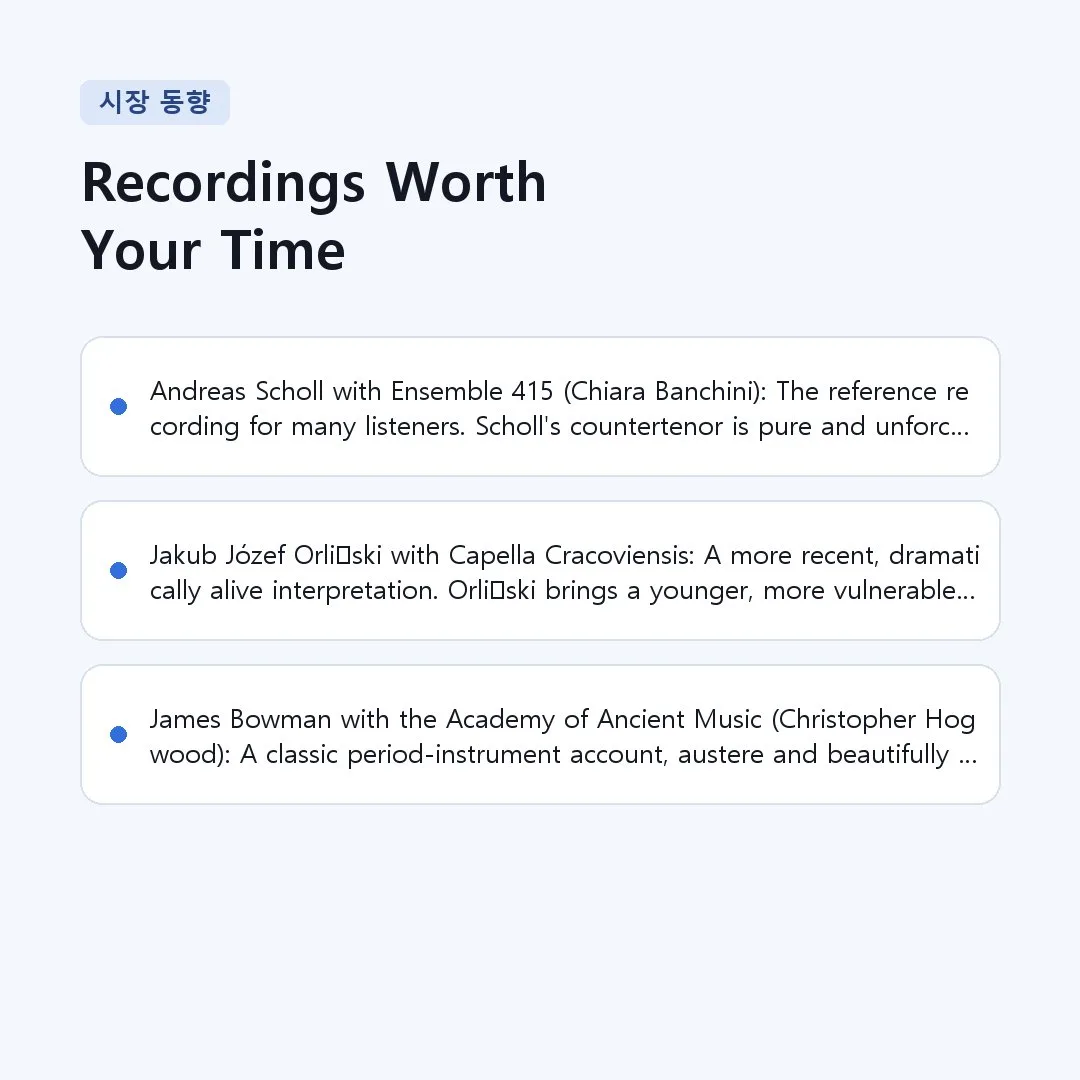
- Andreas Scholl with Ensemble 415 (Chiara Banchini): The reference recording for many listeners. Scholl’s countertenor is pure and unforced, almost devotional. Start here if you want restraint and clarity above all.
- Jakub Józef Orliński with Capella Cracoviensis: A more recent, dramatically alive interpretation. Orliński brings a younger, more vulnerable urgency to the line. Good for first-time listeners who want the emotion brought a little closer to the surface.
- James Bowman with the Academy of Ancient Music (Christopher Hogwood): A classic period-instrument account, austere and beautifully transparent, letting the bareness of the writing speak for itself.

A Closing Thought
We tend to reach for sad music in our saddest moments, and it’s a little mysterious why that helps. Vivaldi’s “Cujus animam” offers one answer. Written by a restless violinist far from home, about a mother’s worst imaginable loss, in two unrelenting minor keys — it should be unbearable. Instead it’s strangely steadying.
Maybe that’s because real comfort isn’t always the same as cheer. Sometimes it’s just being met, exactly where you are, by something that understands. Put this on in a quiet room, let the voice descend, and see if it doesn’t feel less like sinking and more like being held.