
📑 Table of Contents
Press play and within ten seconds something unusual happens. Most string quartets ask you to lean in, to concentrate, to follow four voices weaving polite conversation. This one does the opposite. It throws the windows open.
The viola steps forward with a tune so simple you could hum it after one listen, and the other instruments shimmer around it like heat rising off a wheat field. There is nothing to decode here, nothing academic. It just feels like standing somewhere wide and bright with nowhere you need to be. That immediate, unguarded warmth is exactly why Dvořák’s “American” Quartet has become one of the most beloved entry points into chamber music for newcomers.
Who Was Antonín Dvořák?
Antonín Dvořák (1841–1904) was a Czech composer who rose from genuinely humble beginnings. His father was a butcher and innkeeper in a small Bohemian village, and the family expected the boy to inherit the trade. Music had other plans. Dvořák played violin at village dances and in church, eventually clawing his way to Prague and to international fame built on a gift few composers have ever matched: an endless supply of memorable melodies rooted in the folk music of his homeland.
By the early 1890s he was famous enough that America came calling. A wealthy patron named Jeannette Thurber invited him to New York to direct the National Conservatory of Music, hoping he could help shape a distinctly American style of classical music. Dvořák accepted, crossed the Atlantic, and spent nearly three years in the United States. It was a creative goldmine for him, producing his famous “New World” Symphony among other works, but it also left him profoundly homesick.
A Quartet Born in Three Days
In the summer of 1893, exhausted by New York and aching for something familiar, Dvořák took his family to Spillville, Iowa, a tiny rural community settled by Czech immigrants. There he could hear his native language spoken in the streets, attend Mass in a familiar setting, and walk among fields that reminded him of Bohemia. The relief was immense.
The music poured out of him. He sketched this entire quartet in three days and completed it in about two weeks, later scribbling “Thank God! I am content. It was quick” at the end of the manuscript. You can hear that contentment in every bar. This is not a piece wrestling with grand philosophical questions. It is the sound of a man who has finally relaxed.
The nickname “American” comes from this setting and from the folk-flavored melodies woven throughout, which echo the spirituals and pentatonic tunes Dvořák had been studying. (Worth noting: an older nickname for the piece has rightly fallen out of use because it carried a racial slur, so you’ll only ever see it called the “American” Quartet today.)
How to Listen: Your Guide to the First Movement
The opening movement is marked Allegro ma non troppo, meaning “fast, but not too much.” Here are the moments to listen for.
The famous viola theme (around 0:10). Most quartet melodies are handed to the violin. Here Dvořák gives the very first tune to the viola, the warmer middle voice, while the other three instruments create a soft, rustling backdrop. That choice is why the opening feels so grounded and earthy rather than bright and showy.
The pentatonic glow. Many of the tunes use a five-note scale (the pentatonic scale, the same one you’d get playing only the black keys on a piano). This is the secret behind the music’s “wide open spaces” feeling. Folk traditions around the world use these scales, which is partly why the movement sounds both distinctly American and somehow universal.
The second theme (around 1:30). A new, more lyrical melody arrives, slightly tinged with longing. Listen for how the instruments pass it back and forth like friends finishing each other’s sentences.
The joyful build to the end. As the movement drives toward its close, the energy gathers and the four players lock into a shared, dancing rhythm. There’s a real physical lift to it, the musical equivalent of breaking into a run because you simply can’t help it.
The whole movement lasts only about eight to nine minutes, which makes it a perfect first dose of chamber music for anyone who finds longer works intimidating.
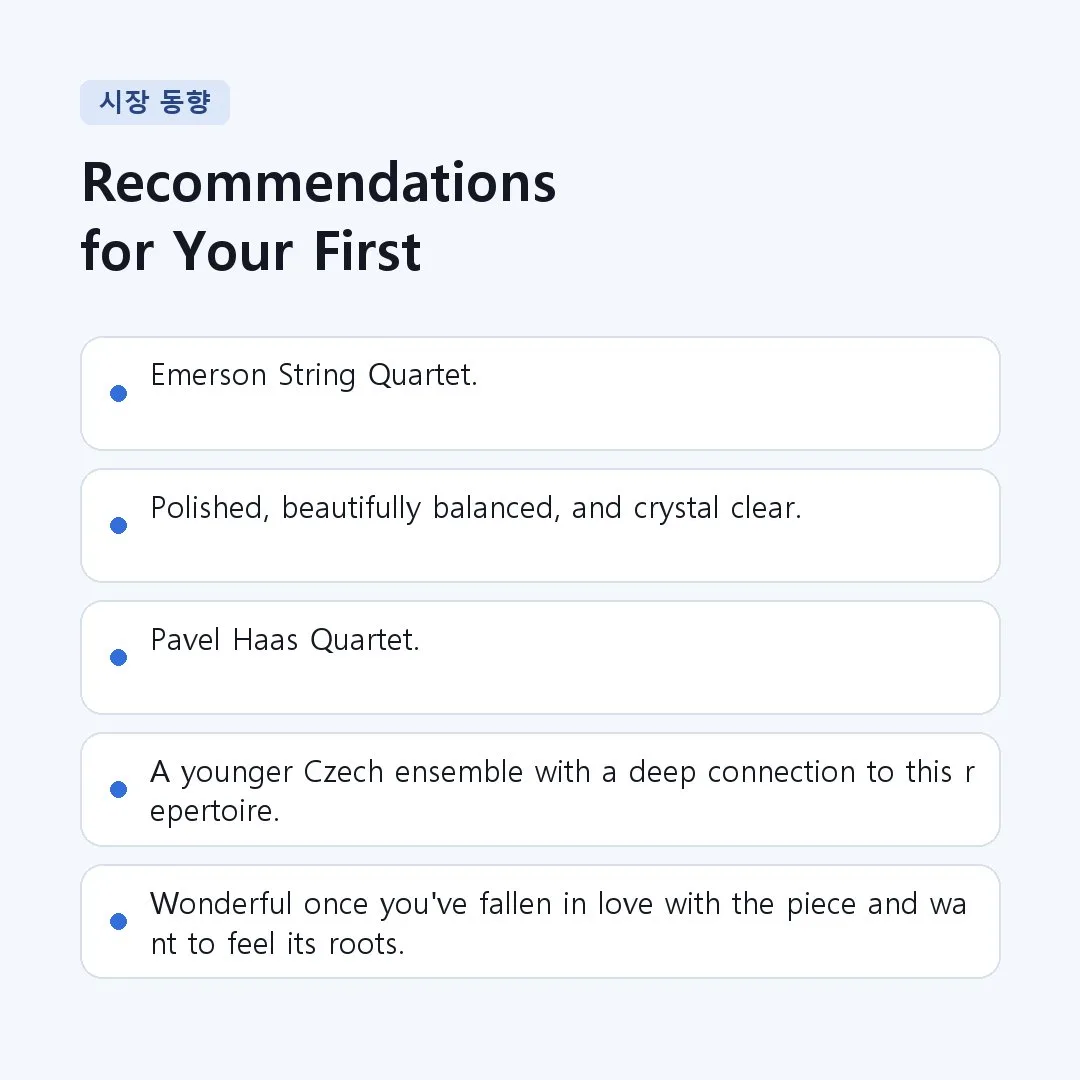
Recommendations for Your First Listen
Emerson String Quartet. Polished, beautifully balanced, and crystal clear. If you want a recording where every line is easy to follow, this is an ideal starting point.
Pavel Haas Quartet. A younger Czech ensemble with a deep connection to this repertoire. Their playing has more rustic bite and rhythmic spring, leaning into the folk-dance energy. Wonderful once you’ve fallen in love with the piece and want to feel its roots.
Alban Berg Quartett. A classic, warm-toned reading with a singing quality that suits the work’s sunny character. A safe and rewarding choice.
For video, search for any of these ensembles performing the quartet live; watching the players exchange glances as they trade the melody adds a whole layer of enjoyment, especially when the viola gets its famous opening moment.

Why This Music Stays With You
There’s a particular kind of beauty in art made not from struggle but from gratitude. Dvořák wrote this quartet at a moment of pure relief, surrounded by his family in a place that felt like home, and he wasn’t trying to impress anyone. He was simply happy, and he let the music say so.
That honesty is what survives across more than a century. You don’t need to know a single thing about sonata form or Czech folk traditions to feel it. You just need eight minutes and a willingness to let the windows open.