
📑 Table of Contents

Imagine sitting in a quiet room as the light fades. Somewhere, almost beneath hearing, a low note rocks back and forth—steady, patient, never changing. And above it, a melody begins to drift, decorating the air the way frost decorates a windowpane: delicate, intricate, weightless.
That is the experience of Chopin’s Berceuse, Op. 57. The word “berceuse” simply means “lullaby” in French, and Chopin took that humble idea—a song to soothe a child to sleep—and turned it into one of the most quietly astonishing pieces ever written for the piano. It runs only about four to five minutes, yet within it lives an entire world of slow, shimmering invention.
You do not need to know anything about music theory to feel what this piece does. It asks only that you slow down and listen.

Who Was Chopin?
Frédéric Chopin (1810–1849) was a Polish composer and pianist who spent most of his adult life in Paris. Among the great Romantic composers, he was unusual: while others wrote grand symphonies and thunderous operas, Chopin devoted himself almost entirely to the piano. He understood the instrument so intimately that, in his hands, it could whisper, sing, weep, and dance.
Chopin was famously frail in health and private in temperament. He disliked large concert halls and preferred playing in intimate salons for small gatherings of friends. This preference shaped his music. Rather than overwhelming you with volume, his works draw you closer, the way a person lowers their voice to tell you something that matters. The Berceuse is one of the purest examples of this art of intimacy.

The Story Behind the Music
Chopin composed the Berceuse in 1844, during a relatively settled and productive period of his life. He was living and working in close connection with the writer George Sand, whose household in Paris and country home at Nohant gave him space to compose.
There is a tender (though debated) tradition that the piece was inspired by a baby in their circle—the infant daughter of the singer Pauline Viardot, who spent time at Nohant. Whether or not that specific story is literally true, the music itself makes the inspiration believable. It genuinely sounds like watching over someone asleep: protective, unhurried, full of soft wonder.
What makes the Berceuse remarkable is its hidden cleverness. Beneath its calm surface, it is built as a set of variations—a form where a single idea is repeated and transformed again and again. Here is the magic: the left hand plays nearly the same gently rocking pattern from beginning to end, almost like a heartbeat that never stops. Meanwhile, the right hand spins ever more elaborate decorations over the top. The foundation stays still; the dream grows richer. It is the musical equivalent of a steady cradle with an ever-changing daydream floating above it.

How to Listen: A Guide for Your First Time
You don’t need to analyze this piece to love it, but a few signposts can deepen the experience.
The opening (0:00–0:30): Listen first to the left hand. You’ll hear a soft, repeating swaying figure—down and up, down and up. This is your anchor. Once you notice it, you’ll realize it almost never leaves. Let it become the rhythm of your own breathing.
The melody arrives (around 0:30): A simple, sweet tune enters above the rocking bass. It is unpretentious at first—the kind of thing you could hum.
The variations unfold (the long middle): This is where the wonder happens. With each repetition, the right hand grows more ornate—rippling runs, glittering little turns, notes cascading like water over stones. Don’t try to “follow” every note. Instead, notice how the simple melody keeps reappearing through the decoration, like a familiar face glimpsed through lace.
The close (final minute): The elaboration gradually softens and settles. The music doesn’t end so much as it dissolves, fading back into the same quiet from which it emerged—as if the listener, too, has finally drifted off.
The whole piece stays in one key (D-flat major) and one mood. That constancy is the point. It is music that asks nothing of you except to rest.
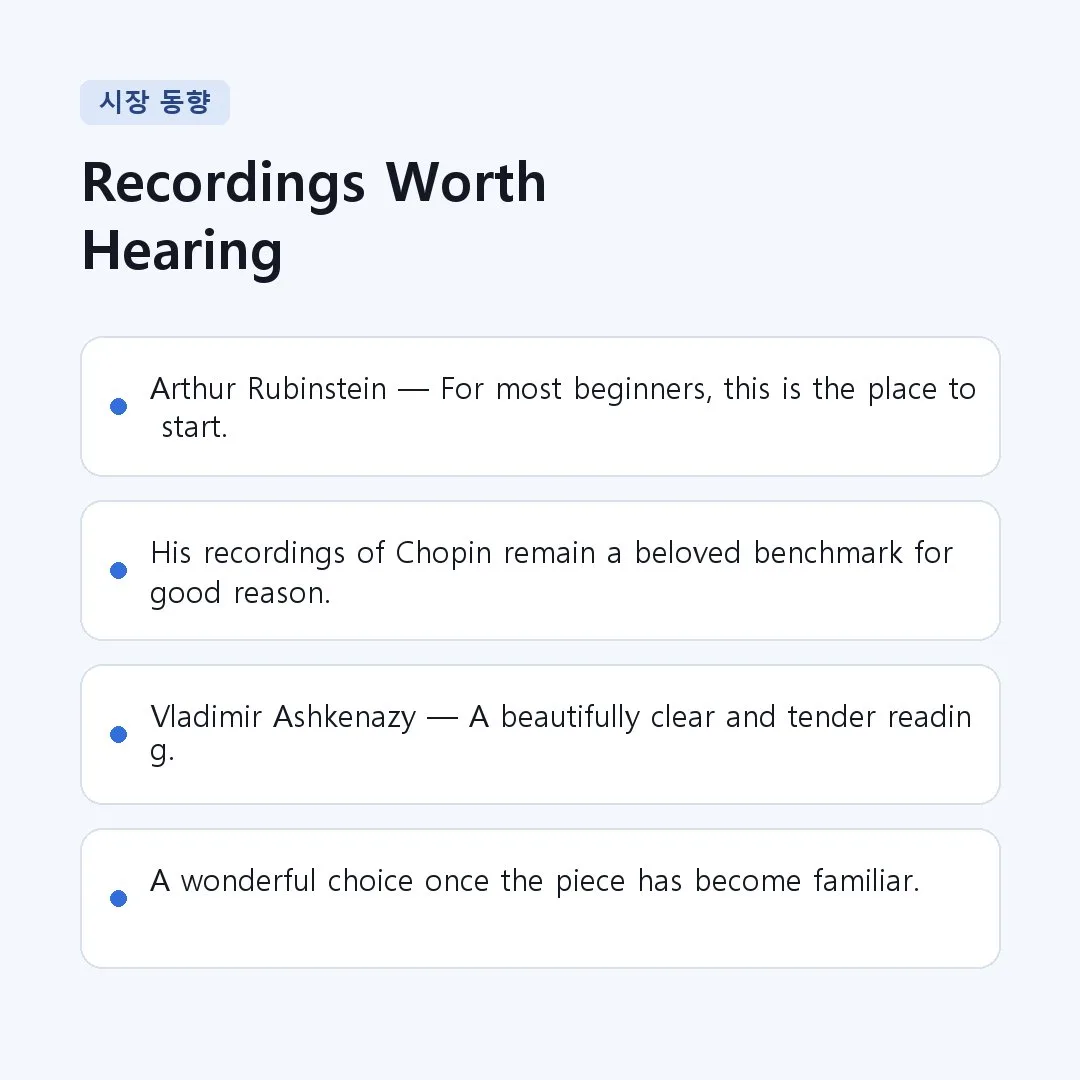
Recordings Worth Hearing
If you’d like to explore the Berceuse, here are a few interpretations that suit different listeners:
Arthur Rubinstein — For most beginners, this is the place to start. Rubinstein plays with warmth and natural flow, never fussy, letting the melody breathe. His recordings of Chopin remain a beloved benchmark for good reason.
Vladimir Ashkenazy — A beautifully clear and tender reading. If you want to hear the inner detail of those delicate right-hand decorations with great transparency, his interpretation is rewarding.
Krystian Zimerman — For the listener who wants poetry and refinement at the highest level. Zimerman, a Polish pianist deeply connected to Chopin’s idiom, brings exquisite control and color. A wonderful choice once the piece has become familiar.
Any of these will serve you well for a quiet evening, a moment of stillness, or the last music of the day before sleep.

A Small Miracle of Stillness
We often assume that great art must be dramatic—loud, fast, overwhelming. The Berceuse gently disagrees. It proves that a master can hold us spellbound with almost nothing: one rocking pattern, one tender tune, and an endless imagination for how to dress it in light.
In a world that rarely stops moving, Chopin offers four minutes of permission to be still. Press play, dim the lights, and let the cradle sway. Sometimes the most beautiful thing music can do is simply watch over us while we rest.

